Cell Structure, Function, and Reproduction: Key Concepts for Biology
 Call Kai
 Learn
Learn Practice Test
 Spaced Repetition
 Match
Match Flashcards
 Knowt Play
1/30

There's no tags or description
Looks like no tags are added yet.
Name | Mastery | Learn | Test | Matching | Spaced | Call with Kai | Chat |
|---|
No analytics yet
Send a link to your students to track their progress
31 Terms
What are the three major components of a cell?
Plasma membrane, cytoplasm, and nucleus.
What is the primary function of the plasma membrane?
To form the outer boundary of the cell and regulate the movement of substances in and out.

What is cytoplasm?
The internal living material of cells that fills the space between the plasma membrane and the nucleus.
What are organelles?
Specialized structures within the cytoplasm that perform distinct functions.
What is the function of ribosomes?
To manufacture enzymes and other protein compounds; they are often called protein factories.
What distinguishes rough endoplasmic reticulum (ER) from smooth ER?
Rough ER has ribosomes attached and is involved in protein synthesis, while smooth ER synthesizes chemicals and makes new membranes.

What is the role of the Golgi apparatus?
To collect chemicals into vesicles for transport from the smooth ER to the plasma membrane, acting as the chemical processing and packaging center.
What is the function of mitochondria?
To be involved in energy-releasing chemical reactions and contain their own DNA.

What do lysosomes contain?
Digestive enzymes that help in breaking down waste and protecting the cell by eating microbes.
What is the centrosome?
A region of cytoplasm near the nucleus that serves as a microtubule-organizing center.
What are microvilli?
Small, fingerlike extensions of the plasma membrane that increase the absorptive surface area of the cell.
What is the function of cilia?
Fine, hairlike extensions that can move in unison to help move substances across the cell surface.

What is the primary function of flagella?
To propel cells, with sperm cells being the only example of flagella in humans.
What is the nucleus?
The control center of the cell, surrounded by a nuclear envelope and containing DNA.
What is chromatin?
The form of DNA in the nucleus that condenses to form chromosomes during cell division.
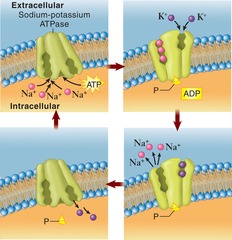
What is the significance of the sodium-potassium pump?
It is an ion pump that uses ATP to move sodium out of and potassium into the cell, crucial for maintaining cellular function.
What is phagocytosis?
An active transport mechanism that involves the engulfing of large particles or bacteria by the cell.
What is pinocytosis?
An active transport mechanism that involves the incorporation of fluids or dissolved substances into the cell.
How does cystic fibrosis affect cell transport?
It results from failed chloride ion transport, leading to thick secretions in the airways and digestive ducts.
What is the structure of DNA?
A double helix made of sugar (deoxyribose), bases (adenine, thymine, guanine, cytosine), and phosphate units.
What is the process of transcription?
The synthesis of messenger RNA (mRNA) from a DNA template, allowing genetic information to pass from the nucleus to the cytoplasm.

What occurs during translation?
Ribosomes synthesize proteins in the cytoplasm using the information contained in mRNA.
What is the cell life cycle?
The process of cell reproduction involving mitosis and cytokinesis, resulting in two daughter cells.

What happens during prophase of mitosis?
Chromatin condenses into chromosomes, centrioles move apart, and the nuclear envelope disappears.
What occurs during metaphase of mitosis?
Chromosomes align at the cell's equator, and spindle fibers attach to each chromatid.
What is anaphase?
The stage in mitosis where centromeres split, and chromatids are pulled to opposite ends of the cell.
What happens during telophase?
Nuclei reappear in daughter cells, the nuclear envelope reforms, and cytokinesis occurs.
What is hypertrophy?
An increase in the size of individual cells, leading to an increase in tissue size.

What is atrophy?
A decrease in the size of individual cells, leading to a decrease in tissue size.
What is hyperplasia?
An increase in cell reproduction, leading to an increase in tissue size.
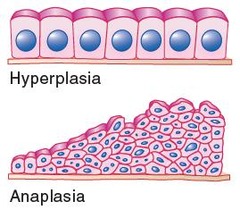
What is anaplasia?
The production of abnormal, undifferentiated cells, often associated with cancer.
