5. Rates Of Reaction
 Call Kai
 Learn
Learn Practice Test
 Spaced Repetition
 Match
Match Flashcards
 Knowt Play
1/28

There's no tags or description
Looks like no tags are added yet.
Name | Mastery | Learn | Test | Matching | Spaced | Call with Kai | Chat |
|---|
No analytics yet
Send a link to your students to track their progress
29 Terms
Physical Reaction Vs Chemical Reaction
Physical : the particles in the substance remains unchanged (only physical state is changed)
Chemical : particles arrangement is different - a new substance has been formed.
Signs of a chemical reaction
New product is formed (could be solid, aqueous, gas)
Gas is produced - Effervescence
Colour change
Temperature change (exothermic VS endothermic)

What is ‘rate’
Change in amount of product/reactant per unit of time
Exothermic Reaction
A reaction that releases energy from the system in the form of heat

Endothermic reaction
A reaction that the system absorbed energy from its surrounding in the form of heat

Why is it during an endothermic reaction, the solution’s temperature drops?
The thermal energy absorbed is converted into chemical potential energy and so the environment and the reaction mixture/solution feels colder
How to collect and test gas formed in reaction
Use a gas syringe or place a beaker underwater
Precipitate
Solid particles that separate from a liquid solution during a chemical reaction - is insoluble
Formula for Rate of Reaction
= Production / time (sec)
How to calculate the rate of reaction at a specific time (using a graph)
Draw a tangent that touches
Create a right angled triangle with points you can easily read on the graph (to reduce errors)
Calculate the gradient of the tangent (change in y/change in x)

3 necessary conditions for successful collisions
Particles must collide
Particles must have sufficient energy (Ea)
Particles must have correct orientation
Activation Energy (Ea)
The minimum energy required by particles to collide and have successful collisions
→ the energy needed to break apart bonds to allow the chemical reaction to occur

How to increase rate of reaction
Increase temperature
Increase concentration/pressure
Increase surface area
Add a catalyst
How does surface area affect rate of reaction
TSA is increased which exposes more inner particles to the surrounding reactants and therefore, more frequent and successful collisions
Surface area and rate of reaction between calcium carbonate and hydrochloric acid
Measure 50cm cubed of hydrochloric acid using a measuring cylinder
Pour the acid into a conical flask
Collect water trough and half fill with tap water
Measure (using a balance) 0.5 grams of small calcium carbonate chips
Fill the measuring cylinder with water and submerge in the trough
Prepare delivery tube, ensuring the tube is underneath the measuring cylinder to collect the gas
Prepare the stop watch and add calcium carbonate chips into conical flask, quickly closing the opening and see how much carbon dioxide is produced
Repeat with bigger chips
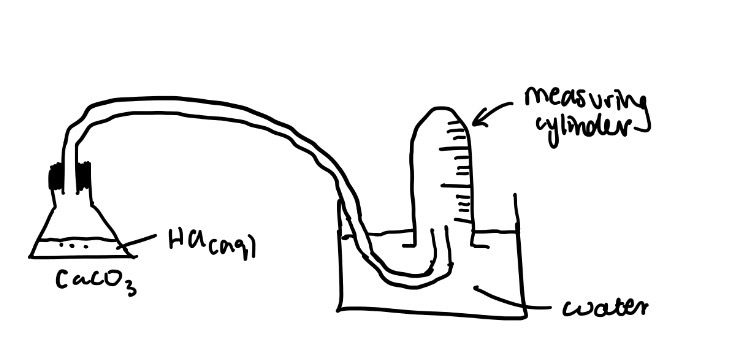
Conclusion : calcium carbonate chips and hydrochloric acid
Smaller particle size of calcium carbonate has a larger surface area. This means there are more, frequent, successful collisions occuring on the surface of the calcium carbonate chips. Due to more, frequent, successful collisions per unit time, the rate of reaction is faster.
Temperature and rate of reaction practical
Measure 15cm of 0.2M sodium thiosulfate using a measuring cylinder and pour it into a boiling tube. Measure 10cm of 1M hydrochloric acid into a boiling tube and place them both in the same water bath (w/ recorded temperature)
Allow the contents of the respective tubes reach the correct temperature and use a thermometer to check
Place a conical flask on the top of the card with a cross. Add the contents into the flask and swirl and start the timer
Record and stop timer when the cross isn’t visible anymore
Repeat for different temperatures

Why is sodium thiosulfate and hydrochloride acid changing colour
The sulfur created will precipitate (an insoluble solid formed from the 2 solutions)
Conclusion : sodium thiosulfate and hydrochloric acid
As the temperature increases, the time taken for the cross decreases as at higher temperatures, particles have more thermal/kinetic energy and move around more quickly which allows for more frequent, successful collisions
Calcium carbonate and hydrochloric acid practical
Measure 2g of marble chips and place them into a conical flask
Place measuring cylinder into water, and fill so there are no bubbles
Measure 25cm cubes of hydrochloric acid using measuring cylinder, prepare clock and add the acid and bung onto the conical flask
Stop the timer when 50cm cubed of carbon dioxide is given off and record
Repeat with different volumes of acid (but add water to ensure mass off water is same)

Conclusion : Calcium carbonate and hydrochloric acid [concentration and rate of reaction]
Increasing concentration increases the number of particles (concentration) per volume. More particles increases the frequency of successful collisions and so the rate of reaction also increases.
High Vs low pressure of gasses
At higher pressure, the particles are closer together

How does pressure (gases) affect rate of reaction
Higher pressure meant a more frequent, successful collisions which results in higher rate of reaction
Catalyst
A substance that can increase rate of a chemical reaction without being used up itself
Homogeneous catalyst
Catalysts in the same state as the reactants in a reaction
Heterogeneous catalyst
Catalysts in different state as the reactants in a reaction
How do catalysts work
Provide an alternative route for the reaction which involves a lower activation energy
Reaction profile diagram
BLUE : uncatalysed, activation energy is higher
RED : catalysed, requires much less energy
Green → Products : ∆H (change in heat) is the same regardless of presence of catalyst

Effects of catalysts on the decomposition of hydrogen peroxide
Collect 5 test tubes and measure 10cm cubed of hydrogen peroxide into each tube
Add 0.25g of each type of metal catalyst/living enzyme (liver, potato, iron oxide, manganese dioxide, copper oxide)
Observe the speed at which bubbles are produced