AP Psych Nervous System, Neurons, Neurotransmitters, Brain Plasticity and Scans
 Call Kai
 Learn
Learn Practice Test
 Spaced Repetition
 Match
Match Flashcards
 Knowt Play
1/95

There's no tags or description
Looks like no tags are added yet.
Name | Mastery | Learn | Test | Matching | Spaced | Call with Kai | Chat |
|---|
No analytics yet
Send a link to your students to track their progress
96 Terms
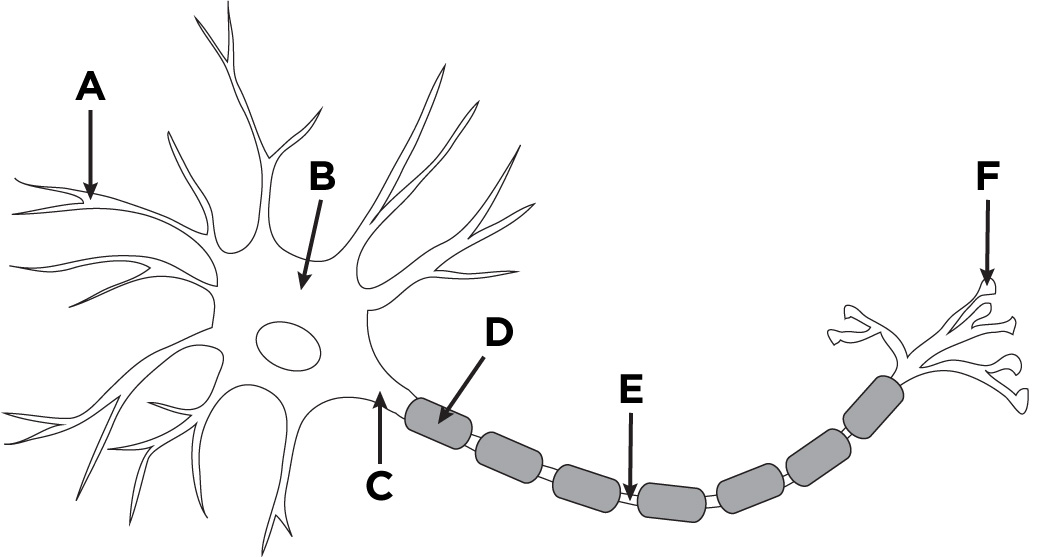
The Neuron
What is A?
Dendrites - receives incoming information

The Neuron
What is B?
Nucleus - don’t forget cell body/soma is what it is in
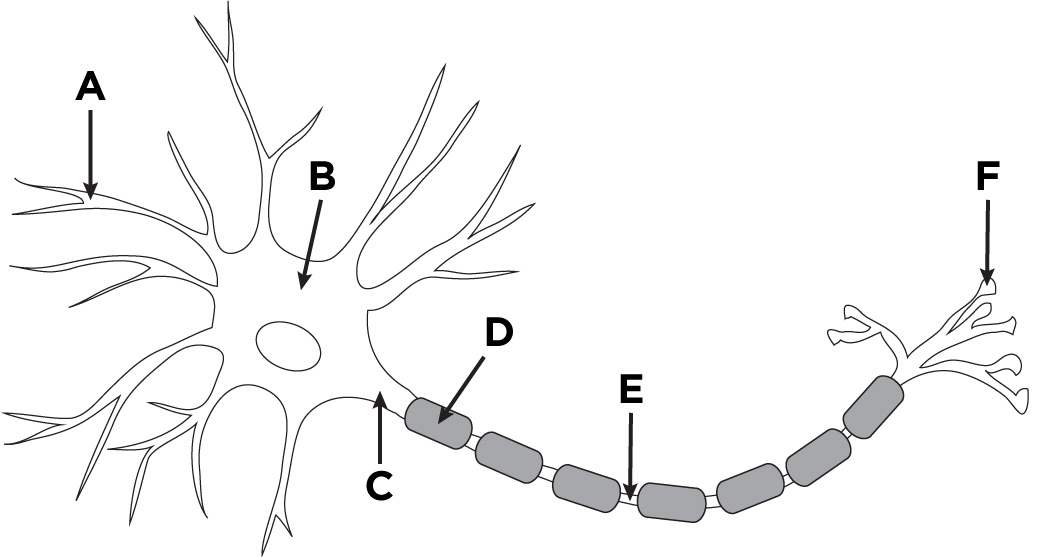
The Neuron
What is C?
Axon - carries neural impulse away from cell body

The Neuron
What is D?
Myelin Sheath - insulates axon and helps neural impulses travel faster
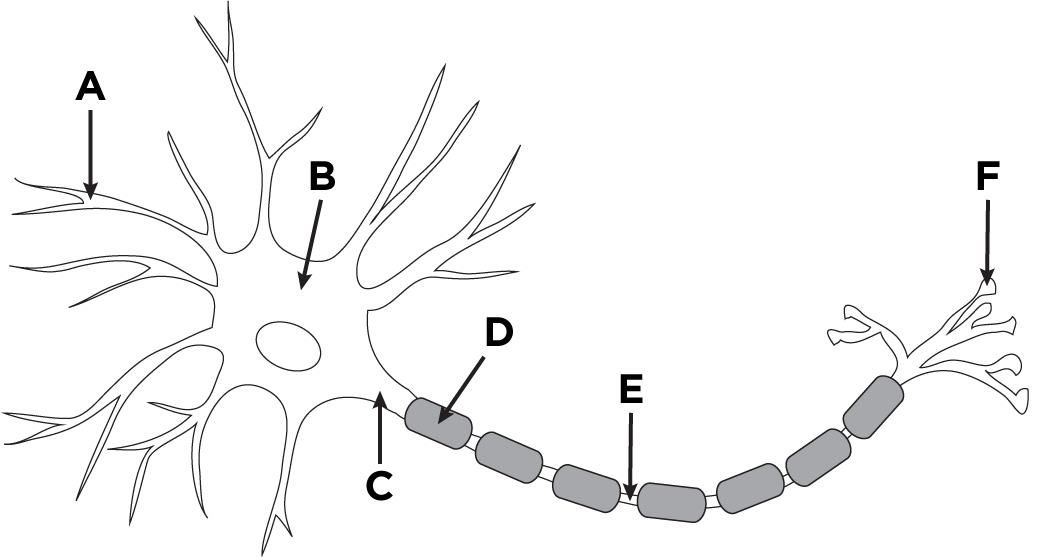
The Neuron
What is E?
The Nodes of Ranvier - allows the action potential to “jump” from node to node

The Neuron
What is F?
Axon terminals - releases neurotransmitters toward the next neuron the presynaptic ending
Synapse - the complete functional connection between two cells including axon terminal, synaptic cleft, and postsynaptic membrane
The synaptic gap/cleft is what neurons communicate through
Neural firing
Called an action potential - has an all-or-nothing response (neuron either fires or does not), dendrites receive neurotransmitter from another neuron across the synapse, reaches its threshold then fires based on all-or-nothing response
How do neurons communicate?
By electrical pulses and chemical signals, communicate through synapse
Acetylcholine (ACh)
Function in motor movement, learning and memory
Released when the nervous system needs to communicate with muscles or support certain brain functions
Example of ACh
ACh - move and remember
Deciding to shoot a basketball, the ACh helps send the message to move muscles and also plays a role in remembering how to shoot.
Excessive ACh
Muscle overactivity such as twitching or spasms
Lack of ACh
Linked to Alzheimer’s disease
Dopamine
Function in motor movement, attention, motivation, reward, emotion, and learning
Can be released when brain is processing rewarding/motivating experiences
Example of Dopamine
Smelling your favorite food and getting excited to eat it
Excessive Dopamine
Associated with psychosis/schizophrenia symptoms
Lack of Dopamine
Lack of movement problems; associated with Parkinson’s disease
Serotonin
Function in mood controls, sleep, hunger, and arousal
Neurons release it to help regulate these processes
Example of Serotonin
Your body is preparing for sleep at night
Excessive Serotonin
Contributes to serotonin syndrome - can cause agitation, confusion, etc.
Lack of Serotonin
Associated with depression and mood problems
Norepinephrine
Function in alertness and arousal
Helps the body and brain become alert and ready to respond, especially during important/stressful situations
Excessive Norepinephrine
Anxiety, increased alertness, and stress responses
Lack of Norepinephrine
Depressed mood, low energy, poor attention
GABA
Major inhibitory neurotransmitter
Released to reduce or slow neural activity when neurons need to be less active
Example of GABA
Trying to relax after a stressful day
Excessive GABA
Excessive slowing/sedation
Lack of GABA
Anxiety and seizures due to neurons becoming overly active
Glutamate
Major excitatory neurotransmitter
Important for learning, memory, and sending signals between neurons
Example of Glutamate
Learning a new concept for AP Psych
Excessive Glutamate
Overstimulation and damage to neurons
Lack of Glutamate
Interferes with learning and memory
Endorphines
Function in pain control and pleasure sensation
Helps reduce perception of pain and can contribute to feelings of pleasure/well-being
Released in response to things such as pain or strenuous activity
Example of Endorphins
Exercising and noticing discomfort seems less noticeable afterward
Excessive Endorphins
Stronger pain reduction
Lack of Endorphins
Increased sensitivity to pain
Agonist
Mimics neurotransmitter
Antagonist
Block neurotransmitter
CNS
Brain and spinal cord communicate through a series of electrochemical signals, process sensory information and direct the body’s responses
PNS
The nerves outside the CNS that carry sensory information to the CNS and relay motor commands out to the body
Sensory Neurons (Afferent Neurons)
Take information from the senses to the brain
Inter Neurons
Take messages from Sensory Neurons to other parts of the brain or to Motor Neurons
Motor Neurons (Efferent Neurons)
Take information from brain to the rest of the body
Somatic Neurons
Enable voluntary muscle movement through motor neurons, sensory neurons relay signals to the brain from sensory receptors (sent through CNS)
Autonomic Neurons
Uncontrollable (automatic functions of digesting, heart beating, etc.)
Sympathetic nervous system - arouses and expends energy (fight or flight)
Parasympathetic nervous system - slows heartbeat, lowers blood sugar, calms system afterwards
Endocrine System
Compromised of hormone-producing organs - have one of the largest impacts on long-term development, mood, and behavior
Major endocrine organs - thryoid, pancreas, adrenal glands, testes/ovaries, pituitary gland
Hormones
Chemicals created and released by organs that travel throughout bloodstream and impact feelings, perception, development, sexuality
Chemical receptors react to hormones based on how much of hormones are present signaling cellular growth, change, and brain activity
Thyroid
Located in neck, controls hormones that boost/reduce metabolism (consumption of energy)
Pancreas
Located in the abdomen behind stomach, releases insulin to manage glucose levels and energy use
Adrenal glands
Above kidneys, release adrenaline in fight or flight situations
Testes/ovaries
Releases testosterone and estrogen - sex hormones that impact sexual behavior, muscle, body fat, aggression
Pituitary gland
“Master gland”, regulates general hormone production, including growth hormone, sex hormones, etc.
Plasticity
Brain’s ability to change/adapt by developing new/alternative neural pathways from existing neurons
In some circumstances the brain can ______ neurons in response to damage by _____________________________________
reorganize, redirecting or training new neurons to maintain the path
Neural damage in the brain that causes the inhibition of limb use can be
reprogrammed to work properly after long-term use
Plasticity is ________ to neurons that have ___________ such as vision and audition, but not regions with entirely different purposes, such as frontal lobe neurons and sensory neurons
limited, similar functions
Neurogenesis
Process where the brain can slowly create small amounts of new neurons
When are neurons most plastic?
When we are young because they become more rigid and fixed as we age
ACh in the brain _______ the brain for _______, signaling to its neurnos that coming information must realign function
primes, change
One can do this by attempting to learn a new physical skill and repeatedly making mistakes
Repeated mistakes release large amount of ________; after 30 minutes a repeated failure opens the window for ______________
Acetylcholine (ACh), 60 minutes of plasticity - 60 min window is where you will perform desired behavior or skill to adapt
EEG
Electroencephalogram detects brain waves through their electrical output, used mainly in sleep research, looked at for function
CAT Scan
Computerized Axial Tomography 3d X-Ray of the brain, good for tumor locating, is used to look at structure
MRI
Magnetic Resonance Imaging a more detailed picture of brain using magnetic field to knock electrons off axis, takes many still pictures and turns images into a movie like production, looked at for structure
PET Scan
Positron Emission Tomography measures how much of a chemical the brain is using (usually glucose consumption), looked at for function
fMRI
Functional MRI, combination of PET and MRI, looked at for functional
Glial cells
cells in nervous system that support, nourish, and protect neurons, can also play a role in learning, thinking, and memory
Threshold
the level of stimulation required to trigger a neural impulse
Refractory Period
a brief resting pause that occurs after a neuron has fired; subsequent action potentials cannot occur until axon returns to its resting state.
What is a neurotransmitter?
A chemical messenger that carries signals from one nerve cell to another
What is a receptor?
A protein on a cell that receives a specific neurotransmitter, it detects signals and triggers a response chemically
What happens when a neurotransmitter is released into the synapse
Molecules diffuse across the space to bind with specific receptors on the postsynaptic cell, altering its electrical state before being cleared from the synapse
Depressants
Slow down body functions
Stimulants
Arouse body functions
Hallucinogens
Distort perceptions or evoke sensation without sensory input
Alcohol, barbiturates, opiates (heroin and morphine)
Examples of depressants
Amphetamines (meth) and cocaine
Examples of stimulants
LSD (acid) and THC
Examples of hallucinogens
Neurotransmitters involved with heroin
Endorphins
What does heroin do to the neuron?
Mimics natural opiate receptor and turns off dopamine inhibition, dopamine is allowed to flood the synapse producing immediate feeling of sedation and well-being, it decreases the activity of the neurotransmitter
overall effect is it acts as a depressant, slowing the nervous system
Neurotransmitters involved with ecstasy
Serotonin
What does ecstasy do to the neuron?
Mimics serotonin and is taken up by serotonin transmitters, causes it to do its job backwards, excess serotonin gets trapped in synaptic cleft resulting in continuous binding, it increases neurotransmitter activity
overall effects serotonin pathways and responsibilities
Neurotransmitters involved with marijuana
GABA and Glutamate
What does marijuana do to the neuron
mimics anandamide and binds to cannabinoid receptors, inhibition turns off and dopamine is allowed to squirt into the synapse, allows GABA and glutamate to be released, takes longer to break down
overall effects short term memory, movement, speed, and calmness
Neurotransmitters involved with meth
dopamine
What does meth do to dopamine
meth mimics dopamine and enters dopamine vesicles, forcing dopamine molecules out and into synapse, excess dopamine is trapped and binds continuously, meth blocks recycling of dopamine, dopamine activity increases
overall effect meth is highly addictive as it works on the brain’s reward pathway
Neurotransmitters involved with alcohol
GABA - alcohol makes it more inhibitory, and Glutamate - alcohol prevents it from exciting cell
Alcohol causes ____ inhibitory activity
More
Neurotransmitters involved with cocaine
Dopamine
What does cocaine do to dopamine transporters?
Blocks transporters, causing dopamine to bind continuously, dopamine gets trapped in synaptic cleft, dopamine activity increases
overall effect is that cocaine concentrates on reward pathway
Neurotransmitters involved with LSD
Serotonin receptors, involved in perception and cognition
What does LSD do at serotonin receptors?
LSD binds to serotonin receptors, sometimes LSD inhibits receptors or LSD will excite receptors, alters brain signaling pathways
overall effects overactivity of serotonin, complex sensory effects, and altered perception
Which drugs affects dopamine
Meth and cocaine
Which drug affects GABA and glutamate
Alcohol
Which drug acts on serotonin receptors?
LSD
Which drug causes dopamine to remain in the synapse by interfering with dopamine transporters?
Cocaine
Which drug causes dopamine transporters to reverse their normal action
Meth
Opiates
Heroin and morphine - addiction comes fast, withdrawal symptoms bad