PSY389 Lecture week 6/7 - Recovering from Alcohol and Other Drug Dependencies
 Call Kai
 Learn
Learn Practice Test
 Spaced Repetition
 Match
Match Flashcards
 Knowt Play
1/19

There's no tags or description
Looks like no tags are added yet.
Name | Mastery | Learn | Test | Matching | Spaced | Call with Kai | Chat |
|---|
No analytics yet
Send a link to your students to track their progress
20 Terms
Changing a behaviour - How do substance dependent individuals break their addiction?
1. What motivates or prevents an individual from considering quitting?
2. What moves them to actually quit?
3. What procedures do they use to quit?
4. Why is quitting so difficult to maintain, with many attempts end in relapse?
5. Finally, how do they achieve success in the long-term?
Models of decision making (Bennett, 1986)
asked 135 opioid users: why and how they started using opioid?
Start with non-opioid drugs (e.g., cannabis, amphetamine)
Introduced to first opioid by friends/acquaintances (i.e., free from pressure)
Made a conscious/deliberate decision to use before actual use due to curiosity, follow friends, integrate with group, share experience with friends, or desire to involve in addict lifestyle (i.e., use has meanings and purposes)
Took between 1 and 3 years to progress from first use to daily use with gaps of non-use or occasional uses in between (i.e., use is intentional and control, not compulsive use)
Desire to feel high, to perform in social situations, to treat psychological issues (e.g., depression) (i.e., drug use is functional)
Continuation (What caused them to continue to use?)
‘I like them’
I want to follow friends
It makes me feel secure and confident
Self-medicate
Drug use is functional
Cessation (What caused them to stop use?)
50% foresaw a lifetime addiction (life is better on opioid) and have no plan to give up (self-determined)
50% considered abstinence conditionally (e.g., entering into a stable relationship, social groups move out of the area, pregnancies) or unconditionally (self-determined, responsible and control)
Thus, Bennett (1986) argued that addiction is best understood through rational choice paradigm
Individual is self determined & responsible
Behaviour is purposeful, intentional & limiting (not out of control)
This view is consistent with drug use being functional, purposeful & not pathological (an assumption of the social learning theory pertaining substance use)
BUT:
The opioid users in Bennett study were self-motivated to use drugs
Motivation: a desire to engage in a behaviour (e.g., use drugs) involves a decision-making process - likened to weighing the pros & cons
Being emotional human beings, we do not always accurately weigh up the relevant options, the pros, and the cons
Emotions are important in decisions
We do not always think rationally and are clouded by emotions •
Thus, do we always make the ‘right’ decision?
Janis & Mann Decisional Balance Sheet of Incentives
Provides a framework for understanding cognitive, emotional and motivational elements of decision
Gains of behaviour contrasted with costs of that behaviour, and costs and gains of NOT doing
When making decision people consider gains and losses:
Gains and losses for self-personal goals
Gain and losses for significant others (family goals)
Self-approval and self-disapproval
Approval and disapproval by significant others
There are some defective coping behaviours which affect quality of decisions
Janis & Mann- Defective Coping Behaviours
1. Unconflicted inertia- carry on as usual without considering other alternatives;
2. Unconflicted change- chose an alternative option without considering other alternatives;
3. Defense avoidance- adopt an inappropriate course of action because alternatives are not considered favourable (e.g., fearful of them);
4. Hypervigilance- respond immediately without considering consequences.
– Hypervigilance and defense avoidance coping mechanisms are common in drug use.
• Encouraged rational vigilant decisions by using a balance sheet of pros and cons, and their likely consequences.
• Individuals who make vigilant decisions suffer less stress and more content with it afterwards.
Example of decisional balance sheet for alcohol problems

What influences motivation or decision to change or not?
• Expectancy (what will happen, the expected good or bad consequences of change)
• Self-efficacy (if I try will I succeed?)
• Importance of consequences of changing or not changing
• In the balance sheet, the pain of staying the same must outweigh the pain of change
What do people say about changing AOD use ?
• Ageing, money, new relationships, work, guilt, social pressure and new information/knowledge.
• Major life events
• Lifestyle changes
• Treatment is only helpful when coincided with significant life event(s)
• Reasons for giving up can appear trivial
CRITICAL FACTORS FOR COMMITMENT TO CHANGE
• Being aware of negative impacts of drug use (functioning, thinking, & feeling)
• Having strong positive view of different possibilities available (new lifestyles and self concept)
• Being optimistic about one’s capacity to change (self-efficacy)
• Having support (personal and/or professional)
• Psychologists can:
help people assess costs and benefits
help people develop vision of abstinence
help build self-efficacy
support people
Stages of change (Prochaska et al., 1994)
• Prochaska et al. (1994) viewed quitting as a process involving different stages.
• Progress through stages is not without reversals
• Setbacks to an earlier stage occur
• Thus, the model involves a spiral rather than linear patterns over time

Stage 1 –Pre-Contemplation (Not Ready for change)
• Denial of problem, no intention to change in near future, unaware of the need to change, underestimating the pros to changing and focus on cons
Therapist Goals: explore costs & benefits, build self-efficacy, explore vision/goal & how decisions fit in, minimise harm(s)
• Help the person develop reason for changing
"Does anything about the issue actually cause you problems or lessen your quality of life?” “If things stay exactly the same where do you see yourself in 5 years?”
Validate experience
"I can understand why you feel that way”
Encourage further self exploration
"From what you have been telling me it sounds like you are managing, but I wonder what it would be like if you didn’t have the problem, could it be better?”
Leave the door open for future conversations
"I don’t want to preach to you; I know that you’re an adult and you will be the one to decide if and when you are ready to give up”
"I hear you saying that you are nowhere near ready to deal with the problem right now.
Stage 2 – Contemplation (Getting ready for change)
• Aware that a problem exists, thinking about changing, but makes no commitment (sitting on a fence)
• More aware of pros of changing, but pros are equal to cons
• Ambivalence can cause them to put off taking action
Therapist’s goals: use motivational interviewing exploring costs, benefits, fears of change, create sense of discrepancy between life without change & how one wants life to be, self-efficacy.
• Validate the person’s experience:
"I’m hearing that you are thinking about dealing with the problem but you’re definitely not ready to take action right now.”
• Acknowledge person’s control of the decision:
"I don’t want to preach to you; I know that you’re an adult and you will be the one to decide if and when you are ready to deal with the problem.”
Clarify person’s perceptions of the pros and cons of attempted change:
”What are some of the downsides of changing? And the upsides?”
Encourage further self-exploration:
"These questions are very important to beginning a successful change to occur. Would you be willing to talk to me about it at our next visit?”
Leave the door open for moving to preparation:
"After talking about this, and doing the exercise, if you feel you would like to make some changes, the next step won’t be jumping into action - we can begin with some preparation work
Stage 3 – Preparation (Ready to change)
• Is ready to change and start taking action
• Takes small steps toward changing behaviour
• Starts making plans – the better prepared the individuals are, the more likely to succeed
Therapist’s goal: goal setting, action plan support
1. Praise the decision to change behaviour:
"It’s great that you feel good about dealing with your problem; you are doing something important to improve the quality of your life and those around you.”
2. Prioritise behaviour change opportunities:
"Looking at the negative aspects of what is happening, what do you think it would be the first thing you would like to see change or improve in her behaviour?
3. Identify and assist in problem solving (e.g., obstacles):
"Have you ever attempted to deal with the problem? What was helpful? What kinds of problems would you expect in making those changes now? How do you think you could deal with them?”
4. Encourage small, initial steps:
"So, the initial goal is try to do this instead of that X number of times this week.”
5. Assist in identifying social support:
"Which family members or friends could support you as you make this change? How could they support you? Is there anything else I can do to help?"
Stage 4 - Action
• Modify behaviour or environment in order to overcome problems.
• Maintain altered behaviour for a period of one day to 6 months
• Successfully altering behaviour means reaching a criterion
Therapist goals:
• Help to develop problem solving and goal setting skills to cope with the changes
• Help to develop better lifestyles
• Help develop relapse prevention skills, recognising triggers to deal with high risks situations
• Help coping with pressures to use to prevent relapse
• Encourage the use of achievable alternatives to drug use
Reinforce change
Praise change
Goals:
• Long term goal (6-12 mths)
• In the first week I will…. In the second week I will…. In the third week I will… In the fourth week I will…
Stage 5 - Maintenance
• Work to maintain abstinence and prevent relapse
• Being free of addictive behaviour and being able to consistently engage in new incompatible behaviour for more than 6 months
• Need to practice a less harmful lifestyle until it becomes automatic (6 months or more)
• Consolidate gains attained
• Reinforce the decision to change and the positives that are happening
• Emphasise the need for external support from family and friends
But in reality... Relapse (recycle) often occurs…
Stage 6 - Relapse
• Stages of change are not linear (Spiral model)
• Relapse can happen at any time and go back to any stage
• Relapse essentially means return to the old behavior.
• When working with clients, therapists try and highlight the difference between lapses and relapse.
• Look at relapse in terms of degree
• Slips and setbacks are part of learning
• Client can feel shame and self-loathing
Stages of Change model - Pros
• has large support
• popular with clinicians & researchers
• appeals to all models- disease or social learning
• Has face validity
• Generates enthusiasm
• not judgemental
Stages of Change model - Criticisms/cons
Time periods/stages are arbitrary
Lack of longitudinal research
Stages may not reflect under lying process.
Does not consider nature, aetiology and development of dependence
Lacked empirical definition of terms and rules
Is difficult to falsify
Stages of Change model - Implications for treatment
Wrong to assume:
Someone wants to change
There is a right time to change
Therapists can make people change
“Tough love” is best
“I am expert, follow me”
Right to assume:
Different interventions for each stage
People must be ready for change
Therapists can help ‘moving’ them along
Methods of Recovery
Natural recovery
Informal self-help
Alcoholics Anonymous, Cocaine Anonynous, Narcotics Anonymous, Women for Sobriety
Formal professional treatment
Pharmacotherapy
Individual or group psychotherapy
Motivational Interviewing
Cognitive Behavioural Therapy
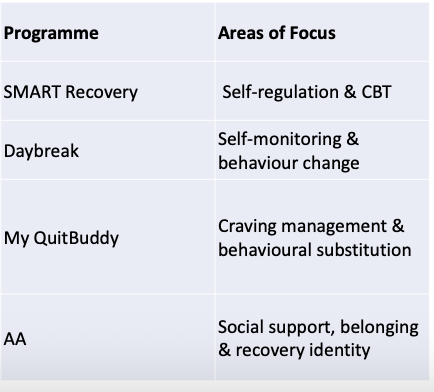
Self-help for Substance Dependence

How Might Self-Help Work?
Changing the person–substance relationship
Trigger-→Craving/Urge-→Coping Strategy→Alternate behaviour→Reward/self-control
Key psychological mechanisms:
• Self-monitoring – tracking substance use and triggers
• Motivation – identifying reasons for change
• Self-efficacy – "I can manage this craving"
• Coping skills – responding differently to urges
• Stimulus control – reducing exposure to triggers
• Alternative reinforcement – finding other rewarding activities
• Relapse prevention – preparing for high-risk situations
Craving does not have to lead to substance use.