Biology Part 2: Mitosis, Mioesis , and Inheritance
 Call Kai
 Learn
Learn Practice Test
 Spaced Repetition
 Match
Match Flashcards
 Knowt Play
1/31

Earn XP
Description and Tags
PERSONAL COPY
Name | Mastery | Learn | Test | Matching | Spaced | Call with Kai | Chat |
|---|
No analytics yet
Send a link to your students to track their progress
32 Terms
What is the purpose of mitosis?
Growth, repair and cell regeneration. Allows single cells to divide and develop into lots of cells to replace worn out and old cells with exact copies, and in single-celled organisms, it's how they reproduce.
Describe the process of Interphase (not apart of mitosis)
Before the process it includes interphase, where a cell grows and copies it’s DNA. One chromosome is now duplicated (x shape)
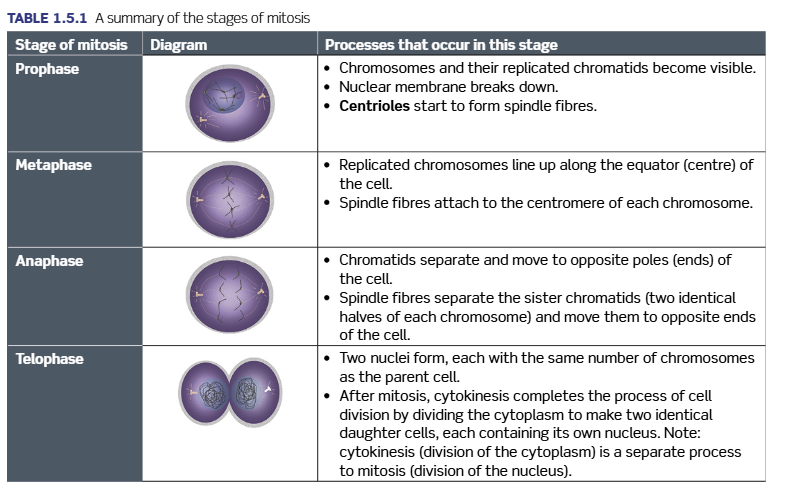
Describe the process of prophase
The duplicated chromosomes become visible, nucleus membrane starts to break down, and spindled fibers form from the centrioles.
Describe the process of metaphase
Chromosomes line up in the middle of the cell. The spindled fibers attach tot he centromere of each chromosome
Describe the process of anaphase
Sister chromatids are PULLED apart, each chromatid pulled to the opposite side of the cell. Once separated each chromatid is called a chromosome.
Describe the process of telophase
the chromosomes reach opposite ends. Two new nuclei form, chromosomes uncoil back into long strands.
Describe the process of cytokinesis (not apart of mitosis)
Cytoplasm divides, splitting the cell into two separate identical daughter cells
What is the purpose of meiosis
Meiosis is the process of cell division that reduces the chromosome number by half, resulting in the formation of four haploid gametes. It is essential for sexual reproduction, allowing for genetic diversity through recombination and independent assortment, ultimately contributing to evolution. It is the process for making sex cells (gametes).
Describe the process of interphase (not apart of meiosis)
Same as interphase for mitosis- cell grows, prepares and DNA is copied so each chromosome is duplicated and now has two sister chromatids.
Describe the process of prophase I
Chromosomes become visible, homologous chromosomes pair up (one per mum and dad), crossing over happens, paired chromosomes swap small pieces of DNA to create genetic variation so each sex cell is different.
Describe the process of metaphase I
Homologous chromosomes line up in the middle. Spindle fibers from opposite poles attach to the kinetochore of each chromosome, preparing the cell for homologous separation in the next phase
Describe the process of anaphase I
Humongous chromosomes separate- sister chromatids STAY TOGETHER
Describe the process of telophase I
Separated homologous chromosomes arrive at opposite poles of the cell, and a new nuclear envelope forms around each set
Describe the process of cytokinesis (not apart of meiosis)
The cell then undergoes cytokinesis to split into two unique haploid daughter cells, each containing only one set of chromosomes.- 23 per pair- 46 in total
Describe the process of prophase II
The chromosomes, which are already duplicated, condense and become visible under a microscope. The nuclear envelope begins to break down, and spindle fibers form, preparing for the separation of sister chromatids in the next phase of meiosis.
Describe the process of metaphase II
the stage of cell division where individual chromosomes line up single-file along the equator of the cell (the metaphase plate). Spindle fibers attach to the centromere of each sister chromatid to prepare for separation
Describe the process of anaphase II
Sister Chromatids separate by spindle fibers to opposite poles of the cell. Once separated, these chromatids are considered individual chromosomes
Describe the process telophase II
he final stage of meiosis II. During this phase, sister chromatids reach opposite poles of the cell, uncoil into chromatin, and the nuclear envelope reforms around each of the four newly separated sets of chromosomes
Describe the process of cytokinesis (not a stage of meiosis- II)
the final physical division of a cell's cytoplasm that splits a single eukaryotic cell into two distinct daughter cells, so four in total with 23 chromosomes per cell.
Homozygous
RR dominant
Homozygous
rr ressive
Heterozygous
both- one from each Rr
Genotype
genetic makeup of an organism BB,bb, Bb
Phenotype
way in which trait is expressed (dimples, red hair)
Punnet square
tool used by geneticists to predict the possible genetic outcomes of a cross between two parents.
It resets after each offspring is born because genetics don’t change
What if F1 and F2 generation
1st square is f1 generation and f1 interbreed, offspring is f2 generation.
What is a test cross?
A test cross is a test performed to determine whether an organism that displays a dominant phenotype is a homozygote or a heterozygote.
The organism with the unknown genotype is always crossed with a homozygote recessive
All stages of Mitosis
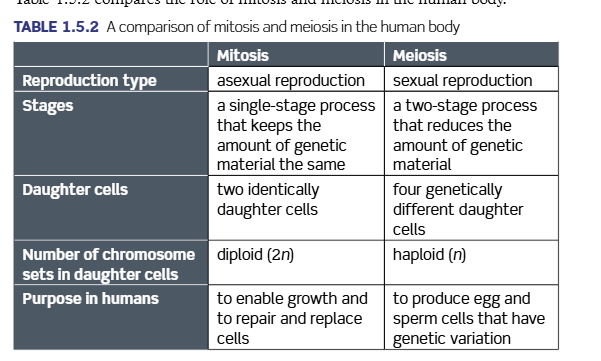
Difference between mitosis and meiosis?
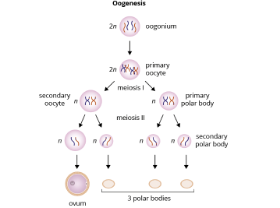
What is oogenesis?
Where Meiosis takes place in the ovaries to produce haploid egg cells for females.
What does oogenesis produce?
one haploid gamete (ovum) and three haploid nuclei (known as polar bodies), which degenerate and disappear naturally
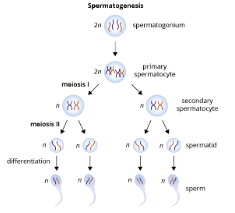
What is spermatogenesis?
Where meiosis takes place in the testes to produce four haploid gamete for males