Chp 12 Humans as Primates - Human Bio
 Call Kai
 Learn
Learn Practice Test
 Spaced Repetition
 Match
Match Flashcards
 Knowt Play
1/46

There's no tags or description
Looks like no tags are added yet.
Name | Mastery | Learn | Test | Matching | Spaced | Call with Kai | Chat |
|---|
No analytics yet
Send a link to your students to track their progress
47 Terms
What kingdom, phyla, class, and order are humans in?
Kingdom; Animalia
Phyla: Chordata
Class: Mammalian
Order: Primates
→ humans as primates classified in same taxonomic family as great apes
What is the classification family of humans?
Homindae (hominids)
Homo sapiens
What is the evolutionary trends of the cerebral cortex?
Cerebrum progressively increased in size, especially cerebral cortex
→ main functions: vision, memory, reasoning & manipulative ability
Trend towards expansion & reorganisation of brain w resultant consequences for behaviour
What is the evolutionary trend for the cerebral cortex?
primates have large brains for their body size
→ Arboreal: need accurate vision, tactile perception, better coordination between sensory stimuli and any muscular response
Progression towards large cerebral cortex
→ = Processes & stores complex sensory info
Hominids have strong pattern of convolutions
→ = increase surface area, 50% increase in surface chiếc compared to cerebral cortex w no convolutions
What is the relative size of the cerebral cortex of humans?
humans relatively large brains ~1350cm³ compared to apes ~400cm³
!! Increased cerebrum !!
→ cerebral cortex Shows greatest degree of development
Surface area of cerebral cortex greatly increased by convolutions
→ brain size measure by cranial capacity
What does the modern human brain contain that is different to primates?
Frontal lobe Has grease enlargement in surface area
→ = higher functions of thinking, reasoning, planning & processing
E.g: Broca’s area (control muscles & ability to speak) & Wernicke’s Area (allow comprehension of spoken words)
How has the human cranium evolved?
large craniums
= more of skull used in housing brain than in apes
High vertical forehead
Lacks prominent brow ridges
Decreased prognathism (shortened snout) = flatter face
Bones of nose protrude = human more prominent nose than other primates
What is the effect of having an increased cerebrum?
ability to move about & locate food
Develop special skills: tool making (diff to tool use)
Behavioural responses & interactive w relatives, allies & adversaries
→ mutual cleaning & grooming = reinforce relationships
→ threats & fighting = maintain hierarchy of dominance
What is the mobility of digits like in primates?
limbs unspecialised in structure = allow great diversity
Pentadactyl = 5 digits each limb
High mobility digits = grasping/prehensile
→ use for climbing by wrapping digits around braced of treads
Evolutionary trend: increase ability to move digits independently of one & another
What is opposability?
first digit can be moved in such way that it can touch each of other digits
→ human big toe epxecption
Lost when human foot became weight bearing rather than grasping appendage
What does the degree of opposability depend on?
relative length of first digit (thumb) compared w other four
Humans possess longest thumb of all primates = contribute ability to manipulate objects w our hands
What do claws provide in evolution?
claws at end of each digit have flattened to become nails
→ important evolutionary change that allow hands & feet to grasp objects without claws getting in way
E.g: Ayes-Ayes claws in all digit except big toe, Lemurs claws in second tow for grooming
What are friction ridges in evolution?
assisting grasping action was development of tactile pads & friction ridges (fingerprints) = provide increased sensitivity & gripping ability
Pattern varies between individuals & from species to species
What is the length of the first digit in evolution?
hands of chimps, orangutans & gorillas all have reduced thumb to allow for more efficient brachiation
→ only allows them to perform power grip but not precision grip
Evolutionary trend of greater manual dexterity came abt due to from appendages no longer relied upon for locomotion
→ on ground, shift to bipedalism allowed hands to be free to manipulate objects which, over time, led to development of important communication skills
→ e.g: writing, drawing, toolmaking
What is precision grip in humans?
four digits used to grip object
Thumb & fingers used to manipulate object
→ not unique to humans
Amt of contact between index finger & thumb is unique
Enables humans to handle small or delicate objects effectively
Requires presence of truly opposable thumb
→ also seen in: old-world monkeys
Precision vs Power grip
chimpanzee has reduced thumb making power grip possible but not precision grip
Human contact between index & thumb allow precision grip
What is the evolutionary trend for feet and hands?
Highly mobile digits
claws to nails
Longer thumb which is opposable
What is the selection pressure for Bipedalism?
early hominins thought to have lived in woodland/forest enviro
→ as climate & habitat change ~5-6 mya, hominins may have been forced to move across open ground to exploit their dwindling food resources amongst trees
→ also would have had to experiment w new food resources in wooded savanna
What are the advantages of Bipedalism?
Carry offspring while following herds on long seasonal migrations
Higher reach when picking fruit from trees
Hands free carrying food away from kill site or growing site to a position of safety.
→ Holding tools & weapons probably consequence of bipedalism rather than cause
Increased range of vision seeing over grass may have helped spot predators or prey at distance
Increased size deter predators
Efficient locomotion bipedalism provides energy efficient method that favours low speed, long distance movement (walking)
Thermoregulation Smaller surface area present to sun at midday (60% less)
→ greater air flow across body when lifted higher off ground assists cooling
Define adaptation
any characteristic that. Helps organism survive
How did adaptations aid in bipedalism?
ability to stand in two les & walk bipedally w striding gait help human ancestors survive
→ therefore skeleton & muscles evolved
Why is the formamen magnum so important and how does it work?
Foramen magnum: hole in skull through which spinal cord passes to brain
position of formamen magnum at base of skull important diagnostic feature of bipedalism
How does the position of the Forman’s magnum imply?
Opening close to rear iof skull implies quadrupedal habit of locomotion: head held upright by powerful neck muscles
Opening located more centrally on skull (modern humans), indicates bipedal habit of locomotion: head balanced on spine & neck muscles reduced in size
What is the position of the foramen magnum in humans vs primates?
Chimpanzee: opening near rear of skull = suggest quadrupedal habit
Australopithecus: opening located closer to position of that found on modern human skulls
Human: opening near central pivoting point of skull, allowing it to balance
How has the curvature of the spinal column show evolution?
humans have double curvature giving spine an S-shape to contribute to upright stance
Lumbar vertebrae are wedge shaped from front to back, forming forward jutting curve (aka Lumbar curve)
Lumbar curve: improves body balance by enabling head to balance on top of spine
Cervical curve: brings vertebral column directly under centre gravity of skull
What does the Human spine look like compared to a Gorilla Spine?
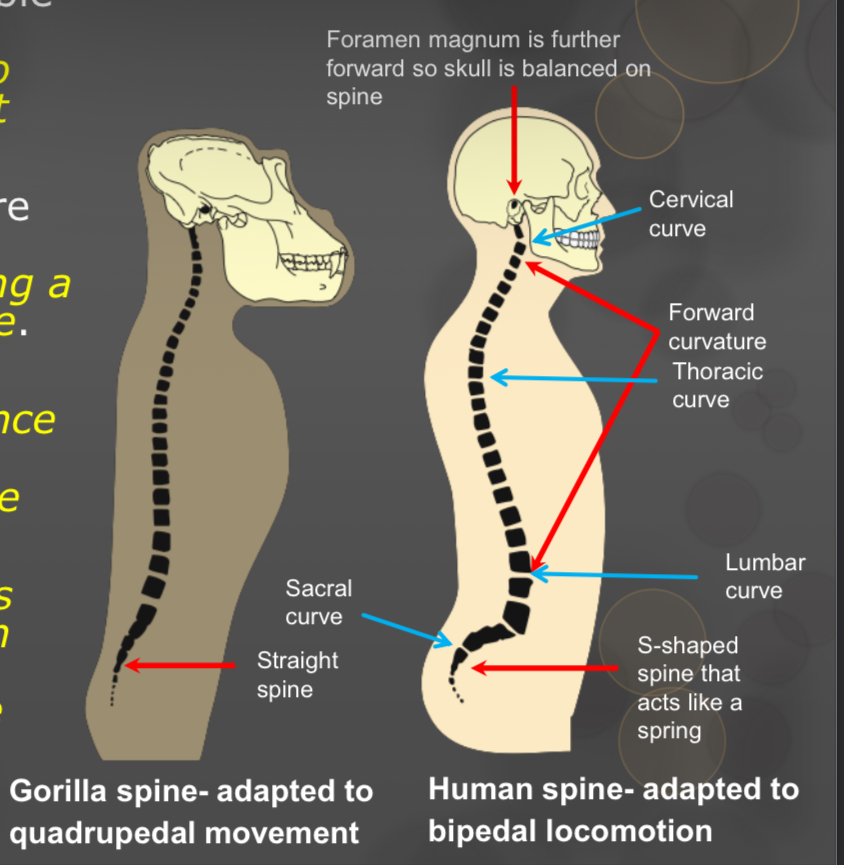
How has the Jaw evolved?
protrusion of Jaw greatly reduced
→ allows skull to balance on top of spine, bcs weight in front of foramen magnum is approximately equal to weight behind
Balance achieved by minimal effort
How has the pelvis evolved?
in humans, bowl-shaped, pelvis broader & shorter from top to bottom than apes
→ bowl shape supports abdominal organs when standing upright & supports developing baby in females
Females: pelvis tends to be slightly broader than males = allow for passage of infant at birth
Broad hip bones provide space for attachment of large gluteal muscles, which move legs & keep upper body upright
How has the carrying angle evolved?
hip joint directly under trunk & head = allow weight of body to be transferred from pelvis to legs
Head of femur large & fits into acetabulum (hip socket) = create carrying angle
→ Hip sockets wide apart but femurs tend to converge towards knees
Gluteal muscles of hip lift short, wide pelvis to prevent tilting when opposite leg is off ground
Thighs bone angled outwards from knees
increased carrying angle = ensure knees brought well under body & weight distribution remains close to central axis when walking
How has the knee evolved?
modern humans = knee joint adapted to bear weight through lateral condyles which are larger than medial condyles
→ results in force that tried to bend knee backward but that is resiste by ligaments of knee joint
= produces joint that require no energy to support body in standing position
Human vs primate knees
Chimpanzees: knee joint adapted to bear weight through medial condyles
What is the weight transmission like from knee to foot?
Knee joint → Tibia → Talus → Tarsals → Metatersals & Phalanges
How has the foot evolved
human foot undergone considerable modifications to better suit bipedal locomotion
Lost prehensility
Toes reduced in length
Big tow large, aligned alongside other toes & no longer opposable
Metatersals shaped in way to form 2 arches: longitudinal & transverse
Humans walk w striding gait: knee & hip fully extended
Wha does the Metatersal arches do?
Transverse arch: unique to humans
→ converts foot into spring, allowing it to transfer weight & improve walking efficieny
What does the direction of weight transmission when walking look like?
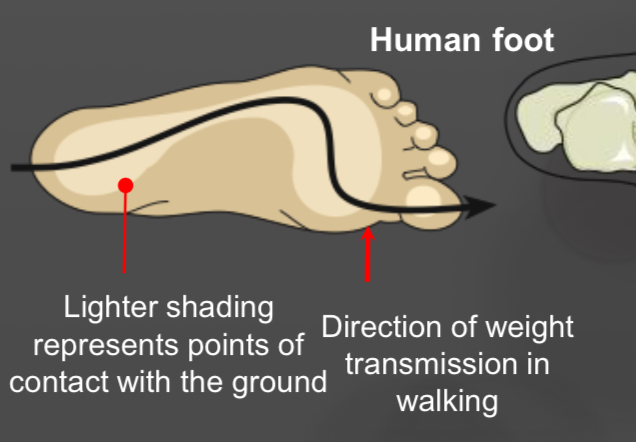
What do the metatarsal arches look like?
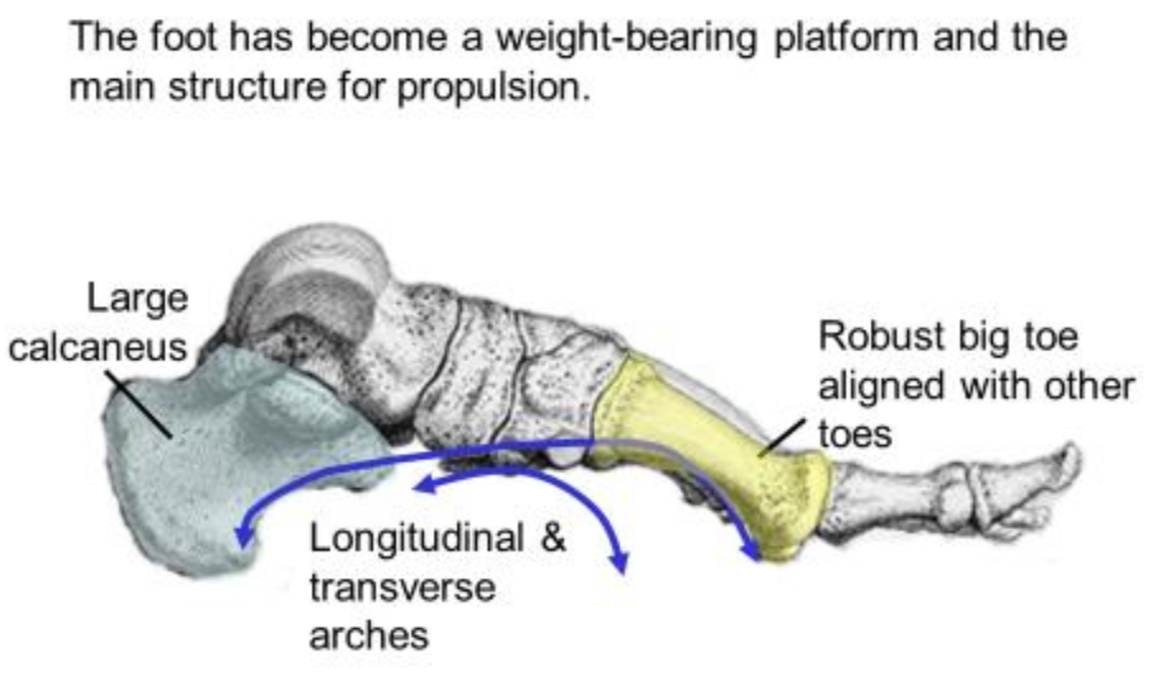
What are the changes in foot anatomy in humans?
Larger calcaneus (heel)
→ improves Flexion of foot
Longitudinal & transverse arches
→ transfers energy from Achilles tendon to big toe
Robust, non-opposable big tow
→ improves stride, provides thrust
How has centre of gravity changed in humans?
unlike apes, humans have legs that are longer than arms
Increases length of stride when walking
Lowers centre of gravity (at chest lvl in apes, pelvis lvl in humans)
→ = more stability
How has stance and locomotion changed in humans?
muscle tone: partial contraction of skeletal muscles
→ sustained muscle tone most evident in muscles that support body in upright position
Humans: muscle bring about movement of spine, hip, knee, ankle & abdominal muscles
NS & variety of sense organ work tgt to maintain tone of these muscles & equilibrium of body
What is striding gait in humans?
walking upright In such a way that hip & knee are fully straighten
→ hominins only animals that have perfect this form of locomotion
How does striding gat work?
When walking: trunk rotates abt pelvis
Forward swinging of arms compensates for natural rotation of body
→ right arm naturally swings forward as left leg extended, vice verse
Swinging of arms ten d keep shoulders @ right angle s direction of travel & reduced amt of energy expended
→ If arms did not move as they dom energy would be wasted reversing rotation of body after each stride
What is dentition in evolution?
2 sets of teeth, deciduous & permanent
→ no. Of each type of tooth expressed as dental formula
Formula gives no. Of each type of tooth in ¼ of jaw
Most have 4 types of teeth:
Incisors & canines: biting & cutting
Premolars & molars: crushing & grinding
What is the trend in no. & arrangement of teeth?
decrease in no. Of teeth in primates, related to reduction in size of face & jaw that has occurred
How have molars evolved in primates?
early mammals: 3-cusp pattern
Apes & humans have Y-5 pattern, 4-cusps in upper molars & 5-cusps in lower
Evolved due to predominantly fruit diet of apes
Humans vs Chimpanzee vs Australopithecsuhecine Jaw
Human:
dental arcade less U-shaped
All teeth smaller
Canines same size as incisors
No diastema (gap)
Chimpanzee
Dental arcade U-shaped
Canines very large
Other teeth are large
Diastema (gap) present
Australopithecus:
dental arcade still slight U-shaped
Canines reduced
Other teeth large
Diastema present
How does skull morphology ê evolve in humans vs chimps
Larger brow ridge of chimp compared to human
Sloping forehead of chimp compared to human
More prognathous (jutting) jaw of chimp compared to human
Larger caNine & gap (diastema) of chimp compared to human
What is the difference of cranium of humans compared to primates
large cranium
High vertical forehead
Lacks prominent brow ridges
Shortened snout
Bones of nose still protrude giving human far more prominent nose than any other primates