DDI, Inducers, Substrates
 Call Kai
 Learn
Learn Practice Test
 Spaced Repetition
 Match
Match Flashcards
 Knowt Play
1/57

There's no tags or description
Looks like no tags are added yet.
Name | Mastery | Learn | Test | Matching | Spaced | Call with Kai | Chat |
|---|
No analytics yet
Send a link to your students to track their progress
58 Terms
What are the different types of pharmacodynamic interactions between drugs?
Additive effects
synergistic
antagonistic
Additive effects definition
The combined effect of two drugs is approximately equal to the sum of their individual effects.
Can occur when:
Drugs act as agonists at the same receptor
Example: Morphine + oxycodone → increased opioid effects/adverse effects
Drugs act through different mechanisms or receptors but produce similar effects
Example: Benzodiazepines + opioids → profound sedation and respiratory depression
Example: Warfarin + aspirin → increased bleeding risk
Synergistic effects definition
The combined effect of two drugs is greater than the sum of their individual effects.
Example: Oxycodone + acetaminophen → greater analgesia than either drug alone
Antagonistic effects definition
One drug reduces or blocks the effect of another drug.
Example: Naloxone blocks opioid effects
What drugs are should be avoided with polyvalent ions?
Quinolones
Tetracyclines
Levothyroxine
oral bisphosphonates
What are CYP enzymes and Pgp pumps?
Cytochrome P450 (CYP) enzymes metabolize drugs and chemicals in the body, while
P-glycoprotein (P-gp) acts as a cellular pump that moves drugs across cell membranes and out of tissues.
What are common CYP inhibitors?
G-PACMAN
Grapefruit
Protease inhibitors(i.e ritonavir)
Azole antifungals
Cyclosporine, cobicstat
Macrolides(except Azithromycin)
Non DHP CCBs
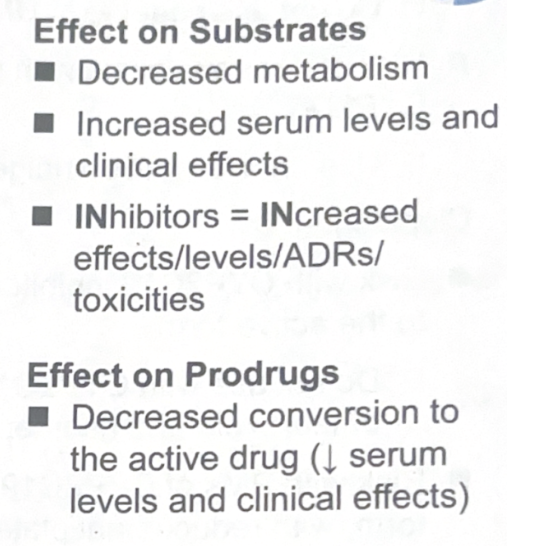
Effects of CYP inhibitors
What are Common CYP inducers
PS PORCS
Phenytoin
Smoking
Phenobarbital
Oxcarbazepine
Rifampin
Carbmazapine
St Johns Wort
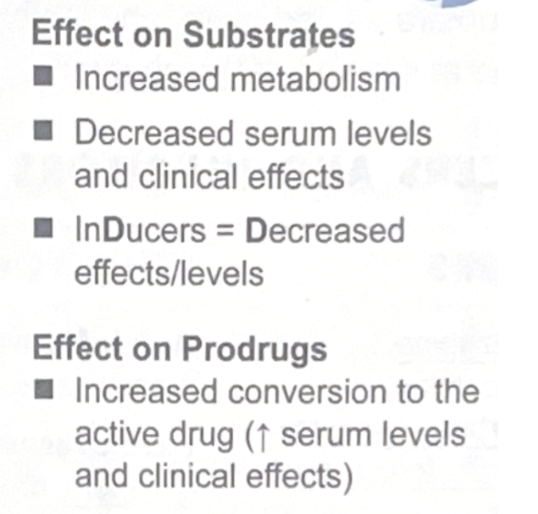
effects of CYP inducers
T/F: Inducers have quick on and off times for their effects
Inducers have a lag time before you see effect; when you stop it it takes 2-4 weeks to see effect disappear completely
What are Common Pgp substrates
Anticoagulants
Cardiovascular drugs(Digoxin, Non DHP CCBs)
HCV drugs(Sofosbuvir)
Immunospuressants(Cyclosporine, Tacrolimus)
Colcichine
What are Common Pgp inducers
Carbamazepine
Phenobarbital
Phenytoin
Rifampin
St. Johns wort
What are common PgP inhibitors
Anti-infectives
Cardiovascular drugs(Amiadrone, Non DHP CCBs)
HCV drugs(Ledipasvir)
HIV drugs(Cobicstat, ritonavir)
Cyclosporine
What is the risk of using Amiodarone + Warfarin and how can we address it?
Risk: Amiodarone inhibits 2C9 which metabolizes Warfarin slower(increased INR and bleeding risk)
Action:
if adding on Warfarin: use low dose
if adding on amiodarone: decrease Warfarin dose by 30-50%
if taking both: monitor INR
What is the risk of using Amiodarone + Digoxin risk and how can we address it?
Risk: Amiodarone inhibits Pgp and Digoxin is a Pgp substrate(decreases excretion and increases ADRs) and both increase risk of bradycardia
Actions
if adding on digoxin: use low dose
if adding on amiodarone: decrease oral digoxin dose by 50%
when taking both:
look for s/sx of digoxin toxicity
monitor HR and look out for BB, Clonidine, or Non DHP CCBs
What is the risk of using Loop Diuretics and Digoxin and how can address it?
Risk:
Loop diuretics decrease K+ and Mg+ and Digoxin toxicity increases with low levels
Loop diuretics can cause renal impairment and Digoxin can be less excreted
Action:
check electrolytes
if Renal impairment: decrease either dose of digoxin or frequency
What drugs when used together decrease HR and how can we address it?
Drugs: BB, Non DHP CCB, Clonidine, Amiodarone, and or Digoxin
Action: monitor HR
What is the risk of using Statins and Strong 3A4 inhibitors and how can we address it?
Risk:
decreased metabolism of lovastatin, simvastatin, or atorvastatin levels; higher drug levels
Action:
Avoid simvastatin and lovastatin if on concurrently; they are CI
What is the risk of using Warfarin with either 2C9 inducers and inhibitors risk and how can we address it?
Risk:
inhibitors: increase levels of warfarin(higher INR and higher bleeding risk)
inducers: decrease levels of warfarin(lower INR and higher clotting risk)
Action: Monitor INR
What is the risk of using 3A4 inhibitors +3A4 substrates that are opioids(i.e fentanyl, oxycodone) and how can we address it?
risk: decreased substrate metabolism leads to increased drug levels/toxicity(i.e sedation)
Action: do not use 3A4 inhibitor with opioid
Which medications are known for the counseling point of avoiding grapefruit juice when taking them?
amiodarone
simvastin
lovastatin
nifedipine
tacrolimus
What is the risk of using Valproate and Lamotrigene and how can we address it?
risk: Valporate decreases Lamotrigene metabolism and increases levels of lamotrigine= increased risk of SJS/TENS
Action: use starter kit of lamotrigine that uses lower dose
What is the risk of concurrently using MAOI+ Drugs/Foods that increase NE/epi/dopamine+ Drugs that increase 5HT and how can we address it?
risk:
blocking MAOI will increase epinephrine, norepinephrine, dopamine, and dopamine
HTN crisis
high 5HT can cause serotonin syndrome
Actions:
do not use together
use 2 week washout period for everything except fluoxetine(Need to wait 5 weeks)
avoid aged cheeses, air-dried meats, and sauerkraut
What is the risk of using CYP2 D6 inhibtors+ 2D6 substrates risk and how can we address it?
Risk: decreased substrate metabolism, and increased ADR metabolism
Action: avoid using together if possible
What is the risk of using 3A4 inhibitors or PgP inhibitors with CNIs or mTOR kinase inhibitors(everolimus or sirolimus) interaction and how can we address it?
risk: decreased substrate metabolism
Action: avoid using together
What is the risk of using ASM CYP inducers + other drugs metabolized by CYP enzymes and how can we address it?
risk:
increased substrate metabolism will cause drug levels to decrease
decreased drug effects with ASMs lead to loss of seizure control
Action:
monitor drug levels
if substrate is lamotrigine, use the starter kit that begins with higher lamotrigine doses
What is the risk of using rifampin + CYP and Pgp substrates risk
risk: increased substrate metabolism will cause drug levels to decrease
What is the risk of CYP3A4 inducers + opioids that are 3A4 substrates
Risk: increased metabolism results in decreased opioid concentration; analgesia will decrease
What is the risk of using CYP3A4 or Pgp Inducers with CNIs or MTOR inhibitors?
Risk: Increased drug metabolism of CNIs or MTORs leads to lower levels in body= increased risk of transplant rejection
How does smoking affect Antipsychotics, Antidepressants, Anxiolytics, or Theophylline
smoking induces 1A2
risk:
current smoker: 1A2 substrates will have low levels
smokers who quit: when inducer is stopped, drug concentrations will increase toxicity
Note: NRT products do not induce CYP
What meds carry serotonergic toxicity?
Medications:
Antidepressants
MAOI
Opioids
triptans
St. Johns wort
Buspirone, Lithium, DXM
What do we do for meds that have additive risk of serotnergic toxicity?
avoid serotonergic agents together
need washout period
What meds carry bleeding when added together and actions
Meds:
Anticoagulants
Antiplatets
NSAIDs
SSRIs/SNRIs
Natural Products
What do we do for meds that have additive bleeding risk?
Actions: avoid generally unless if:
NSAID PRN with SSRI/SNRI
ASA and NSAID PRN
dual antiplatet therapy
bridging overlap
What meds carry hyperkalemia when added together, their risk, and actions
Meds:
RAAS
Potassium sparing diuretics
What do we do for meds that have additive hyperkalemia risk?
Actions:
do not use ACE with ARBS or ARNI
avoid salt substitutes
What meds carry QTc prolongation risk and actions?
Meds:
Antiarrythmtics
anti-infectives
except isavuconazium
antidepressants
highest risk with citalopram
antipsychotics
highest risk with ziprasidone/Second gen AP
Oncology meds
droperidol
What do we use for meds that have additive QT prolongation effect?
limit QT prolongation unless amiodarone for arrhythmia in HF
do not exceed:
Citalopram:
20 mg for citalopram in elderly
40mg daily
Escitalopram:
10 mg for elderly
20 mg daily
swap to seterlaine if need; the most safe
do not use droperidol for inpatient N/V
What meds carry the highest risk CNS depression?
Opioids + BZDs
Actions for meds with additive CNS depression risk?
do not use alcohol
avoid combining CNS depressants
For opioids:
do not combine with BZDs
XR have risk when taken with alcohol
What meds carry additive ototoxicity risk?
Aminoglycosides(i. gentamicin, neomycin)
Cisplatin
Loop diuretics
Salicylates
Vancomycin
Risk: hearing loss
What to do for meds that have additive ototoxicity effect?
consult audiology, avoid using multiple drugs
meds that carry additive effect of nephrotoxicity
anti-infectives
cisplatin
CNI(Cyclopsporine, tacrolimus)
loop diuretics
NSAIDs
Radiographic dyes
Actions of meds with additive effects of nephrotoxicity
maintain adequate hydration
monitor drug levels
If using Cisplatin-→use amifostine concurrently
Meds with hypotensive/orthostasis additive risk?
PDE5 inhibitors + 3A4 inhibitors or Nitrates or Alpha 1 blockers
actions for meds with hypotensive/orthostasis additive risk?
for 3A4 inhibitors: start with half the dose of PDE5 inhibitor
PDE5 and nitrates: CI from concurrent use
PDE5 and alpha 1 blocker: start with half the dose when adding a drug from either class
CYP3A4 Substrates
Analgesics
Anticoagulants
Cardiovascular drugs: amiodarone, CCB, or ranolazine
Immunosuppressants: CNI
Statins: atorvastatin, lovastatin, simvastatin
NNRTIs
PDE-5 inhibitors:
CYP3A4 inducers
PS PORCS
CYP3A4 inhibitors
G-PACMAN
1A2 substrates
R-warfarin, theophylline
1A2 inhibitors
Ciprofloxacin, fluvoxamine
1A2 inducers
Carbamazepine, phenobarbital, phenytoin, primidone, rifampin, smoking, St. John's wort
2C9 substrates
S-warfarin
2C9 inhibitors
Amiodarone, fluconazole, metronidazole, SMX/TMP
“2C9 hates ABX”
2C9 inducers
PS PORCS
2D6 substrate
analgesics: codeine, meperidine, tramadol
Tamoxifen
2D6 inhibitors
Amiodaorone, Bupropion, fluoxetine, duloxetine, and paroxetine
“2D6 hates Antidepressants”