A&P Exam 1
 Call Kai
 Learn
Learn Practice Test
 Spaced Repetition
 Match
Match Flashcards
 Knowt Play
1/104

There's no tags or description
Looks like no tags are added yet.
Name | Mastery | Learn | Test | Matching | Spaced | Call with Kai | Chat |
|---|
No analytics yet
Send a link to your students to track their progress
105 Terms
Define Life
Order, Evolutionary Adaptation, Response to the Environment, Regulation, Energy Processing, Growth & Development, Reproduction
5 Environmental Factors of Life
1) Water 2) Oxygen 3) Food 4) Heat 5) Pressure
Water
Most abundant substance in the body
Required for metabolic processes
Required for transport of substances
Regulates Body Temp
Food
Provide Necessary Nutrients
Supplies Energy
Supplies Raw Material
Oxygen (gas)
1/5 of air
Release energy from nutrients
Heat
Form of energy
Partly controls rate of metabolic activity
Pressure
Application of force on an object
Atmospheric pressure = breathing
Hydrostatic pressure = blood flowing
Order of Organization of an Organism
Atom —> Molecule —> Macromolecule —> Organelle —> Cell —> Tissue —> Organ —> Organ System —> Organism
Emergent Properties
Result from the arrangement & interaction of parts within a system
Characterize non-biological system example
Ex. Functioning bike emerges only when all of necessary parts connect in the correct way
Biological Systems
combination of components that form a more complex organization
ex. cells, organism, & ecosystem
Physical laws & needs to exchange materail w/ the environment limits range of animal forms
Anatomy
study of structure of an organism
Physiology
study of functions an organism performs
Which keyboard more efficient?
Dvorak keyboard efficient than QWERTY but is what we use as its been accepted in society
Why are not all animals designed equally?
Natural Selection
Raw Materials
If natural selection strong + little variation or highly specialized = extinction
Physical laws + need to exchange materials with the environment limits range of animal forms
3 Important Figures in A&P
Galen - 165-200 AD (Greek) —> assembled anatomical knowledge, worked on Apes, 1300 Years, “The” reference = many mistakes
Leonard Da Vinci —> dissected 30 bodies before Pope stopped him
Andreae Vesalil —> De Humani Corporis Fabrica 1543
Homeostasis
Maintaining a stable internal environment
Homeostatic Control Mechanism
monitors aspects of the internal environment & corrects as needed —> variations are within limits
Recepter - provides info about the stimuli
Control Center - tells what a particular value should be (set point)
Effector - elicits responses that change conditions in the internal environment
Negative Feedback Mechanisms
Prevent sudden, severe changes in the body
Corrects the set point
Causes opposite of bodily disruption to occur i.e. the “negative”
Most common feedback loop type
Ex. body temp, blood pressure, & glucose regulation
Positive Feedback Mechanisms
Increases (accelerates) the actions of the body
Short Lived
Do Not require continuous adjustments
Ex. blood clotting & child birth
Cranial Cavity
space inside the skull that holds & protects the brain

Vertebral Cavity
long narrow cavity inside the backbone that houses the spinal cord
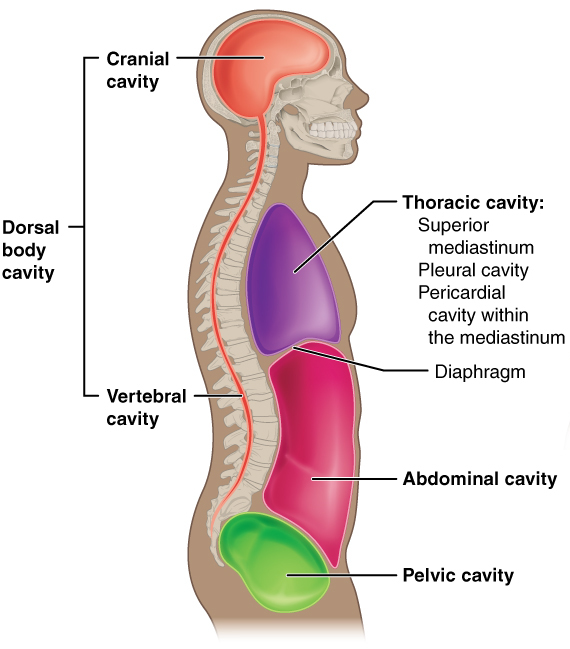
Thoracic Cavity
second largest human body that is located inside the chest between the neck and diaphragm - organs = heart, lungs, trachae, thymus gland, major blood vessels

Diaphragm
dome shaped muscle that serves as the physical partition between the thoracic & abdominal cavity
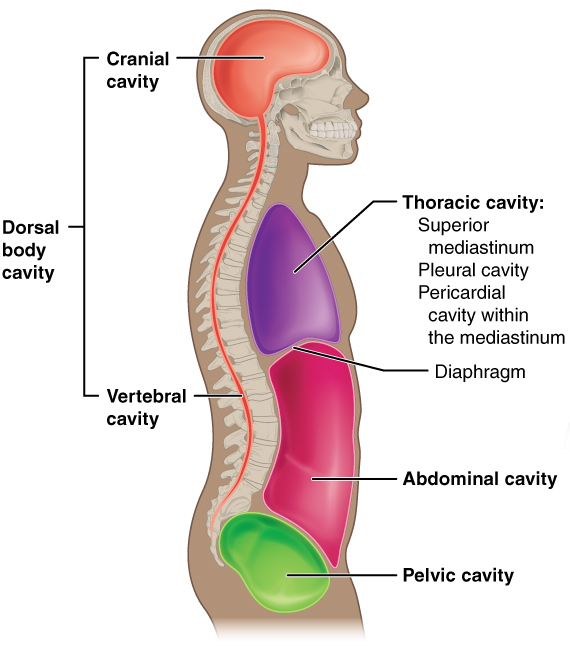
Abdominal Cavity
largest hollow space in the body between the chest and the pelvis - organs = digestive systems (Stomach, liver, pancreas, spleen, and most of the intestine) & the excretory system (kidney & adrenal glands)

Pelvic Cavity
bowl shaped space located at the base of the trunk (below the abdomen) enclosed by the hip bones, sacrum, & coccyx
Organs = digestive system (The lower end of the large intestine, including the rectum and anal canal) & Urinary System (The urinary bladder and the upper parts of the urethra)

Visceral Layer
covers an organ
Parietal Layer
lines a cavity or body wall
Anatomical Terminology
standardized, often latin or greek
anatomical position - standing erect, facing forward, upper limbs at the side, palms facing forward & thumbs out
Posterior
Towards the back or rear portion of the human body
ex. the shoulder blades are posterior to the rib cage
Anterior
Towards the front of the body
ex. The shin is anterior to the spinal cord
Superior
Towards the head
ex. the head is superior to the knee
Inferior
Closer to the feet
ex. the hips are inferior to the heart
Lateral
away from the middle of the body
ex. the fingers are lateral to the ribs
Medial
closer to the middle of the body
ex. the heart is medial to the wrist
Proximal
closer to the center of the body or the point where the limb connects
ex. the shoulder is proximal to the elbow
Distal
away from the center of the body or the point where the limb connects
ex. the fingers are distal to the elbow
Deep
away from the outside surface of the body
ex. the ribs are deep to the skin
Superficial
towards the outside surface of the body
ex. the skin is superficial to the lungs
Ipsilateral
on the same side of the body
ex. a left arm injury is ipsilateral to a left leg injury
Contra-lateral
on opposite sides of the body
ex. the rigth hand is contralateral to the left hand
Sagittal Plane
divides the body into left & right portions
Mid-sagittal divides body into equal left + right portions

Transverse or Horizontal Plane
divide body into superior & inferior portions
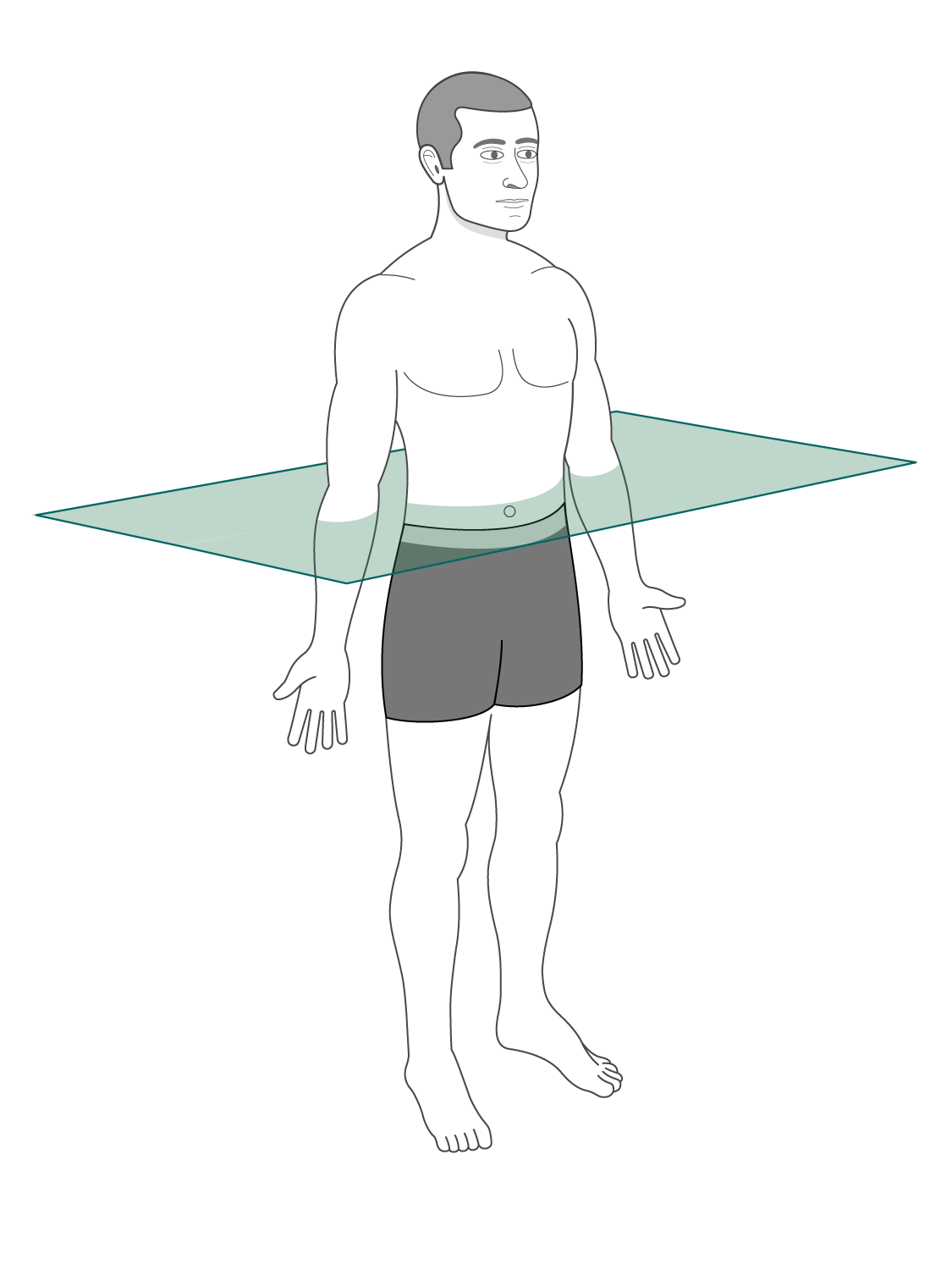
Frontal Plane
divides body into anterior and posterior portions

Abdominal Subdivisions
Right Upper Quadrant, Left Upper Quadrant, Right Lower Quadrant, Left Lower Quadrant

Chemistry in A&P
Body functions depend on cellular function & cellular function results from chemical changes
All living organism collection of atoms & molecules
All life forms composed of matter (anything contains mass & occupies space)
Element
a substance that cannot be broken down chemically into any other substance
Atom
A bit of matter that cannot be subdivided any further without losing essential properties
Organism dies —> atoms recycle
Atomic Structure = Nucleus with protons & neutrons surrounded by electrons
Proton
positive charged subatomic particles that are located in the nucleus
number of protons distinguishes one element form another
Atomic number - also equal to number of electrons & protons if net charge 0
Periodic Table
organized by atomic number, 92 naturally occurring elements , >26 made in lab
Rows correspond to number of electron shells
Columns left to right, indicate number of electrons in outer shell
Similarities occur as same number in electron in outer shell = similar bonding
Isotopes
number of neutrons in an aotm can vary independently of number of protons
Single element can exist in various forms (isotopes) —> depending on number of neutrons it possesses
Ex. Isotopes of hydrogen = hydrogen, deuterium, tritium
Radioactive Decay
isotopes used in carbon dating —> when heavy carbon breaks down slowly (can figure out how long someone was dead for)
Atomic Mass
Protons & neutrons are nearly equal in mass & weigh more than electrons
Atomic mass scale indicates an atom’s mass relative to mass of other atoms
Weight
derived from gravitational pull on mass
Mass
amount of matter in an atom independent of location & gravity
Hydrogen, Oxygen, Carbon, & Nitrogen
95% of atoms in living organisms
Hydrogen & oxygen are primarily in wter
Nitrogen in protein
Carbon is building block of all living matter
Mineral & Trace Elements
less than 1% & less than .01% —> essential for normal growth & function
25 elements in the human body
Ions
charged atoms
Atom that loses one or more electrons = positively charged = cations
Atom that gains or more electrons = negatively charged = anions
Molecule
particle formed when two or more atoms chemically combine (ex. O2, , N2 )
Molecular Formula - depict the elements present & number of each atom present in molecule (H2O)
Compound
particle formed when two or more atoms of different elements chemically combine
Covalent Bonds
share an electron (strongest bond)
H=single bonds, O=2 bonds, N=3 bonds, C=4 bonds
Octect Rule
atoms are stable when their outer shell is full —> most atoms the outer shell is filled with 8 but hydrogen is filled with 2
Ionic Bonds
an attraction between two oppositely charged ions, forming a compound
Hydrogen bond
an attraction between the slightly positvely charged hydrogen atom of one molecule & the slightly negatively charged atom of another (weakest)
Chemical Reactions
occur when chemical bonds form or break among atoms, ions, or molecules
Reactants - starting materials of a reaction (atoms, ions, & molecules)
Products - substances formed at the end of chemical reactions
Synthesis Reaction
more complex chemical structure is formed (A + B = AB)
Decomposition Reaction
chemical bonds are broken to form a simpler chemical structure (AB —> A + B)
Exchange Reaction
chemical bonds are broken & new bonds formed (AB + CD —> AD + CB)
Reversible Reaction
the products can change back to the reactants (A+B ←→ AB)
Electrolytes Reaction
substances that release ions in water (NaCl —> Na + Cl-)
Acids Reaction
electrolytes that disassociate to relase hydrogen ions in water (HCl —> H+ + Cl-)
Bases Reaction
substances that release ions that can combine with hydrogen ions (NaOH —> Na+ + Cl-)
Salts Reaction
electrolytes formed by the reaction between an acid & base (HCl + NaOH —> H2O + NaCl)
pH
the amount of H+ in a solution its a measure of its acidity
Acid
greater proportion H+ ions to OH- ions
H+ very reactive
Acids can donate H+ to other chemicals
Stomach acid
Bases
greater proportion OH- to H+ ions
Low H+, High OH-
Antacids
Baking soda, seltzer
Blood pH
can quickly absorb excess H+ to keep solution from being too acidic
can release H+ ions to counteract increases in OH- concentration
normal blood pH is 7.35-7.45
Homeostasis controls & regulates pH
buffers chemical reactions
Alkalosis
occurs when blood pH rises to 7.5-7.8
Acidosis
occurs when blood pH lowers to 7.0-7.3 (holding breath)
Organic Molecules
contain C & H
usually larger than inorganic molecules
dissolve in water & organic liquids
carbs, proteins, lipids, & nucleic acids
Inorganic Molecules
generally do not contain C & H
usually smaller than organic molecules
Usually disassociate in water, forming ions
water, oxygen, carbon dioxide, & inorganic salts
Inorganic Substances - Water
Most abundant compound in living material
2/3 the weight of an adult human
Major component of all body fluid
Medium for most metabolic reactions
Important role in transporting chemicals in the body
Absorbs & transport heat
Inorganic Substances - Oxygen
Used by organelles to release energy from nutrients in order to drive cell’s metabolic activities
Inorganic Substances - Carbon Dioxide
waste product released during metabolic reactions
must be removed from the body
Inorganic Salts
Abundant in body fluids
Sources of necessary ions (Na+, Cl- , K+ Ca+2 )
Play important role in metabolism
Properties of Water
Water has unusual properties that make it critical for life:
High surface tension (pressure applied to water surface)
V-shaped H2O molecules held together by hydrogen bonds
Bonds strong enough to give H2O surface tension
Cohesion (ex. allows trees to move water from roots to leaves)
Large heat capacity (heat used to break/reform hydrogen bonds —> water temp doesn’t increase)
Low density as a solid (ice has max number of hydrogen bonds form —> molecuels spread apart)
Liquid water hydrogen bonds constantly break & reform = more density
Solvent
4 Types of Macromolecules
Carbohydrate, Lipids, Protein, Nucleic Acids
Carbohydrates
Macro-molecules that function as fuel (C, H, O in 2:1 H:CO)
Carbon hydrogen bonds store a lot of energy & easily break down
Monosaccharides
simple sugars (3-7 carbon atoms)
glucose, fructose, & galactose
Most carbs ultimately converted into glucose
Blood sugar
If energy needed than glucose is broken down if not needed then it is stored as glycogen (short term) or fat (long term)
Complex Carbohydrates
Time released energy packets
Disaccharides (sucrose & lactose), Polysaccharides (starch & cellulose)
Starch - glycogen is “animal starch”
Cellulose - provide structural support for plants (humans can’t break down)
Chitin 0 makes up outer-skin of arthropods (humans can’t break down)
Fiber
“roughage” —> colon cancer prevention & reduction
Undigestible by humans
Lipids
store energy for “rainy day”
Lipids are macromolecules with several functions including energy storage
Lipids = hydrophobic
Lipids = non-polar, greasy to touch, significant of energy storage
Composed of C,H,O —> energy stored in many carbon hydrogen bonds
Glycerol head region & fatty acid tails
Contain more stored energy than carbs
Fats including triglycerides common in food (are one type of lipid)
Characterized by long hydrocarbon tials, fats effectively store energy in bonds connecting molecules
3 Types of Lipids
Fat = long term energy storage
Sterols = regulate growth & development
Phospholipids = form the membranes that enclose cells
Saturated Fats
single bond
each carbon in hydrocarbon chain is bound to 2 hydrogen atoms —> solid at room temp
Unsaturated Fats
double bond
at least one carbon is bound to just one hydrogen (double bond) —> liquid at room temp
Cholesterol
used along with phospholipids to build sex hormones & membranes
important components of cell membranes —> can attach to vessel walls & cause them to thicken which may lead to high BP, stroke, & heart attack
Steroid Hormones
regulate sexual development, maturation, & sex cell production
Estrogen includes memory & mood
Testosterone stimulates muscle growth (synthetic variation)
Phopholipids
major component of cell membrane (hydrophilic head & hydrophobic tail)
Protein
versatile macromolecules that serve as building blocks (200,000 types)
amino acids - 20 different amino acids strung together make a protein
Protein 3-D Shapes
Primary structure - the sequence of amino acids in a polypeptide chain
Secondary structure - hydrogen bonding between amino acids
2 common patterns = twist like a corkscrew & zig-zag folding
Tertiary Structure - folding and bending of the secondary structure due to bonds such as hydrogen bonds or covalent sulfur bonds
Quartnary Structure - two or more polypeptide chains are held together by bonds between the amino acids on different chains (ex. hemoglobin)
Denatured Protein
extreme environment (heat, pH) disrupts protein shapes & function