Final lab
 Call Kai
 Learn
Learn Practice Test
 Spaced Repetition
 Match
Match Flashcards
 Knowt Play
1/45

There's no tags or description
Looks like no tags are added yet.
Name | Mastery | Learn | Test | Matching | Spaced | Call with Kai | Chat |
|---|
No analytics yet
Send a link to your students to track their progress
46 Terms
Exoenzymes
An exoenzymes is an enzyme secreted by a microorganism into its surrounding environment. These enzymes break down large molecules into smaller molecules that can then be absorbed.
Name the 4 media that tested for exoenzymes. Are they selective or differential media?
Skim Milk Agar, Starch Agar, Gelatin deep , Spirit Blue Agar are all differential media
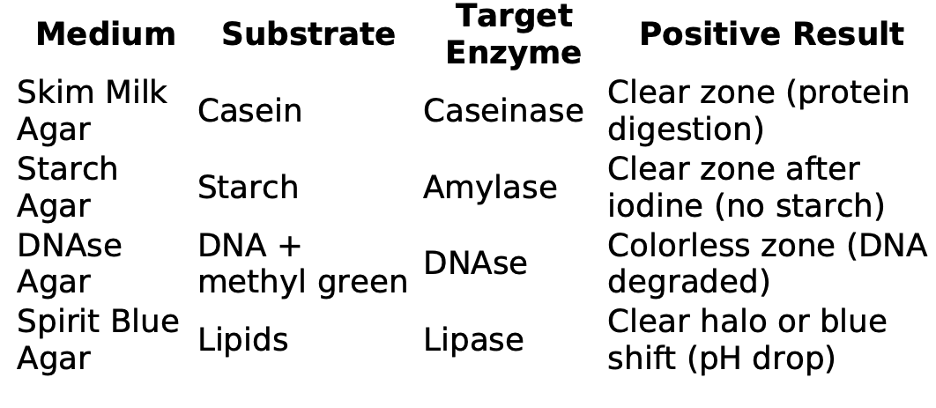
What are the substrates and enzymes is was being tested for in Skim milk agar, DNAse , Spirit Blue agar and in Starch agar? What was the result for a positive test for the enzymes? Ex. Did the organism show a clear area around the bacterial growth.
What were the reagents used on starch agar. What color did the agar turn in the starch had not been digested?
Yes, Both Gram’s iodine and Lugol’s iodine react with starch to produce a dark blue-black color.
What was the pH indicator used in sprit blue agar?
The Spirit blue Agar (lipase test)
What is the dye used in the DNAse agar?
Methyl green/ toluidine blue
What does EMB and MSA agar stand for?
EMB: Eosin Methylene Blue
MSA: Mannitol Salt Agar
What category of bacteria are inhibited by EMB and MacConkey agars?
Gram-positive
What is the pH indicator and sugar found in MacConkey agar. What color of colonies indicates a positive result?
Pink or red color
Which media is used to distinguish Staphylococcus aureus from Staphylococcus epidermidis? What colors did these two organisms show when grown on this media?
Staphylococcus aureus: Yellow colonies with a yellow halo due to mannitol fermentation
Staphylococcus epidermidis: Small pink or red colonies with no color change in the medium (does not ferment mannitol)
What ingredients are the selective and differential factors in MSA?
Selective ingredient: 7.5% sodium chloride (NaCl)
Differential ingredients: Mannitol and phenol red
Mannitol fermentation produces acid that turns phenol red yellow; non-fermenters leave the medium red or pink
What is the pH indicator in MSA?
phenol red
What is the component of MSA that is fermented by some bacteria?
D-mannitol
What is the color change on MSA when S. aureus is grown on the media.
Red to yellow
Which media would be best to identify coliforms (gram negative lactose fermenters) in a water sample?
Eosin Mehthylene Blue (EMB) agar and MacConkey agar
What are the distinctive characteristics of how E. coli and E. aerogenes grow on EMB?
Escherichia coli: Dark colonies with a metallic green sheen
Enterobacter aerogenes: Large pink to purple ‘fisheye’ colonies with dark centers but no metallic green sheen
What tests are included with IMVIC?
Indole, methyl red, Voges-Proskauer, Citrate
What is the name of the reagent used in the indole test? How is the reagent added to the tube? What is the color change that indicates a positive result?
Indole Test: Kovacs Reagant the top layer to turn red positive result
Reagent added to the tube 5 drops of methyl red
Pink/red color positive result
How do you inoculate a TSI slant?
TSI slant is inoculated by stabbing the needle. 35c to 37c
What does TSI stand for?
TSI stand for Triple Sugar Iron
Along with iron sulfate what are the 3 sugars and pH indicator in an TSI slant.
3 sugar glucose, lactose, and sucrose and phenol red
Know the colors changes on a TSI and what sugar is being fermented. What does it mean when the tube turns black?
Interpret sugar fermentation (yellow=acid, red/pink= alkaline) and H2s production (black precipitate)
What does MRVP stand for?
Methyl red-voges Proskauer
What are the two tests being utilized in MRVP?
Methyl red (MR) and Voges-Proskauer (VP)
What are the reagents added to the VP test? What does the color change indicate?
VP test requires alpha-naphthol (reagent A) and potassium hydroxide (KOH, Reagent B)
Red=positive and yellow= negative
What is the enzyme tested for in the urea test.
: Urease
What is the pH indicator in this media?
phenol red
What is the color of media under acidic and basic conditions?
Acidic: Yellow
Basic Color: Pink
This test is very useful in identifying what genus of bacteria
The Urease test is especially useful, as Proteus spp. Hydrolyze urea
What indicates a positive catalase test?
Catalase test: Add hydrogen peroxide to bacterial smear and observe for bubbling
Describe the color change in alpha, beta and gamma hemolysis.
Alpha hemolysis: brown-green color
Beta hemolysis: red color
Gamma hemolysis: no change color
What type of hemolysis is most likely to indicate a pathogenic bacterium?
Beta hemolysis
What is broken down in the blood agar to create the hemolysis?
Broken down in the blood agar to create the hemolysis: red blood cells (erythrocytes) and protein hemoglobin
1. Know what type of hemolysis can be distinguished between the optochin and bacitracin disks?
Optochin will distinguish between alpha hemolytic bacteria
Bacitracin will distinguish between beta hemolytic bacteria
The coagulase test is useful in distinguishing which genus and species of bacteria.
Staphylococcus aureus and other species within the genus Staphylococcus
What chemical is used in the bile solubility test. What organism is likely to show a positive result on the bile solubility test?
Chemical used: Sodium Deoxycholate
Positive result S. pneumoniae
What organisms did we test in lab that had a positive result in the bile solubility test?
Streptococcus pneumoniae
What are the three sugars tested for in the carbohydrate fermentation test? What is the name of the tube used to detect gas production?
Durham tube containing glucose, lactose, and sucrose
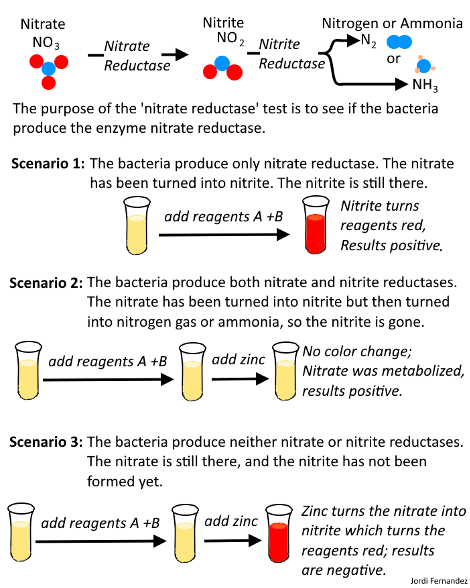
1. What is the order of the reagents added to the nitrate test?
Nitrate reagent A-sulfalamic acid
Nitrate reagent B- naphylythamine
Zinc powder
Know the two possible scenarios of compounds that tan organism can break down into if they organism has both the enzymes to break down nitrate and nitrate.
Nitrogen gas or ammonia
1. Review the results of the nitrate reductase test below;
1. What is the Kirby Bauer sensitivity test used for?
This is useful for determining which antibiotics are effective against a particular bacterium
1. What are the factors that affect the results?
Agar depth, bacterial density, and incubation temperature
Application 1:
A pipettor is used to accurately measure small amounts of liquids. The pipettors may be fixed or adjustable in volume.The liquid is drawn up into disposable push-on/pull-off plastic tips, which are usually replaced after each use with a fresh tip to prevent contamination of the samples.
TRIS (Tris(hydroxymethyl)-aminomethane) is one of several buffers, others include phosphate and acetate, which areoften used in biological solutions to maintain a particular pH. This helps the DNA maintain a particular structure and behave in a certain manner. The EDTA is also often used in biological solutions as a chelator, which is a molecule that binds metal ions such as calcium, iron and magnesium. The removal of these ions by binding to the chelator helps ininactivating enzymes, such as nucleases and in destabilizing membranes
Application 2:
This is measured by the amount of absorbance or the optical density, at a particular wavelength of light. The higher the concentration of protein, the deeper the color becomes, and the higher the optical density value. In order to determine the concentration of an unknown, the optical density of the unknown is compared to the absorbance of known concentrations of protein. A pipettor is an instrument that is used to accurately dispense small amounts of liquid. To use the pipettor slowly depress the plunger on the pipette to the first stop, immerse the tip about 1/4 inch into the buffer and slowly release the plunger.
Application 5:
Electrophoresis is a procedure that uses electricity to move molecules. When observing the results of the electrophoresis of the mixed dye sample, the original one color solution should have separated into a number of bands of different color, each color representing different sizes of molecules. It is possible to obtain the actual sizes of the bands by comparing thedistance a band of unknown size has migrated from the starting well compared to the distance a band of known size has migrated from the starting well.