Study Guide (1.1): Unit 1 - PSYC 311 (Cognitive Psychology): History
 Call Kai
 Learn
Learn Practice Test
 Spaced Repetition
 Match
Match Flashcards
 Knowt Play
1/31

Earn XP
Description and Tags
* - not directly on study guide
Name | Mastery | Learn | Test | Matching | Spaced | Call with Kai | Chat |
|---|
No analytics yet
Send a link to your students to track their progress
32 Terms
Psychology
The scientific study of the nature, functioning, and development of the human mind
Cognitive Psychology
The branch of psychology that explores the operation of mental processes related to perceiving, attention, thinking, language, and memory, mainly through inferences from behavior
Behaviorism
An approach to psychology…based on the study of objective, observable facts rather than subjective, qualitative processes, such as feelings, motives, and consciousness
Cognitive Neuroscience
The scientific study of the brain structures and processes that underlie and support different acts of cognition
What is “The Brain”
The Meat / Hardware - the organ inside our head
How many Neurons are in “The Brain”?
About 86 billion
What is “The Mind”?
The Abstract / Software
It is the organized totality of an organism’s mental and psychic processes, including cognitive activities and functions, such as perceiving, attending, thinking, problem solving, language, learning, and memory
How does The Mind differ from The Brain?
The brain is the physical organ inside your head, while the mind is the invisible set of thoughts, feelings, and consciousness that the -brain creates-
The -Brain creates- portion of the sentence is extremely important since it directly contradicts Mind-Body Dualism
Mind-Body Dualism
Idea that the mind and the brain are distinct entities. Asserts that the mind is non-physical.
This means that the mind does not rely on the brain for its existence; it is an independent entity that merely interacts with or uses the brain.
Cognition
The states and processes involved in knowing
and awareness, which in their completeness include
perceiving, conceiving, remembering, reasoning,
judging, imagining, and problem solving
Or, what goes on in our minds during perception, attention, memory, and decision making
What is the Empiricism vs. Nativism Debate?
Empiricism, or Nurture, is the theory that all knowledge originates from experience—or our environment
Nativism, or Nature is the theory that emphasizes the role of innate factors in the acquisition of knowledge—our knowledge is from our biology/is hereditary.
Describe a Cognitive System and how it’s influenced by Nature vs. Nurture
The System (Language Acquisition): Language acquisition is the cognitive system responsible for processing and producing speech, turning environmental sounds into structured communication.
Nature (Nativism): Inborn biological structures, like Chomsky's proposed Language Acquisition Device, give humans a genetic blueprint and universal grammar rules to learn language naturally.
Nurture (Empiricism): Environmental exposure and social interaction dictate the specific language a child learns, as they copy vocabulary and adapt to the feedback of caregivers.
What are the 5 Main Schools of Thought?
Structuralism
Functionalism
Behaviorism
Gestalt Psychology
The Cognitive Revolution
Structuralism
Asks “what are the basic elements of cognition?”
Breaks down conscious experience into its basic sensory components using the self-reflective method of introspection
Uses the Bottom-Up Approach
Gathers raw data from individual pieces of information and piece them together to form a complete picture.
Relies heavily on Introspection
A methodological technique in which trained observers are asked to reflect on, and report on, their conscious experience while performing cognitive tasks.
Example: From a bottom-up, structuralist perspective, you do not experience the "apple" as a whole object, but rather as your brain combines the immediate, raw sensory inputs of a sharp crunching sound, a cool wet texture, and a tart flavor into a conscious moment.
Introspection
A methodological technique in which trained observers are asked to reflect on, and report on, their conscious experience while performing cognitive tasks.
Or, a formalized process of looking inward to examine and report one's own conscious thoughts, feelings, and sensory experiences.
Functionalism
Ask “what are the functions of the mind?”
Investigates why the mind, or a
particular cognitive process, works the way
it does
Uses the Top-Down Approach
A cognitive process where your brain uses pre-existing knowledge, expectations, and context to interpret sensory information
Emphasizes evolution and adaptation — Evolutionary Psychology
Cognitive processes were evolved for a goal
Example: From a top-down, functionalist perspective, your brain uses past memories to instantly identify the fruit and pre-program your expectations for its crisp crunch and sweet taste before the food even touches your tongue
Top-Down Processing vs Bottom-Up Processing
Top-Down Processing (Functionalism):
Your brain's knowledge and memories.
Concept-driven (Big picture → Details)
Very fast; uses shortcuts to make quick guesses.
Example: Recognizing a blurry shape in your dark bedroom as your jacket because you know you left it there.
Bottom-Up Processing (Structuralism):
The raw sensory data (eyes, ears, skin).
Data-driven (Details → Big picture).
Slower; analyzes every piece of data incoming.
Example: In a dark room, your eyes detect raw sensory details like a fabric texture, a shadow, and metal zippers, which your brain slowly pieces together to conclude it is a jacket only after analyzing the physical data first.
What was the goal of Structuralism?
It sought to break down adult conscious mental experiences into their most basic, fundamental elements and discover how these components combine to form complex thoughts.
How does Functionalism approach a psychological phenomenon?
Functionalism approaches a psychological phenomenon by asking "What is its purpose?" rather than "What is it made of?" Instead of breaking a mental process down into static parts, functionalists look at consciousness as a dynamic, fluid stream and evaluate how specific thoughts, feelings, or behaviors help a human (or animal) adapt, survive, and thrive in their environment.
What is the conclusion to the Structuralism vs Functionalism Debate?
There is no one or the other, the answer is both

Gestalt Psychology
Rejects Structuralism
Believes that Psychological phenomena can only be understood -holistically-
The whole is other than the sum of its parts, meaning your mind automatically imposes structure and organization on the environment rather than just processing isolated pieces
Because these relationships between items and concepts determine our experience, they cannot be ignored when studying how we perceive the world.
How Gestalt Psychology and Functionalism Differ
They both reject structuralism, but they do differ—primarily through organization and evolution
Gestalt Psychology:
How does the mind structure and organize what it perceives right now?
It focuses on the immediate mechanics of perception and visual organization.
Example: Your mind automatically groups the individual birds together based on spatial relationships, making you perceive a single moving arrowhead shape.
Functionalism:
Why did this mental process evolve, and how does it help us adapt?
Focuses on the long-term utility, purpose, and evolutionary function of behavior.
Example: Your mind perceives the birds quickly so you can calculate if they are a threat or a food source, maximizing your chances of survival.

Behaviorism
Asks “what phenomena can we observe?”
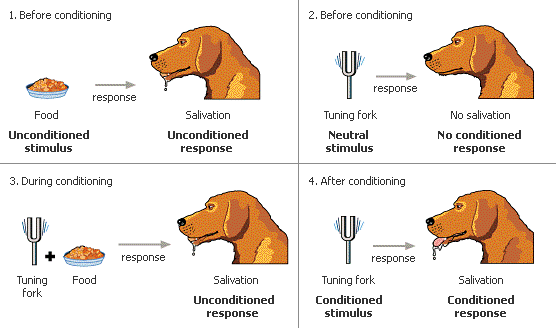
Believed that behavior should only be studied through directly observable actions, arguing that an external trigger (stimulus) instantly causes a reaction (behavior) without any need to study the mind as a separate step in between.
Classic Behaviorist rejected “thinking” and “the unconscious mind”with John B. Watson arguing that thoughts are just tiny physical movements in the tongue and vocal cords, while B.F. Skinner viewed mental ideas as simple internal copies of external stimuli.
This approach became hugely popular for a time because it grounded psychology in hard, measurable science and explained human actions much more effectively than previous schools of thought
Now modern behaviorist aren’t as strict and now study internal thoughts and emotions
The Cognitive Revolution
Rejected Behaviorism
Overthrew strict behaviorism by proving we can scientifically test "unobservable" mental processes like memory and attention.
Sought to study unobservable processes of the mind
Uses the Computer Metaphor
Treats the brain as hardware and the mind as software.
Neuroscience allowed scientists to actively "read" data and track physical information processing inside a living brain.
We are currently still in the Cognitive Revolution
What is the relationship between Behaviorism and The Cognitive Revolution?
The Cognitive Revolution was a direct backlash against Behaviorism, breaking open the "black box" of the mind by arguing that psychology cannot explain human actions without scientifically studying the internal mental processes—like memory and attention—that happen between a stimulus and a response.
This movement overthrew the behaviorist view of humans as simple, reactive machines and replaced it with the computer metaphor, framing the brain as hardware and the mind as software to prove that internal thought processes could be predicted, modeled, and tested
What is the Computer Metaphor?
The computer metaphor views the brain as biological hardware and the mind as the software, allowing scientists to study human thoughts not as mysteries, but as measurable computer programs
It explains human cognition through a data loop where senses act as input (keyboard), short-term and long-term memory act as storage (RAM and hard drive), and thoughts act as processing algorithms that generate behavior as the output (screen display)
What are Neuronal Underpinnings? And how does it relate to the “Under the Hood” concpet?
Modern neuroimaging technology measures brain activity both during active cognitive tasks and while at rest, allowing scientists to "peek under the hood" of human consciousness.
Neuronal underpinning is simply the name of what lies underneath cognitive processes, and going ‘Under the hood’ allows us to see these processes
Going ‘Under the hood’ has practically eliminated Behaviorism, and it allows us to use brain imaging approaches to directly measure mental processes
Ex) High-resolution brain scanning can decode and predict a person's decisions up to 4 seconds before they are even consciously aware of making a choice
Ex) Advanced neuro-AI models can now decode activation patterns in the visual cortex to accurately reconstruct and reproduce the exact images or shapes a person is looking at in real time
This biological data helps researchers localize specific mental functions to precise brain regions and scientifically test whether different cognitive processes operate as independent, discrete systems.
What are the Modern Schools of Thought?
Information-Processing
Connectionist
Ecological
Evolutionary Psychology
Information-Processing vs Connectionist
Information-Processing:
Views cognition as as a rigid, step-by-step hierarchical flow where data moves through fixed, centralized stages (like input → storage → output)
Treats the mind like a traditional digital computer running a linear program line-by-line
Connectionist:
Views cognition as a decentralized network of weighted connections where information is processed across thousands of interconnected nodes all at the same time.
Treats the mind like a biological neural network modeled after the actual physical architecture of the human brain.
Choose any topic and draw a Information-Processing and Connectionist digram related to that topic
Topic: Identifying a Zombie running towards you in a video game
Information Processing (hierarchal flow/serial processing)
[ STEP 1: INPUT ] ──► Your eyes register a shape with green skin and torn clothes.
│
▼
[ STEP 2: FEATURE ANALYSIS ] ──► Brain checks details: Green skin? Yes. Groaning? Yes.
│
▼
[ STEP 3: MEMORY SEARCH ] ──► Accesses your long-term memory drive to find a match.
│
▼
[ STEP 4: DECISION ] ──► Match found: These combined traits equal a "Zombie."
│
▼
[ STEP 5: OUTPUT ] ──► Your thumb slams the controller button to shoot.
Connectionist (Network of weighted connections/parallel processing)
[INPUT NODES ] [ HIDDEN LAYER ] [ OUTPUT NODES ]
(Raw Features) (Pattern Strengths) (Final Perception)
(Green Skin) ══► (Rotting Flesh Pattern) ══► [ ZOMBIE NODE]
║ (99% Fired/Match!)
║ ▲
(Groaning) ═══════════════════════════════╝
│
───► (Human with Flu Pattern) ───► [SICK HUMAN NODE]
(1% Fired/No Match)
The double lines (══) represent heavily "weighted" connections built from playing horror games. Because green skin and groaning almost always mean a monster, that path fires instantly and automatically.
*Ecological Approach
All cognition occurs in a specific environmental context, meaning that perception is direct, immediate, and inseparable from action because our brains instantly recognize what the environment "affords" us to do without needing a computer-like step of decoding raw data first
Evolutionary Psychology
Argues that human cognitive processes did not develop randomly, but instead evolved as functional adaptations to solve specific survival and reproduction problems faced by our ancestors
It is important to be weary of evolutionary arguments, as it is easy to fall into the trap of creating unprovable "just-so stories" that guess why a behavior evolved without hard, scientific evidence to back it up