Histotechnology
 Call Kai
 Learn
Learn Practice Test
 Spaced Repetition
 Match
Match Flashcards
 Knowt Play
1/264

There's no tags or description
Looks like no tags are added yet.
Name | Mastery | Learn | Test | Matching | Spaced | Call with Kai | Chat |
|---|
No analytics yet
Send a link to your students to track their progress
265 Terms
Select the procedure suitable for demonstrating secretory granules in a carcinoid tumor:
A. Wilder reticulum
B. PAS-aniline blue
C. Snook
D. Sevier-Munger
D. Sevier-Munger
The Sevier-Munger technique is an excellent argyrophil procedure for demonstrating carcinoid tumors. It is similar to, but shorter than, the Grimelius.
In Bodian's method for nerve fibers and neurofibrils, Protargol impregnates both neurofribrils and connective tissue. Subsequently, connective tissue is rendered colorless by replacement of silver with this metal:
A. copper
B. gold
C. lead
D. tin
A. copper
In Bodian's method, sections are incubated in a solution of Protargol containing metallic copper. The copper replaces silver that has been deposited in connective tissue, resulting in silver impregnation of only nerve fibers and neurofibrils.
What is the thickness of most standard glass slides?
A. 0.5 mm
B. 1.5 mm
C. 3.0 mm
D. None of the above
B. 1.5 mm
Which of the following probe types are used to detect a translocation?
A. Centromere probes
B. Break-apart probes
C. Locus-specific probes
B. Break-apart probes
Break-apart probes target two areas of a specific gene sequence in order to detect a translocation. When a break in the gene sequence occurs, the green and red signal will NOT be close together anymore and will thus appear as separate green and red signals
A centromere probe targets the centromeric region of the particular chromosome. These probes allow us to enumerate the number of centromeres and thus chromosomes of a particular kind.
A locus-specific probe targets a specific gene sequence of interest. These probes can be used to determine whether a gene is amplified, deleted, or present in a normal copy number.
ONLY monoclonal antibodies can be used for immunohistochemical (IHC) techniques for the demonstration of infectious diseases.
A. True
B. False
B. False
The histology section of the laboratory had 12,652 labor hours for the year. How many FTEs (full-time equivalents) were used by this section?
A. 4.4000000000000004
B. 5.70
C. 6.10
D. 9.1999999999999993
B. 5.70
To calculate FTEs, or full-time equivalents, divide the total number of hours of all the employees (total paid hours, productive or worked hours, and nonproductive or benefit hours) by 2080, the number of hours a full-time person works in one (1) year. This is calculated by multiplying 40 hrs/week X 52 weeks/yr. = 2080 15. [12,652 total hrs. / 2,080 hr/person = 6.1 FTEs]
Fluorescence in situ hybridization (FISH) can be used to qualify patients for chemotherapy.
A. True
B. False
A. True
Orth solution is prepared with which of the following constituents?
A. mercuric chloride, potassium dichromate, and sodium sulfate
B. potassium dichromate, sodium sulfate, and 37-40% formaldehyde
C. potassium dichromate, sodium sulfate, and absolute alcohol
D.mercuric chloride, sodium sulfate, and 37-40% formaldehyde
B. potassium dichromate, sodium sulfate, and 37-40% formaldehyde
Helicobacter pylori is a causative bacteria linked to duodenal ulcers, MALT lymphomas, and stomach cancers.
A. True
B. False
A. True
Low profile blades (or feathers) require more frequent sharpening, unlike the high profile blades.
A. True
B. False
B. False
Low profile and high profile "blades" are disposable and do not require sharpening.
Which dye groupe would normally be chosen to stain Nissl bodies:
A. quinoneimine
B. Azo
C. Xanthene
D. anthraquinone
A. quinoneimine
Nissl bodies are sharply stained with basic aniline dyes such as thionin, azure A and cresyl violet, that are in the quinoneimine group.
Select the enzyme that is frequently used as a marker for mitochondria.
A. Phosphorylases
B. Diaphorases
C. Oxidoreductases
D. Esterases
B. Diaphorases
To prevent moth-holes in tissue, coarse-facing (or trimming) paraffin blocks is best done at what thickness?
A. 20-30 microns (µ)
B. 40-50 µ
C. 50-60 µ
D. Never above 10 µ
A. 20-30 microns (µ)
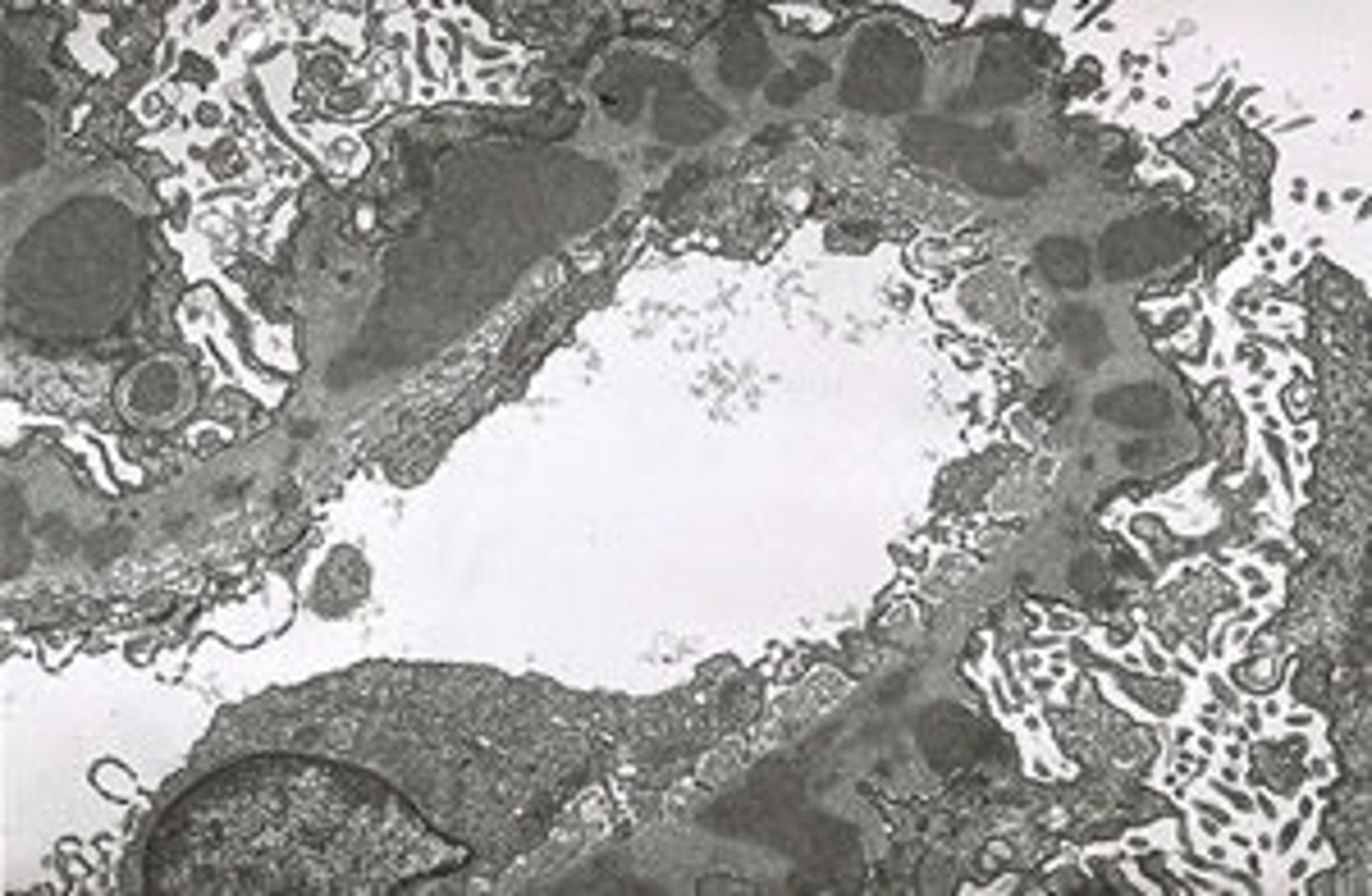
The irregular, electron dense structures seen in the capillary loop of this renal biopsy are:
A. lysosomes
B. basement membranes
C. mitochondria
D. immune complexes
D. immune complexes
The electron micrograph shows electron-dense subepithelial immune complex deposits, they appear within and on the outer aspect of the glomerular basement membrane. Lysosomes and mitochondria do not accumulate within the basement membrane.
Tissue sections were placed in a container of saline, and fixed in the microwave oven. After routine processing, the H&E stained sections reveal small, dense blue nuclei. This probably could be corrected in the future by:
A. diluting the hematoxylin for any microwaved tissue
B. monitoring the temperature of the saline more closely
C. allowing the tissue to remain in the saline for 5 minutes after microwaving
D. placing the tissue in 10% neutral buffered formalin for microwaving
B. monitoring the temperature of the saline more closely
When using the microwave oven for fixation, the temperature must be carefully controlled or irreversible morphologic damage will result. Overheating causes tissue antigenicity and enzymatic activity to be lost. Allowing tissue to remain in the overheated saline longer would only make the problem worse.
The cytotechnologist informs you that there is no staining color present in the slides for the Papanicolaou run. The most likely cause is:
A. exhausted stains
B. insufficient staining time
C. prolonged time in clearing reagent
D. incomplete removal of fixative prior to staining
A. exhausted stains
If color is absent in a run, the stains are exhaused and need changing.
Which of the following fixatives requires washing with water before processing?
A. Carnoy fluid
B. Bouin solution
C. 10% neutral buffered formalin
D. Zenker solution
D. Zenker solution
Tissue must be washed in running water after fixation in Zenker solution to remove the excess fixative. If Zenker-fixed tissue is immediately transferred to the alcoholic dehydrating solutions, a residual chrome pigment may be formed. If formed, this pigment is very difficult to remove from the microscopic sections. Tissues fixed in Bouin solution are washed with 50% alcohol.
When performing the Bodian method for neurofibrils, prolonged treatment in this solution may interfere with primary staining:
A. sodium thiosulfate
B. oxalic acid
C. gold chlroide
D. alcohol
B. oxalic acid
The Bodian method involves impregnation of tissues with silver proteinate compound which is then reduced to visible metallic silver by hydroquinone. Following toning in gold chloride, staining intensity can be further increased by treatment with oxalic acid. Treatment in oxalic acid, however, should not be prolonged or it will interfere with the silver proteinate reaction.
Several H&E slides were viewed under the microscope. The tissue was markedly dark blue/ purple, including some of the connective tissue. Consider the scenario and the probable cause(s) for the results.
Pick more than one:
A. Tissue was over-exposed to Bouin or Zenker fixative
B. Tissue was stained in hematoxylin for too long
C. Tissue was not differentiated properly in acid alcohol solution
D. Tissue was not placed in bluing solution
B. Tissue was stained in hematoxylin for too long
C. Tissue was not differentiated properly in acid alcohol solution
What kind of objective lens is adjusted for two colors of light?
A. Parfocal
B. Bifocal
C. Achromatic
D. Apochromatic
C. Achromatic
An achromatic objective lens is adjusted for two colors of light.
A parfocal lens is a lens that stays in focus when magnification/focal length is changed.
A bifocal lens is a lens which has two parts with different focal lengths.
An apochromatic lens corrects for spherical aberration at two wavelengths or colors and for chromatic aberration at three wavelength.
The solution in the trough when sectioning epoxy resins is usually:
A. dioxane
B. EDTA
C. water
D. xylene
C. water
Which of the following is the preferred fixative solution for use in the preservation of lymphatic and hematopoietic tissues?
A. Osmium tetroxide
B. Methyl alcohol
C. Potassium dichromate
D. B-5
D. B-5
Of the fixatives listed, only B-5 has found wide acceptance for preservation of hematopoietic and lympho-reticular tissue, due to its ability to demonstrate beautiful nuclear detail.
For electron microscopy (EM), tissue sections that are cut on the ultramicrotome are picked up on mesh copper grids for metal staining.
A. True
B. False
A. True
On what type of specimen can the "lines of Zahn" be seen grossly?
A. aortic aneurysm
B. long bones
C. peripheral nerve
D. skeletal muscle
A. aortic aneurysm
The lines of Zahn are created by alternating deposits of platelets, fibrin and red cells giving the cut surface a laminated appearance. These thrombi are formed in the heart of the aorta. When found, a laminated cut surface should be described because this implies thrombosis at a site of blood flow.
The descriptive term "demarcated used in a gross description means:
A. defined edges or boundaries
B. amorphous
C. villous
D. serpentine
A. defined edges or boundaries
A colonic specimen is received that includes ileum, cecum, ascending colon, and transverse colon. The proximal margin will be from which segment?
A. transverse colon
B. cecum
C. ileum
D. ascending colon
C. ileum
A method that will stain hemoglobin emeral green is the:
A. Gomori
B. Dunn-Thompson
C. Okajima
D. Fontana-Masson
B. Dunn-Thompson
Because of the selectivity of collagen fibers for a specific hydrogen ion concentration with acid aniline dye-picric acid mixtures, demonstrating them necessitates:
A. low pH staining solution
B. high pH staining solution
C. ethanol as the dye solvent
D. oxalic acid in the dye solution
A. low pH staining solution
The most likely cause of inadequate staining using the wrights preparation is:
A. improper pH of the solution
B. that smears or sections are too thin
C. that the staining solution is not ripened
D. that staining was done at room temperature
A. improper pH of the solution
The fixative agent chromium trioxide is categorized as what type of fixative?
A. Additive
B. Non-coagulating
C. Alcoholic
D. Aqueous
A. Additive
This specific esterase enzyme staining method is unique in that it can be performed on paraffin embedded tissue.
A. NADH Diaphorase Stain
B. Succinic Dehydrogenase Stain
C. Phosphorylase Stain
D. Napthol AS-D Chloroacetate Esterase Stain
D. Napthol AS-D Chloroacetate Esterase Stain
A gram stain has been done on a reactive, inflammatory lymph node, and the background structures are staining intense red, making identification of gram-negative organisms very difficult. The most likely cause of this problem is:
A. overstaining with basic fuchsin
B. overstaining with crystal violet
C. insufficient differentiation with picric acid-acetone
D. insufficient differentiation with acetone and alcohol
C. insufficient differentiation with picric acid-acetone
Argentaffin cells are also known as:
AKupffer cells
B. Grimelius cells
C. Paneth cells
D. Kulchitsky cells
D. Kulchitsky cells
The descriptive term "pus" means:
A. necrosis
B. atrophy
C. inflammation
D. fibrin
C. inflammation
Of the following, which is LEAST likely to cause a reproductive hazard in humans?
A. alcohol
B. chemicals
C. fungus
D. radiation
C. fungus
Select the fixative that is suitable for either the Heidenhain aniline blue (azan) or Mallory aniline blue stains:
A. Orth
B. 10% NBF
C. Zenker
D. absolute ethanol
C. Zenker
When monitoring the air flow of a chemical hood, it is found that it is below recommended levels. The hood appears to be working correctly, as is the exterior ventilation duct. Moving the hood to which of the following locations might improve the direction of the air flow?
A. by the door to the hall
B. close to the laboratory's ventilation wall duct
C. into a corner
D. near a window that opens
C. into a corner
The function of potassium permanganate in the phospotungstic acid hematoxylin (PTAH) method is thought to be that of a:
A. sensitizer
B. mordant
C. differentiator
D. dye-trapping agent
D. dye-trapping agent
What condition is necessary for the secondary antibody in an indirect method?
A. It must have trypsin in the diluent
B. It must have hydrogen peroxide in the diluent
C. It must be raised against the IgG of a different species in which the primary antibody has been raised
D. It must be raised against the IgG of the same species the primary antibody has been raised
D. It must be raised against the IgG of the same species the primary antibody has been raised
One advantage of using alcohol-based eosins over aqueous eosins is that they will stain slower and produce a wider range of shades of reddish-orange.
A. True
B. False
A. True
All of the following are drawbacks of the microwave procedure for PAS (periodic acid Schiff) EXCEPT for:
A. Non-specific staining of tissue
B. Schiff solution should not be re-used after microwaving
C. Very slow color development
D. Toxic vapors released when Schiff solution is heated
C. Very slow color development
According to CLIA, tissue grossing is defined as high complexity testing. What is the minimum degree that CLIA requires for an individual to perform tissue grossing in the anatomic pathology laboratory?
A. Bachelor's degree
B. Associate's degree
C. Master's degree
D. High school diploma
B. Associate's degree
Lymph node is stained with a silver method for reticulin and counterstained in nuclear fast red. After dehydration, there is a film over the entire slide that remains through clearing and coverslipping. The most likely cause is:
A. silver was contaminated by metal forceps
B. nuclear fast red was too concentrated
C. unreacted silver remained on the slide
D. failure to rinse with water after counterstaining
D. failure to rinse with water after counterstaining
The Helly solution to be used for fixation is dark brown and cloudy when removed from the shelf. This indicates that:
A. the solution pH has changed
B. too much mercuric chloride was added to the solution
C. formaldehyde was added too early
D. acetic acid must be added to clarify the solution
C. formaldehyde was added too early
Dyes that stain acid mucosubstances a different color from that of the dye solution are called:
A. metachromatic
B. orthochromatic
C. amphoteric
D. empirical
A. metachromatic
The Ralph and Lepehne methods for demonstrating hemoglobin are based on the presence of this substance in red cells:
A. phospholipid
B. iron
C. peroxidase
D. porphyrins
C. peroxidase
Prior to staining bone marrow smears with the Giemsa stain, what is used to fix cells on the glass slide?
A. Fixation in methanol for 1-10 minutes
B. Fixation in Carnoy's for 1-10 minutes
C. Fixation in Orth's solution for 1-10 minutes
D. Fixation in glutaraldehyde for 1-10 minutes
A. Fixation in methanol for 1-10 minutes
Since argentaffin and argyrophil granules are found in similar tissues, two stains (ie. Fontana Masson and Grimelius) must be done on same tissue to differentiate between carcinoid tumors.
A. True
B. False
A. True
Denaturation of the probe is required for the probe to bind to the DNA in the tissue, but you do NOT have to denature the DNA in the tissue.
A. True
B. False
B. False
A virus is the ONLY infectious entity that can be detected by immunohistochemical (IHC) technique.
A. True
B. False
B. False
Which of the following hematoxylin stains would be impractical for a high-volume clinical histology laboratory where fast turnaround times are essential?
A. Gill's
B. Heidenhain's
C. Mayer's
D. Harris's
B. Heidenhain's
The proper speed of frozen sectioning:
A. is fast and even
B. is similar to the speed for paraffin sectioning
C. is slow and even
D. varies with the tissue and tempature
D. varies with the tissue and tempature
Potassium dichromate at a pH above 3.75 is considered to be what category of fixative agent?
A. Non-coagulating
B. Aqueous
C. Coagulating
D. Dehydrating
A. Non-coagulating
Potassium dichromate is considered a non-coagulant fixative when used at a pH above 3.75. Below a pH of 3.75, it is considered coagulating.
Which of the following is MOST responsible for the pattern of airflow in a chemical hood, and the elimination of dead zones within the working area of a hood?
A. baffles
B. filters
C. foils
D. sash
A. baffles
All of the following fixatives are preferred for electron microscopy EXCEPT:
A. Bouins solution
B. Osmium tetroxide
C. Glutaraldehyde
D. Millonig formalin
A. Bouins solution
In a - 15°C cryostat, 30mm sections of fixed brain are fragmenting at the knife edge. This problem can be prevented by:
A. lowering the temperature of the cryostat to -30°C
B. raising the temperature of the cryostat to -5°C
C. soaking the brain in a sucrose solution before freezing
D. using the anti-roll plate
B. raising the temperature of the cryostat to -5°C
If tissue is fragmenting, a colder temp, would only further fracture the tissue
What is the result of leaving tissue in the cryostat unprotected for too long?
A. This does not produce an issue
B. The tissue will have varied thickness of sections
C. Severe dehydration
D. The tissue will produce compressed, wrinkled, or jammed sections
C. Severe dehydration
Bloody tissues are most prone to the following microtomy artifacts EXCEPT for which one?
A. Parched earth
B. Chatter
C. Moth-eaten holes
D. Bubbles
D. Bubbles
Which statement best describes the function of chief cells located in the stomach?
A. Secrete digestive enzymes
B. Secrete alkaline mucous to protect the stomach from acid
C. Secrete lubricating mucous
D. Secrete replenishing cells as they are sloughed off the mucosal surface
A. Secrete digestive enzymes
What percentage of the lymph nodes found on a colon cancer dissection should be submitted for histology?
A. 50%
B. 75%
C. 90%
D. 100%
D. 100%
Other than peroxidase, what is the MOST frequently used enzyme for labeling antibodies?
A. Acid phosphatase
B. Alkaline phosphatase
C. Glucose oxidase
D. Trypsin
B. Alkaline phosphatase
A positive spirochete control showed pale gray organisms after staining. Which of the following may be the cause of these problematic results?
A. Silver solution was not adequately heated
B. Tissue did not spend enough time in impregnation solution
C. Tissue did not spend enough time in developer/reducer
D. All of the above
D. All of the above
Hard or bony tissue should be embedded:
A. in cross-section
B. on edge
C. on end
D. on an angle
D. on an angle
The dye used in the preparation of Schiff reagent is:
A. carmine
B. basic fuchsin
C. alcian blue
D. crystal violet
B. basic fuchsin
A mark has been made on the front of the hood, off to one side. This mark indicates:
A. level at which to place the sash
B. limit to height for storing chemicals inside the hood
C. location where it is safe to stick your head inside the hood
D. place to test the airflow velocity of the hood
A. level at which to place the sash
When staining for calcium with alizarin red S, tissue sections are deparaffinized and taken to:
A. distilled water
B. 25% alcohol
C. 95% alcohol
D. 1% acetic acid
C. 95% alcohol
Lipofuchsin, a fine yellow-brown granular pigment, is commonly seen in liver, heart muscle, ganglion cells and:
A. spleen
B. lungs
C. stomach
D. adrenals
D. adrenals
Formalin penetrates tissue slowly, but fixes tissues rapidly.
A. True
B. False
B. False
Formalin penetrates and adds very quickly to tissue, but fixes very slowly, as it takes a long time to cross-link tissue proteins. Tissue that is poorly fixed in formaldehyde can be denatured by alcohol and heat and lead to artifact formation.
The substance stained red in this image is found in which of the following layers?
A. mucosa
B. submucosa
C. muscularis externa
D. serosa
B. submucosa
A liquid has a closed cup flash point below 100o F (38o C.). This makes the liquid:
A. combustible
B. explosive
C. flammable
D. corrosive
C. flammable
Combustible liquids have a flash point at or above 100o F. An explosive chemical is one that causes a sudden, almost instantaneous release of pressure, gas and heat when subjected to sudden shock, pressure or high temperature.
Which of the following is an action of acetic acid?
A. shrinks tissue
B. renders nuclei acidophilic
C. forms salt linkages between protein chains
D. coagulates nucleoproteins
D. coagulates nucleoproteins
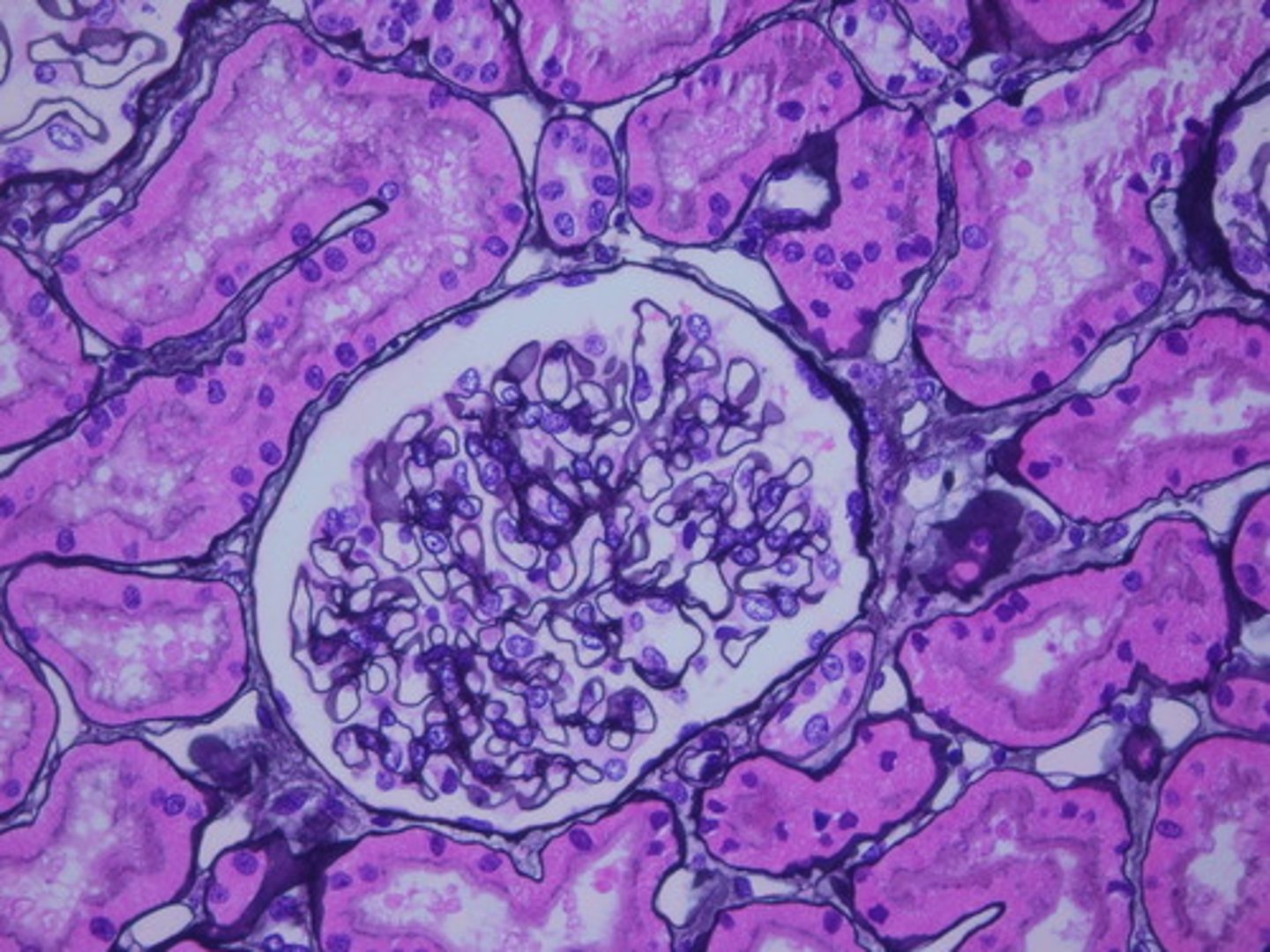
The stain shown in this image is most likely the:
A. Jones methenamine silver
B. Steiner and Steiner
C. Bielschowsky
D. von Kossa
A. Jones methenamine silver
When sucrose is used to treat tissue for enzyme histochemical studies:
A. tissue cannot remain in the sucrose solution for long periods of time
B. tissue should be treated with sucrose first and then fixed
C. the solution should contain 30% sucrose and 1% gum acacia
D. it makes frozen sectioning impossible
C. the solution should contain 30% sucrose and 1% gum acacia
Nissl substance can be demonstrated by staining parallel sections before and after extraction using:
A. diastase
B. ribonuclease
C. hyaluronidase
D. deoxyribonuclease
B. ribonuclease
The nerve process carrying the nerve impulses toward the neuron (information input) is called the:
A. Axon
B. Neuroglia
C. Synapse
D. Dendrite
D. Dendrite
Transferring the resin embedded tissue sections from a glass or diamond knife should be performed using any of the following except:
A. forceps
B. glass slide
C. paint brush
D. wire loop
B. glass slide
Acidic mucosubstances can be demonstrated by the Prussian blue reaction following treatment of the sections with:
A. diastase
B. hyaluronidase
C. dimedone
D. colloidal iron
D. colloidal iron
Which of the following are common insoluble substrates used with an immunohistochemical (IHC) alkaline phosphatase staining method? (Choose all that apply.)
A. Fast blue BB
B. Fast red TR
C. New fuchsin (red)
D. Naphthol-AS-phosphate and fast red
C. New fuchsin (red)
D. Naphthol-AS-phosphate and fast red
What is the preferred temperature to dry paraffin sections on slides?
A. 10° C above the melting point
B. 10° C below the melting point
C. At the melting point
D. There is no preferred temperature
C. At the melting point
For cryostats that are used daily, it is recommended that decontamination occurs at this interval.
A. Daily
B. Weekly
C. Bi-weekly
D. Monthly
B. Daily
All of the following are characteristics of glutaraldehyde EXCEPT:
A. Hardens tissue
B. Penetrates slowly but fixes tissue rapidly
C. Penetrates rapidly but fixes tissue slowly
D. False positive Schiff's reaction
C. Penetrates rapidly but fixes tissue slowly
The cutting angle is between the block face and the upper facet of the knife.
A. True
B. False
A. True
B-5 fixative is prepared by combining mercuric chloride with which of the following constituents?
A. potassium dichromate and glacial acetic acid
B. sodium acetate and glacial acetic acid
C. sodium acetate and 37-40% formaldehyde
D. sodium acetate and absolute alcohol
C. sodium acetate and 37-40% formaldehyde
Excessive amounts of ferric iron present in spleen and bone marrow is indicative of hemochromatosis.
A. True
B. False
A. True
Adenovirus (ADV) "smudge cells" can be seen in histologic and cytologic preparations.
A. True
B. False
A. True
The face velocity of the air current through the front of a chemical fume hood should be approximately how many linear feet per minute?
A. 50
B. 75
C. 100
D. 125
C. 100
The diagnosis of Alzheimer's disease is based on the presence of neuorofibrillary tangle and neuritic plaques in the:
A. spinal cord
B. neocortex
C. medulla oblongata
D. cerebellum
B. neocortex
All of the following are characteristics of using zinc salts in fixatives EXCEPT:
A. improves antigenicity and nuclear detail
B. good replacement for mercury in fixatives
C. preserves enzyme activity
D. Good for long-term storage of wet tissue
C. preserves enzyme activity
Aminoalkylsilane is a slide adhesive preferred for in situ hybridization (ISH) studies.
A. True
B. False
A. True
How might the fixative action of zinc tris be classified?
A. Dehydrant
B. Preservative
C. Chelator
D. Solvent
B. Preservative
A positive control tissue for fungi was stained with Grocott's methenamine silver method and the results showed non-fungal tissue elements stained deep black as well as the fungi. What caused the non-specific staining in tissue?
A. Too much time in silver solution
B. Temperature of silver solution too high
C. Chromic acid too weak or old
D. All of the above
D. All of the above
A leiomyoma is a benign tumor commonly found in the:
A. bone
B. uterus
C. liver
D. spleen
B. uterus
Plates used to support abrasive powders and lubricants for the sharpening of knives may be composed of all of the following except:
A. aluminum
B. copper
C. glass
D. iron
D. iron
Cryostat sections of FIXED tissue tend to float off the slides during staining. This problem can be prevented best by:
A. coating the slide with a protein mixture
B. heating the slide over a Bunsen burner
C. picking the sections up with a room temperature slide
D. sectioning at a warmer cryostat temperature
A. coating the slide with a protein mixture
In which of the following may celloidin blocks be stored?
A. cardboard box
B. chloroform
C. ether
D. mineral oil
D. mineral oil
A protozoan that causes neurologic disease in patients with acquired immunodeficiency syndrome (AIDS) is:
A. Cryptosporidium muris
B. Leishmania donovani
C. Giardia lamblia
D. Toxoplasma gondii
D. Toxoplasma gondii
The formaldehyde in Helly fluid:
A. reduces the chromate salt present in the solution
B. coagulates and denatures the tissue proteins
C. prevents turbidity and precipitate formation
D. decreases the rate of penetration and fixation
A. reduces the chromate salt present in the solution
A laboratory employee culturing M. tuberculosis needs to be working at which Biosafety Level?
A. Level 1
B. Level 2
C. Level 3
D. Level 4
C. Level 3
After cutting tissue suspected of being infected with CJD, the hard surfaces of the tables should be decontaminated with:
A. 1% potassium permanganate
B. 10% formalin
C. 5% sodium hydroxide
D. undiluted bleach
D. undiluted bleach
Which of the following is the preferred method for removing formalin pigment in tissue?
A. Alcohol with ammonium hydroxide
B. Iodine followed by sodium thiosulfate
C. 95% alcohol
D. Acetic acid alcohol
A. Alcohol with ammonium hydroxide