Orphism, Futurism, Suprematism & Constructivism
 Studied by 0 people
 Call with Kai
 Learn
Learn Practice Test
 Spaced Repetition
 Match
Match Flashcards
 Knowt Play
1/9

There's no tags or description
Looks like no tags are added yet.
Name | Mastery | Learn | Test | Matching | Spaced | Call with Kai |
|---|
No study sessions yet.
10 Terms
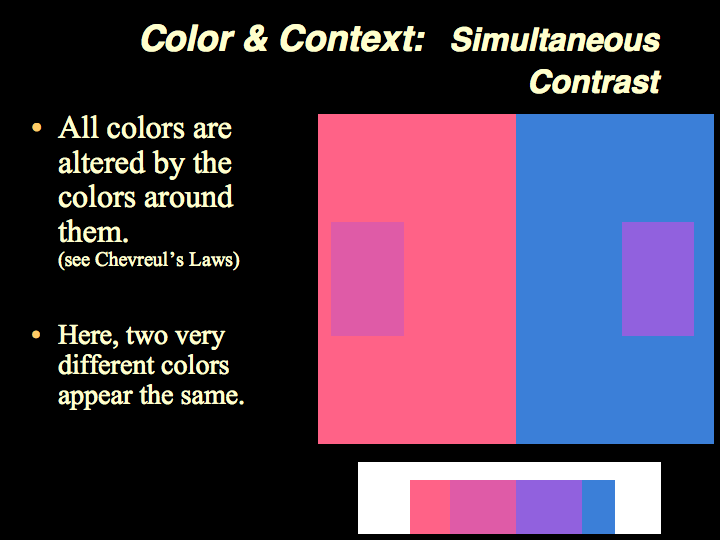
Orphism
an early 20th-century abstract movement that developed from Cubism, focusing on pure color, rhythm, and light through simultaneous contrast.
Developed from Cubism, but color replaces structure
Inspired by Chevreul’s color theory (simultaneous contrast)
Focus on rhythm, light, movement, and sensation
Bridge between Cubism and abstraction
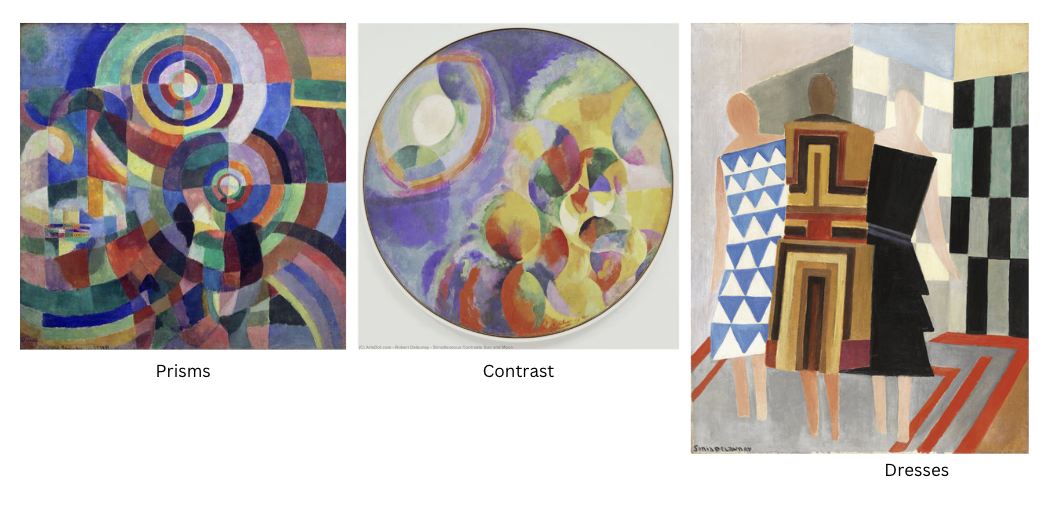
Orphism Pieces
Sonia Delaunay – Electric Prisms (1914)
Abstract composition of colored discs
Vibrating contrasts of color
Robert Delaunay – Simultaneous Contrasts: Sun and Moon (1912)
Optical vibration
No traditional depth
Color creates motion
Sonia Delaunay – Simultaneous Dresses (1925)
Abstract painting translated into fashion
Art + body + movement
Modern lifestyle design
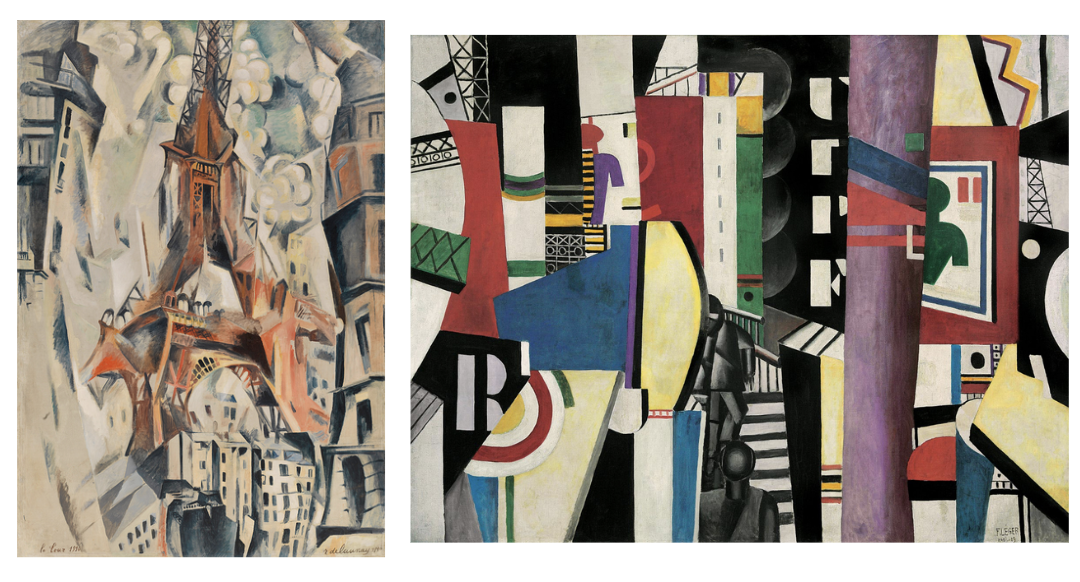
Painting the Modern City
Rapid industrialization and urban growth transformed European cities.
Artists sought new visual languages to represent speed, noise, fragmentation, and energy.
Robert Delaunay – The Eiffel Tower (1911)
Icon of modern Paris
Fragmented structure
Color and movement
Fernand Léger – The City (1919)
Machine-age aesthetic
Bold geometry
Fragmented urban signs
Futurism
an early 20th-century avant-garde movement that celebrated speed, technology, machines, and modern life, rejecting the past and traditional art.
Originated in Italy
Celebration of speed, machines, violence, modernity
Rejection of the past
Influenced by Cubism but more aggressive
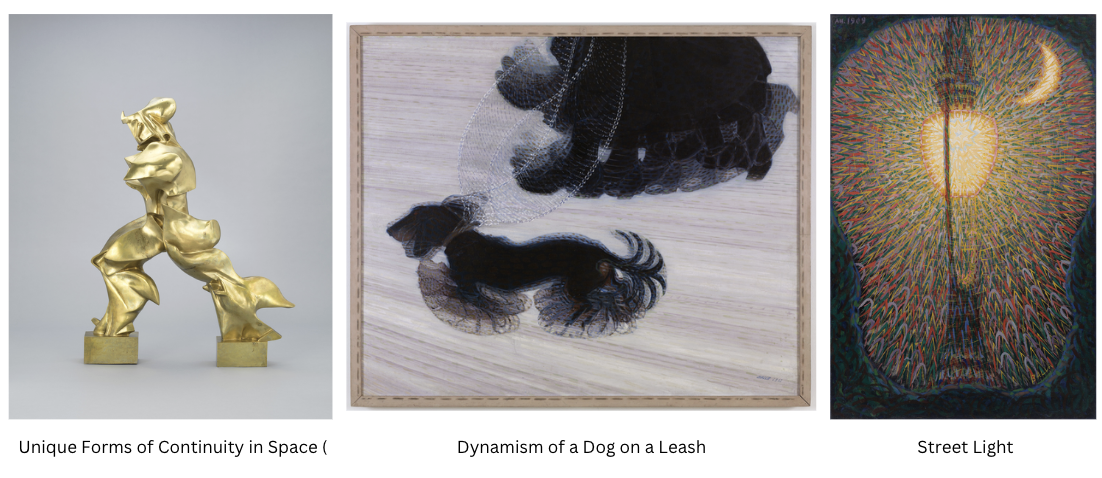
Futurism Pieces
Umberto Boccioni – Unique Forms of Continuity in Space (1913)
Icon of Futurism (often the single image used to represent the movement)
Translates Futurist ideas into sculpture
Human body becomes pure motion and speed
Giacomo Balla – Dynamism of a Dog on a Leash (1912)
Clearest visual explanation of movement
Uses repetition like photography and chronophotography
Giacomo Balla – Street Light (1910–11)
Technology replaces nature (electric light vs moon)
Symbol of modern city and progress
Radiating energy = Futurist visual language
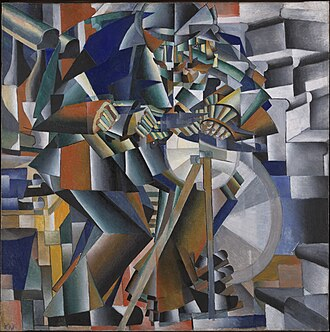
Cubo-Futurism
Kazimir Malevich – The Knife Grinder (1912–13)
Cubist fragmentation + Futurist motion
Machine-like human
Repetitive forms
Transition toward abstraction
Suprematism
an early 20th-century abstract movement that aimed to express pure feeling through simple geometric forms and non-representational art. (Russia)
Complete abstraction
Art free from representation
Focus on pure feeling
Simple geometric forms
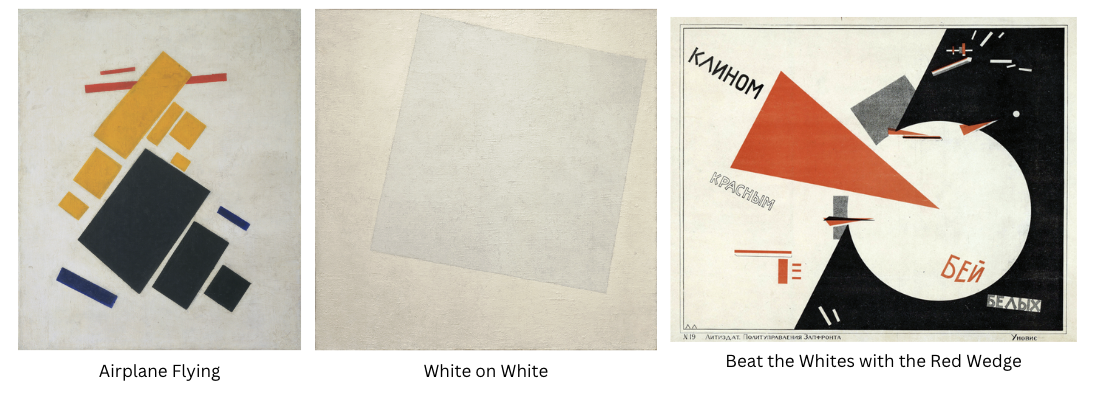
Suprematism Pieces
Malevich – Airplane Flying: Suprematist Composition (1915)
No reference to reality
Sense of weightlessness
Malevich – White on White (1918)
Extreme abstraction
Art reduced to essence
Radical break from representation
El Lissitzky – Beat the Whites with the Red Wedge (1919–20)
Abstract propaganda poster
Suprematist geometry
Political meaning
Constructivism
an early 20th-century movement that rejected “art for art’s sake” in favor of functional, industrial design serving social and political purposes. (Russia)
Art serves society
Linked to Russian Revolution, propaganda
Rejection of “art for art’s sake”
Use of industrial materials
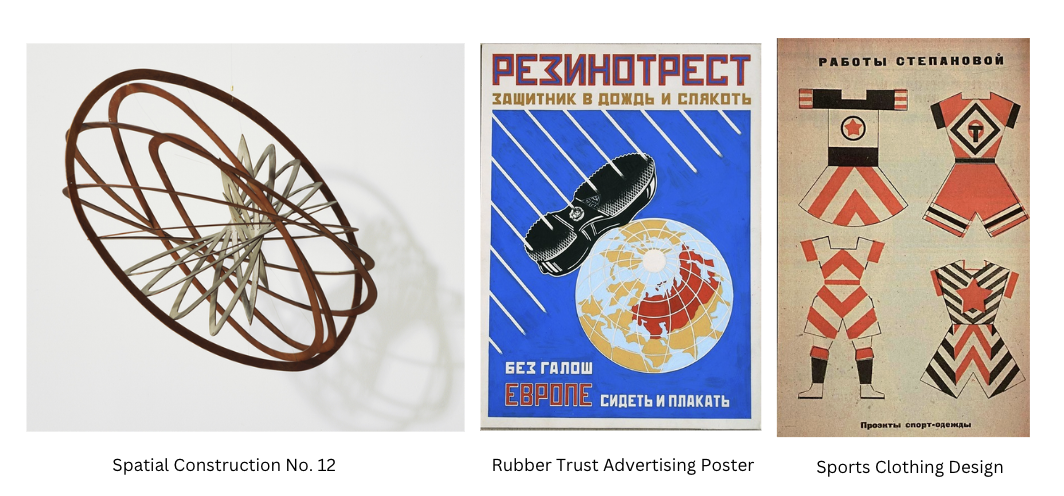
Constructivism Pieces
Aleksandr Rodchenko – Spatial Construction No. 12
Purest statement of Constructivist principles
Hanging sculpture, Industrial materials
Real space, not illusion
Aleksandr Rodchenko – Rubber Trust Advertising Poster (1923)
Constructivism applied to graphic design & propaganda
Clear link between art, industry, and politics
Photomontage + bold typography
Varvara Stepanova – Sports Clothing Designs (1923)
Constructivism moving into everyday life
Functional, mass-produced design
Strong socialist ideology
Art as useful, not decorative