Population Ecology - Chapter 36
 View linked note
 Call Kai
 Learn
Learn Practice Test
 Spaced Repetition
 Match
Match Flashcards
 Knowt Play
1/29

Earn XP
Description and Tags
Vocabulary flashcards covering the key concepts of population ecology, growth models, survivorship, and human demographics based on Chapter 36 of Campbell Biology.
Name | Mastery | Learn | Test | Matching | Spaced | Call with Kai | Chat |
|---|
No analytics yet
Send a link to your students to track their progress
30 Terms
Population
A group of organisms of a single species that occupies the same general area and may breed to form viable offspring.
Population ecology
The study of how and why populations change, focusing on changes in population size and the factors that regulate populations over time.
Population dynamics
The study of the interactions between biotic and abiotic factors that cause variations in population sizes.
Population density
The number of individuals of a species per unit area or volume.
Clumped dispersion pattern
A distribution where resources are often unequally distributed and individuals are grouped in patches around shared common resources; it is the most common distribution pattern.
Uniform dispersion pattern
A distribution where individuals are equally spaced in the environment and are most likely interacting.
Random dispersion pattern
A distribution where individuals in a population are spaced in an unpredictable way.
Life tables
A tracking of survivorship, which is the chance of an individual in a given population surviving to various ages.
Survivorship curve
A plot of survivorship as the proportion of individuals from an initial population that are alive at each age.
Type I survivorship curve
Characterized by long life and significant parental involvement.
Type II survivorship curve
Characterized by a less assured life and less parental involvement compared to Type I.
Type III survivorship curve
Characterized by high mortality rates where death is almost a certainty for young individuals, and there is no parental involvement.
Exponential growth
The rate of population increase under ideal conditions, calculated using the formula G=rN.

Per capita rate of increase (r)
The average contribution of each individual to population growth.
Logistic growth model
A description of idealized population growth that is slowed by limiting factors as population size increases, calculated as G=rNK(K−N).
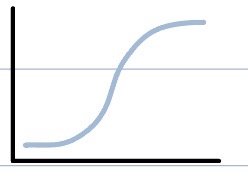
Carrying capacity (K)
The maximum population size that a particular environment can sustain.
Intraspecific competition
The competition between individuals of the same species for limited resources, acting as a density-dependent factor that limits growth.
Density-independent factors
Abiotic factors unrelated to population density that affect population size, such as fires, storms, or seasonal changes in weather.
Boom-and-bust cycles
Regular fluctuations in population density that may be caused by food shortages or predator-prey interactions.
Life history
The traits that affect an organism’s schedule of reproduction and death, including age of first reproduction, number of offspring, frequence of reproduction, and amount of parental care.
r-selected life history traits
Characteristics of populations that produce more offspring and grow rapidly in unpredictable environments.
K-selected life history traits
Characteristics of populations that raise fewer offspring and maintain relatively stable populations.
Sustainable resource management
A practice involving harvesting crops and eliminating damage to the resource to maintain long-term viability.
Demographic transition
The shift from high birth and death rates to low birth and death rates, lowering the rate of growth in developed countries.
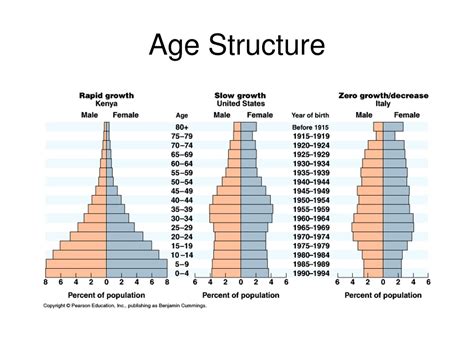
Age structure
The proportion of individuals in different age groups, which reveals population growth trends and social conditions.
Population momentum
Continued population growth occurring despite reduced fertility as a result of a previous expanding population's youth reaching childbearing years.
Ecological footprint
An estimate of the amount of land required to provide the raw materials an individual or nation consumes, including food, fuel, and waste disposal.
Population Ecologist
Study natural population structure and dynamics
Dispersion Patterns
The way individuals are spread within their area or habitat, often categorized as uniform, clumped, or random.
Age Structure Diagrams
Population Pyramids showing a population’s growth trends and social conditions