Chapter 5: Dynamic Cell
 Call Kai
 Learn
Learn Practice Test
 Spaced Repetition
 Match
Match Flashcards
 Knowt Play
1/23

There's no tags or description
Looks like no tags are added yet.
Name | Mastery | Learn | Test | Matching | Spaced | Call with Kai |
|---|
No analytics yet
Send a link to your students to track their progress
24 Terms
Energy
capacity to do work
Two basic forms of energy
Potential & Kinetic
Potential Energy
Stored energy
Kinetic Energy
energy of motion
Calorie
amount of heat required to raise the temperature of 1g of water by 1 degrees Celsius
Kilocalorie/calorie
1,000 calories
value listed on food packages
Energy Laws
Conservation of Energy & 2nd law of thermodynamics
Conservation of Energy Law
energy can be created or destroyed, but it can be changed from one form to another
Second Law of Thermodynamics
Energy can not be changed from one form to another without loss of usable energy.
Entropy
relative amount of disorganization
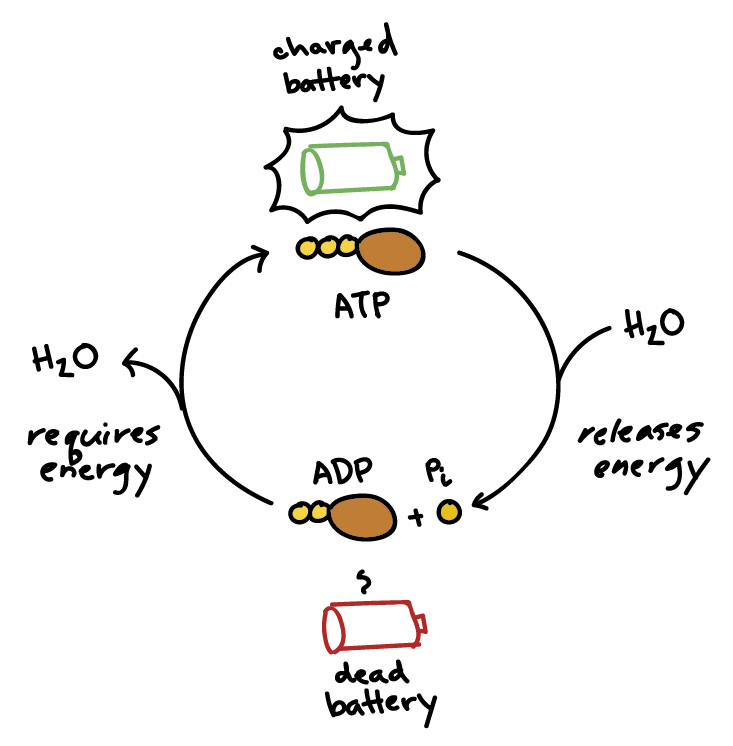
ATP Cycle
Plasma Membrane
regulates traffic in and out of a cell.
selectively permable
Passive Transport
substances move from higher to lower concentration, no additional energy is required.
Active Transport
substances move from lower to higher concentration, additional energy is required
Bulk Transport
movement independent of gradients, additional energy is required
Osmosis
the spontaneous movement of water (or another solvent) across a semipermeable membrane, moving from an area of higher water concentration (low solute) to an area of lower water concentration (high solute)
Isotonic Solution
no net gain/loss of water
concentration of water is same on both side
Hypotonic Solution
Concentration of water outside cell is greater than inside of cell
cell gains water, swell
Hypertonic Solution
has a higher concentration of solutes (like salt or sugar) compared to another solution
water moves out of cell (shrinks)
Exocytosis
movement out of cell
Endocytosis
movement into cell
Phogocutosis
Cell surrounds, engulfs and digests particle.
Pinocytosis
Vesicle forms around liquid or small particles
Receptor-mediated endocytosis
receptors for particular substances found in coated pit.