PAW & Urinary System
 Call Kai
 Learn
Learn Practice Test
 Spaced Repetition
 Match
Match Flashcards
 Knowt Play
1/210

There's no tags or description
Looks like no tags are added yet.
Name | Mastery | Learn | Test | Matching | Spaced | Call with Kai | Chat |
|---|
No analytics yet
Send a link to your students to track their progress
211 Terms
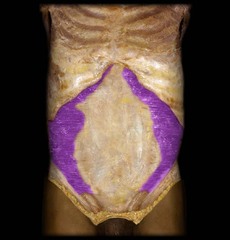
Posterior abdominal wall - not flat
What area is found within the blue-dashed line?
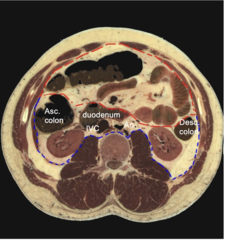
Region posterior to the parietal periotneum
What area is found within the red-dashed line?
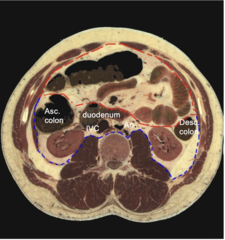
Retroperitoneum
Region posterior to the parietal periotneum (red dashed line) and the posterior abdominal wall is the:
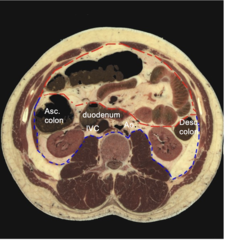
T7
the abdomen "technically" begins at what vertebral level?
psoas major m.
iliacus m.
quadratus lumborum m.
transversus abdominis m.
name the 4 muscles of the posterior abdominal wall:
latissimus dorsi m.
external oblique m.
iliac crest
what structures make up the lumbar triangle (of Petit)?
True
T/F: Most lumbar hernias are secondary to trauma or surgery and primary lumbar hernias are rare
Hernia
The lumbar triangle is a weak spot that could give rise to...
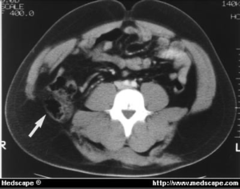
lumbar hernia
identify the pathology
quadratus lumborum m.
identify the structure
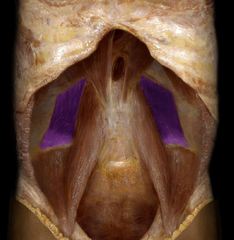
Iliopsoas m.
what muscle of the posterior abdominal wall allows for hip flexion?
Iliopsoas m.
identify the structure
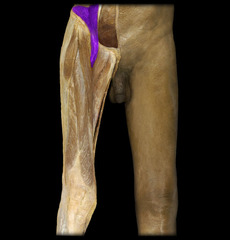
psoas major m.
identify the structure
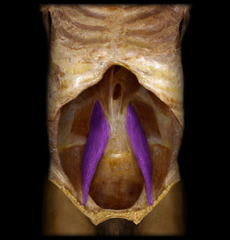
psoas minor m.
identify the structure
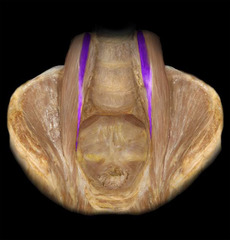
transversus abdominis m.
identify the structure
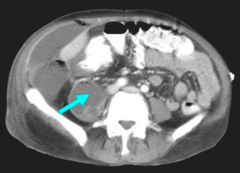
psoas abscess
identify the pathology
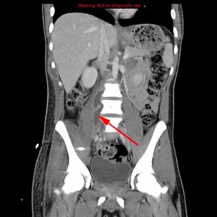
psoas abscess
identify the pathology
psoas abscess
patient presents with pain in the lower back and abdomen that sometimes radiates to the anterior thigh and hip. Patient is struggling to overcome a tuberculosis infection. What is the diagnosis?
psoas abscess
An infectious disease that commonly spreads from an intra-abdominal process such as the GI tract or vertebrae, into the psoas muscle and deep to its fascial sheath.
For example, tuberculosis may form an abscess in the lumbar vertebrae and pus can enter the fascial tube and pass inferiorly along the psoas muscle over the hip joint and deep to the inguinal ligament.
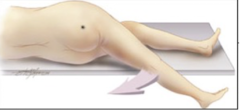
Psoas sign
Pain on passive extension (or flexion) of the right thigh. Patient lies on left side.
Examiner extends patient's right thigh while applying counter resistance to the right hip (asterisk)
inflamed appendix
patient presents with pain in the lower back, abdomen and right thigh during flexion and extension. What is the likely cause?
infected sigmoid colon
patient presents with pain in the lower back, abdomen and left thigh during flexion and extension. What is the likely cause?
IVC
what structures passes through the diaphragm at the T8 vertebrae level?
IVC
what structure pierces the central tendon of the diaphragm to enter the abdominal cavity?
esophagus
what structures passes through the diaphragm at the T10 vertebrae level?
abdominal aorta
what structures passes through the diaphragm at the T12 vertebrae level?
phrenic n.
innervation for diaphragm:
right crus
what part of the diaphragm forms the esophageal hiatus?
esophagus
what structure passes through the right crus?
T10
the right crus loops at what vertebral level?
abdominal aorta
what structure passes into the abdominal cavity through the right and left crura, posterior to the esophagus?
Right crus
identify the structure
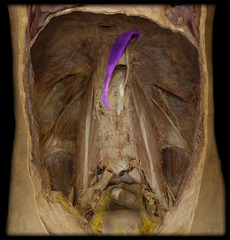
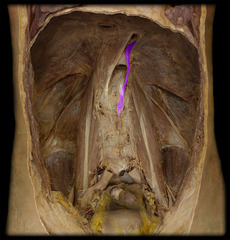
Left crus
identify the structure
inferior phrenic aa.
what arteries supply the diaphragm at the level of T12?
L4
at what vertebral level does the abdominal aorta bifurcate into the right and left common iliac aa?
external iliac a.
which branch of the common iliac a. supples the lower limbs?
internal iliac a.
which branch of the common iliac a. supples the pelvic structures?
GI tract
Unpaired branches of the abdomen supply the:
celiac trunk
superior mesenteric a.
inferior mesenteric a.
median sacral a.
name the 4 unpaired branches of the abdominal aorta:
inferior phrenic a.
middle suprarenal a.
renal a.
gonadal a.
lumbar aa.
name the 5 paired branches of the abdominal aorta:
Abdominal Aortic Aneurysm (AAA)
identify the pathology
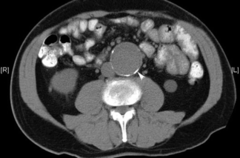
Abdominal Aortic Aneurysm (AAA)
identify the pathology
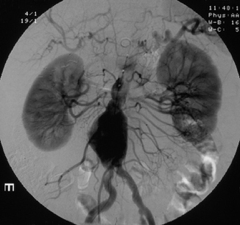
Ruptured: >90%
Pts arrive at hospital: 40-70%
Ruptured AAA leads to what % mortality versus patients who arrive at the hospital
common iliac vv.
the IVC is formed by the conjunction of the:
IVC
the right inferior phrenic v. drains into the:
left renal v.
the left inferior phrenic v. drains into the:
IVC
the right suprarenal v drains into the:
left renal v.
the left suprarenal v drains into the:
IVC
the right gonadal vein drains into the:
left renal v.
the left gonadal vein drains into the:
left renal vein
Left gonadal v., left suprarenal v., left inferior phrenic vein drain first into the...
IVC
Right gonadal vein and right suprarenal vein drain directly into...
Left gonadal and left suprarenal vein
SMA may constrict left renal vein, blocking the...
Left renal vein
Edema of left testicle and ovary if ________ is blocked
Right gonadal v.
identify the structure
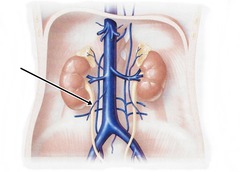
Left gonadal v.
Identify the structure
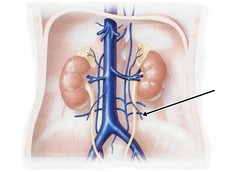
Left suprarenal v.
Identify the structure
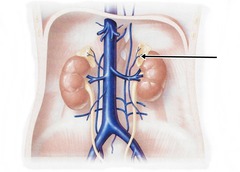
Left renal v.
Identify the structure
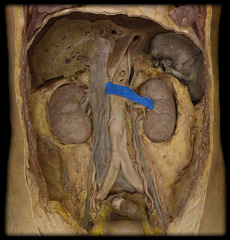
left renal v.
what structure crosses directly anterioinferior to the superior mesenteric artery?
superior mesenteric a.
the paired renal arteries sit at the same level as what unpaired artery?
left psoas muscle
if there was a blockage in the left renal vein, what structures would not be affected:
- left kidney
- left testicle/ovary
- left adrenal gland
- left side of diaphragm
- left psoas muscle
Iliohyogastric n.
Identify the structure at #1
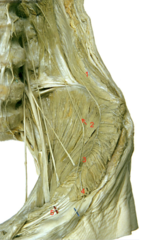
Ilioinguinal n.
Identify the structure at #2
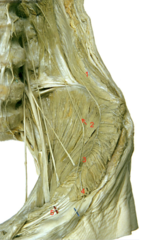
Lateral cutaneous nerve of thigh
Identify the structure at #3
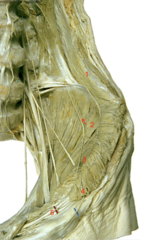
Genitofemoral n.
Identify the structure at #4
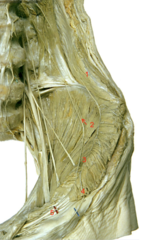
Femoral n.
Identify the structure at #5
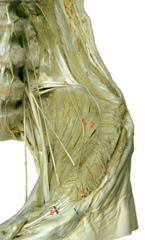
abdominal muscles
In addition to supplying sensation to inguinal region and lower limb, subcostal, Iliohypogastric and ilioinguinal nerves also supply motor innervation to...
T8 - T12
Skin of anterior abdominal wall supplied by lower intercostal nerves:
Subcostal n. (T12)
Identify the structure at #1
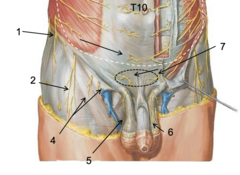
Lateral cutaneous n. of thigh (L2,3)
Identify the structure at #2
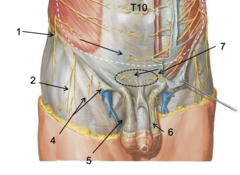
Femoral branches of genitofemoral n. (L1,2)
Identify the structure at #4
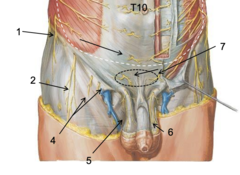
Genital branch of genitofemoral n. (L1,2)
Identify the structure at #5
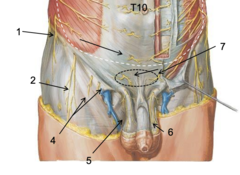
Ilioinguinal n. (ant. scrotal branch) (L1)
Identify the structure at #6
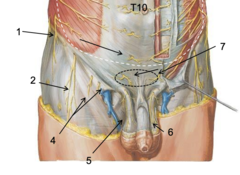
Iliohyogastric n. (L1)
Identify the structure at #7
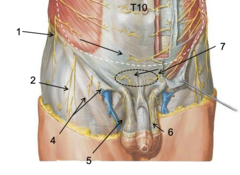
genitofemoral n.
what nerve pierces through the psoas muscle?
genitofemoral n.
identify the structure
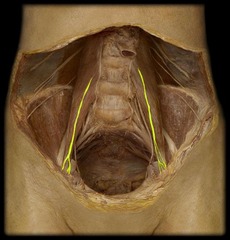
subcostal n.
identify the structure
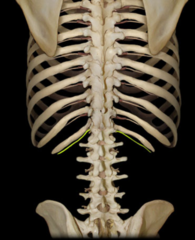
iliohypogastric n.
identify the structure
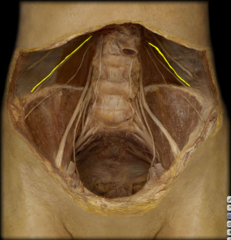
ilioinguinal n.
identify the structure
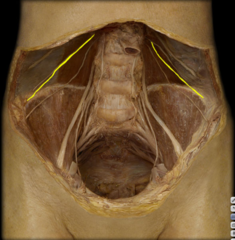
femoral n.
identify the structure
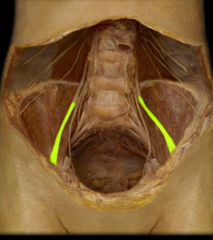
Sympathetic trunk
What is the blue box pointing to?
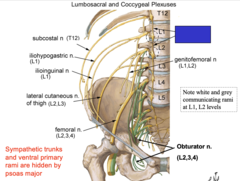
psoas major m.
the genitofemoral n. pierces through what muscle?
lateral cutaneous nerve of thigh
what nerve runs over the superior surface of the iliacus muscle?
femoral n.
what nerve runs over the inferior surface of the iliacus muscle?
subcostal n.
what nerve runs inferior to the 12th rib?
iliohypogastric n.
ilioinguinal n.
what nerves cross over the quadratus lumborum m.?
genital branch of genitofemoral nerve
what branch of the genitofemoral n. travels through the inguinal canal to provide efferent fibers to the cremaster m.?
femoral branch of genitofemoral nerve
what branch of the genitofemoral n. travels below the inguinal ligament to provide afferent fibers to the skin of the thigh?
T12
the subcostal nerve arises from spinal nerve level:
L1
the iliohypogastric nerve arises from spinal nerve level:
L1
the ilioinguinal nerve arises from spinal nerve level:
L1-L2
the genitofemoral nerve arises from spinal nerve level:
L2-L3
the lateral cutaneous nerve of the thigh arises from spinal nerve level:
L2-L4
the femoral nerve arises from spinal nerve level:
L2-L4
the obturator nerve arises from spinal nerve level:
Psoas major
Sympathetic trunks and ventral primary rami are hidden by what muscle?
L1, L2
Note the white and grey communicating rami at what levels?
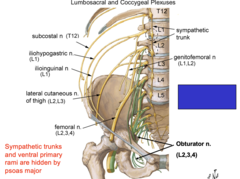
celiac ganglia
postsynaptic efferent sympathetic cell bodies from the greater splanchnic nerves are found at the:
aorticorenal ganglia
postsynaptic efferent sympathetic cell bodies from the least splanchnic nerves are found at the:
superior mesenteric ganglia
postsynaptic efferent sympathetic cell bodies from the lesser splanchnic nerves are found at the: