Law for Data Science module 3
 Call Kai
 Learn
Learn Practice Test
 Spaced Repetition
 Match
Match Flashcards
 Knowt Play
1/21

There's no tags or description
Looks like no tags are added yet.
Name | Mastery | Learn | Test | Matching | Spaced | Call with Kai | Chat |
|---|
No analytics yet
Send a link to your students to track their progress
22 Terms
Intellectual property as private law
IP has elements from property and contract law
IP has relative rights
IP property rights (absolute) → copyright
Intellectual property rights (IPRs)
Incentive to create/innovate and to share
Subject matter of IPRs are non-rivalrous and non exclusionary
IPRs are limited in time
Trademark
Badge of origin
Have to be registered
Requirements: a sign, capable of being represented graphically, distinctive from origin
Includes: words, personal names, designs, letters, numerals, the shape of goods/their packaging
Trade secrecy
Has the following requirements:
Has commercial value
The information has been protected with reasonable efforts to keep it secret
Not generally known or easily accessible to people who normally deal with that type of information
Trade secrecy characteristics
Not protection of idea/date
Protection against improper appropriation, use, disclosure
Cheaper that patent protection
Societal drawback: Algorithms remain unavailable to others, reducing follow-on innovation
Patents
An exclusive legal right that allows an inventor to prevent others from making, using, or selling an invention for a limited time in exchange for publicly disclosing it
Limited in time
Requirements: an invention, novelty, inventive step, industrial application
Pro’s patent
Exclusive rights
Court actions
Base for loans
Limited in time (20 years)
Con’s patent
High cost (30000-60000)
Disclosure requirement (work is shared with the public)
Limited in time (20 years)
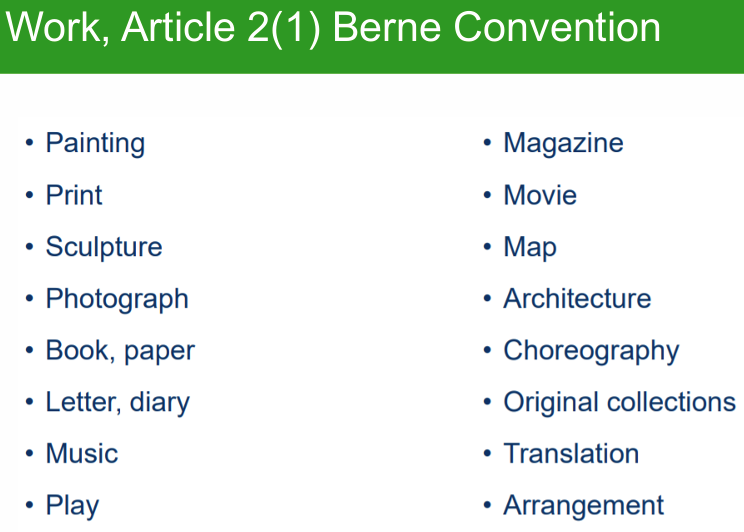
Copyright
A legal right that automatically protects original creative works by giving the creator exclusive rights to use, copy, and distribute them
Copyright protection
No protection of ideas
BUT protection of the expression of a creation
Requirements copyright
Originality
Author’s own creation
Bares creators personal stamp
Free and creative choices were made
Exclusive rights
Exploitation rights (allows you to make money)
Moral rights
Hyperlinking
Providing clickable links to copyrighted content is generally lawful unless it reaches a new public, bypasses access restrictions, or links (especially for profit) to content that is illegally published
Who owns (copyright - software)
Incase 1 author → the author self
Multiple authors (employees) → owner company owns it (company contract)
Multiple authors (no employees) → everyone gets owner rights
Exceptions copyright
Art 5
Most notable: covering acts of reproduction necessary for the reasonable use of the program
Exception private use: most times they limit the number of devices (e.g. Netflix)
Right to observe/test/study (provided you already had the right to use)
Decomplication
Reproduction and translation of code allowed
Provided it is used to achieve interoperability
Cannot be used for further purposes/shared with others
Cannot be used to create a similar program
Creative commons licenses
Free software globally with no restrictions possible by subsequent users, for subsequent versions (CC0 → also referred to as copyleft)
Attribution (by) → Others must give you credit the way you request
ShareAlike (sa) → Others can use, modify and share your works, as long as they distribute any modified work on the same terms
NonCommercial (nc) → Others can use, modify and share for any purpose other than commercially
NoDerivatives (nd) → Others can copy, use and share your work, but are not allowed to modify your work
Database
A structured collection of independent works, data, or other materials that are systematically organized and individually accessible by electronic or other means
Two distinct rights form the database directive
Art 3 (which has its basis in copyright) → Database must be original, does not require substantial investment
Art 7 (sui generis right) → not al databases are protected, does not require originality does require substantial investment
Substantial investment
obtaining
verification
presentation
don’t need all three, only one is enough
Can be quantitative or qualitative
Lawful users
May extract or reuse insubstantial parts of a public database.
Applies to databases made publicly available.
Must not interfere with the database's normal exploitation or harm the maker's legitimate interests.
Must not infringe the copyright holder's rights.
New legislation - Data Act
Art 43
Databases containing certain data → The sui generis database right does not apply to data generated by or obtained from connected products or related services covered by the Data Act