1.1.2 CPU Performance
 Call Kai
 Learn
Learn Practice Test
 Spaced Repetition
 Match
Match Flashcards
 Knowt Play
1/10

There's no tags or description
Looks like no tags are added yet.
Name | Mastery | Learn | Test | Matching | Spaced | Call with Kai | Chat |
|---|
No analytics yet
Send a link to your students to track their progress
11 Terms
Give three characteristics of a CPU that can affect its performance.
Clock speed
Cache size
No. of cores
What is clock speed?
Number of cycles clock sends per second — measured in Hz
1GHz = 1 billion cycles per second
What effect does higher clock speed have on CPU performance?
More FDE cycles per second
More instructions processed in given time
Improves performance
What effect does cache size have on CPU performance?
Larger cache = more frequently used data and instructions stored
Reduces no. of times CPU accesses main memory
What is cache?
Memory that provides fast access to frequently used instructions and data
Explain one reason why the cache size affects the performance of the CPU.
Data transferred faster
Makes CPU more efficient
What is a core?
Processing unit inside CPU
What effect does the number of cores have on CPU performance?
Multiple instructions can be processed simultaneously — improves performance
Why won’t doubling cores always double performance?
Cores must communicate
Some programs aren’t designed to use multiple cores
The specification of two CPUs is shown in Fig. 1.
Computer 1 | Computer 2 |
Clock Speed: 1 GHz | Clock Speed: 1.4 GHz |
Cache size: 2 MB | Cache size: 2 MB |
Number of Cores: 4 | Number of Cores: 2 |
When running a 3D flight simulator, Computer 1 is likely to run faster than Computer 2.
Using the information in Fig. 1, identify one reason for this. [1]
More cores
The specification of two CPUs is shown in Fig. 1.
Computer 1 | Computer 2 |
Clock Speed: 1 GHz | Clock Speed: 1.4 GHz |
Cache size: 2 MB | Cache size: 2 MB |
Number of Cores: 4 | Number of Cores: 2 |
When running a 3D flight simulator, Computer 1 is likely to run faster than Computer 2.
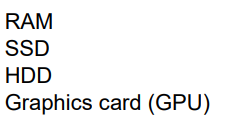
Identify two other parts of a computer that are not in Fig. 1, which could improve the performance of the computers. [2]
RAM
SSD