Reporting psychological investigations & reliability/validity
 Call Kai
 Learn
Learn Practice Test
 Spaced Repetition
 Match
Match Flashcards
 Knowt Play
1/23

There's no tags or description
Looks like no tags are added yet.
Name | Mastery | Learn | Test | Matching | Spaced | Call with Kai | Chat |
|---|
No analytics yet
Send a link to your students to track their progress
24 Terms
What is the order of a scientific report?
Abstract
Introduction
Method
Results
Discussion
References
(Aunt Irene Makes Really Delicious Ramen)
What is the abstract section in a scientific report & why is it important?
A short summary (150-200 words) that includes all the major elements: the aims & hypotheses, method/procedure, results & conclusions
When researching a particular topic, psychologists will often read lots of abstracts to identify those investigations that are worthy of further examination
What is the introduction section in a scientific report?
A literature review of the general area of investigation, detailing relevant theories, concepts & studies that are related to the current study
Incudes the aims & hypothesis
What is the method section in a scientific report?
A detailed description of what the researcher(s) did, so other researcher are able to replicate the study:
design → e.g. independent groups, naturalistic observation, etc & justifications given for the choice
sample → information related to the people involved: quantity, biographical/demographic information (ensuring this doesn’t compromise anonymity), sampling method & target population
apparatus/materials → detail of any assessment instruments used & other relevant materials
procedure → a list of everything that happened from beginning to end (including a record of everything that was said to participants: briefing, standardised instructions & debriefing)
ethics → an explanation of how ethical issues were addressed within the study
What is the results section in a scientific report?
Summary of the key findings from the investigation:
likely to include descriptive statistics (e.g. tables, graphs & charts, measures of central tendency/dispersion)
inferential statistics should include reference to the choice of statistical test, calculated & critical value, the level of significance & the final outcome (i.e. which hypothesis was rejected & accepted)
if qualitative methods of research was used, the results are likely to involve analysis of themes &/or categories
What is the discussion section in a scientific report?
Researchers explain results verbally in relation to previous research & psychological theory
They also discuss limitations of the method or sample, suggest improvements for future studies & consider wider implications, including real-world applications & contributions to existing knowledge
What is the referencing section in a scientific report & why is it important?
List of sources that are referred to or quoted in the report (e.g. journal articles, books or websites) & their full details:
provides credit for other researchers’ ideas → avoids claims of plagiarism
helps future researchers identify the author’s sources & find related studies
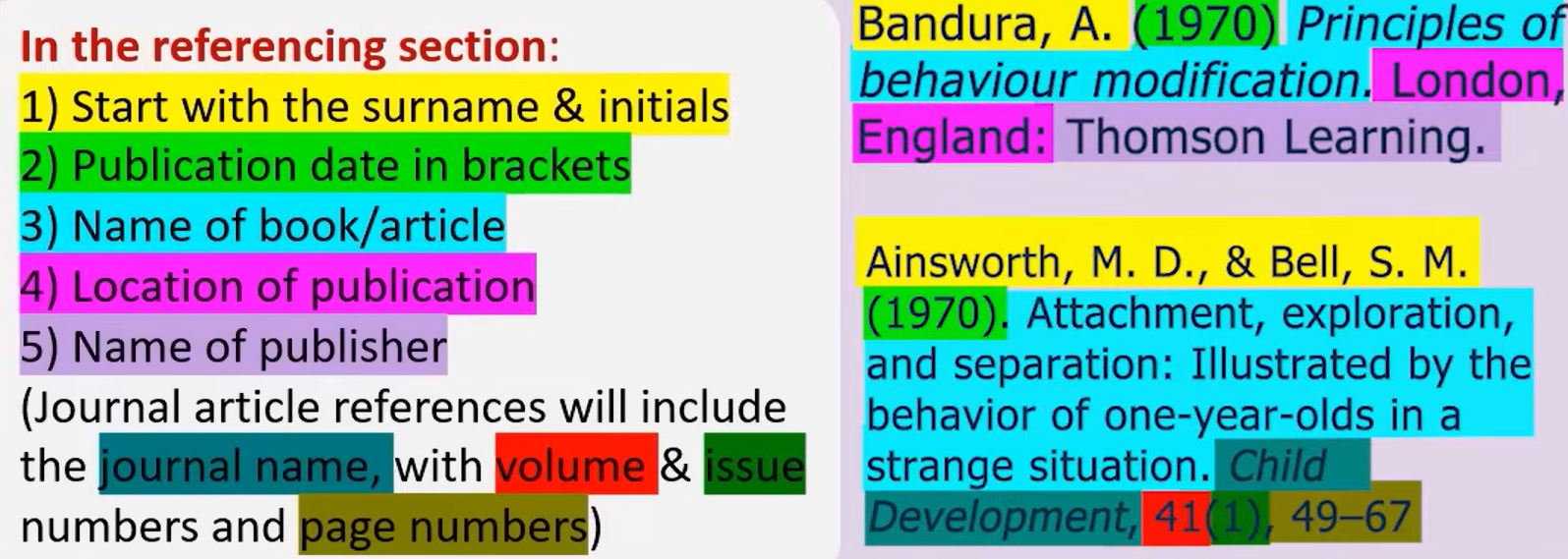
How is a referencing section written for a book & journal article?
Book article:
Surname & initials
Publication date in brackets
Name of book
Location of publication
Name of publisher
Journal article:
Surname & initials
Publication date in brackets
Name of journal
Volume & issue number
Page number
What is the definition of reliability?
The consistency of measurements of procedures in a research study
What is the definition of internal reliability?
Refers to the extent to which the procedures & measurement tools used in a study are consistent & can be used again to produce similar results under the same conditions
What is the definition of split-half reliability?
Method for assessing internal reliability of a psychological test, questionnaire or survey
Involves splitting a measure into two halves & calculating the correlation between the scores of both halves, with high correlation indicating good reliability
What is the definition of external reliability?
Refers to the extent to which the measures/tools used to assess behaviours/attitudes produce consistent results when the study is replicated over time or conducted by different researchers
What is the definition of inter-rater reliability?
(type of external reliability): an assessment of the extent to which two or more ratings/observations of the same behaviour are consistent
What is the definition of test-retest reliability?
(type of external reliability): an assessment of the consistency of a psychological test or questionnaire to see how similar scores/responses are when a person is tested twice
What is the definition of validity?
The extent to which an observed effect is genuine, the researcher measured what they intended to & the findings can be generalised to a wider population or setting (accuracy)
What is the definition of internal validity?
The extent to which the effects of a study are due to the manipulation of the independent variable & the researcher has measured what they intended to measure
What is the definition of concurrent validity?
(type of internal validity): the extent to which a psychological measure relates to an existing similar measure
What is the definition of face validity?
(type of internal validity): the extent to which a questionnaire, etc appears (on the face of it) to be measuring what it claims to
What is the definition of predictive validity?
(type of internal validity): the extent to which a test, measure or study can accurately forecast future behaviour, performances or outcomes
What is the definition of external validity?
The extent to which an observed effect can be generalised to other times, people & settings
What is the definition of ecological validity?
(type of external validity): the extent to which the research effects are likely to be demonstrated in other settings
What is the definition of temporal validity?
(type of external validity): focuses on the ability to generalise findings beyond the particular historical context of the study
What is the definition of population validity?
(type of external validity): measures how well the sample of participants represents the target population & findings can be generalised to other people
How to answer ‘design a study’ questions (12 marks) ?
(always think: what, how, why?)
Write sub-headings for each bullet point & write your answer underneath
Define variables/co-variables & operationalise
State the study’s aims
Identify the research method (e.g. correlational, experimental, observational) & justify it
Write a directional or non-directional hypothesis & justify it
State target population & sampling method
State the experimental design & justify it
Explain how participants will be assigned to conditions & justify it
Choose a statistical test & justify it
Identify extraneous variables & how they will be controlled
Highlight possible ethical issues & how to address them
Outline the procedure, including resources/materials used
Include debriefing details