BIo 161 - Mitosis: Cell Reproduction
 Call Kai
 Learn
Learn Practice Test
 Spaced Repetition
 Match
Match Flashcards
 Knowt Play
1/97

There's no tags or description
Looks like no tags are added yet.
Name | Mastery | Learn | Test | Matching | Spaced | Call with Kai |
|---|
No analytics yet
Send a link to your students to track their progress
98 Terms
somatic cells
all body cells forming an organism’s tissues and organs, excluding reproductive germ cells (sperm and eggs) (gametes = reproductive cells)
All cells in body have some rate of turnover
vary in specific genetically determined speeds/rates
Cell reproduction
cells must replicate (ie. DUPLICATE) themselves
For growth, tissue turnover, repair, and replacement of cells.
Tissues (esp. with rapid turnover)
skin has fast turnover
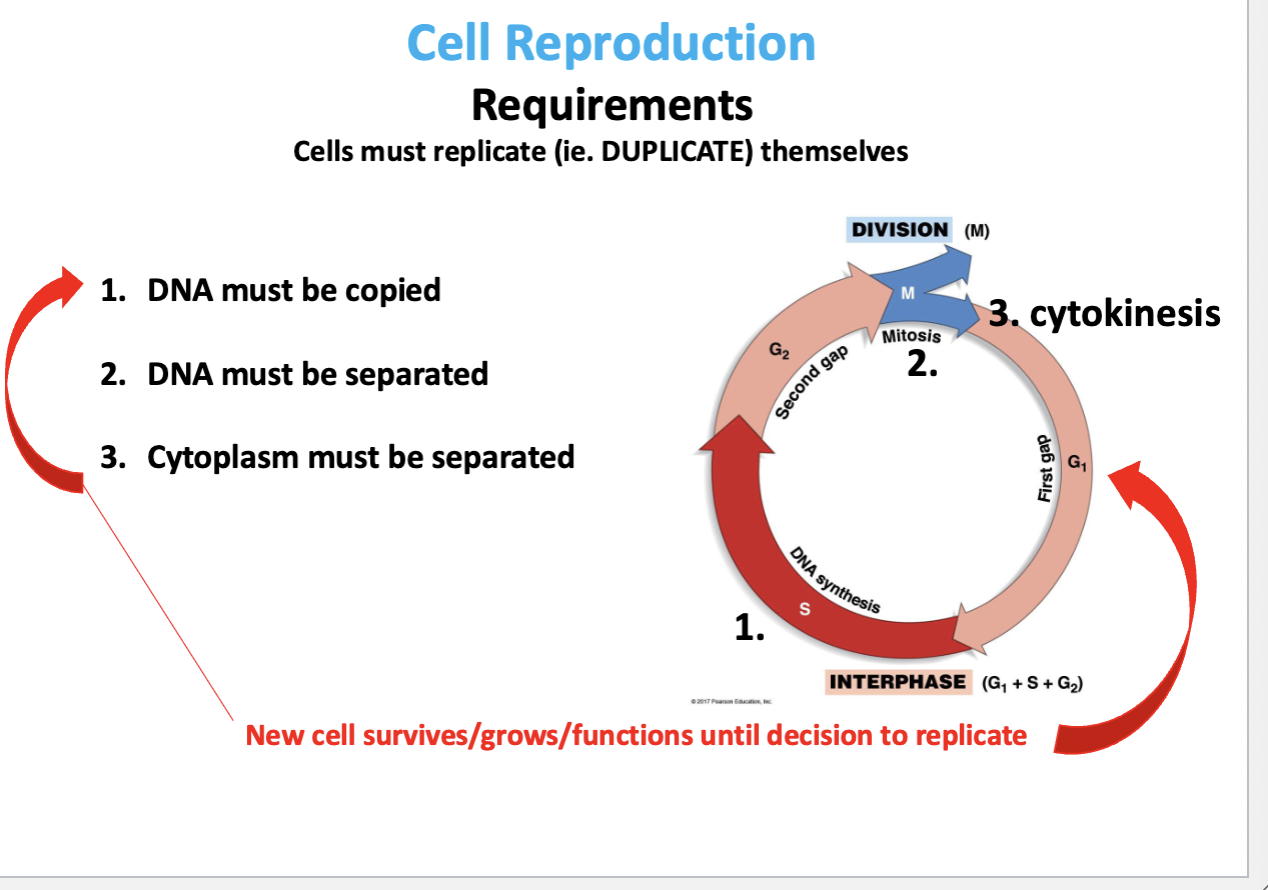
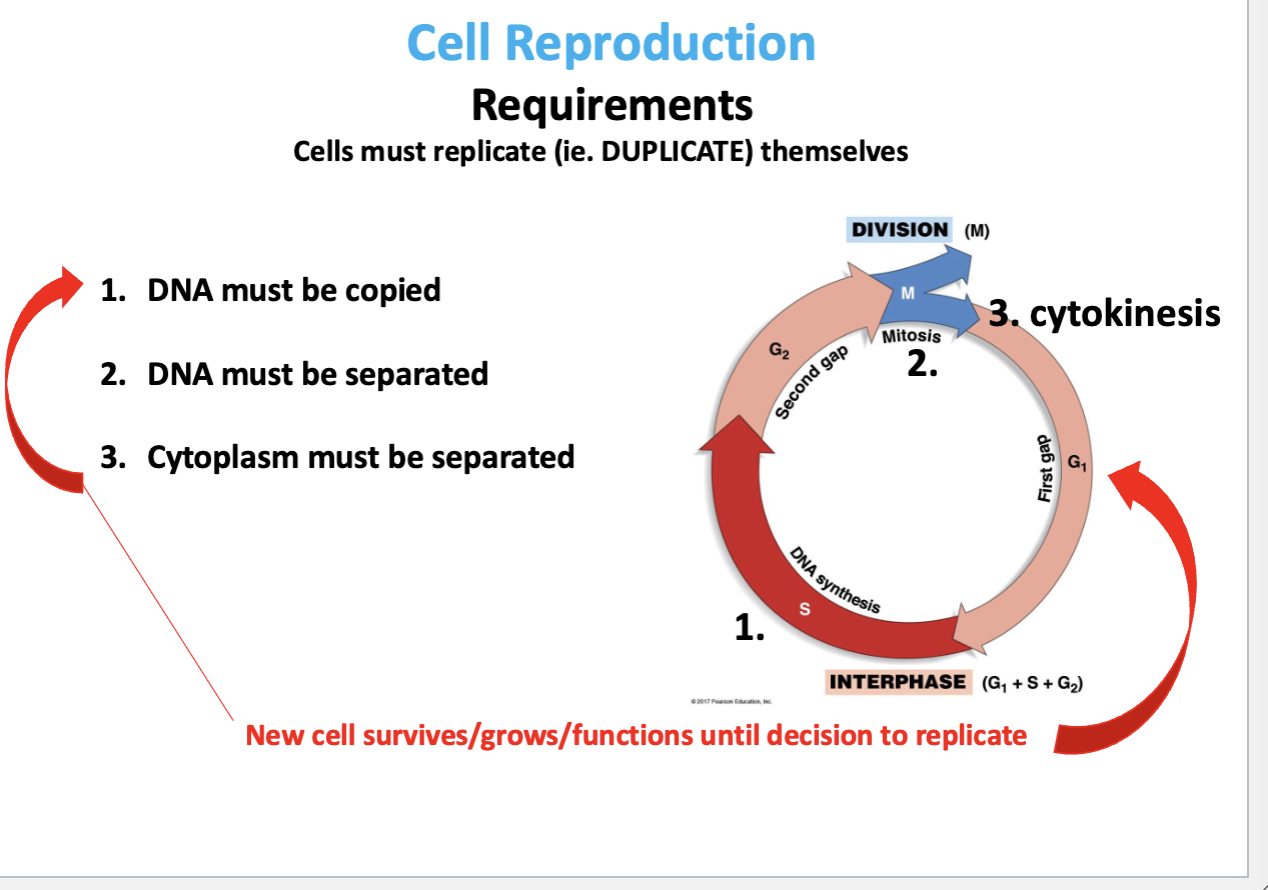
1st Requirement for Cell Reproduction
DNA must be copied
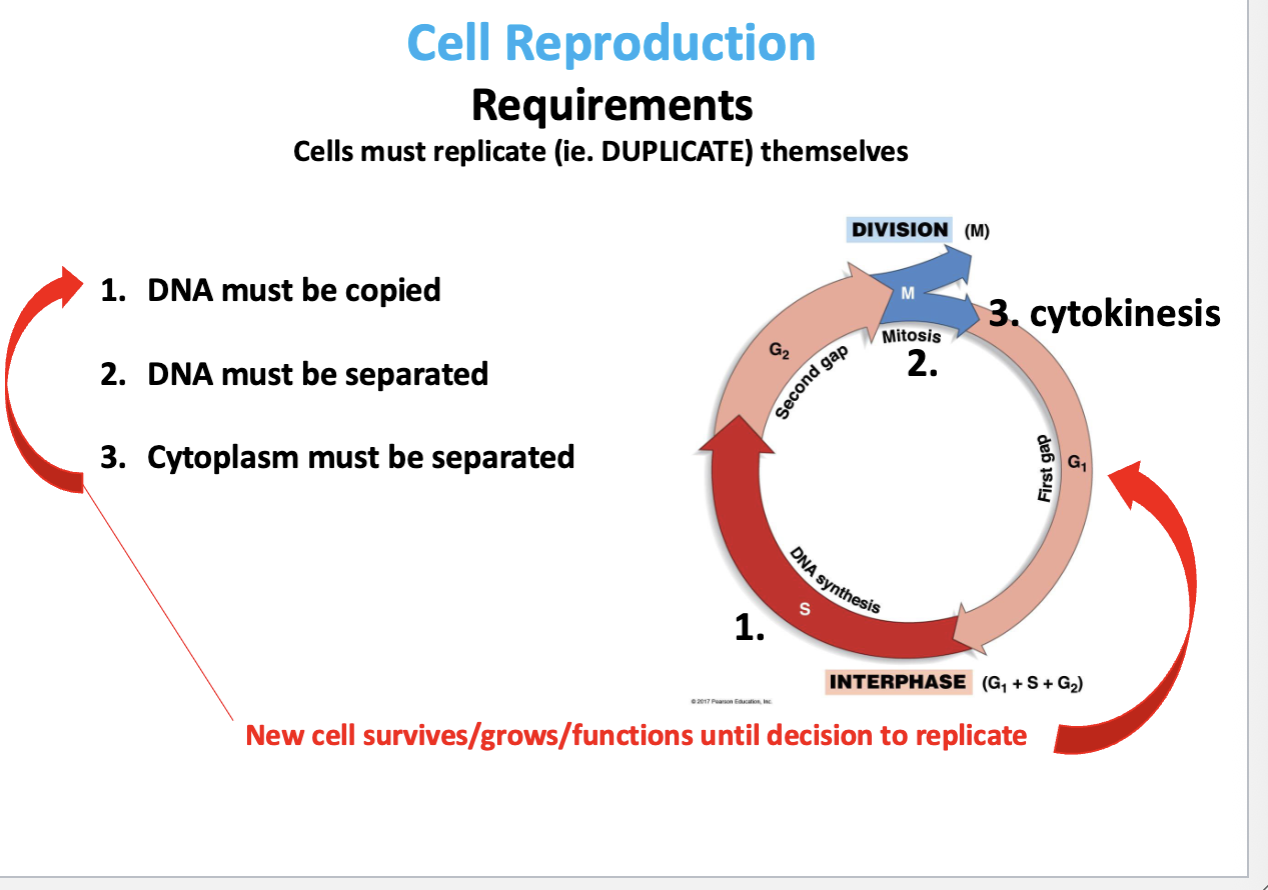
2nd Requirement for Cell Reproduction
DNA must be separated
3rd Requirement for cell reproduction
Cytoplasm must be separated
Cell Reproduction Requirement 1: Why must DNA be copied before cell division?
1 cell to 2 cells, 2 copies of DNA needed
Each daughter cell requires a complete copy of DNA for survival.
Cell Requirement 2: Why must DNA be separated?
daughter cell requires all DNA for survival
Cell Requirement 3: Why must cytoplasm be separated?
Physical separation required
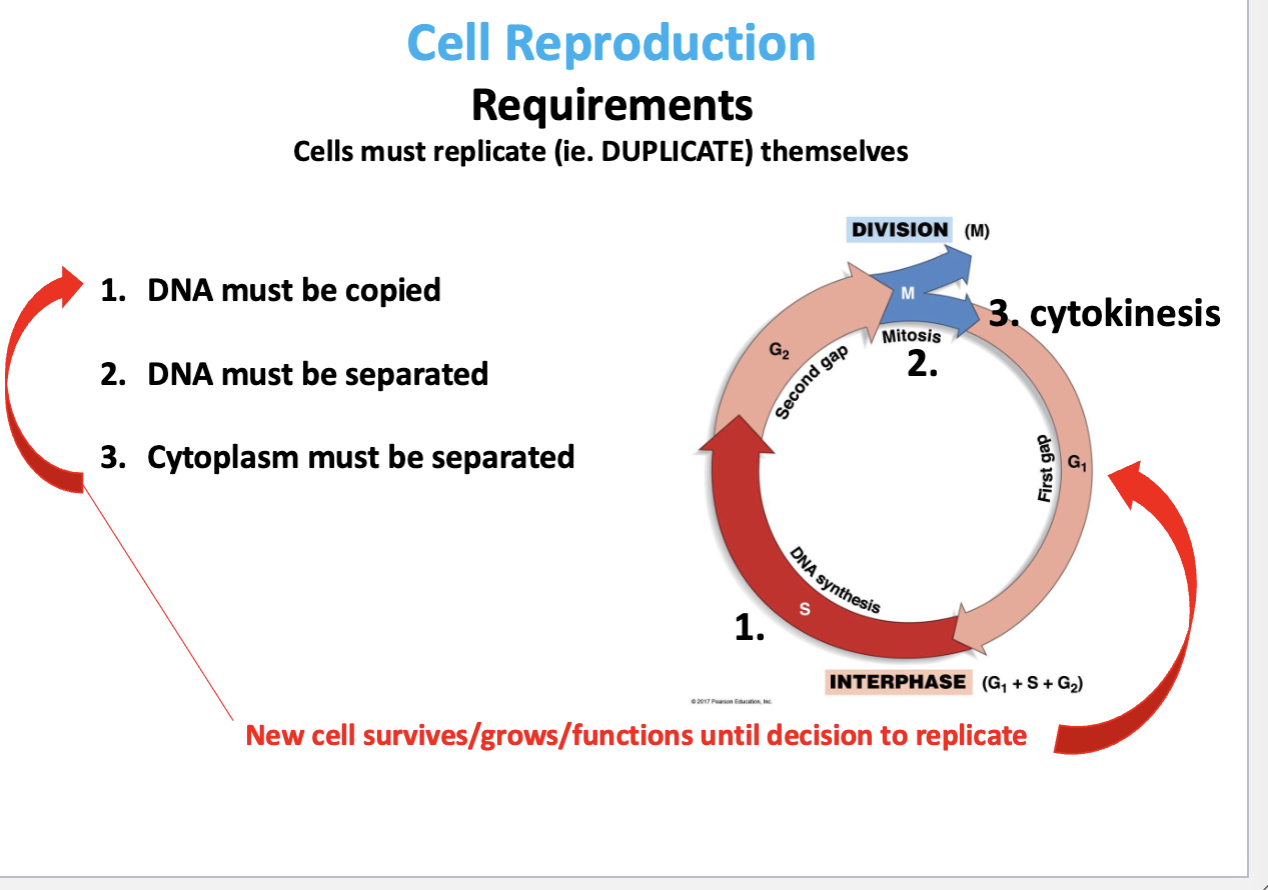
How cell reproduction requirements fit into cell cycle
1) DNA copied in S phase (DNA synthesis)
2) DNA separated in M phase, Mitosis
3) Cytoplasm separated in Cytokinesis
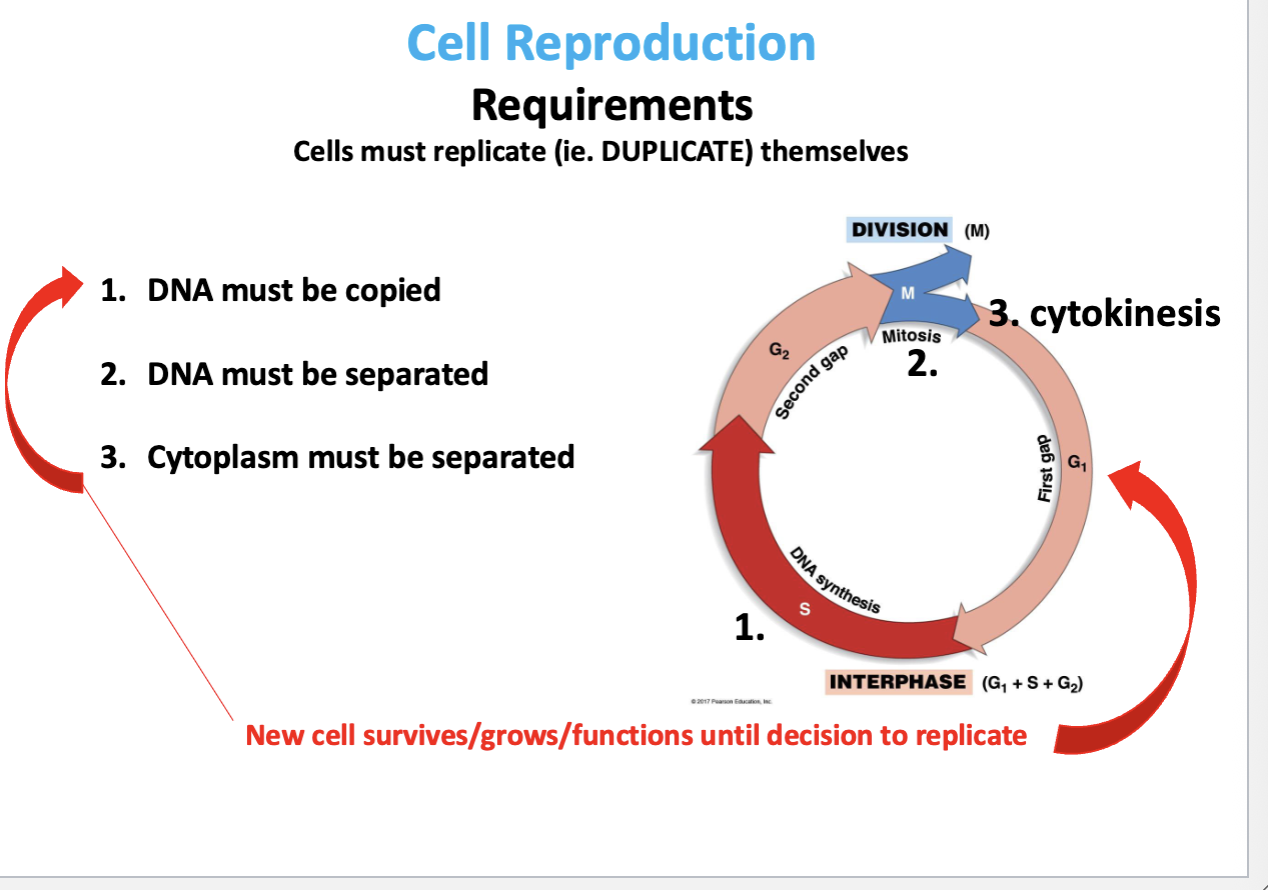
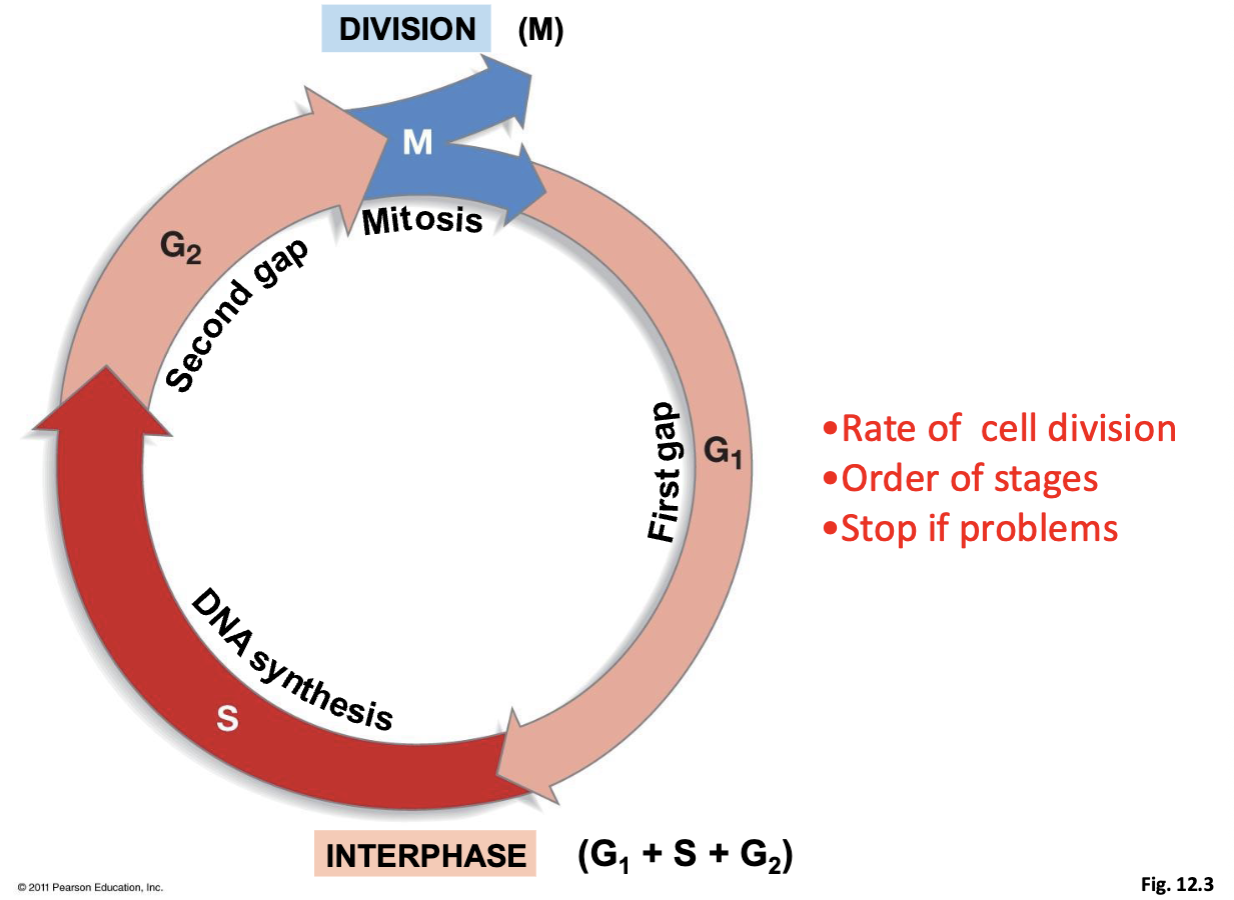
Two Distinct Phases (parts) to the cell cycle
1) Interphase
2) Mitotic Phase
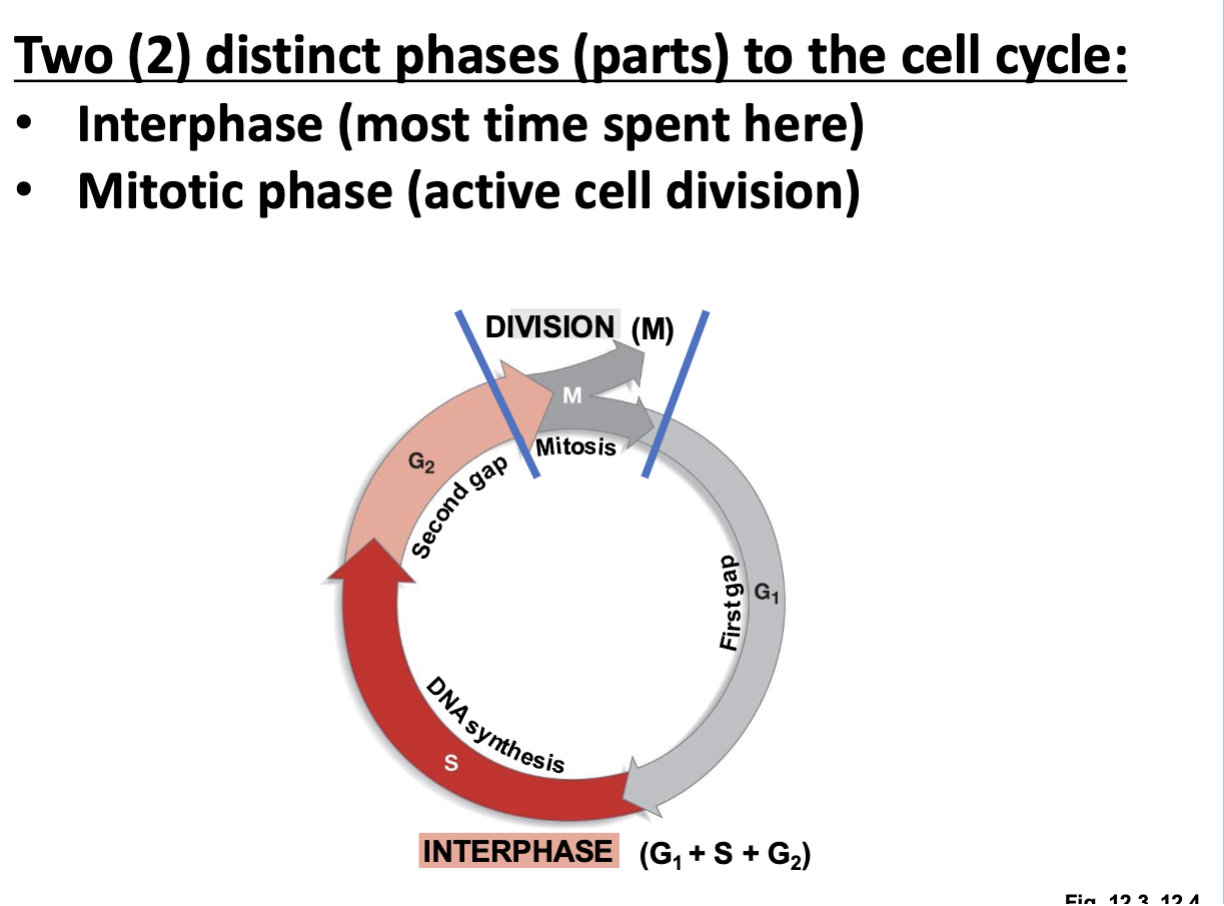
Which phase occupies most of the cell cycle?
Interphase
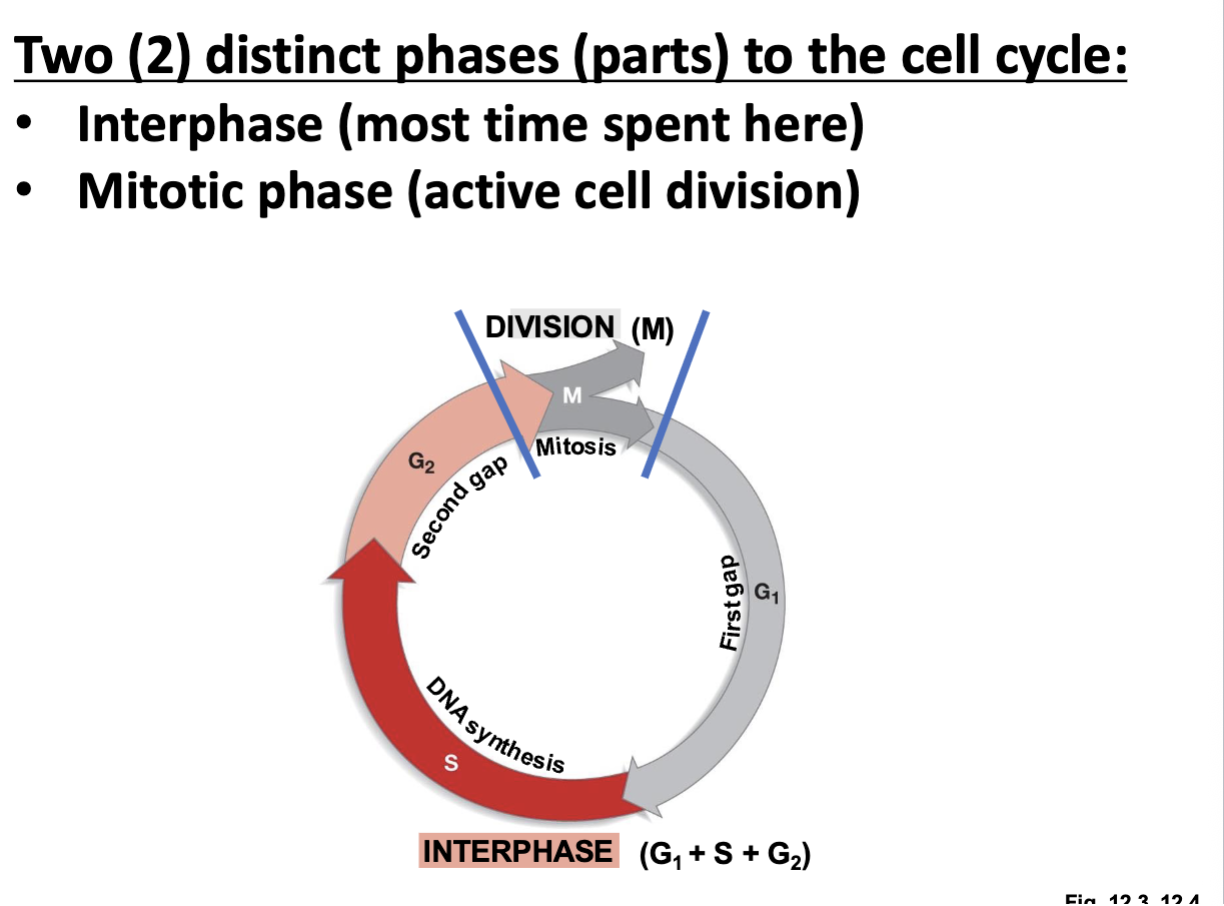
What phases make up interphase?
G1, S, and G2.
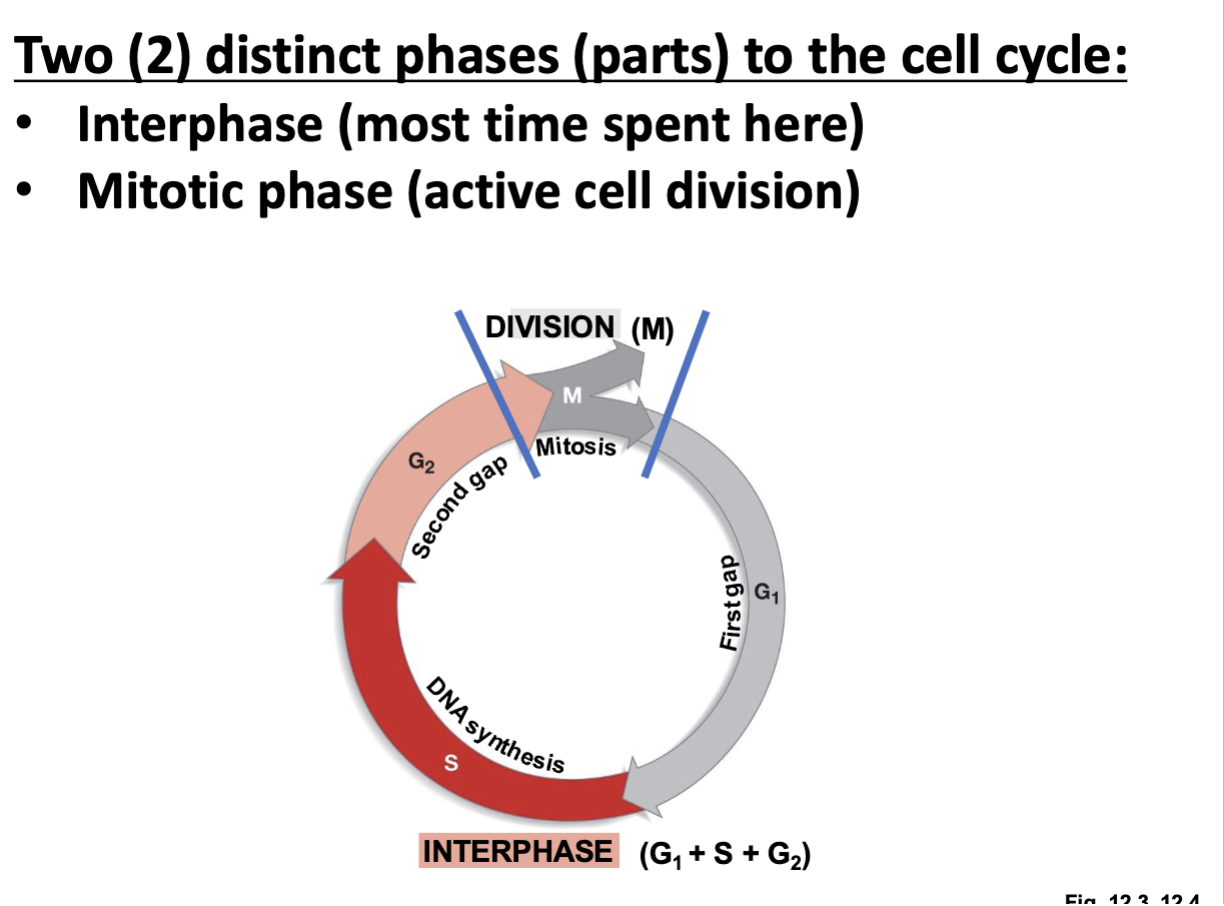
What is chromatin?
DNA associated with proteins in an uncondensed form.
What is a chromosome?
Condensed chromatin visible during cell division.
What are sister chromatids?
Two identical copies of DNA produced during DNA synthesis, CONDENSED & joined @ centromere
When are sister chromatids formed?
During S phase after DNA replication. (cohesins still intact, chromatids fused together, uncondensed)
When do sister chromatids separate?
During anaphase (in mitosis)
What is a centromere?
Region joining sister chromatids together (what is left of cohesin proteins that fused chromatin copies together after chromatin condenses)
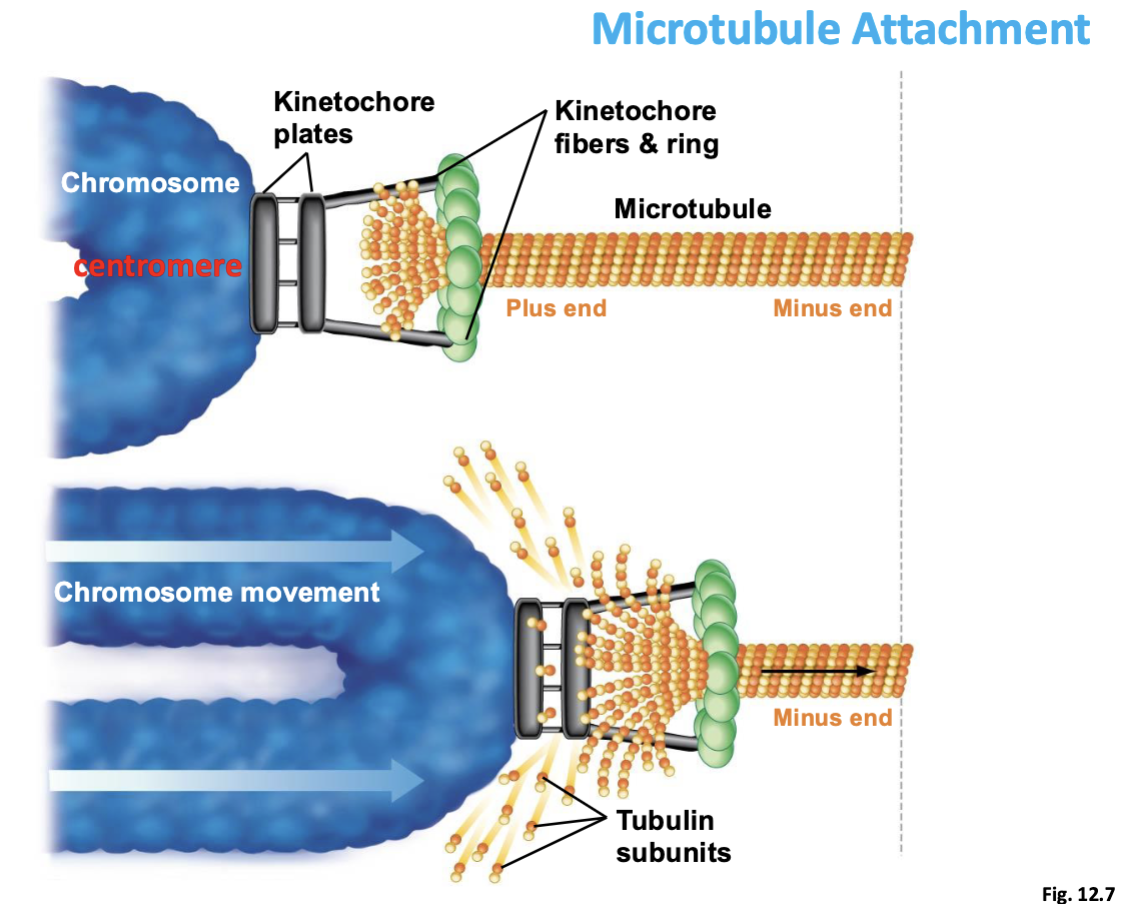
What is a kinetochore?
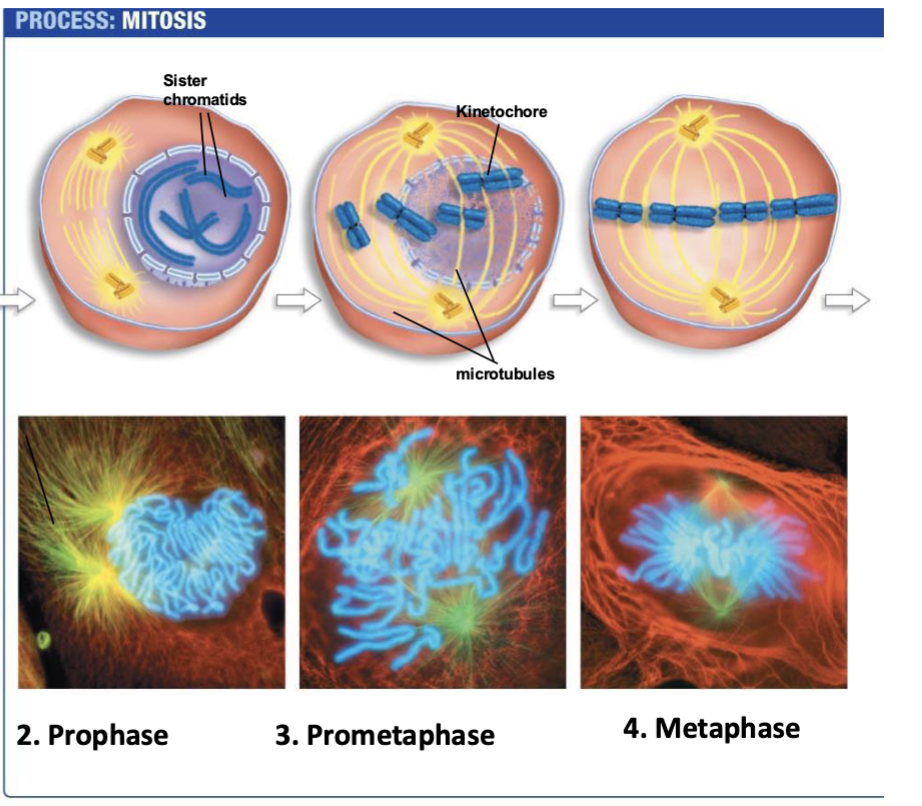
Protein structure on the centromere where spindle microtubules attach. (protenacious attachment)
What allows chromosomes to stay attached while microtubules grow and shrink?
The kinetochore.
In the G1 phase the cell is
Actively growing, synthesizing proteins, increasing volume, and preparing for DNA replication (S phase). It is part of the continuous cycle
In the G0 phase…
A quiescent stage existing outside the active cycle. Cells are differentiated and metabolically active but do not divide (& have no intention to go through cell division)
W/appropriate signals (accumulation of products + enzymes necessary for copying DNA)
cell will kick out of G0 phase into G1 phase to transition to DNA synthesis phase
Chromosomes in Cell Cycle: G1
Chromosomes exist as loose, decondensed chromatin to allow for gene expression.
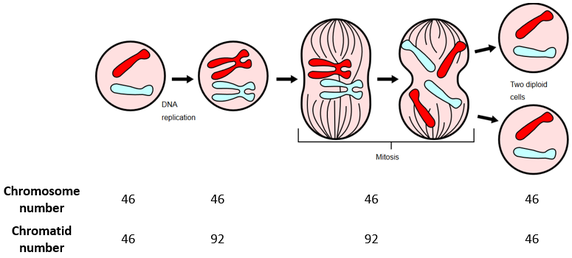
4 chromosome example but Human cells have 46 single-stranded chromosomes (46 chromatids).
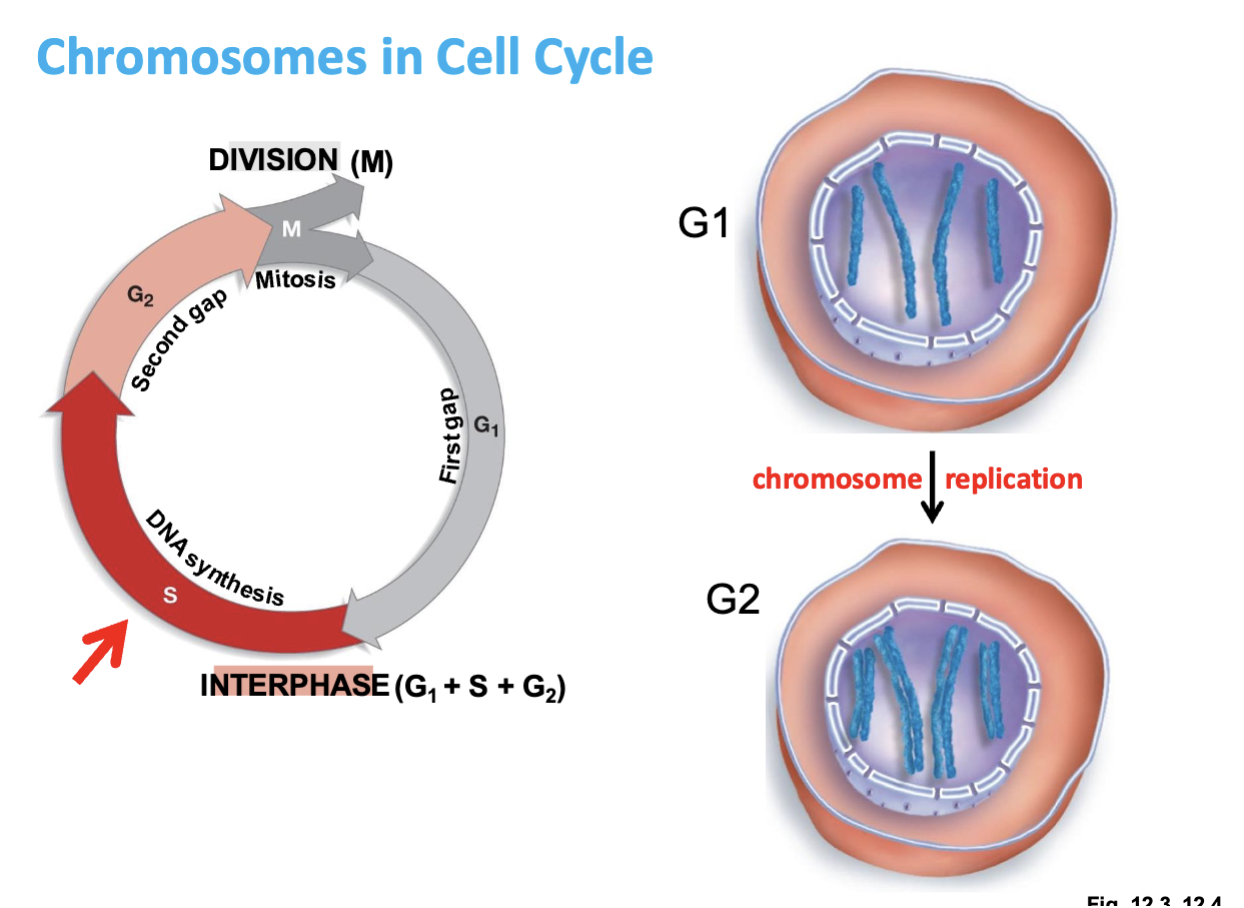
Chromosomes in Cell Cycle: S Phase
DNA replicates. The chromosome number remains 4, but each chromosome is now duplicated
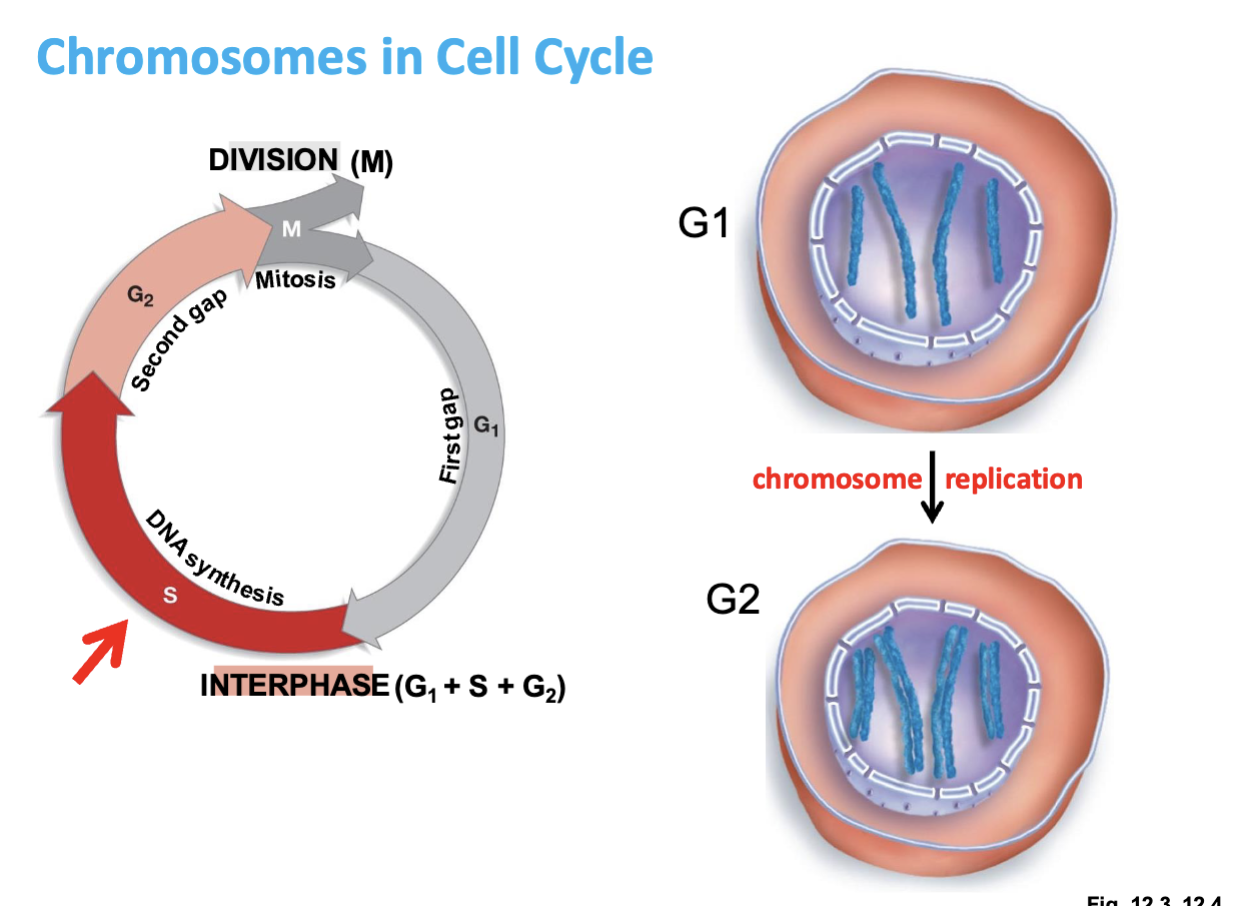
Chromosomes in Cell Cycle: G2 Phase (initially)
(after DNA Synthesis) still 4 chromosomes —> 2 exact copies of chromatin
cohesins (proteins) stitch copies of chromatin together! —> behave as 1 chromosome
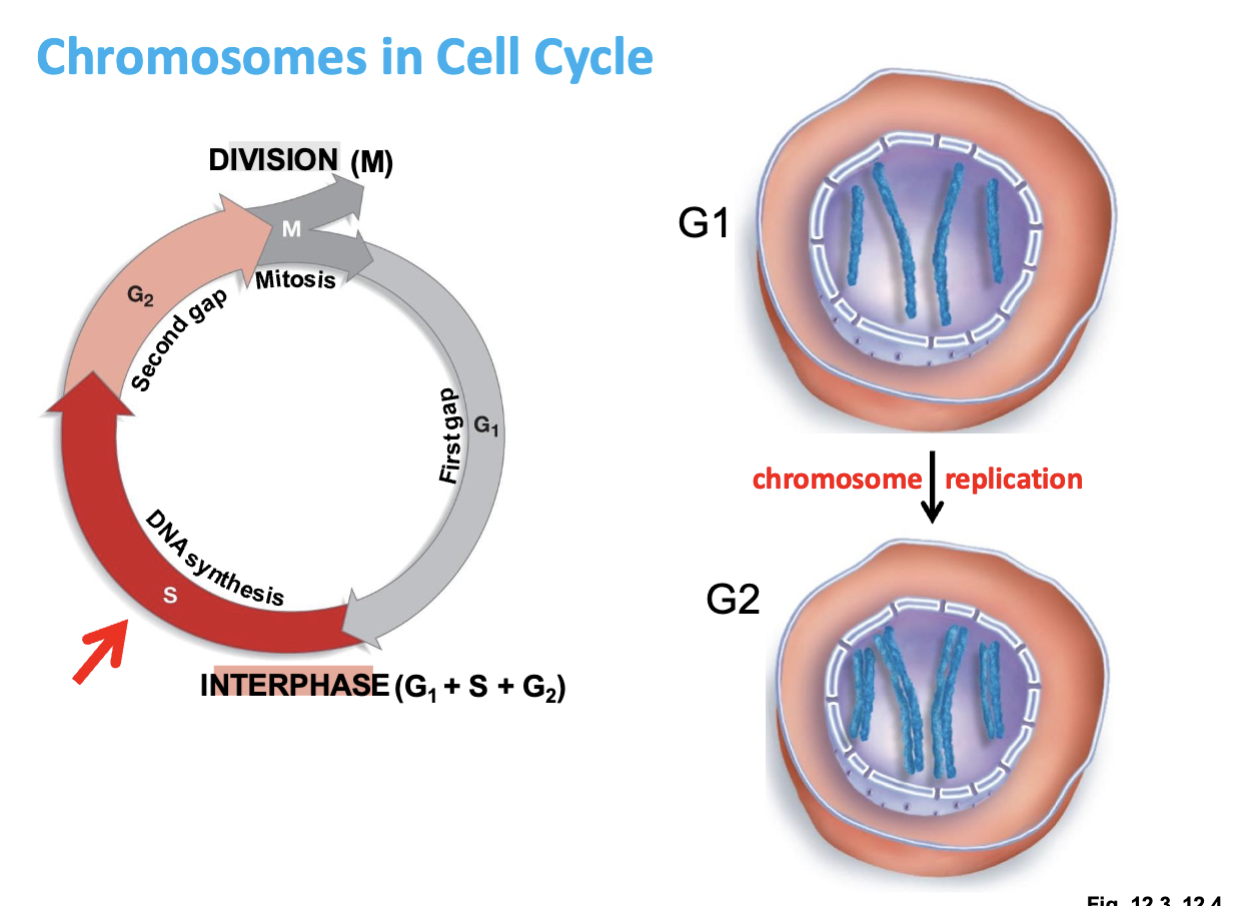
Chromosomes in Cell Cycle: G2 Progression
As cell progresses through end of G2, cohesins stay on
still 4 chromosomes each consisting of 2 identical sister chromatids
(BUT STILL LONG/LOOSELY COILED & UNCONDENSED) (fully develop in prophase)
Prophase: most arm cohesins come off
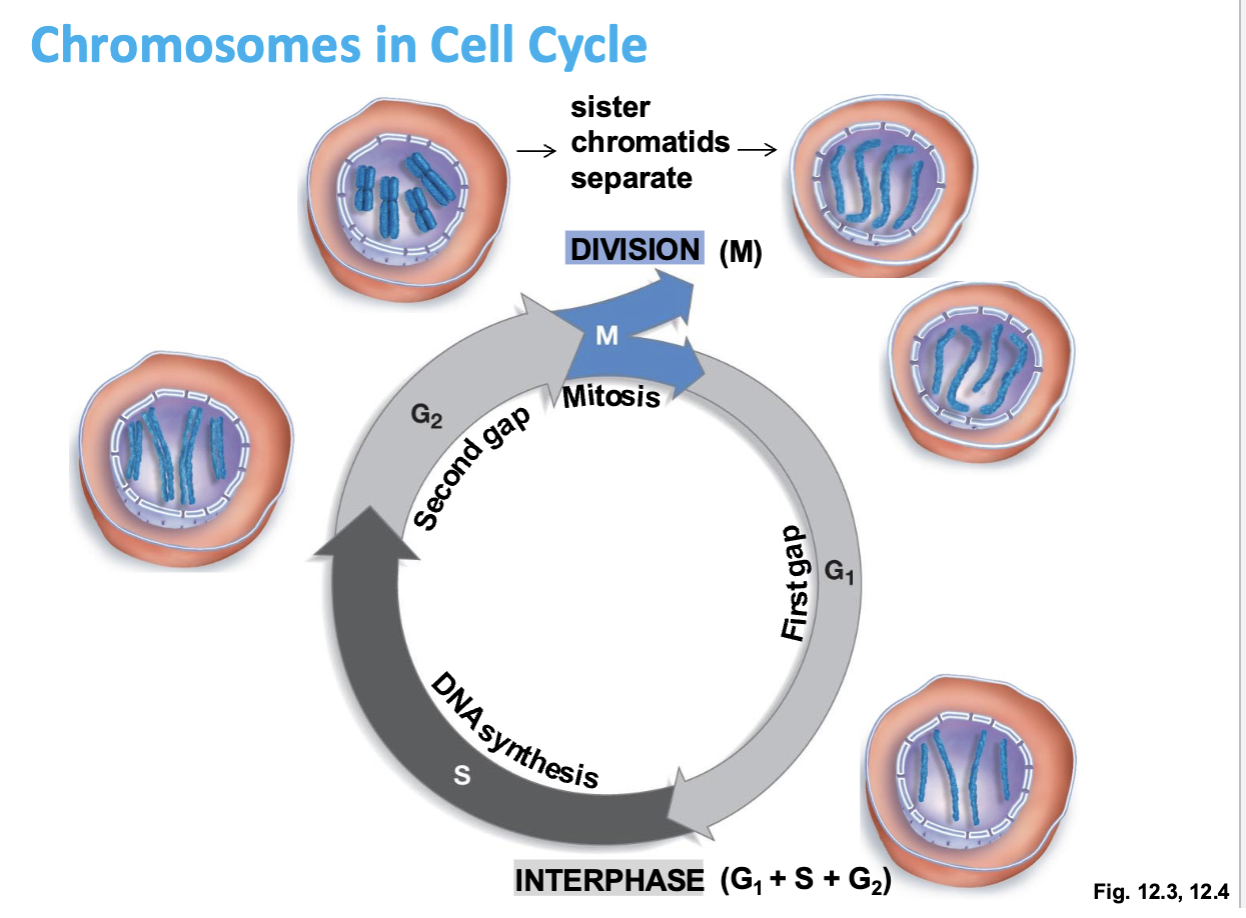
Chromosomes in Cell Cycle: Brief Description Mitosis
sister chromatids condense early on & then separate in mitosis
POST mitotic stage = 2 cells EACH WITH 4 chromosomes
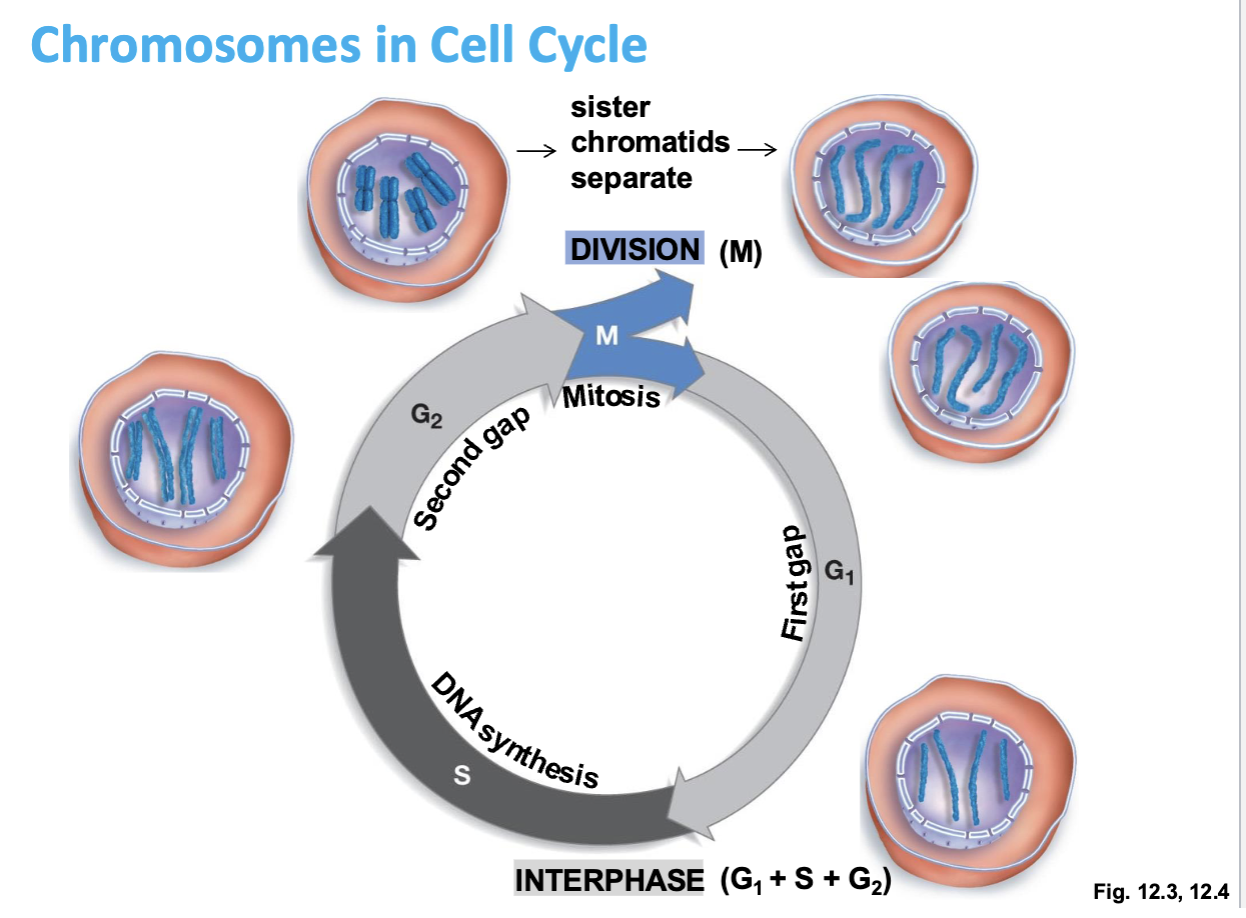
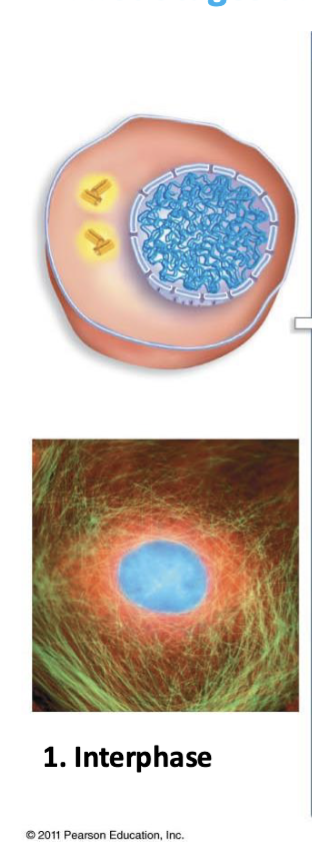
Prior to Mitosis: Interphase Cell
nuclear membrane intact during interphase (G1, S, G2)
chromatin uncondensed in nucleus
cell in G2 (cell & nucleus prepare itself) (chromosomes in G2 = sister chromatids joined w/cohesins + the centromere, but they are still long and tangled)
have Duplicate MTOC (centrosome in animals)
What moves chromosomes during mitosis?
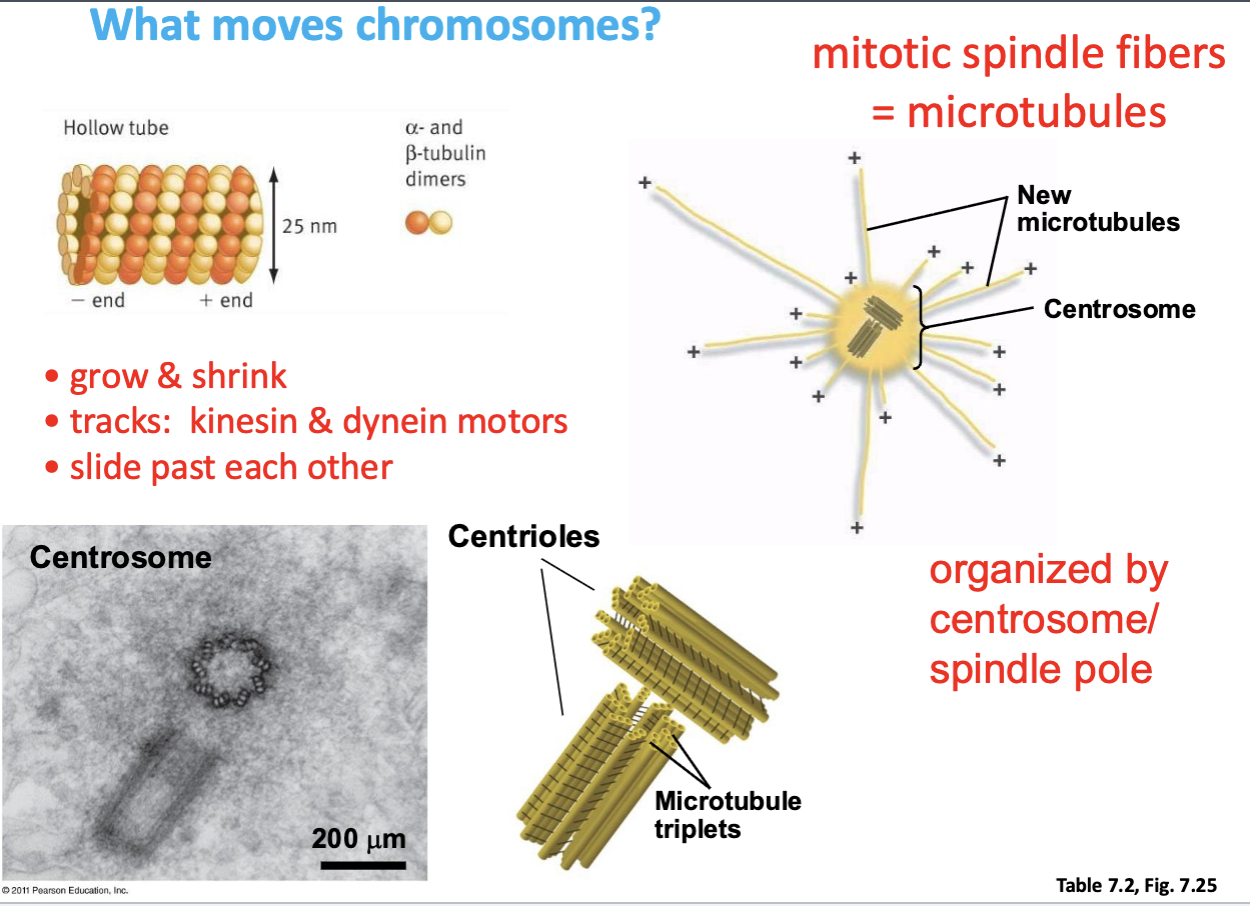
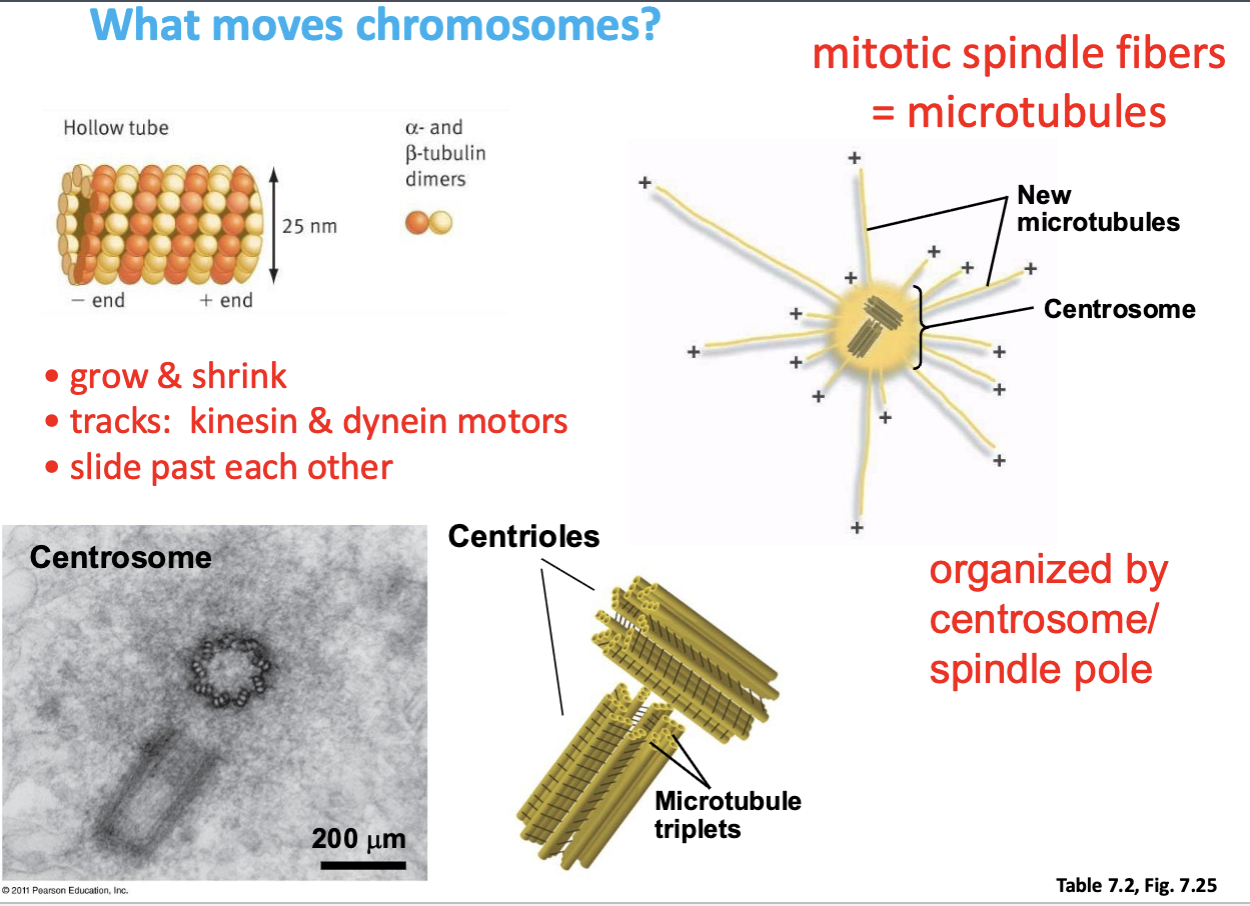
Mitotic spindle fibers = microtubules!
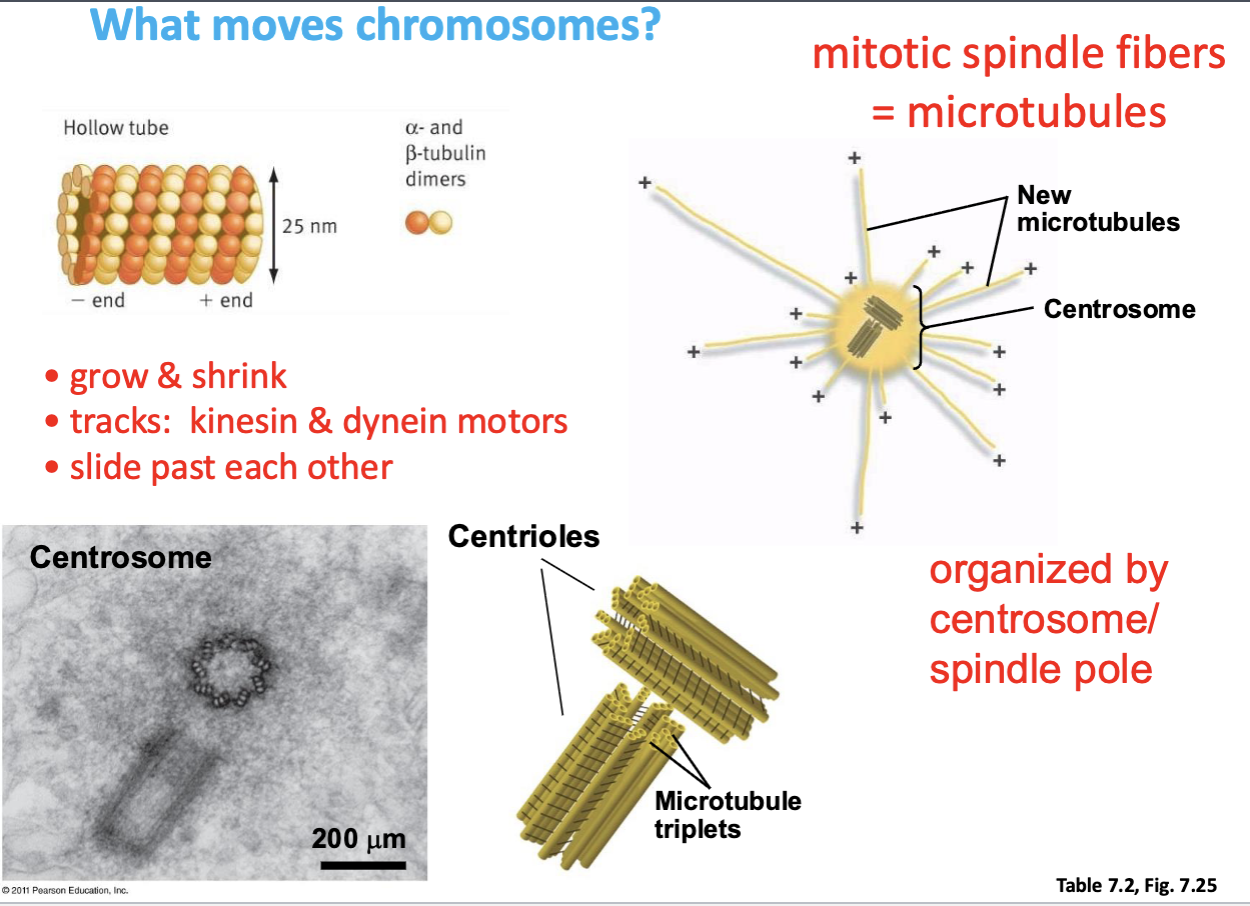
Microtubules are made up. by
alpha & beta tubulin (protein) subunits
—> form cylindrical hollow tubules
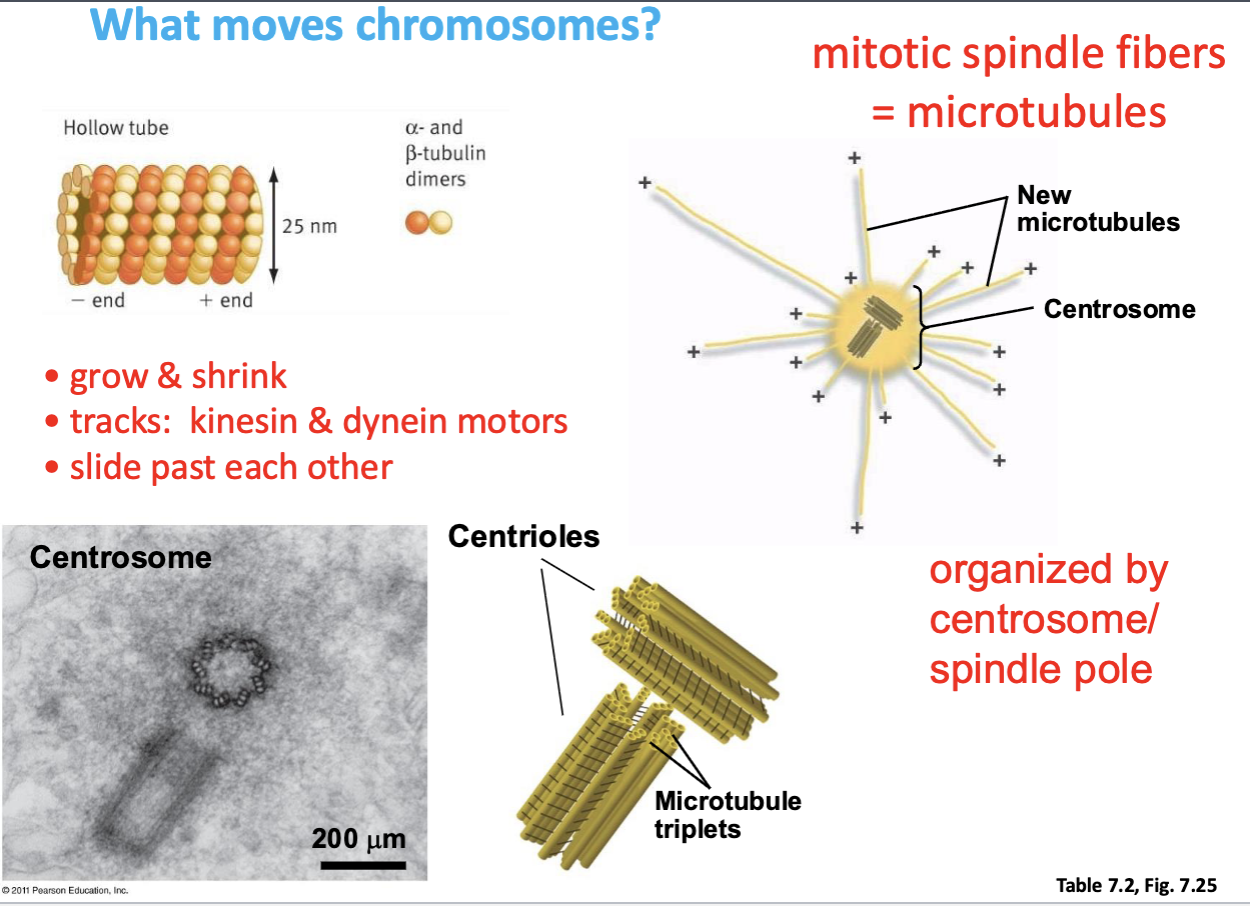
What motor proteins move along microtubules?
Kinesin and dynein motors
—> motors carry components (organelles, structures) along microtubules, but can aslo take 2 microtubules, connect them w/moto protein so walking makes them slide past each other!
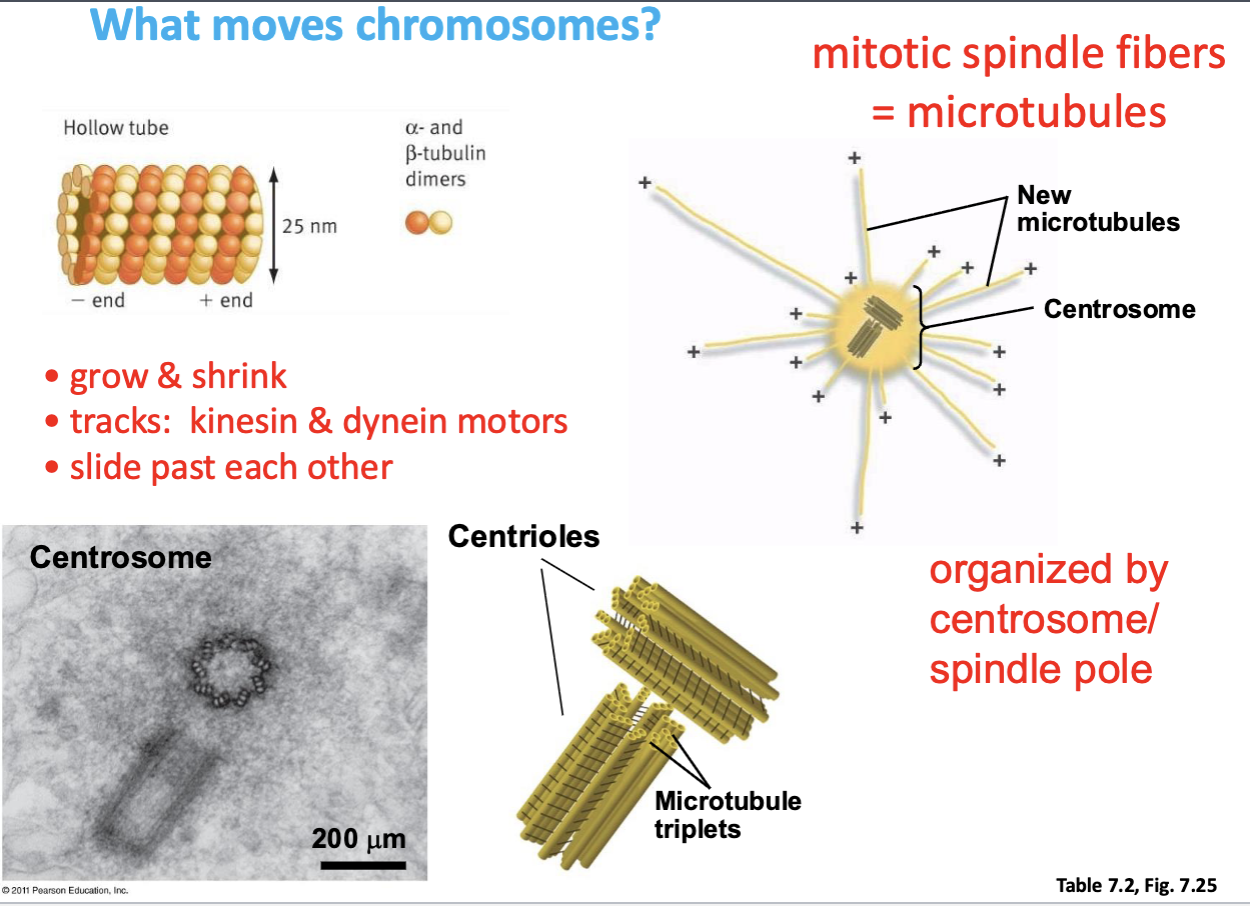
What properties of microtubules are important during mitosis?
grow & shrink
slide past each other (connected w/motoprotein so walking makes them slide past each other)
serve as tracks for kinesin & dynein motors
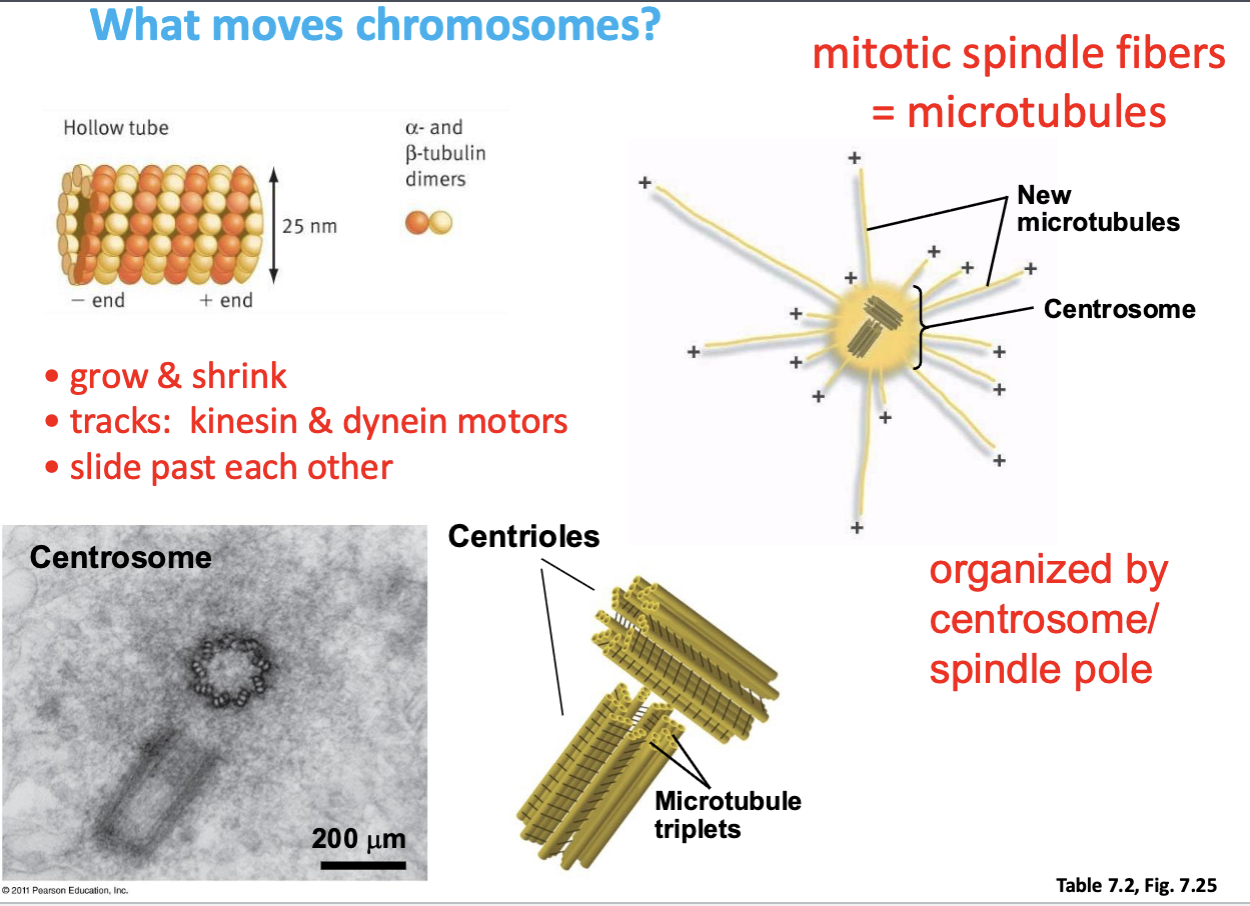
Microtubules have..
a positive and negative end!
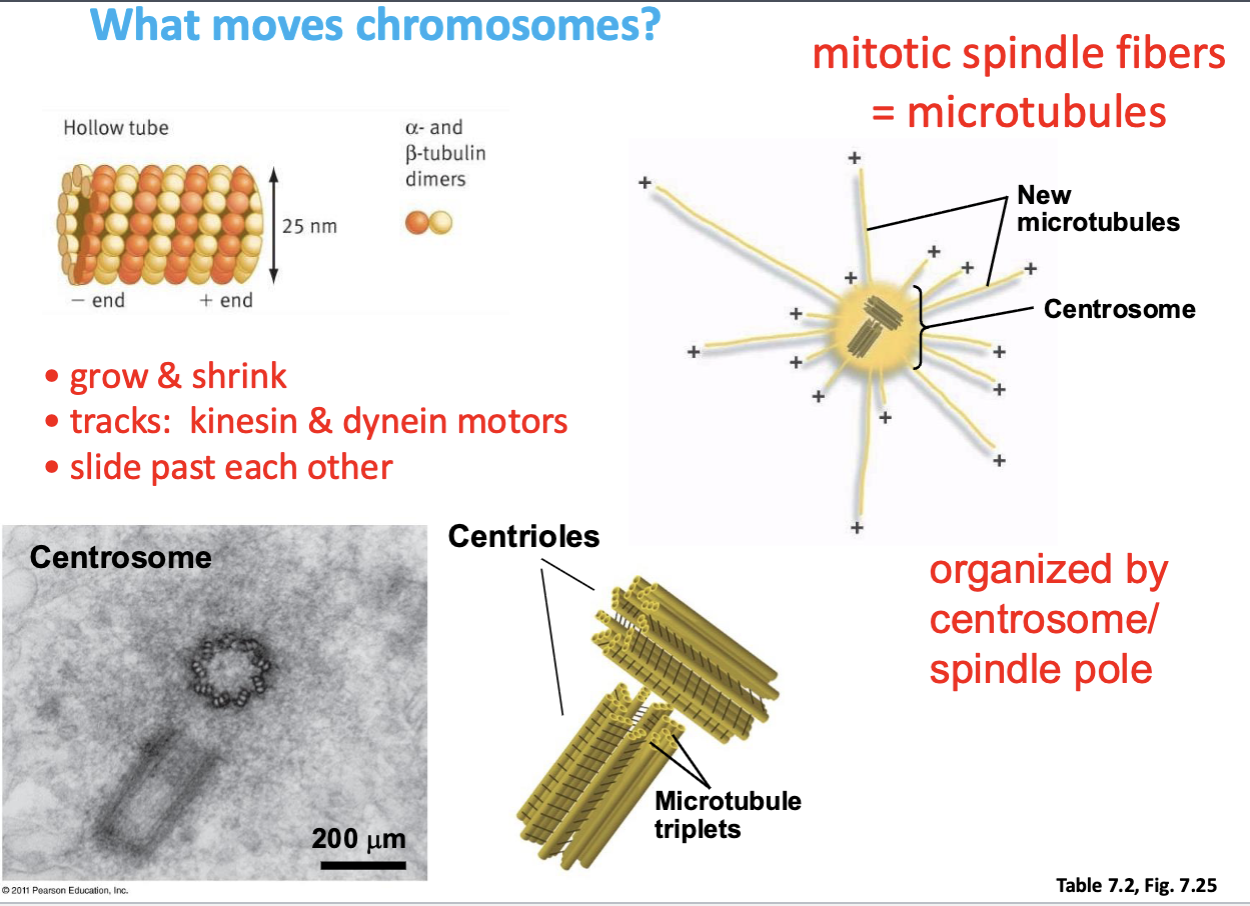
Where are the positive end of microtubules?
extending outward toward the cell periphery (the cell membrane or edges)
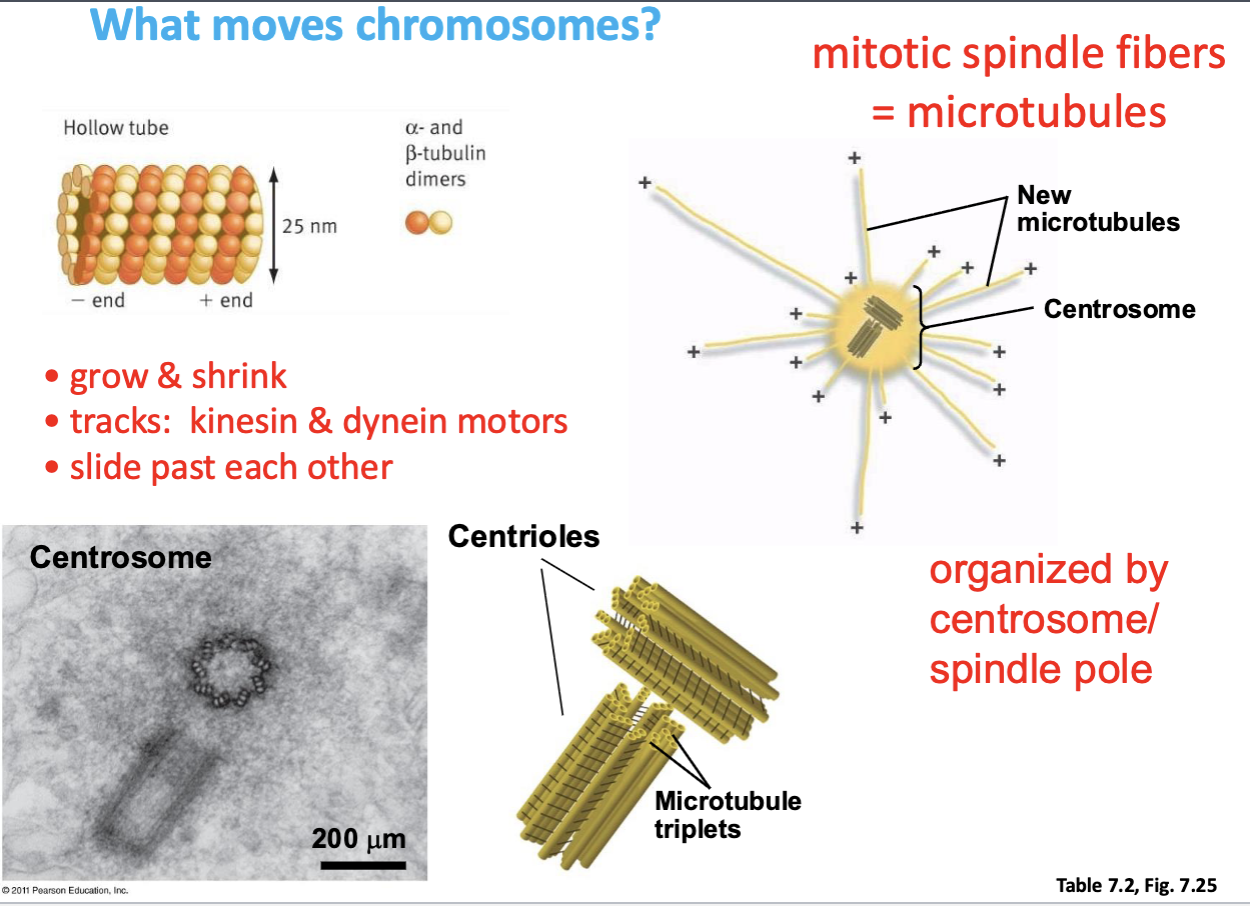
Where are the negative end of microtubules?
embedded into microtubule organizing center
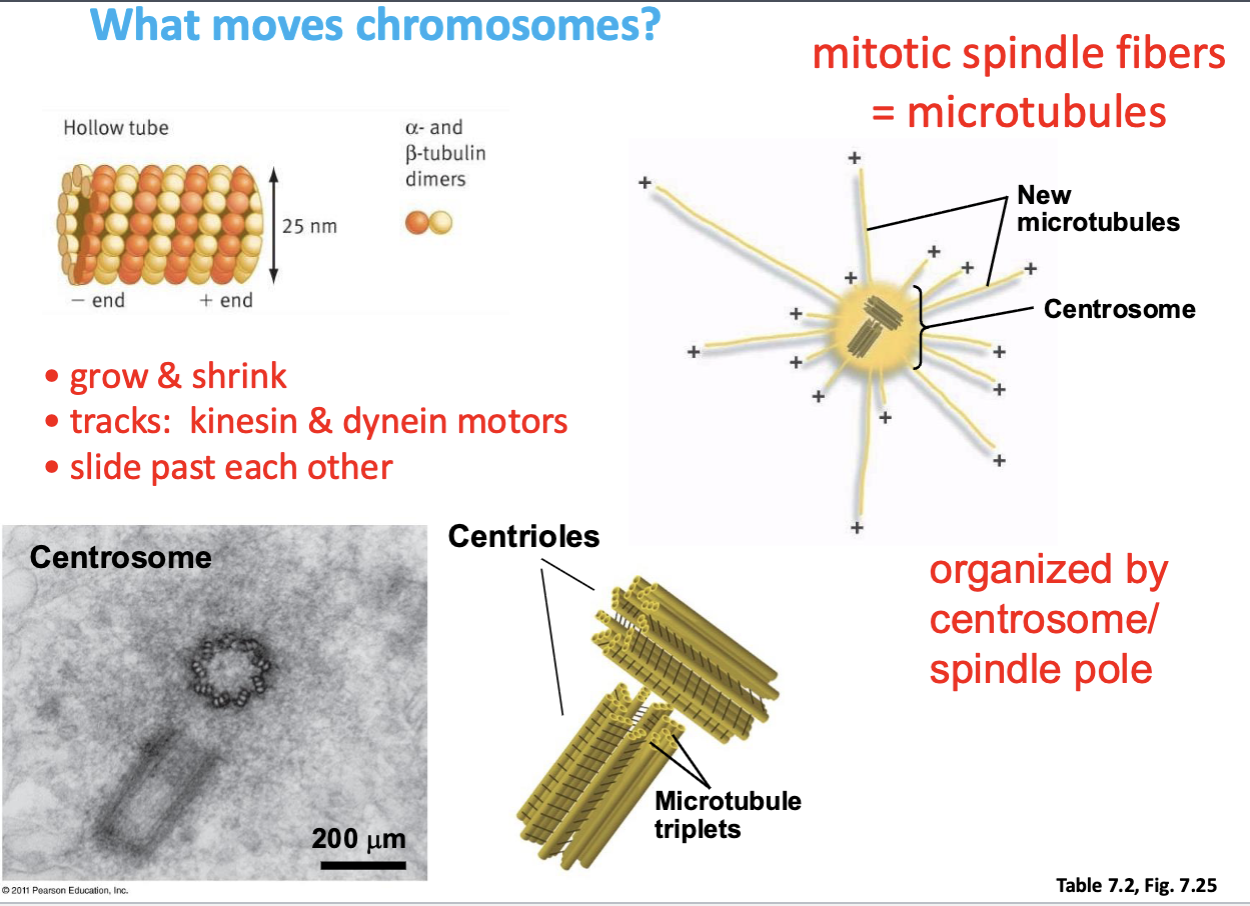
Microtubules are organized by..
centrosome/spindle pole (Microtubule organizing center)
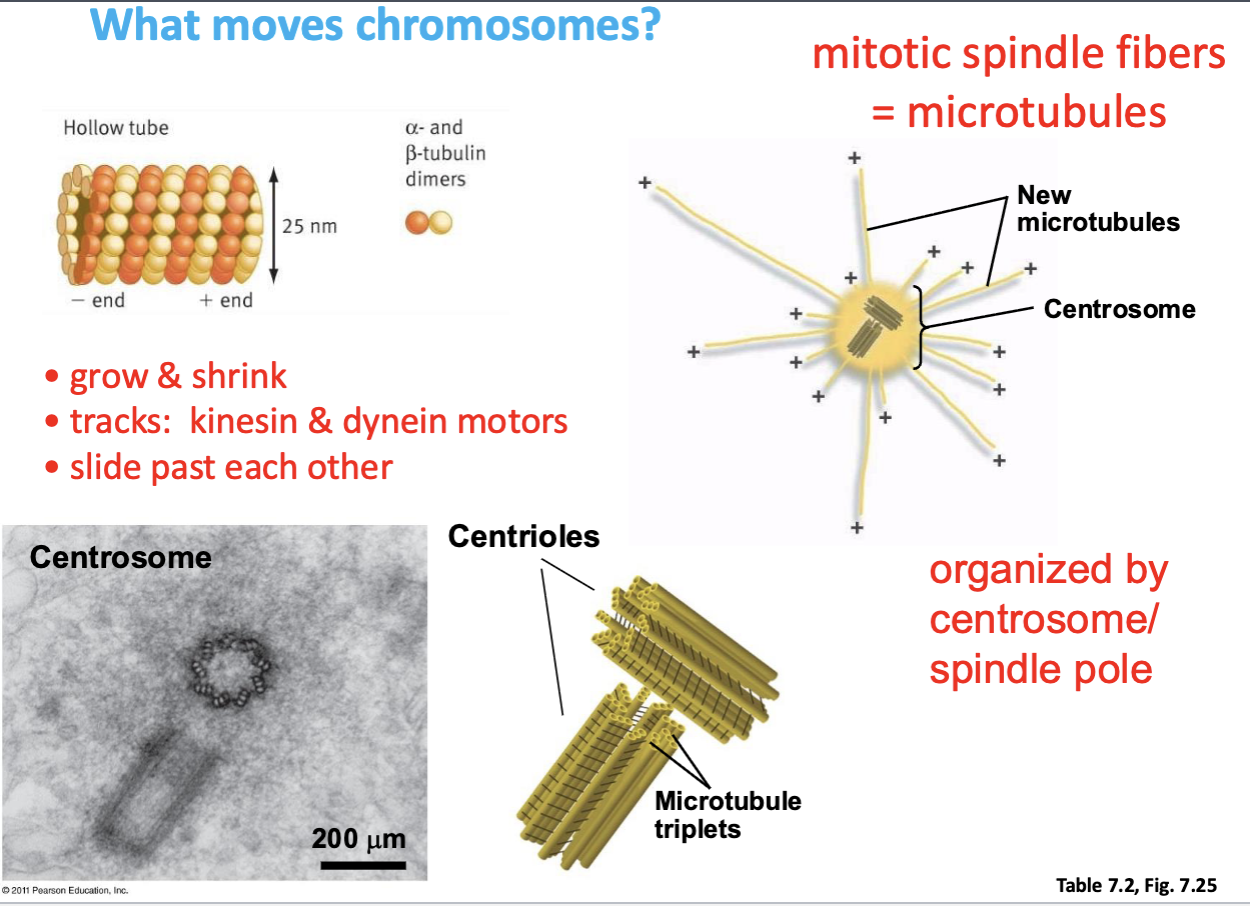
Zooming into MTOC…What are centrioles?
center of centrosome from which all of microtubule fibers/spindles are going to derive from
What are centrioles in the MTOC made up of?
made up of triplets of microtubules organized in a nonomer (9) pattern
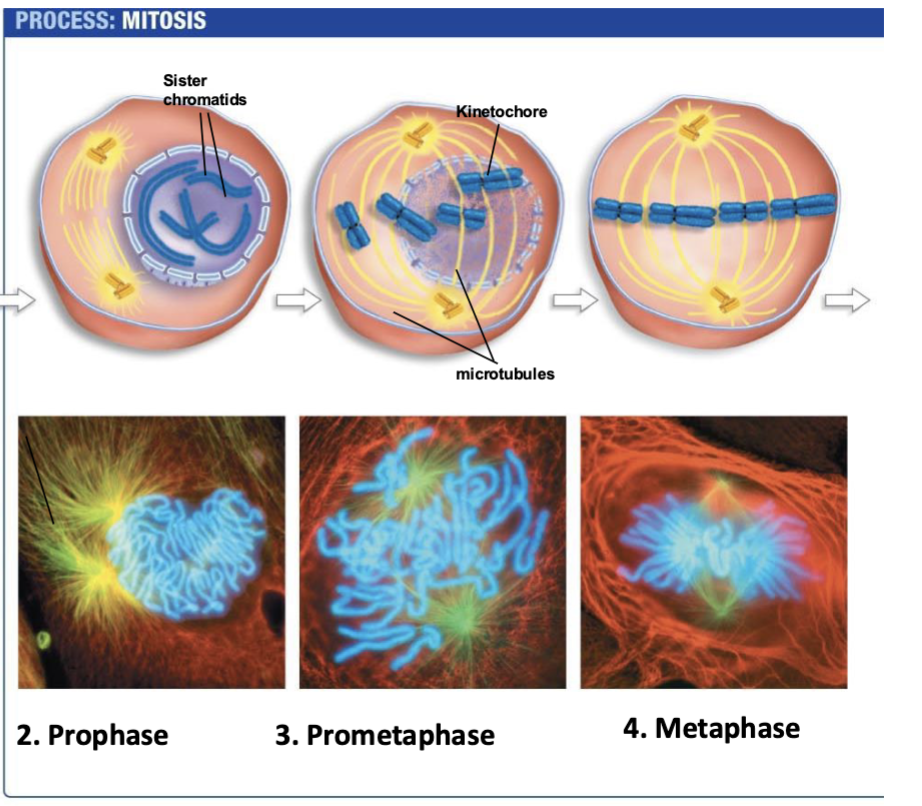
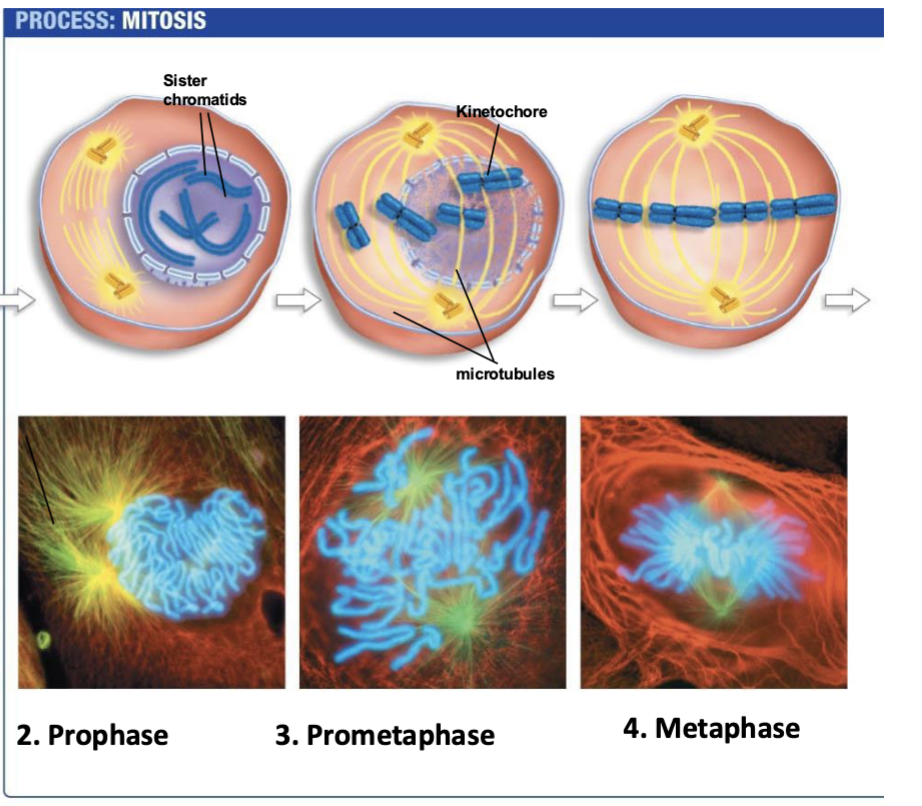
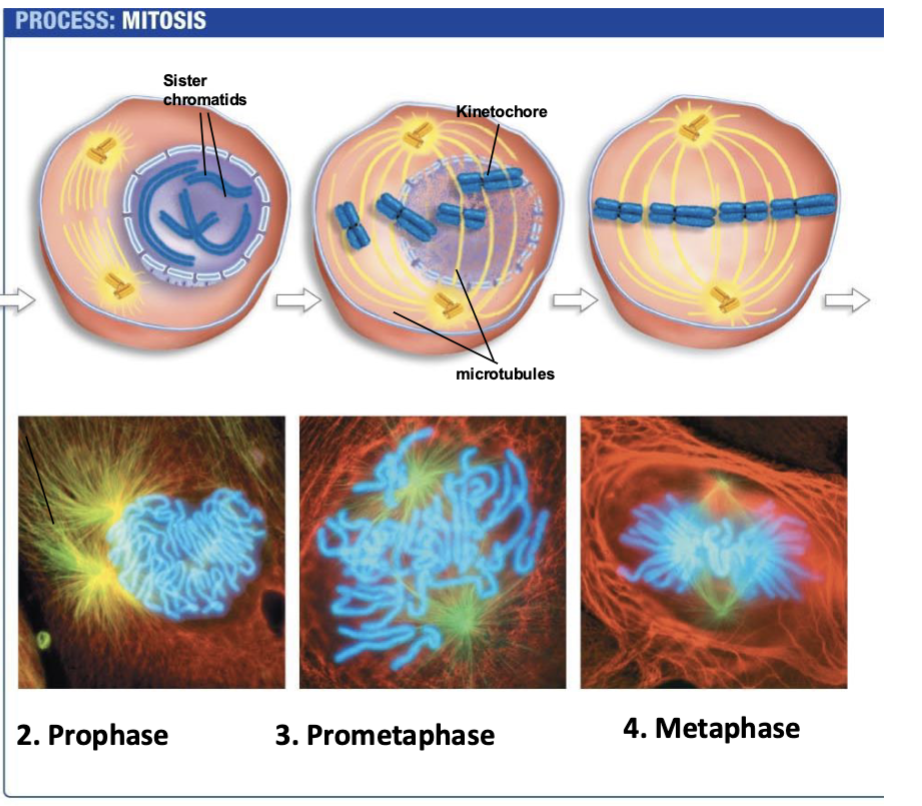
First Stages of Mitosis: Prophase
“early phase”
Each MTOC separate itself & nevigate toward seperate poles of cells
chromatin condense into sister chromatid + long, loose sister chromatids condense to become short, thick, and moveable (X shape)
What happens to chromatin during prophase?
it condenses into visible sister chromosomes (X shape)
First Stages of Mitosis: Prometaphase
“Early Middle” phase
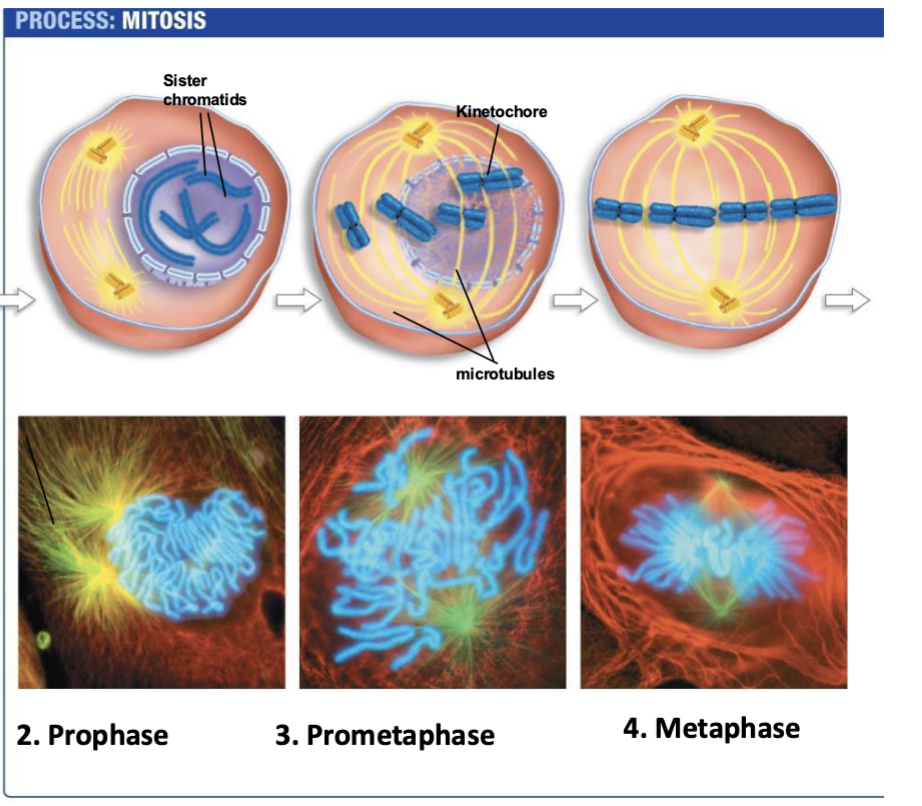
Microtubules from MTOC reach out & pair up w/sister chromatids —> Attach to kinetochores
full condensation of chromosomes
degradation of nuclear membrane
What important event allows spindle fibers to access chromosomes?
Breakdown of the nuclear envelope.
What phase of mitosis does the breakdown of nuclear envelope occur?
Prometaphase
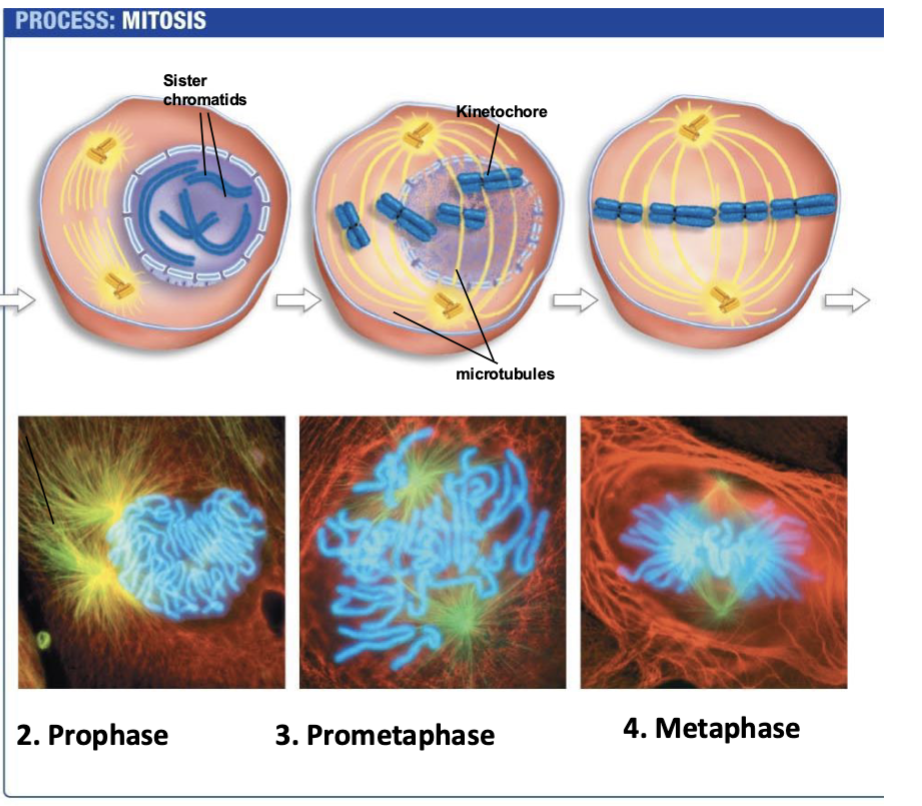
First Stages of Mitosis: Metaphase
each sister chromatid tethered to MTOC via microtubule attachment @ kinetochore of centromere
MOTC fully positioned on opposite poles of cell
alignment of all chromosomes @ metaphase plate
What is the metaphase plate?
Imaginary plane where chromosomes line up during metaphase.
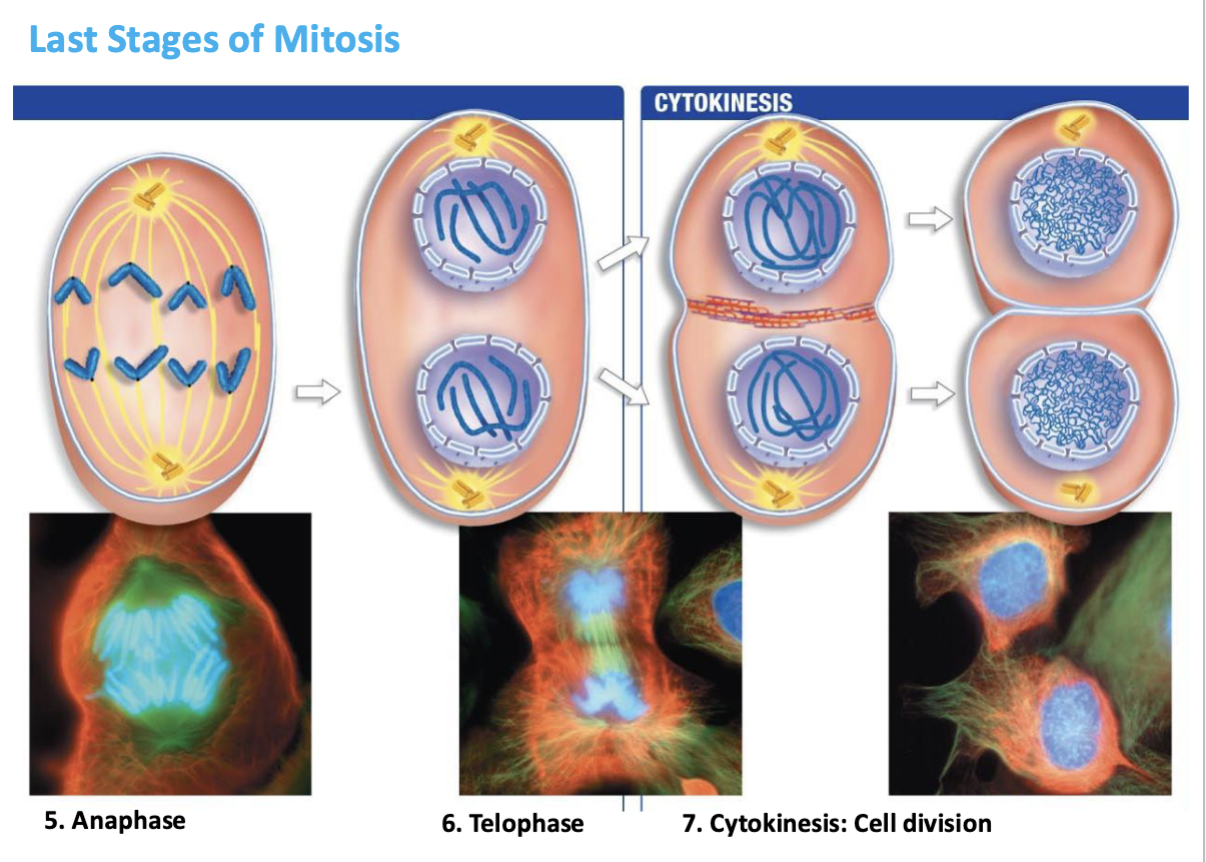
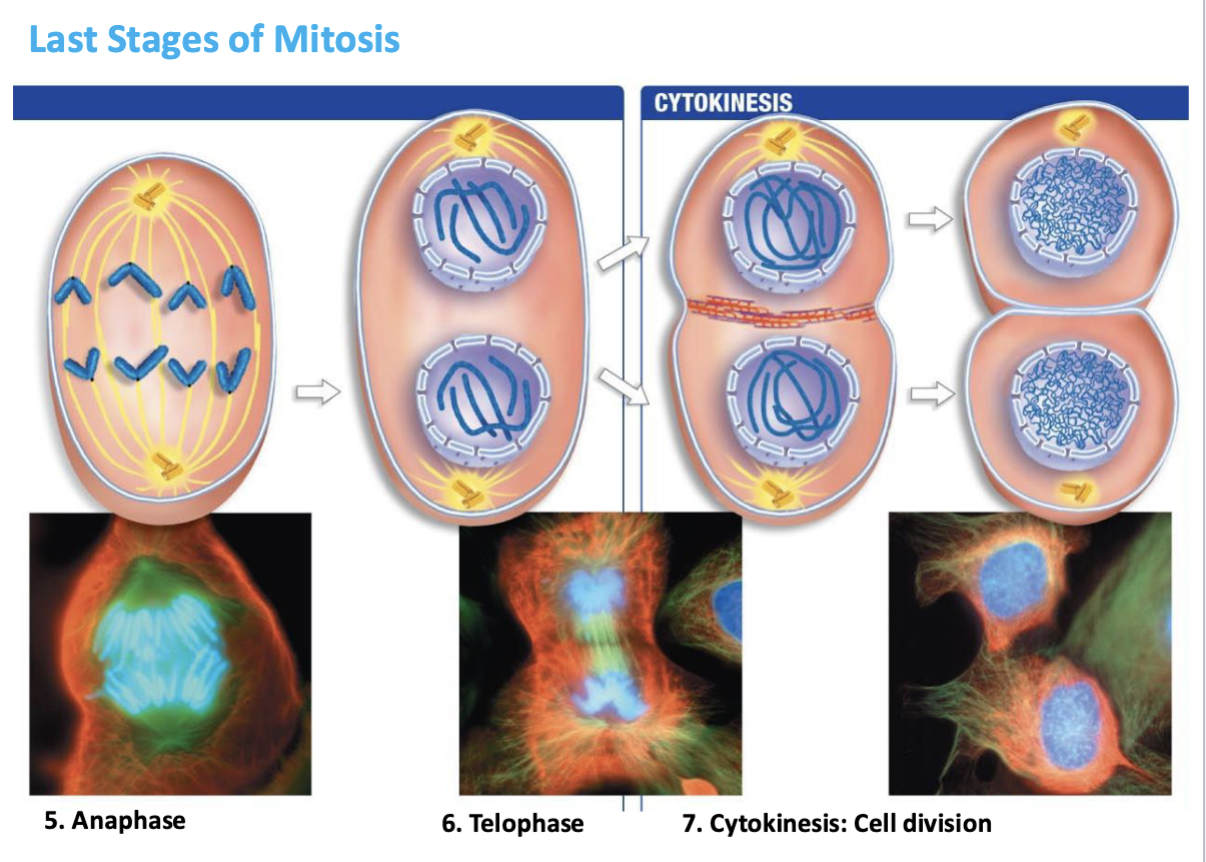
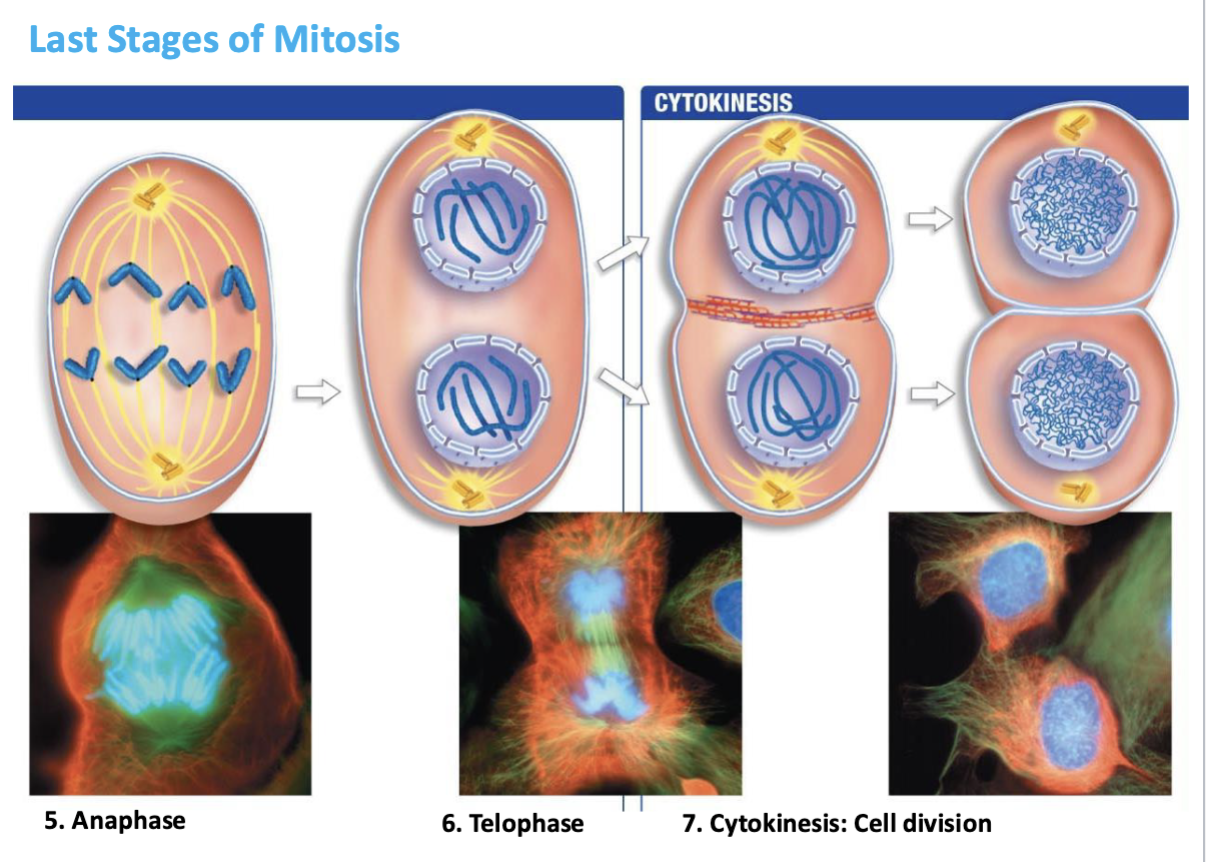
Last Stages of Mitosis: Anaphase
'“Against” Phase
Last of cohesins degraded by enzymes & sister chromatids can move against each other & pull away towards independent poles of parent cell
DOUBLE number of chromosomes
What triggers chromosome movement during anaphase?
Microtubule shortening and motor proteins.
What are the two types of movement during anaphase?
sister chromatids move toward poles and spindle poles move farther apart.
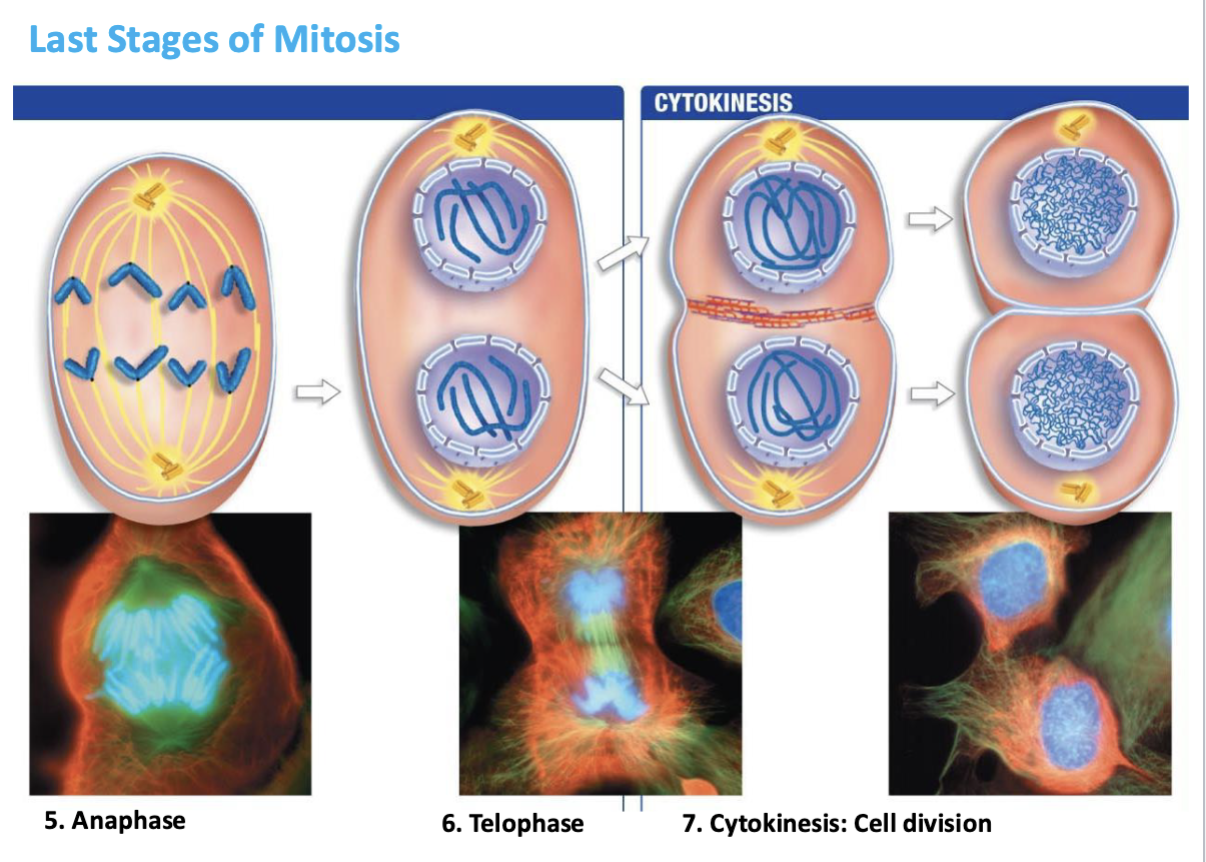
Last Stages of Mitosis: Telophase
End phase
nuclear membranes reform around decondensing chromosomes (decondense back into chromatin)
degradation of microtubules
Microtubule Degradation: Power to pull chromosomes & move towards independent poles comes from….
comes from hydrolysis of alpha & beta tubulin subunits (microtubule degradation)
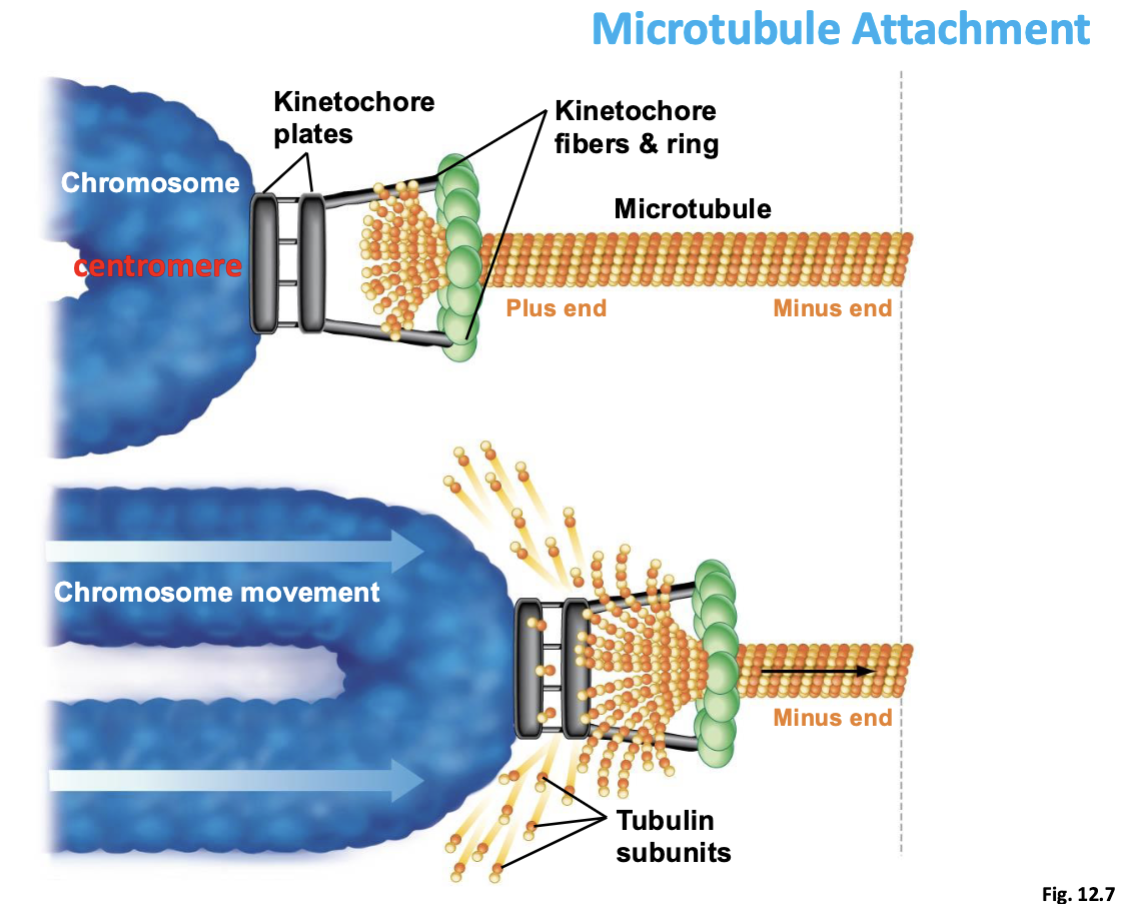
Microtubule degradation
Kinetochore fibers & ring (attached to centromere) pulls chromosome while degrading microtubules
Last Stages of Mitosis: Cytokinesis
cell division
Division of the cytoplasm into two daughter cells.
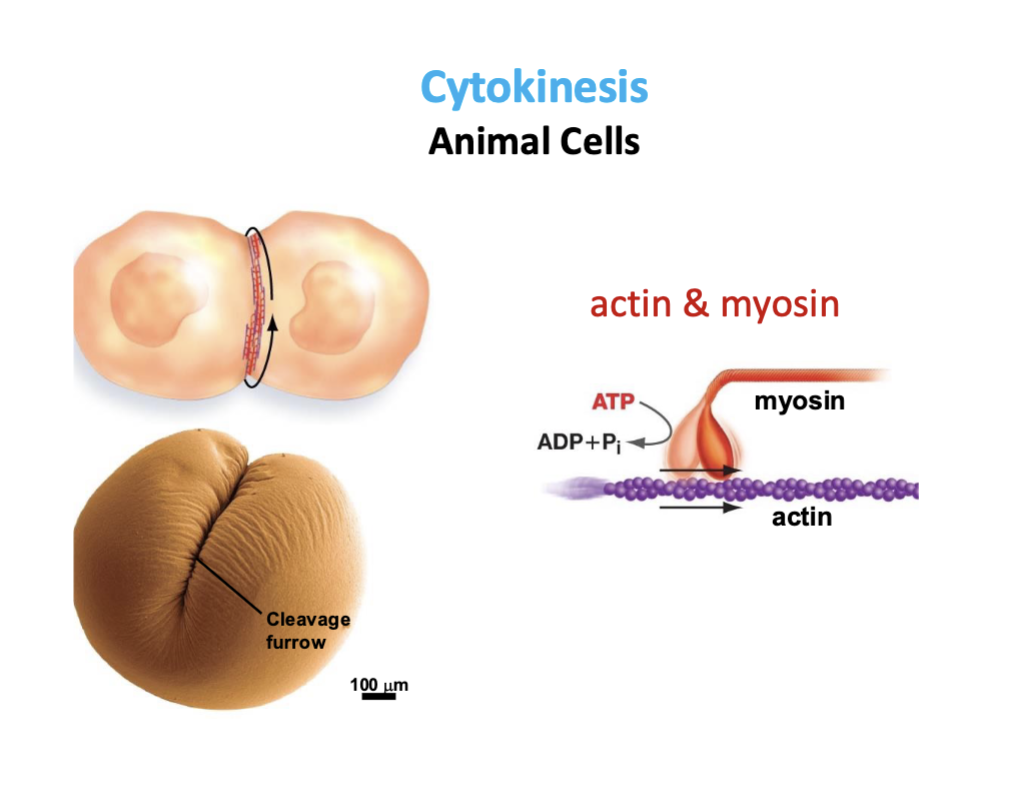
What proteins are involved in cytokinesis in animal cells?
Actin and myosin
think “cinching belt”
motor force drives cinching/closing of actin filaments driven through myosin protein
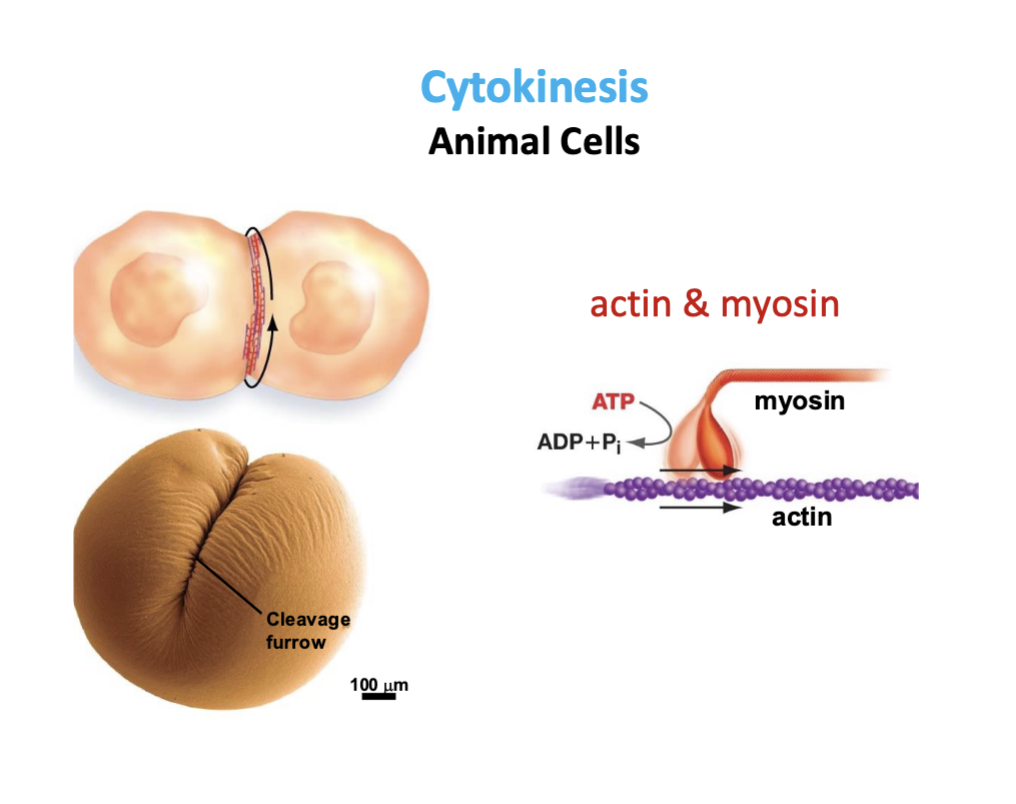
Division of Cell: As myosin walks along actin filaments…
actin filaments pulled closer together, shrink ring & create cleaver furrow —> breakage between cells & detaches cells apart
Chromosomes condense and spindle begins forming.
Prophase
Nuclear envelope breaks down and spindle attaches to chromosomes.
Prometaphase
Chromosomes aligned at cell center.
Metaphase
Sister chromatids separate.
Anaphase
Nuclear Envelope reform
Telophase
Cytoplasm divides
cytokinesis
Why is cell cycle regulation important?
Controls timing/order of division and prevents damaged cells from dividing.
some cells rapidly divide (RBC’s 2-3 million/second)
some cells rarely divide (neurons seldomly divide, usually in G0)
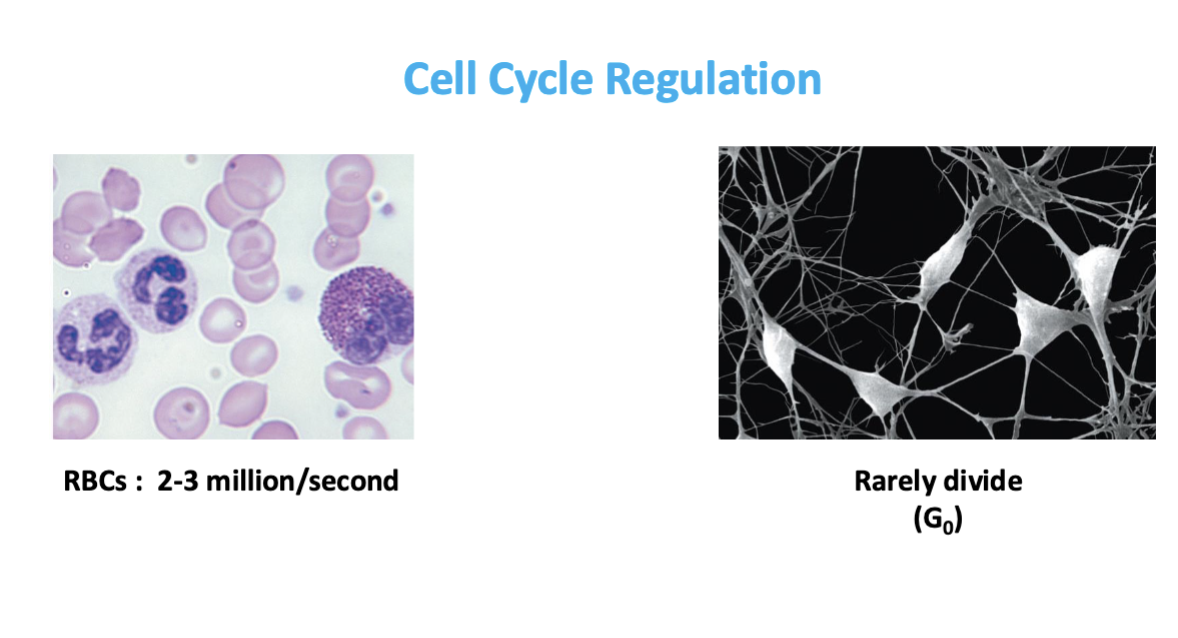
Some regulation cell has to keep in mind
Rate of cell division
Maintaining order of stages
Stop if problems
What regulates progression through the cell cycle?
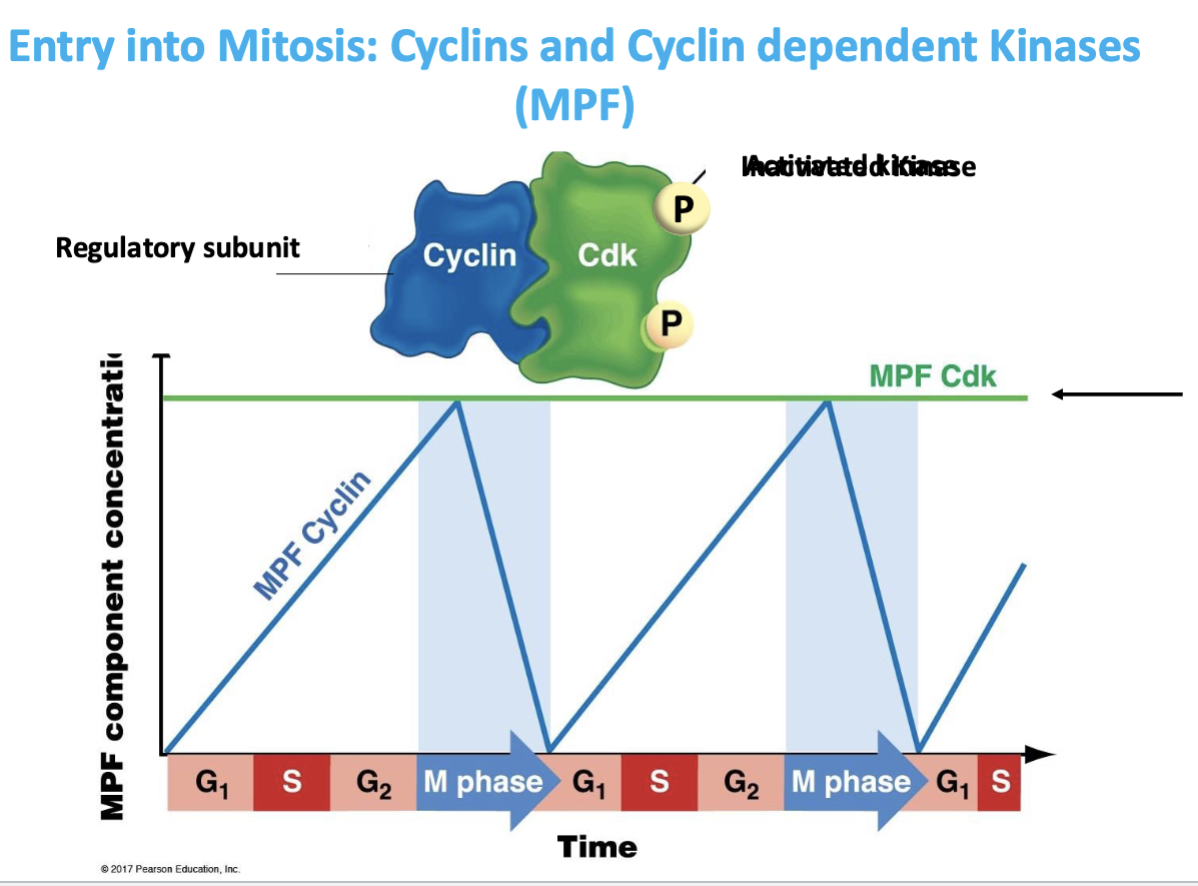
Cyclins and cyclin-dependent kinases (Cdks) (MPF)
kinases = proteins that phosphorylate
What is MPF?
Mitotic Promoting Factor
Mitotic cyclin/Cdk complex that promotes entry into mitosis.
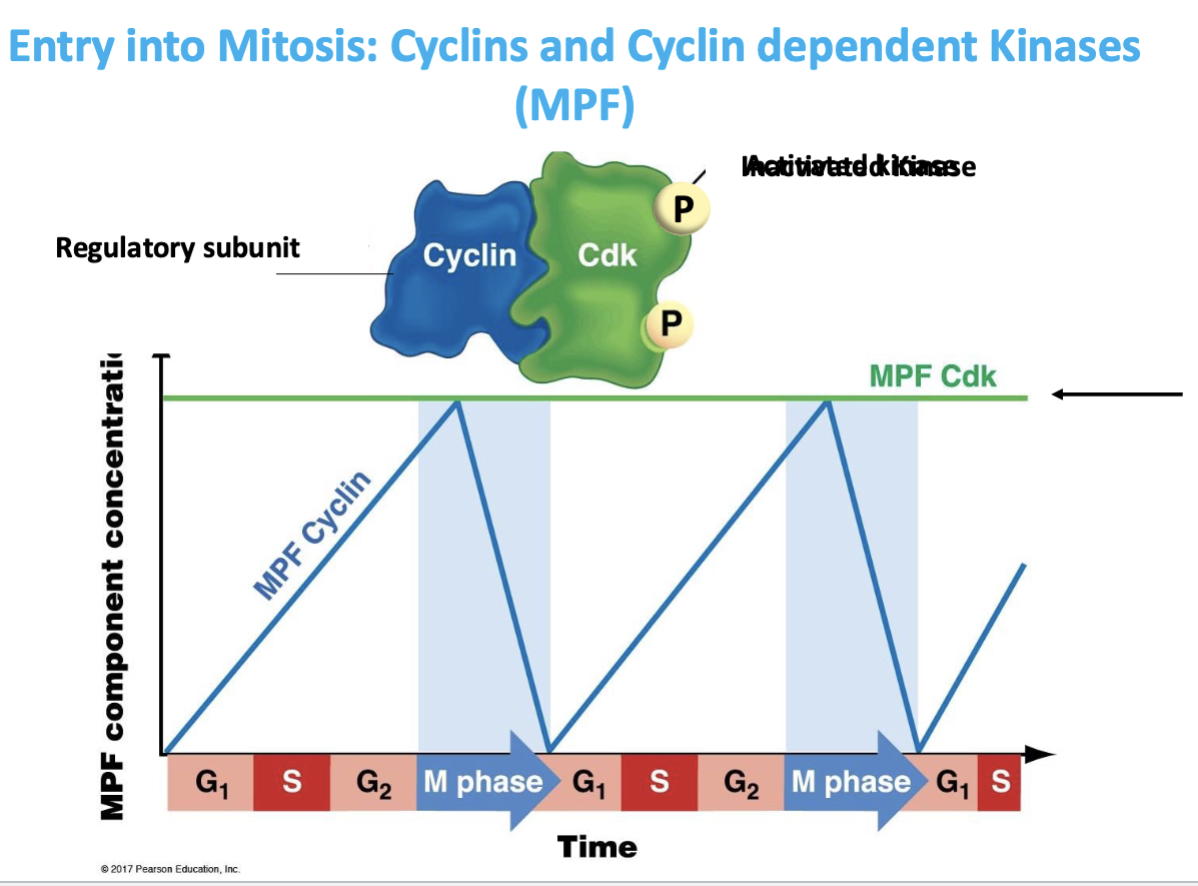
Regulatory Subunit of MPF
Cyclin (does not act alone)
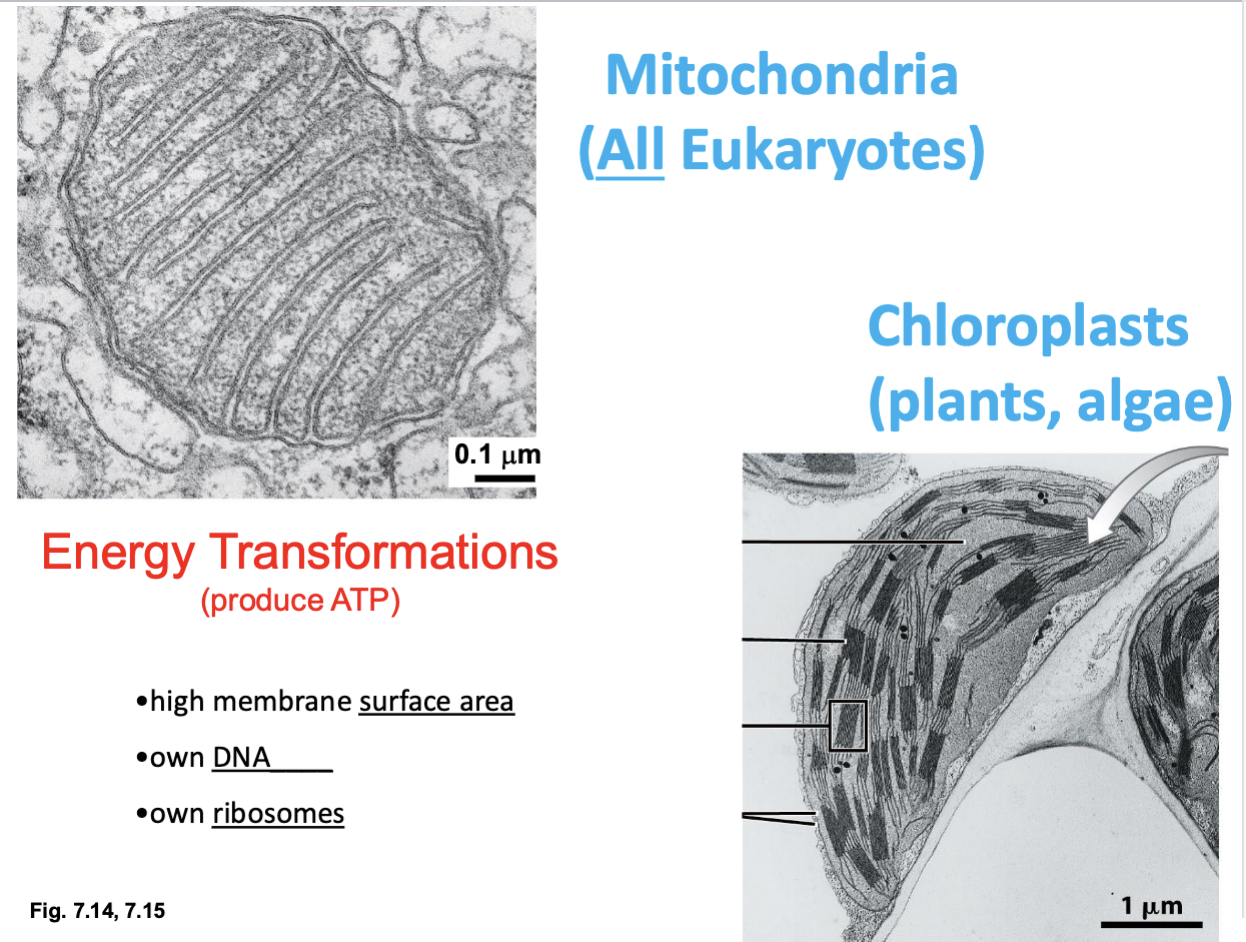
MPF CDK has an allosteric site (on top)
determine whether it is activated or inactivated
allosteric site dephosphorylated to kickstart mitosis & cyclin dependent —→ linase is active
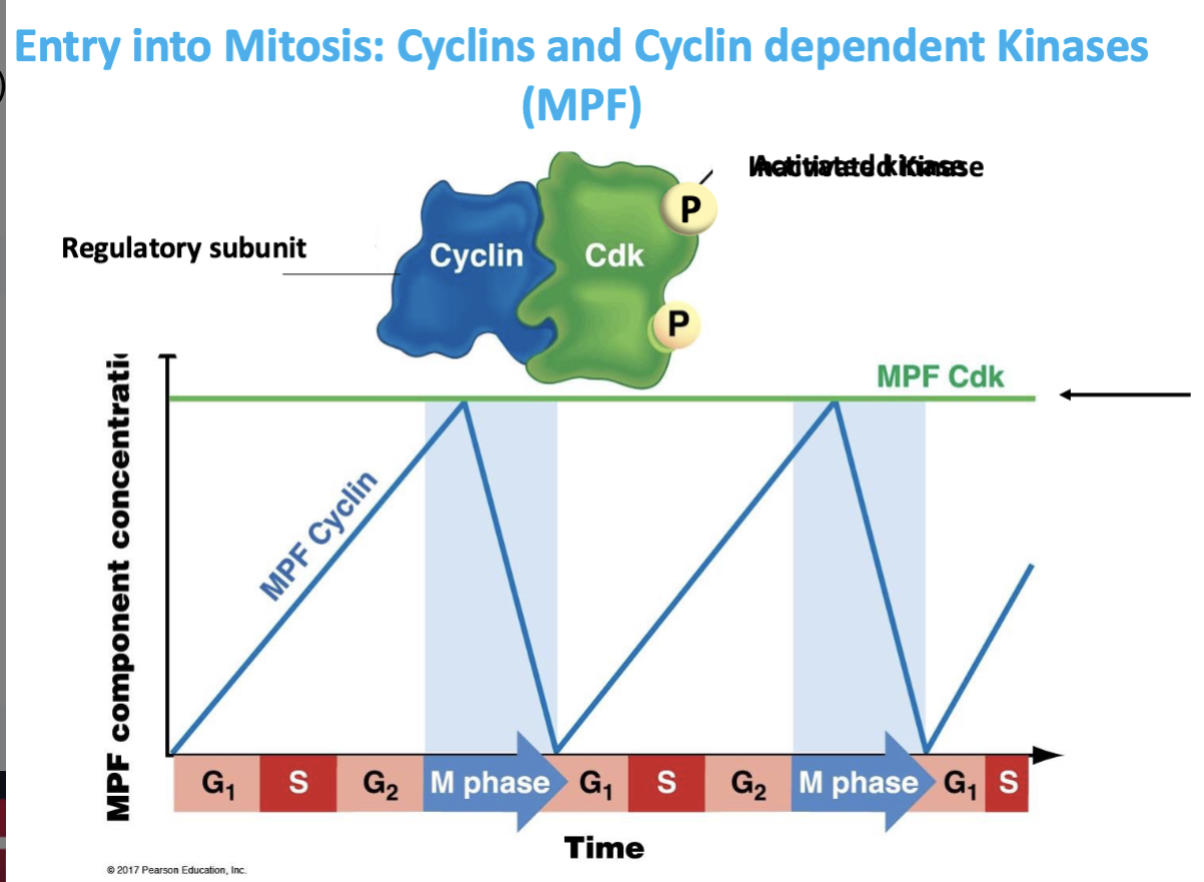
MPF CDK is active when
it has 1 phosphate
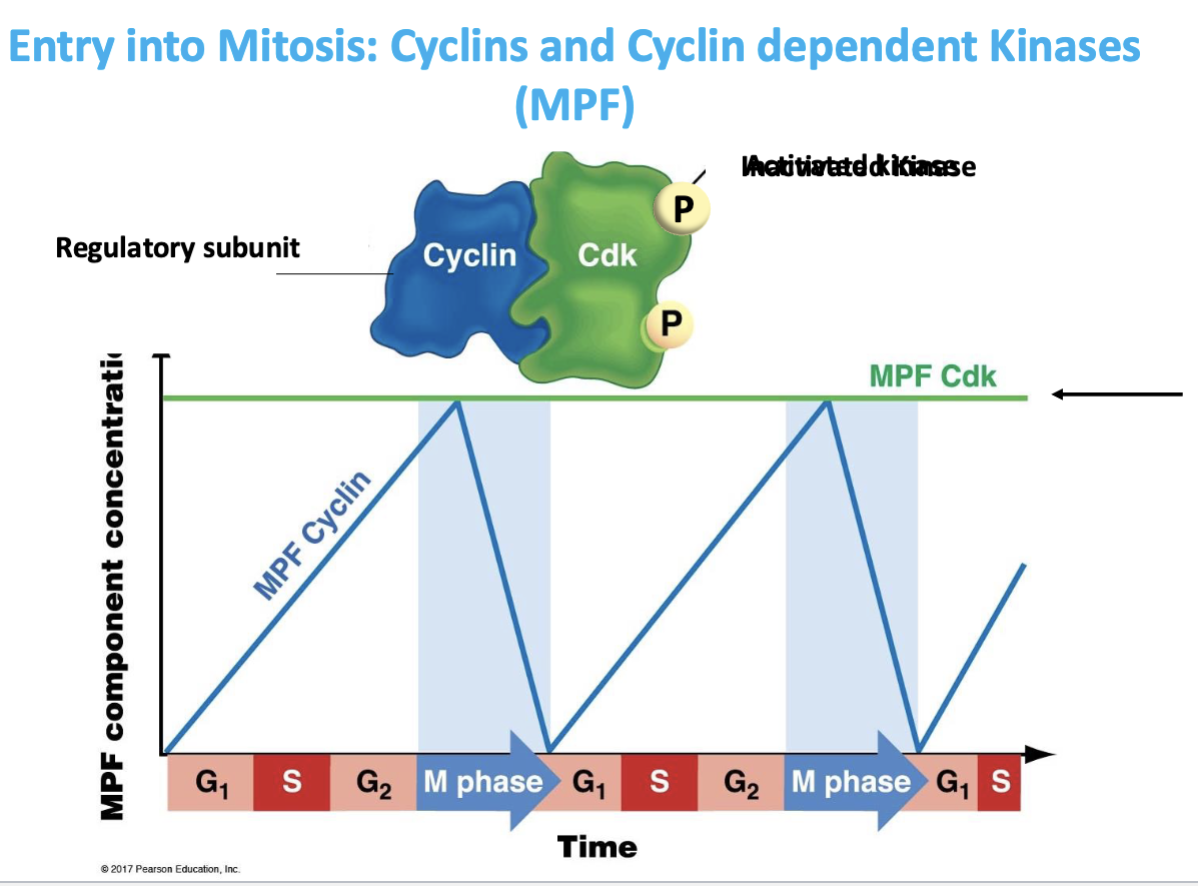
MPF CDK is inactive when
it has 2 phosphates
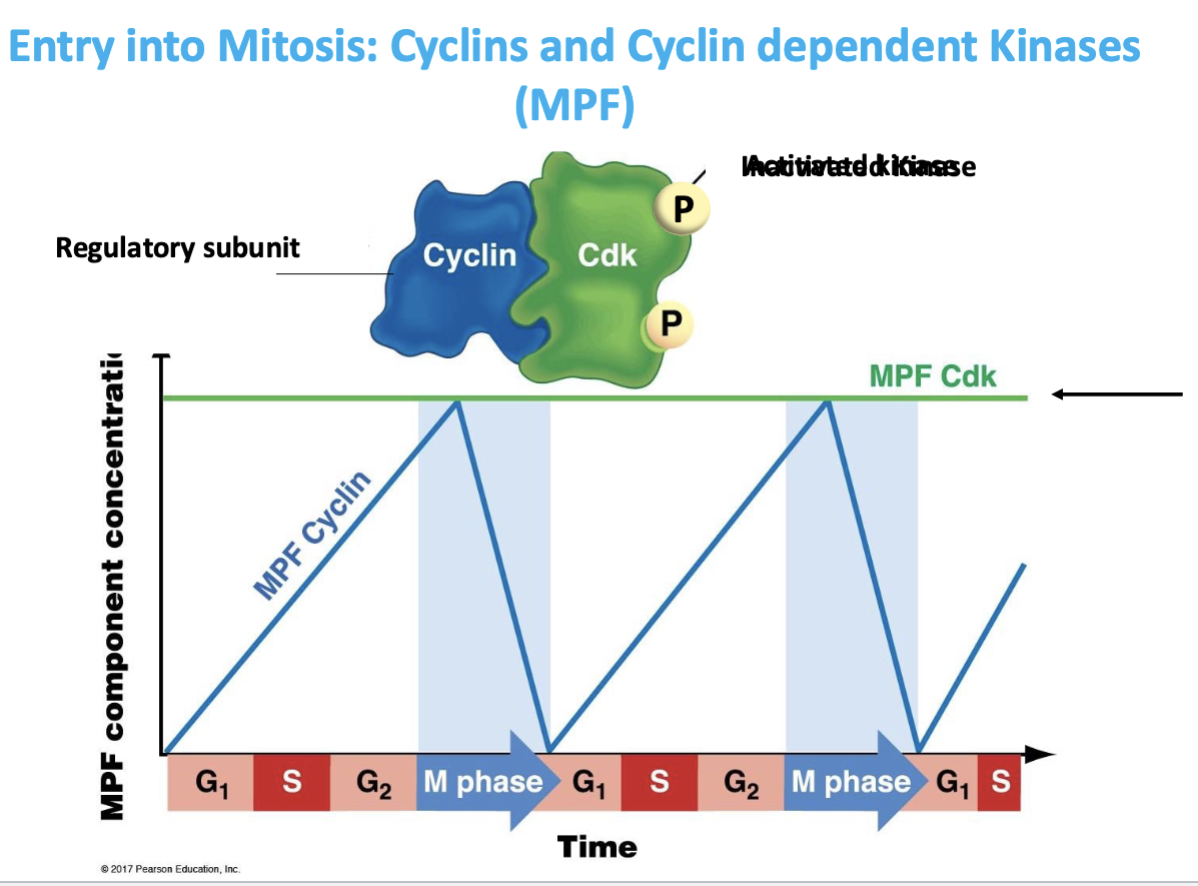
MPF Cyclin increases during…
interphase
cyclin-dependent Kinase inactive (double phosphorylated)
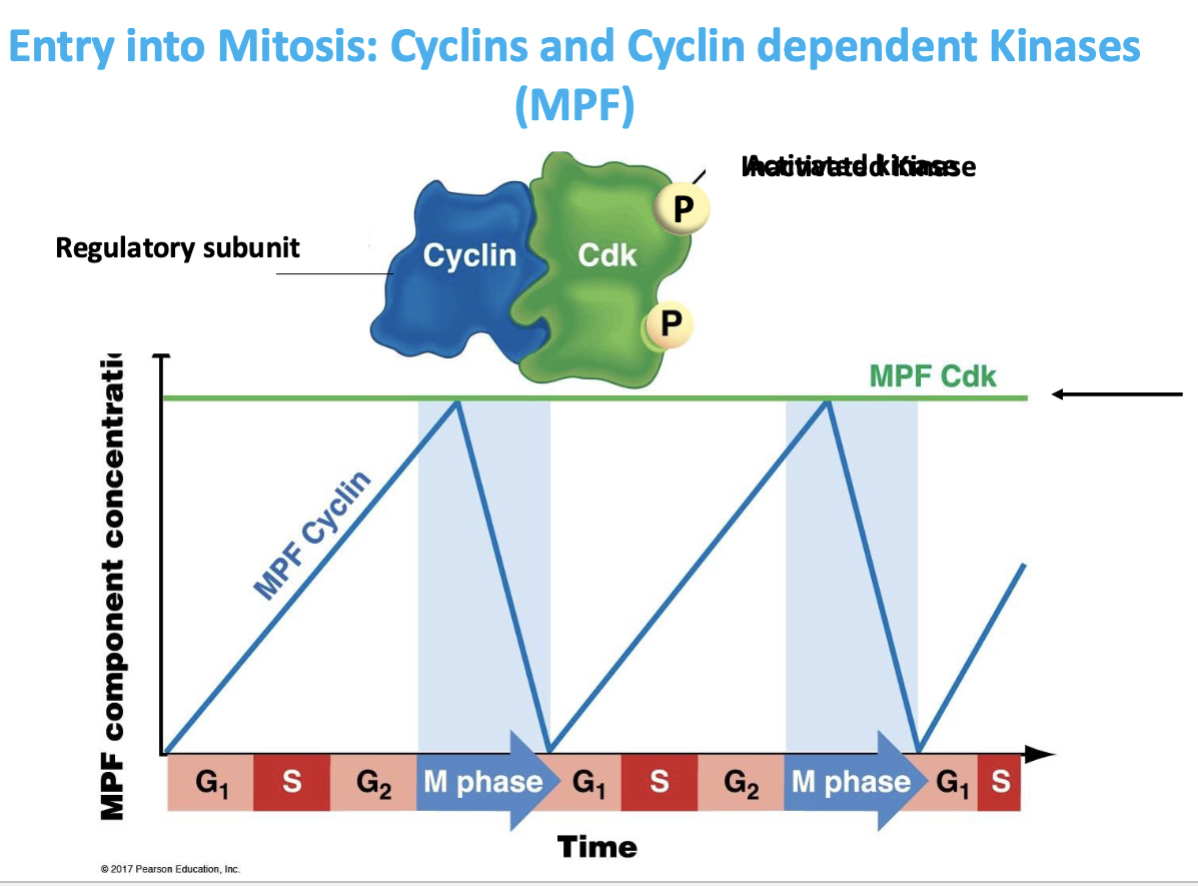
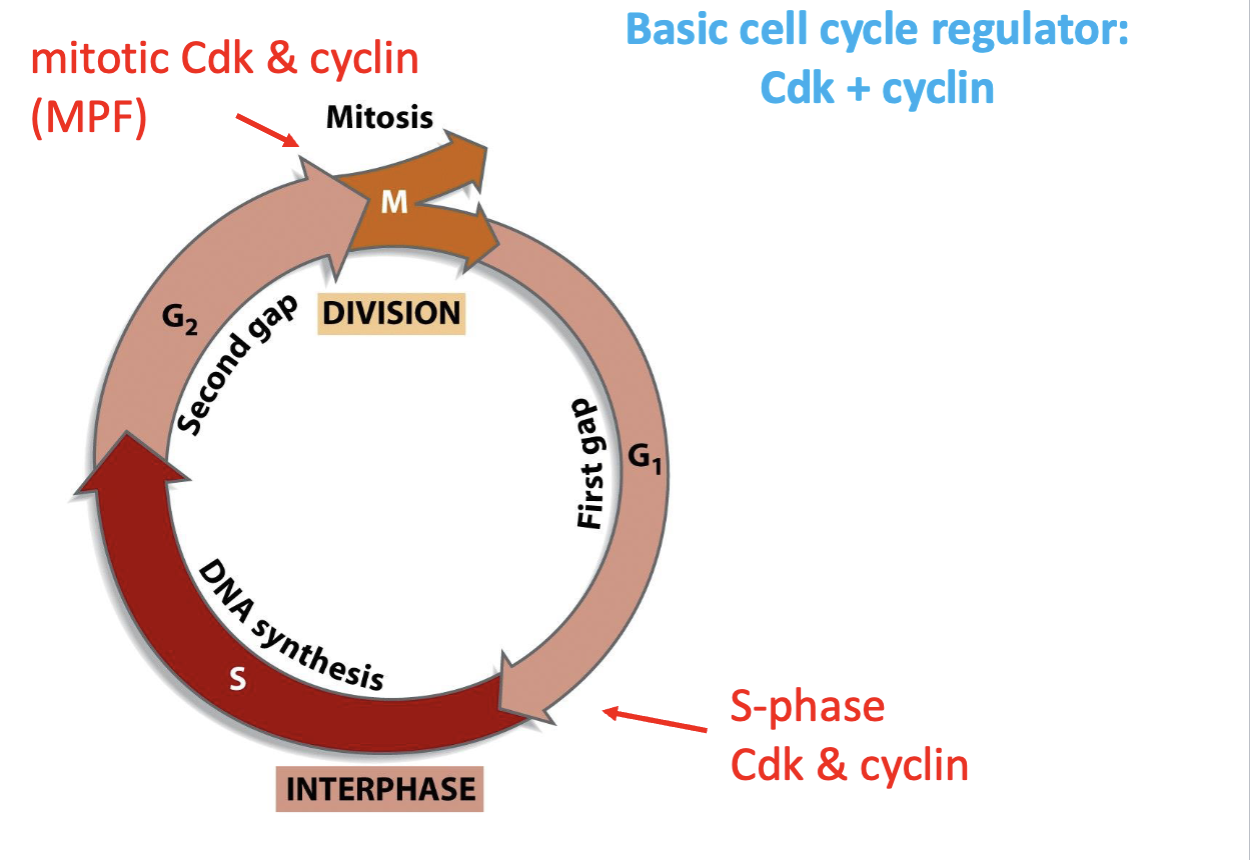
Basic Cell Regulator: CDK + cyclin
Mitotic CDK & cyclin to push cell into Mitosis
BUT CDK & cyclin also present to push cell into S-phase (checkpoints scattered throughout cell cycle)
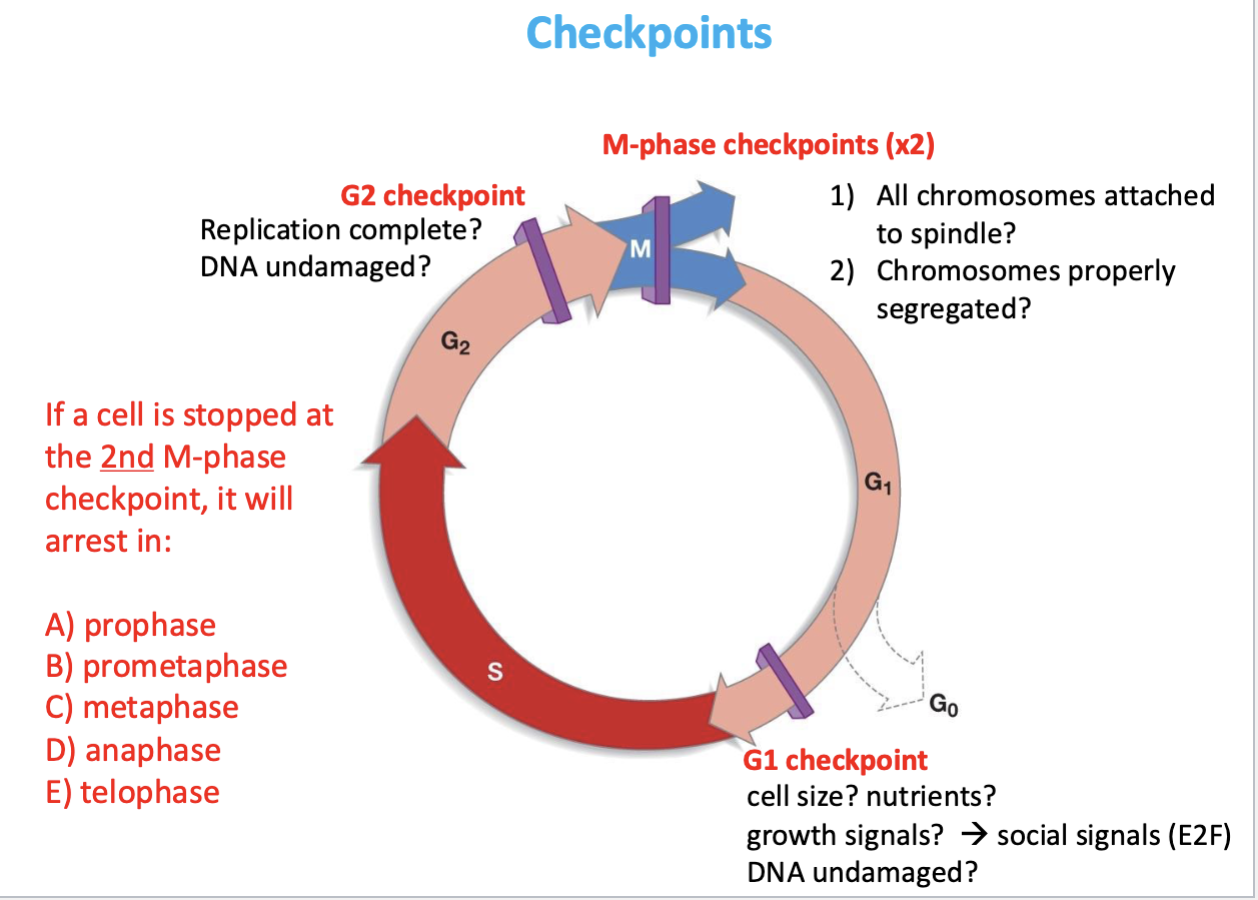
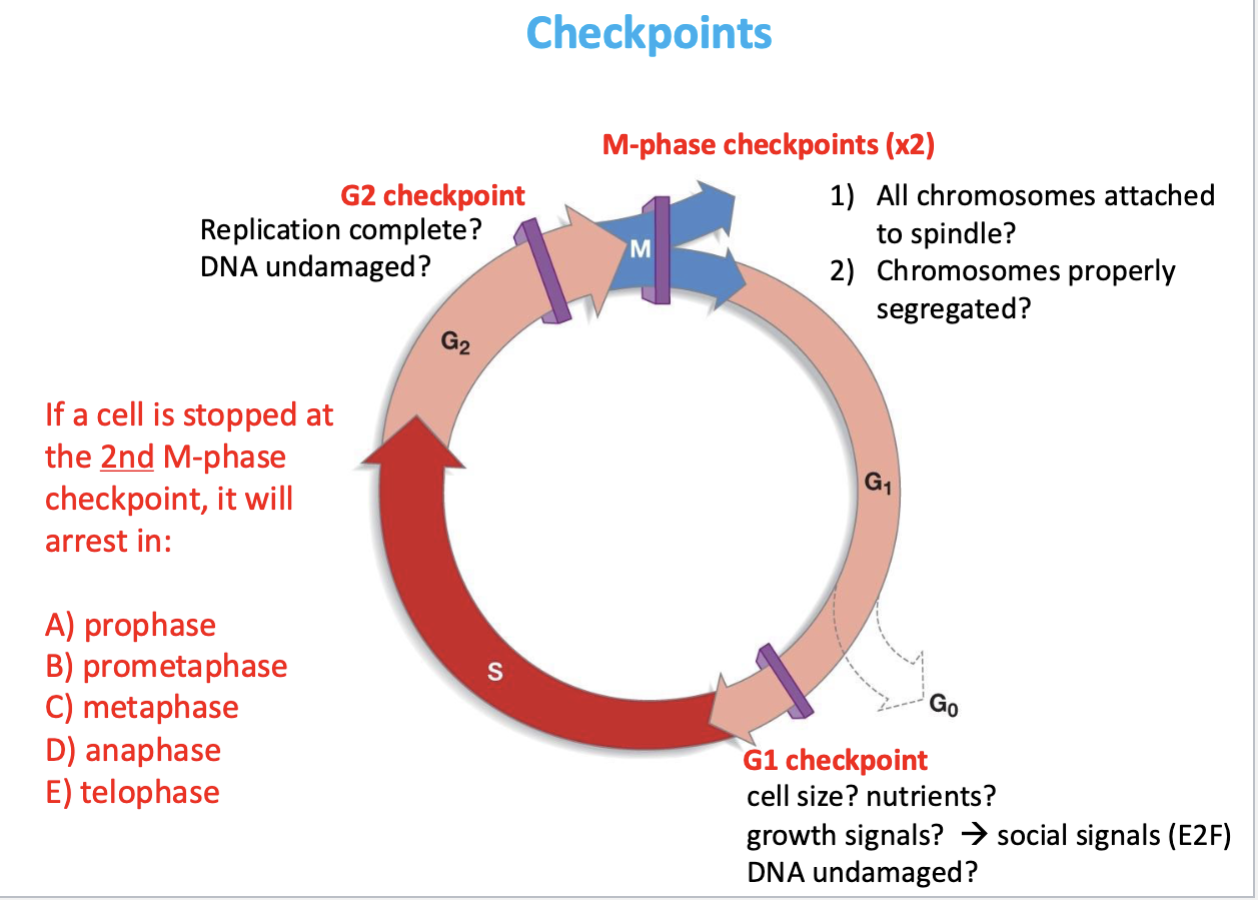
G1 Checkpoint
checks Cell size (after last mitotic event, cell needs to grow to appropriate size before it can transition to new cell cycle)
check nutrients (measuring available energy, need high ATP/ADP ratio)
growth signals —> social signals (E2F)
& check DNA condition (making sure it is undamaged)
G2 Checkpoint
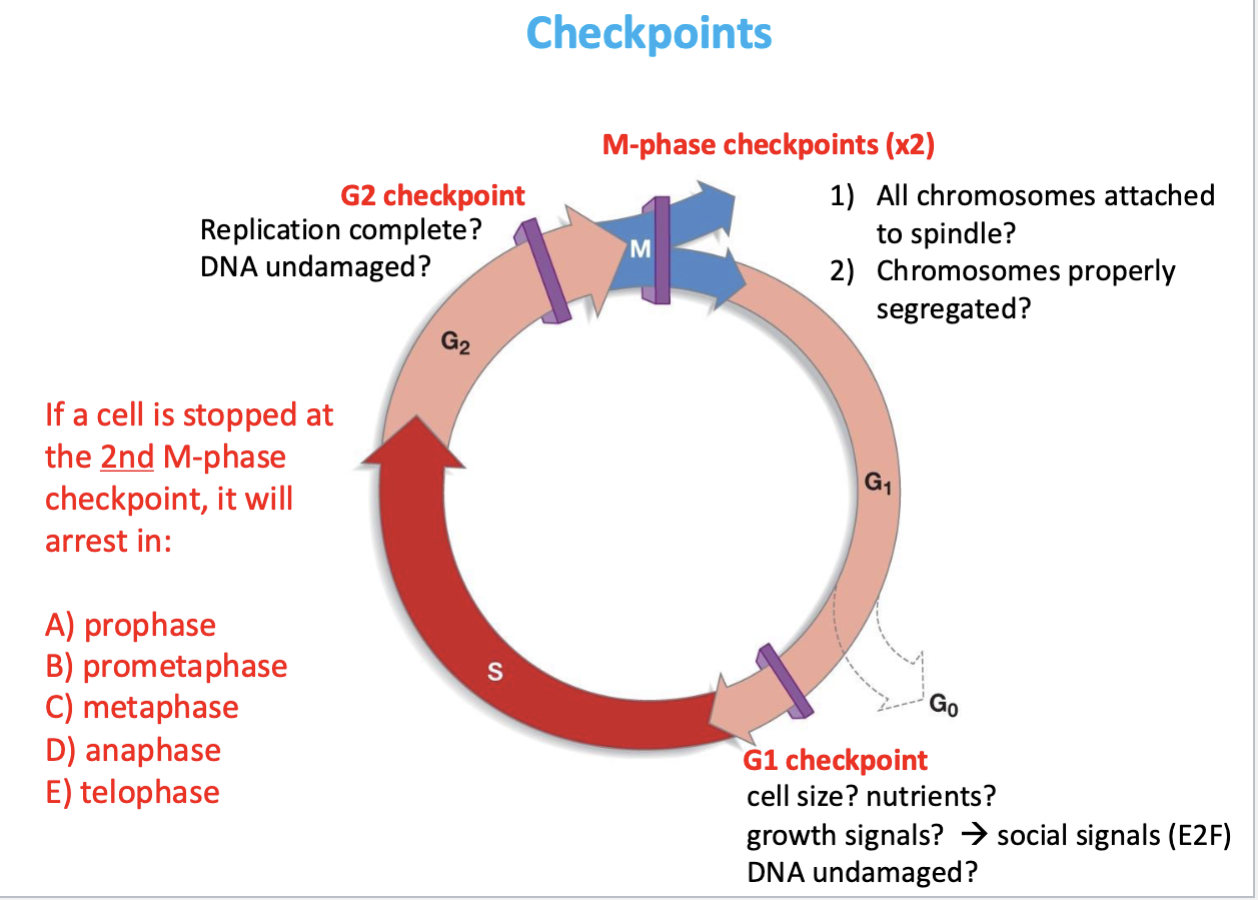
check if replication is complete
check DNA condition again (is it undamaged?, was S phase carried out properly?)
M Phase Checkpoint has 2 components: What does the first check?
1) Checking that all chromosomes attached to spindle (& aligned in middle, metaphase)
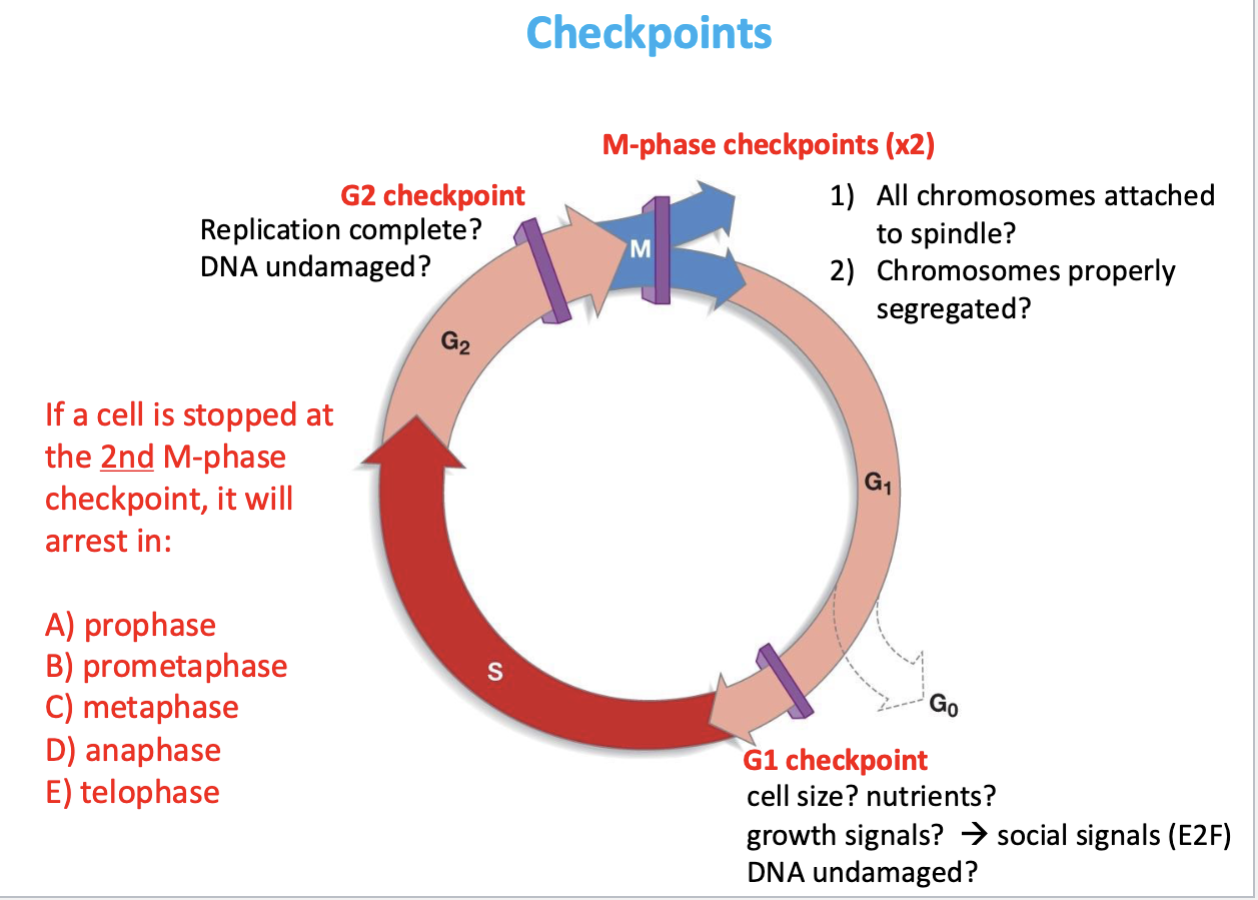
M Phase Checkpoint has 2 components: What does the second check?
Whether all chromosomes properly segregated
anaphase —> sister chromatids broken apart & go to opposite poles
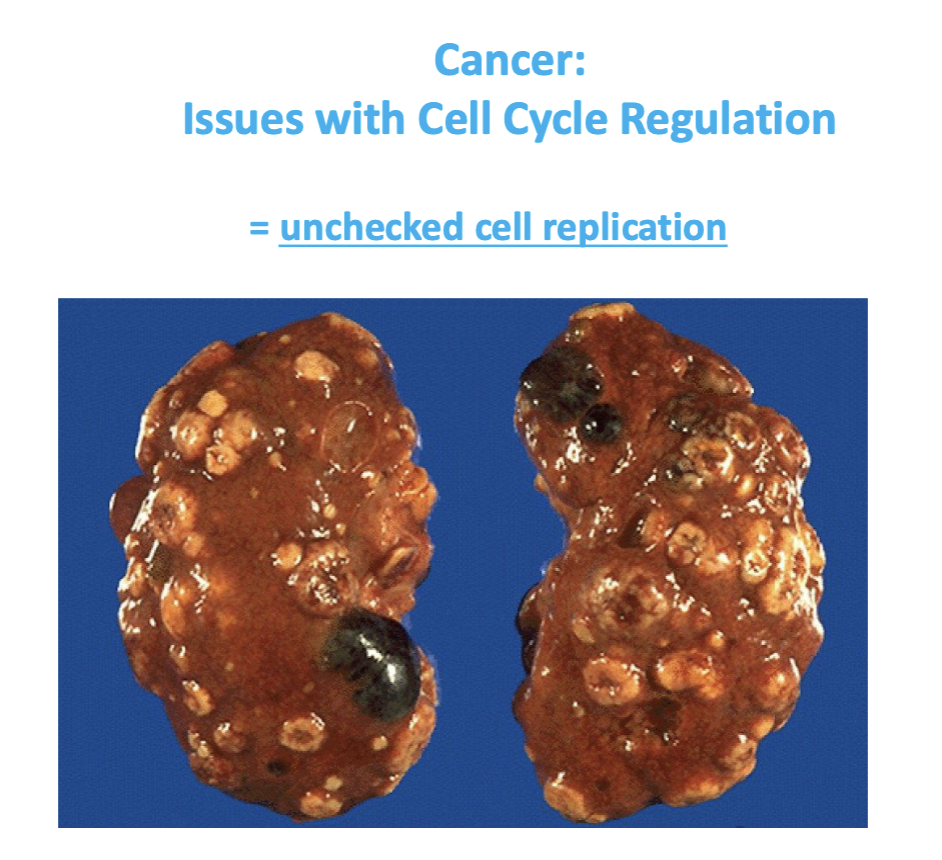
Cancer: issue with cell cycle regulation
= unchecked cell replication
→ leads to overgrowth of cells in unregulated manner
Mitosis 1 brief
Interphase (G1, S, G2) (brief)
Mitosis 2 brief
Prophase (brief)
Mitosis 3 (brief)
Prometaphase (brief)
Mitosis 4 (brief)
Metaphase (brief)
Mitosis 5 (brief)
Anaphase (brief)
Mitosis 6 (brief)
Telophase (brief)
Mitosis 7 (brief)
cytokinesis: cell division (brief)
What is the difference between a chromatid and a chromosome?
A chromatid is one half of a replicated chromosome
whereas a chromosome consists of DNA wrapped around proteins in a highly organized manner.
A cell in G1 phase has 6 unreplicated chromosomes. How many DNA double helices does the cell have after chromosome replication?
12
Scientists isolate cells in various phases of the cell cycle. They find a group of cells that have
1 & one half times more DNA than G1 phase cells. The cells of this group are ________.
in the S phase of the cell cycle (In G2 have 2x amount of DNA)
A cell has 6 unreplicated chromosomes. How many replicated chromosomes does the cell have after chromosome replication?
6
Which of the following phases are characterized by having cells with chromosomes consisting of two sister chromatids?
G2, prophase and metaphase
After the G1 phase, what makes up a single chromosome?
a double stranded DNA molecule
For eukaryotic cells in the G2 phase, each chromosome is composed of ________ joined at the ________.
two sister chromatids; centromere
Progression through the cell cycle is regulated by oscillations in the concentration of which type of molecule?
cyclins
Identify the events in the cell cycle that must be completed successfully for daughter cells to share an identical complement of chromosomes.
All the chromosomes must be replicated during the S phase.
The spindle apparatus must connect with the kinetochores of each sister chromatid in prometaphase.
The sister chromatids of each replicated chromosome must be partitioned in anaphase and fully separated into daughter cells by cytokinesis.
Which of the following would be used to differentiate between benign and malignant tumors?
The ability to invade other tissues
DNA & Chromosome count: Original cell/Parent cell
same number of chromosomes
original amount of DNA
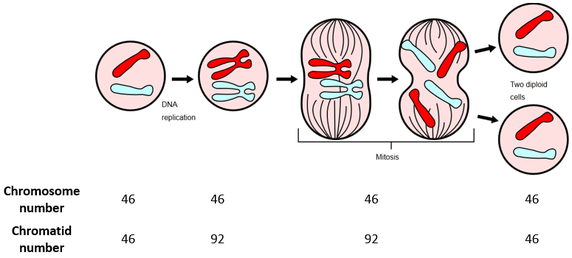
DNA & Chromosome count: After DNA replication (S Phase) in Parent cell
same number of chromosomes
double the DNA
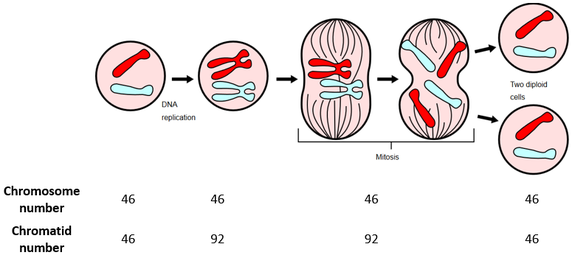
DNA & Chromosome Count: After Mitosis (In Daughter cells)
same number of chromosomes as parent cell
same amount of DNA as original amount of DNA in parent cell