6. endothermic and exothermic reactions
 Call Kai
 Learn
Learn Practice Test
 Spaced Repetition
 Match
Match Flashcards
 Knowt Play
1/22

There's no tags or description
Looks like no tags are added yet.
Name | Mastery | Learn | Test | Matching | Spaced | Call with Kai | Chat |
|---|
No analytics yet
Send a link to your students to track their progress
23 Terms
energy
capacity to do work or cause change
law of conservation of energy
energy cannot be created or destroyed, only transformed from one form to another
total amount of enegy in a system is constant
energy in systems
if energy in a system rises/falls → energy in system’s surroundings will fall/rise
enthalpy
total present energy in the substance
chemical potential energy (stored in bonds)
kinetic energy (particle motion)
chemical potential energy in H
not heat → does not increase temperature
kinetic energy in H
heat exists in the environment (responsible for temperature)
energy from vibration of particles
chemical reactions
chemical bonds in reactants are broken and new bonds are formed to make the products
as energy gained/lost → change in how much potential energy is stored in bonds
as energy must be conserved → change in potential energy must be balanced by an opposite change in kinetic energy (heat)
bond making
potential energy lost in reaction → converted to kinetic energy (heat) → heat released into surroundings → increase in temperature
bond breaking
kinetic energy (heat) absorbed from surroundings → potential energy increase in reaction → decrease in temperature
enthalpy change
chemical reactions that occur at constant pressure (eg: open beaker/test tube) → heat gain/loss of system = ΔH

other name of ΔH
heat of reaction
exothermic reactions
reactions that release heat into surroundings
how exothermic reactions occur
chemical potential energy in bonds converts to kinetic energy
surplus kinetic energy (heat) is released into surroundings → increasing temperature
heat is lost to surroundings → H decreases → ΔH is negative
endothermic reactions
reactions that absorb heat from surroundings
how endothermic reactions occur
Ek converts to Ep
To replace lost Ek → heat is absorbed from surroundings → decreasing temperature
heat is gained from surroundings → H increases → ΔH is positive
bond breaking
absorption of energy
raises H
endothermic
bond breaking in reactions
reactant bonds stronger/more numerous → more energy absorbed to break them than released
reaction that invests more energy into bond breaking than bond forming is endothermic
bond making in reactions
product bonds stronger/more numerous → more energy released to form them than absorbed
reaction that invests more energy into bond forming than bond breaking is exothermic
activation energy
minimum energy required to break bonds in reactants for reaction to occur
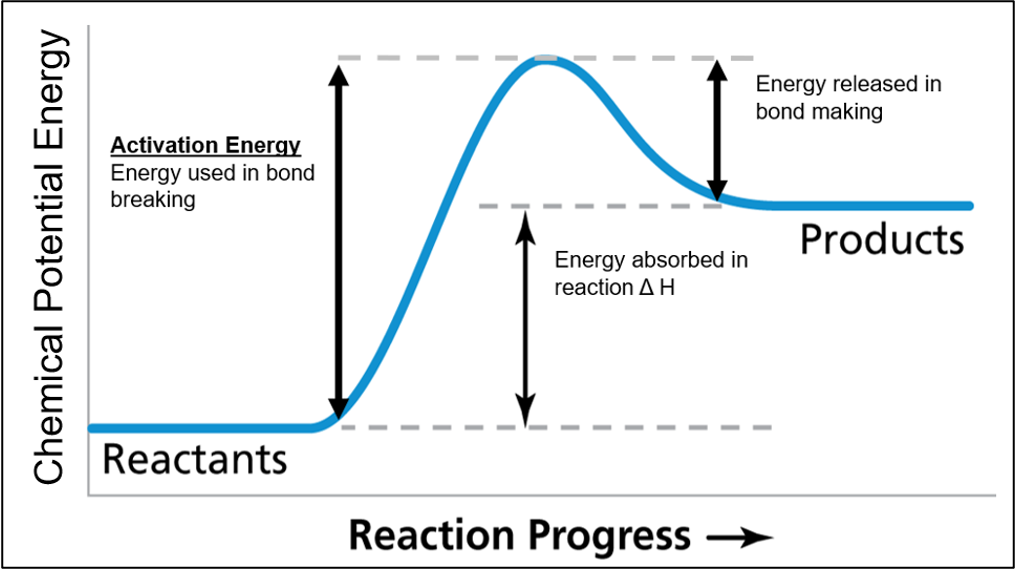
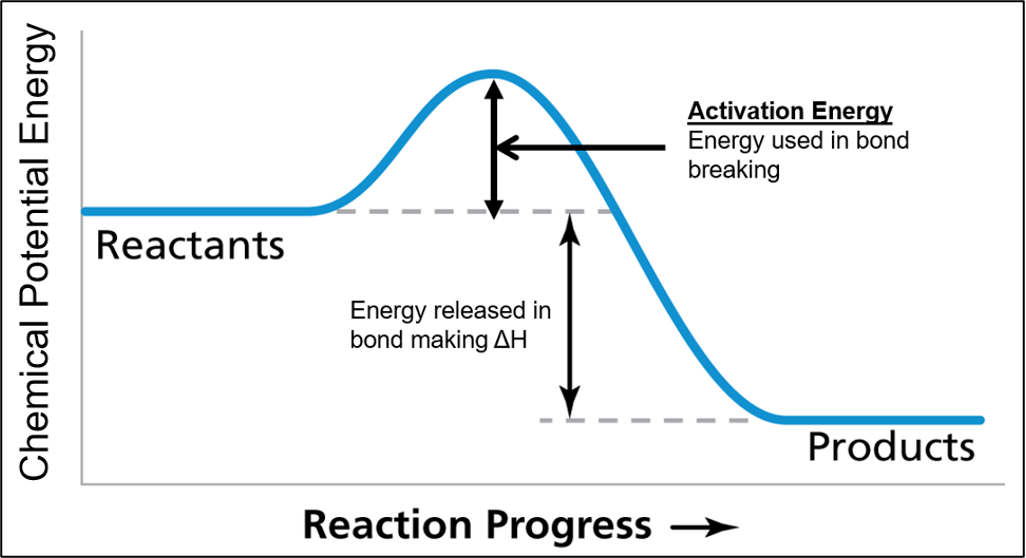
energy profile diagrams
include
ΔH of reaction
activation energy
x-axis: reaction progress
y: axis: Ep
energy profile diagrams - endothermic
energy in bond breaking in reactants > energy released in bond making in products
energy is absorbed
energy profile diagrams - endothermic
energy in bond breaking in reactants < energy released in bond making in products
energy is released
thermochemical equations
show ΔH
show energy (heat) absorbed/released
