Lecture 11 Transformers
 Studied by 0 people
 Call with Kai
 Learn
Learn Practice Test
 Spaced Repetition
 Match
Match Flashcards
 Knowt Play
1/17

There's no tags or description
Looks like no tags are added yet.
Name | Mastery | Learn | Test | Matching | Spaced | Call with Kai |
|---|
No study sessions yet.
18 Terms
What kind of data can transformers handle
all kinds of data, image, video, text, etc. super powerful for answering MLP related problems
Encoder - used for classification, feature extraction
Decoder - used for text generation LLM stuff
token
token - chunk of text
common/short words = one token just depends on dictionary
long less common words = multiple tokens
byte-pair encoding (BPE)
byte pair encoding
starts with character level vocab and starts iteratively merging frequent pairs into new tokens until desired vocab size reached
frequent pairings matched in frequency tables ~30-100k words
token input
each token is a one hot vector [nxN]
the one is in the position of the index in the dictionary (token ID)
token vector
vector of each token ID of the input in its order
(token ID is the index in the dictionary)
Transformer
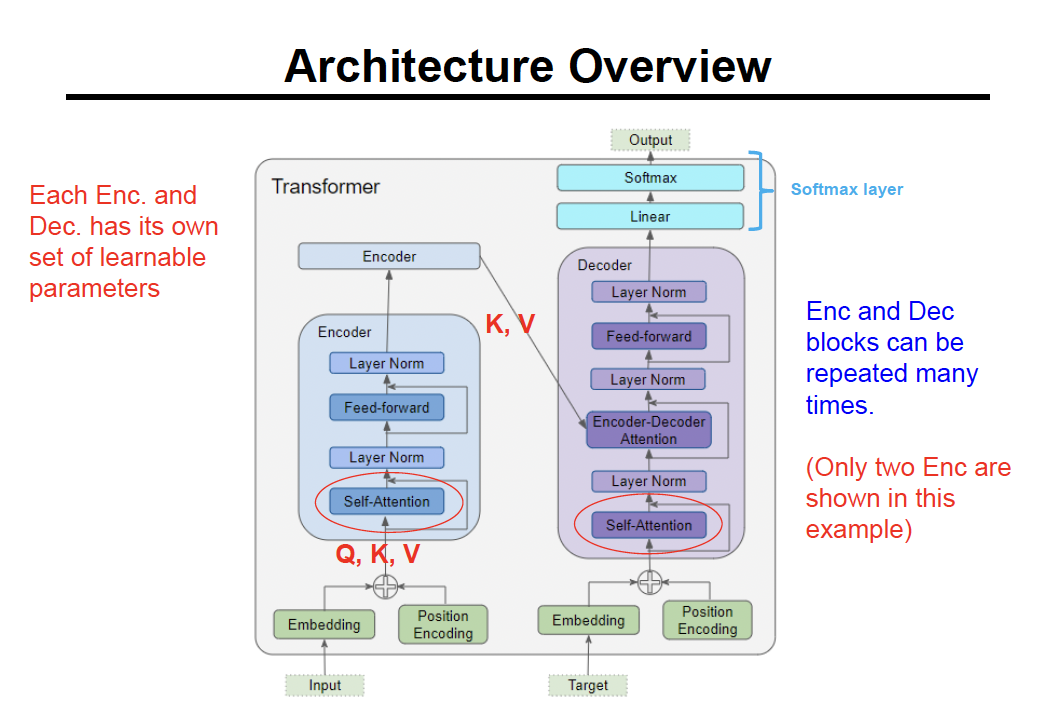
encoder + decoder + self attention
autoregressive model
n tokens in, one token out
output used as part of next iteration input
probabilistic
uses (softmax) to return a probability distribution of possible tokens and outputs the highest probable output
Self attention - basic parts
Data tensor X [n x N]→
(in practice data is 3D with [ _ x _ x B]
(batch size) Determined through back propagation
Query Q (what' I’m looking for)
Q = WQX [n x dQ ]
Key K (what I contain)
K = WKX [n x dK]
Value V (actual content of X that will be passed forward)
V = WVX [n x dV]
W = linear projection [N x d{K, Q, V}](transformations) learned so each Q,K,V are different
notations
n = # of tokens
N = dictionary size
hyperparameters
d = embedding size (dimension size? used for the QKV) (larger d means more information from the token )
H = # of attention heads (similar to # of filters in CNN)
Self-attention operations
Compute scores between different input vectors S = Q . KT [n x n]
in smoothie ex these is how much u like the fruit
Add mask
Normalize the scores for the stability of gradient Sn= S/sqrt(dk) [n x n] dk = embedding size
Apply softmax to translate the scores into probabilities (attention weights) P = softmax(Sn) [n x n]
P is the correlation matrix of the input tokens [0, 1] bc of softmax
Obtain the weighted value matrix with Z = V * P [n x d]
important bc it integrates only most relevant parts of context for each token, eliminating unfiltered noise
![<ol><li><p>Compute scores between different input vectors S = Q <strong><sup>.</sup></strong> K<sup>T</sup> [n x n]</p><ol><li><p>in smoothie ex these is how much u like the fruit</p></li></ol></li><li><p>Add mask</p></li><li><p>Normalize the scores for the stability of gradient S<sub>n</sub>= S/sqrt(d<sub>k</sub>) [n x n] d<sub>k</sub> = embedding size</p></li><li><p>Apply softmax to translate the scores into probabilities (attention weights) P = softmax(S<sub>n</sub>) [n x n]</p><ol><li><p>P is the correlation matrix of the input tokens [0, 1] bc of softmax</p></li></ol></li><li><p>Obtain the weighted value matrix with Z = V * P [n x d]</p><ol><li><p>important bc it integrates only most relevant parts of context for each token, eliminating unfiltered noise</p></li></ol></li></ol><p></p>](https://knowt-user-attachments.s3.amazonaws.com/d3e9b9b9-20f5-4132-a364-fac5454b5e2e.jpg)
Self-attention masking
Need to add padding to get to max length of input, and need to mask padding so not considered in calculations
Add before normalizing or applying softmax
matrix of -infinity for padding tokens (becomes 0 in softmax)
0 for actual inputs
Multi-head attention (MHA)
allows for attention between multiple words
MHA output [n x dH] - attention for each token
basically dH # of self attention concatenated together (each with diff QKV)
each self attention head gets a diff dimension (feature) and so its not redundant and analyzing the same data
Transformer architecture
input —> embedding + position encoding → encoder stack → decoder → linear → softmax → output
How input / output works in transformers
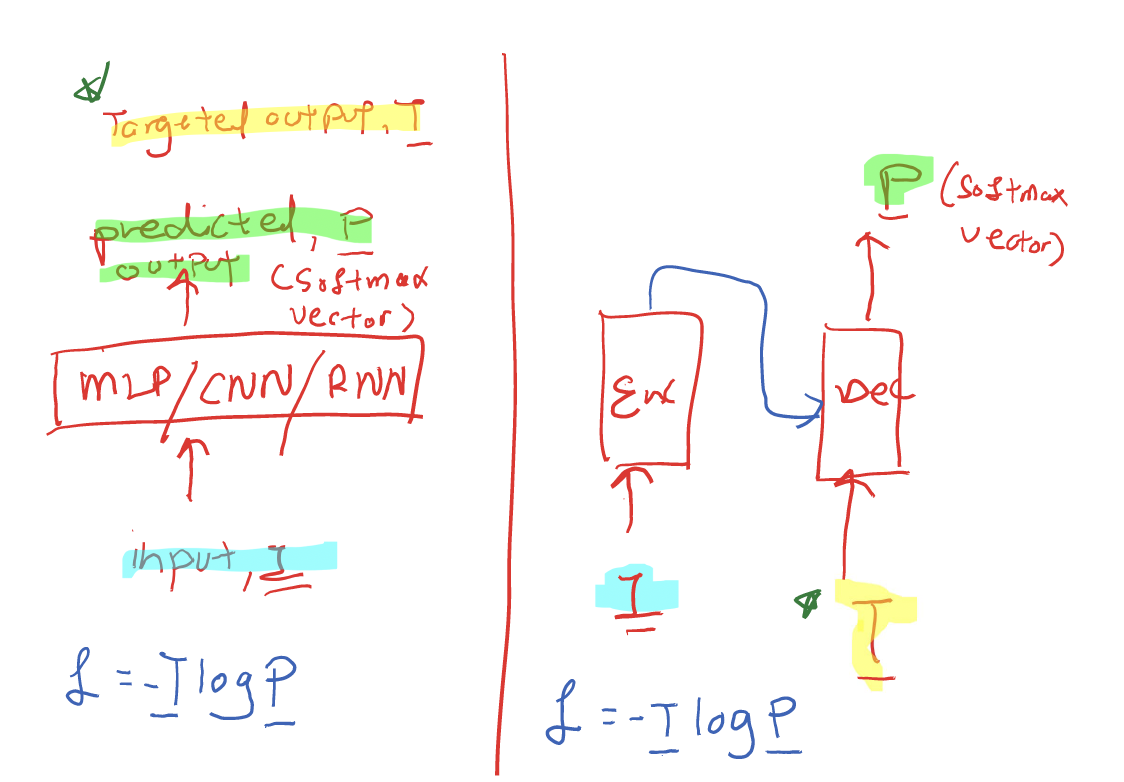
all input, one out, then out becomes new input
still minimize loss (cross-entropy) but the target output is not isolated and instead included in the input unlike other models
Encoder
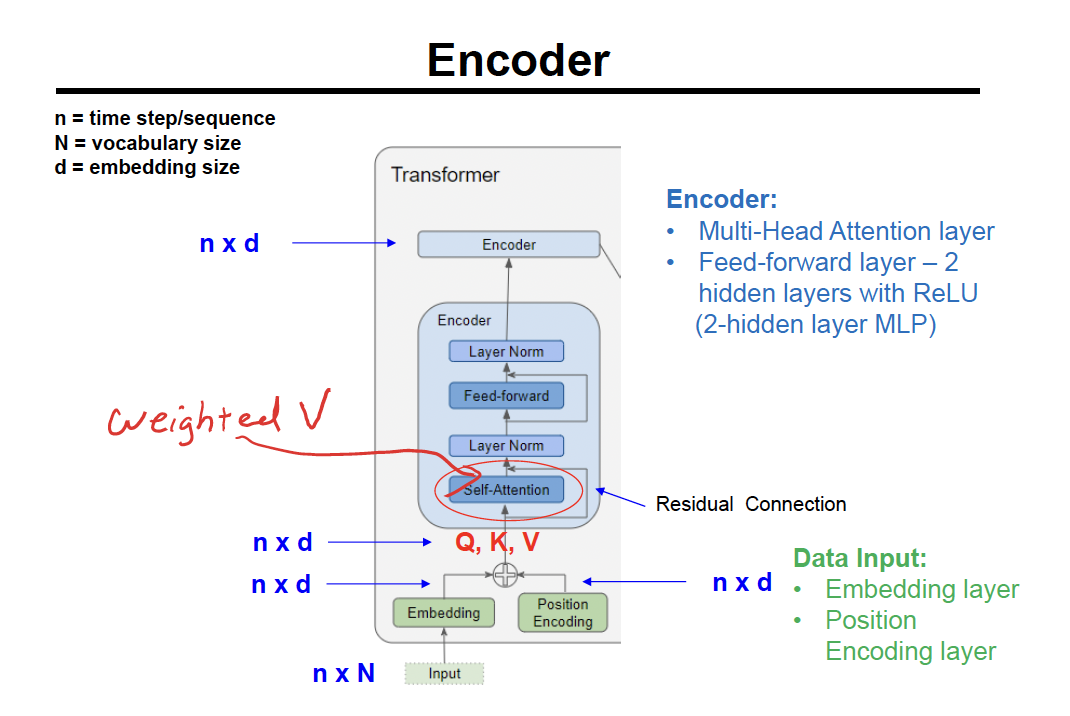
input →
embedding + position encoding →
self - attention (produces weighted V) → residual connection (skip connection) →
layer norm →
feed forward →
2 hidden layers with ReLU (2-hidden layer MLP)
layer norm → decoder
Layer normalization
variant of batch normalization
normalizes using mean and std row by row instead of whole matrix
when dividing by std also add 0.0001 to avoid overflow
Input embedding
converts raw data (one-hot vector) → embedding
encodes the meaning of the words
linear projection module
Sinusoidal position encoding
k = hyperparameter controlling frequency range
larger = smoother but less informative encodings
d = encoding dimension
pt is corresponding encoding
sin(w* t) if even
cos(wk *t) if odd
w = 1/10002k/d
Decoder attention
utilizes cross attention - not the same as attention used in encoder
helps combine input and target sequence
target language Q
input language K and V
triangular masking for n tokens in one token out (auto reg nature)
greedy decoding from softmax, just choose highest probability, get the Token ID (dictionary index) and the token itself