Refractive Index
 Call Kai
 Learn
Learn Practice Test
 Spaced Repetition
 Match
Match Flashcards
 Knowt Play
1/25

There's no tags or description
Looks like no tags are added yet.
Name | Mastery | Learn | Test | Matching | Spaced | Call with Kai | Chat |
|---|
No analytics yet
Send a link to your students to track their progress
26 Terms
Explain why light refracts
It enters a medium of a different optical density, causing the wave to change speed, so it changes direction
Explain whether light refracts towards or away from the normal when entering a more optically dense material
Light slows down, so bends towards the normal
Explain whether light refracts towards or away from the normal when entering a less optically dense material
Light speeds up so bends away from the normal
What happens to the wavelength when light enters a new medium
Changes
What happens to frequency when light enters a new medium
Stays constant
When light enters a more optically dense material, what happens to wavelength
Decreases
When light enters a less optically dense material, what happens to wavelength
Increases
Why is light slower in materials
It interacts with particles
Refractive index
The ratio between the speed of light in a vacuum and the speed light in a material
What is n in the refractive index equation
The refractive index of the material
What is v in the refractive index material
The speed of light in that material
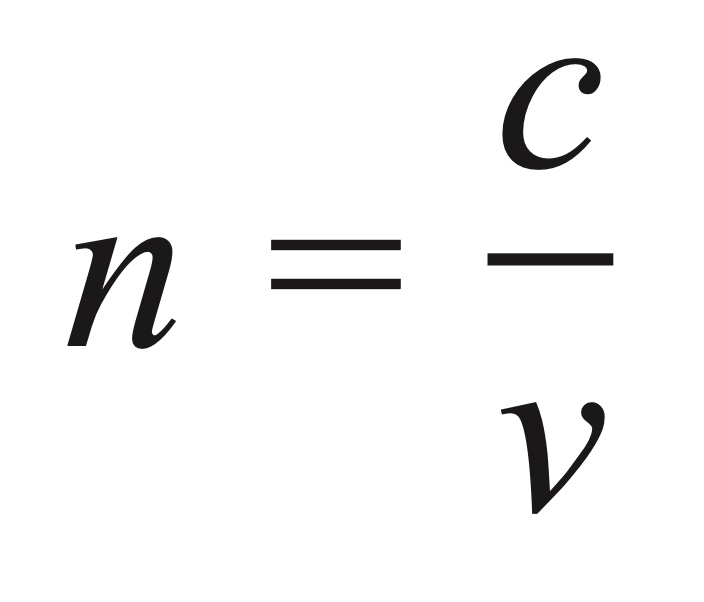
Refractive index equation
n = c/v
Angle of incidence
The angle between the normal and incoming light
Angle of refraction
The angle between the refracted ray and the normal
What is θ1 in Snell’s law
Angle of incidence
What is θ2 in Snell’s law
Angle of refraction
Snell’s Law equation
n1sinθ1 = n2sinθ2

Experiment to find the refractive index of a glass block
1- Place a glass block on a piece of paper and draw around it.
2- Use a ray box to shine a beam of light onto the glass block
3- Trace the path of the incoming and outgoing beams of light
4- Remove the block and join up the two paths with a straight line
5- Measure the angles of incidence and refraction, substitute 1 in for the refractive index of air and find the refractive index of the block with Snell’s law
How to improve the refractive index experiment
-Turn off the lights
-Use large angles for smaller percentage uncertainty
-Narrower beam of light
When does the critical angle of a material occur
When the refracted angle is at a right angle to the normal
Explain why the critical angle is when the angle of refraction is at a right angle
When light enters a less optically dense medium, it speeds up, so bends away from the normal. The greater the angle of incidence, the greater the angle of refraction. Eventually, the angle of refraction will be inside the block. The lowest angle possible for this is the critical angle as the refracted ray has just entered the block by being 90 degrees to the normal
When does total internal reflection occur
-The angle of incidence is greater than C
-Light is entering a less optically dense medium
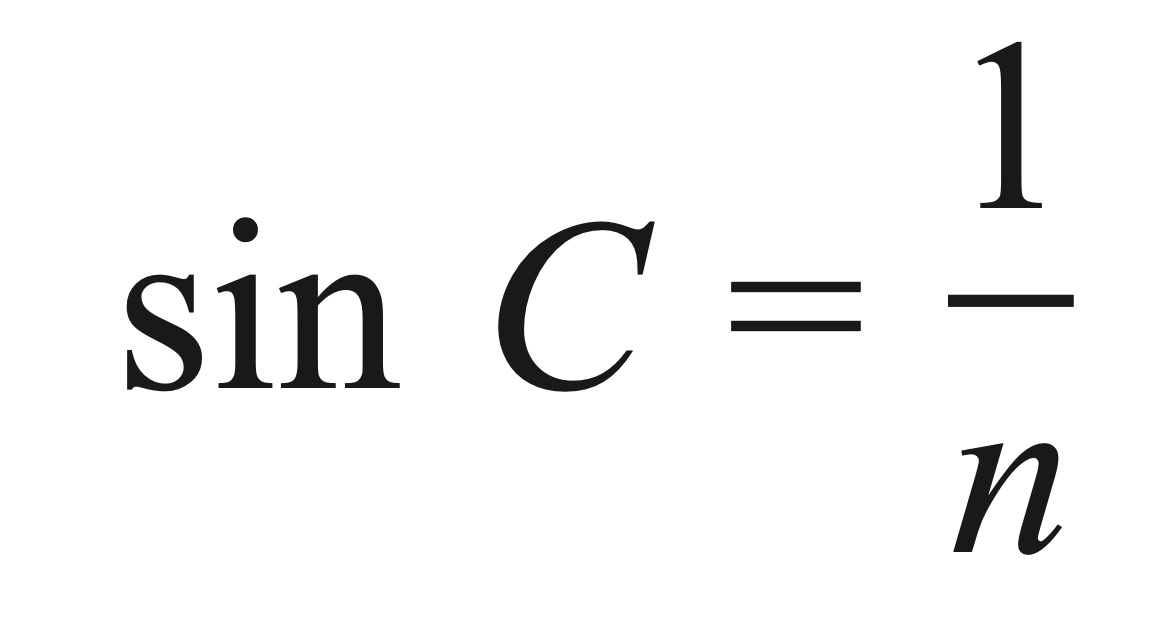
Critical angle equation
sinC = 1/n
When does the critical angle equation apply
If the boundary is material-air where the material is more optically dense than air
How to investigate total internal reflection
1- Shine a light ray into the curved face of a semi-circular block
2- Vary the angle of incidence until the light beam refracts so much that it exits the block along the straight edge (θ1 = C)
3- If you increase the angle of incidence beyond this, the ray is totally internally reflected
Why should the light be shone through the curved face of a semi-circular block when investigating TIR and not the flat face
The light will enter at right angles for every angle of incidence, whereas for a flat face it would only enter at one