WPS 264 Water in wood & EMC
 Call Kai
 Learn
Learn Practice Test
 Spaced Repetition
 Match
Match Flashcards
 Knowt Play
1/10

There's no tags or description
Looks like no tags are added yet.
Name | Mastery | Learn | Test | Matching | Spaced | Call with Kai | Chat |
|---|
No analytics yet
Send a link to your students to track their progress
11 Terms
Hygroscopic property of wood
Wood exhanges water vapour with environment until equil reached
If air drier, wood wil desorb water. If air more humid, wood will adsorb water.
Phenomenon is called sorption
Bound & free water
Free (capillary) water; liquid water within lumens & cell wall cavities.
Bound water; water within cell walls hydrogen bonded to cellulose & hemicelluloses.
Bound to hydroxyl groups of cellulose, hemicelluloses and also lignin but less.
Limited by number of soption sites
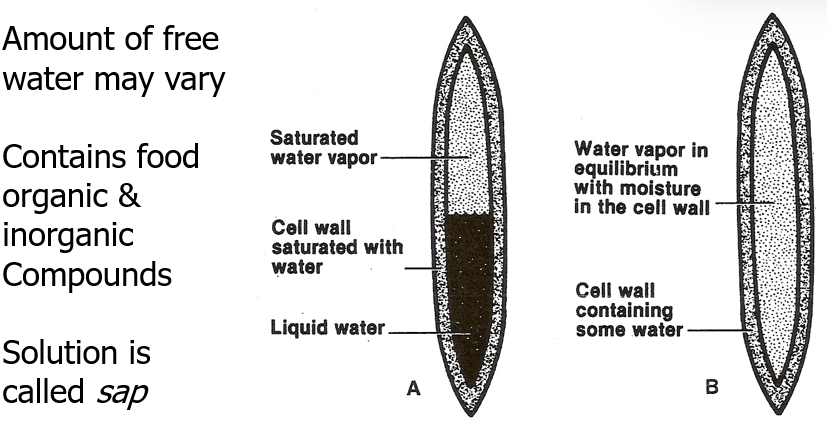
Water in cell wall
Water molecules adsorbed to hydroxyl groups
At high MCs up to 10 H2O molecules can be attracted to each possible sorption site.
OH groups of cellulose are crosslinked to each other in crystalline areas, which decrease sorption sites.
Removal of water
Free water removed first, then water starts to leave cell wall
All “dry” wood still contains water in cell wall
Physical properties change drastically if bound water also removed
FSP
MC at which cell wall is saturated & voids are empty.
~30% MC
FSP decreases with increasing temp; ~0.1% for each 1C.
Higher extractives means lower FSP.
FSP decreases with increasing density.
Increasing temp decreases FSP.
Hydrogen bonding sites on lignin, hemicelluloses & celluloses may already be ‘occupied’.
Most physical properties (shrinkage, mechanical & electrical properties) change below FSP. FSP can be experimentally determined by measuring this property as function of MC.

Equilibrium moisture content
MC of wood eventually attained by piece of wood upon extended exposure to air at a constant relative humidity & temp.
Only possible in confined space eg. kiln
Species vary slightly in EMC (about 5%), but increases with relative humidity.
Low EMC attributed to high content of extractives
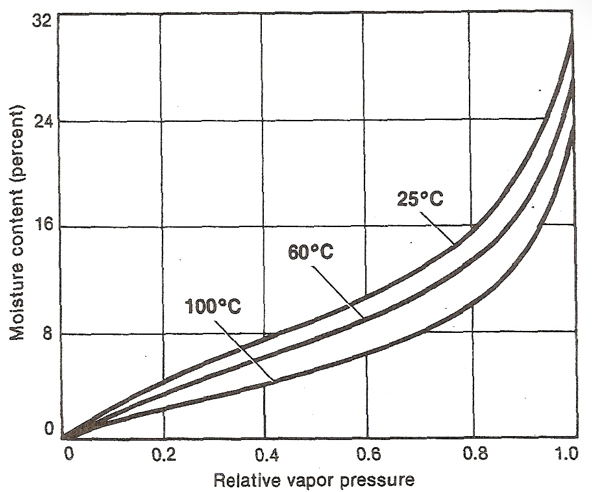
Temp influences EMC to small degree. EMC lower at higher temps.
Temps > 100C has permanent effect; wood becomes less hygroscopic
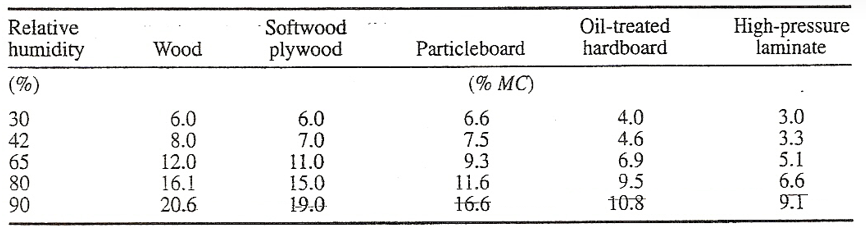
Most composite wood products have lower EMC
EMC of wood products
EMC generally lower
Plywood & laminated wood closer to raw wood
Particle/fibreboard are considerably different
densification
addition of resin
coatings
fillers
→ means less hygroscopic
Desorption
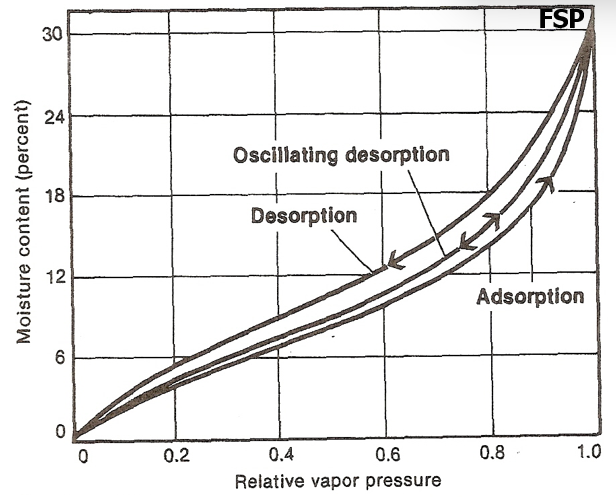
Loss of moisture called desorption
Begins by evaporation of surface water
Free water from cavities drawn to surface by capillary forces & evaporates from surface
Bound water diffuses to surface & evaporates
Adsorption
In greenwood hydroxyl groups of cellulose in cell wall are saturated with water molecules
When dried, hydroxyl groups move closer & weak cellulose bonds are formed
Fewer adsorption sites than originally if humidity increases again
Sorption hysteresis
At constant temp → isotherm sorption curve
Desorption curve up to 3% higher than adsorption curve
If humidity changes frequently → middle curve
Initial desorption curve always higher than adsorption or further desorption curves
After first drying, hygroscopicity of wood is permanently reduced due to crosslinked of hydroxyl groups during first desorption curve
Hysteresis and species
Vary with species
General form of sorption curve always the same, vertical position changes
Caused by extractives occupying binding sites.