Historical Geology 1002 Test 3
 Studied by 0 people
 Call with Kai
 Learn
Learn Practice Test
 Spaced Repetition
 Match
Match Flashcards
 Knowt Play
1/42

There's no tags or description
Looks like no tags are added yet.
Name | Mastery | Learn | Test | Matching | Spaced | Call with Kai |
|---|
No study sessions yet.
43 Terms
Mechanisms for End Permian Mass Extinction: What led to the decline of reef organisms?
Carbon disolves into ocean- ocean acidification- prevents organisms from calcifying
Mechanisms for End Permian Mass Extinction: What led too the decine of bottom dweller organisms?
carbin serves as fertilizer for a marine phytoplankton- algal blooms- blocks out light- anoxia
Mechanisms of the End-Permian Mass Extinction: What led to loss in costal and near shore enviornments?
rapid warming-sea level rises
What is ocoean acidification?
ocean aborbs CO2 and increases pH of ocean
Anoxia
a depletion of oxygen
Mechanisms of End Permian Mass Extinction: What causes desertification?
loss of vegetation, change in climate
Mechanims of End-Permian Mass extinction: What is the cause and effect of Hydrogen Sulfide Emissions?
anoxia, low oxygen water allows for microbes to release Hydrogen Sulfide- rises to the surface- damages ozone layer- extra UV (and damage) let through
Which mass extinction(s) did involve a meteor impact as a prominent mechanism? What
End-Cretacaous
Which mass extinction(s) did NOT involve a meteor impact as a prominanet mechanism?
End-Ordovician, Late Devonian, End-Permian, End-Trassic
Trends in/ Evolution of Paleozoic Plants
progress from Sulurian’s small short trees to form tall Late Devonian trees and widespread forest, then progressed to Carboniferous coal-swamp floras dominated by spore bearing plants. As the climate became drier, early seed plants “take off” and spore bearing plants become less common
When did the expansion of vertebrates onto land occur?
Late Devonian
What was the first vertebrate to move to land? How?
Early tetrapods were the first, evolved from lobefin fish that has strong joints and muscalar appendages that they used to push along the shallow water, occasionally into muddy banks, eventually forming limbs and spine needed and adjusting to breathing air
What is an Amniote?
an egg adapted for land
what is the difference bwteen anapsid, synapsids, and diapsids
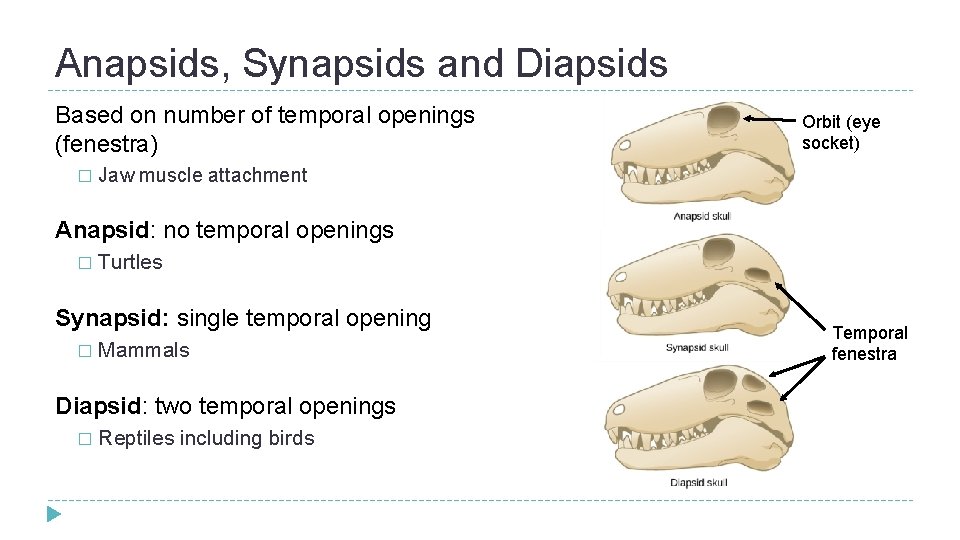
Newark Supergroup: What are the sedimentary structures present in the Newark Supergroup rocks that tell us that some of thier sediments were deposited in rivers?
river deposits:(fluvial facies) cross-bedded sandstones, chanell erosion, conglomerate lag (comglomarate layer of rounded pebbles and cobbles that current could not carry)
Newark Supergroup: What are the sedimentary structures present in the Newark Supergroup rocks that tell us that some of thier sediments were deposited in lakes?
lake deposits (lake margin), indicated by ripple marks and mud cracks
What is the Newark Supergroup?
a series of Triassic-Jurrasic rift basins (where tectonics were pulled apart) in eastern North America
Newark Supergroup: What kinds of fossils are in the Newark Supergroup?
mostly trace fossils of fauna, invertebrates, organisms, tracks, some body fossils but this is limited because of the acidic enviornment
Newark Supergroup: Why are there not a lot of skeletal body fossils in the Newark Supergroup?
the acidic enviornment of deeper anoxic lakes killed off most fish fossils, red beds= oxidizing conditions that promote rapid decay and and erosion
Cretaceous- Early Paleocene Earth & Life: What is the role of iridium in discovering that the K-Pg Extinction is associated with a meteor impact?
iridium is an element very rare on earth and very common in asteroids. In 1980 Luiz + Walker Alvarez identified a global iridium spike in thin clay layers at 350 sites around the world. Suggesting a metor hit earth and the impact spread globally
Cretaceous Early Paleogene Earth & Life : What are the mechanims of the K-Pg Mass Extinction
Dust Cloud- blocks primary productivity growth- global cooling (impact winter/killing animals that need sunlight like reptiles), Release of Greenhouse gases (drove post impact growth), vaporization of sulfur rich sediments- acid rain, wildfires (futher darkened skies and removed habitats and vegitation), tsunamis(killed coastal environments)
Cenozoic Earth& Life& Quaternary and Beyond: When did grasslands become more common and widespread? Why?
about 20(15?)-5 mya, drier conditions and mountian building meant there were rain shadows, these drier enviornments favored grass over trees, frequent fires preventing trees from regrowing????
Cretaceous- Early Paleogene Earth & Life: What are the two major orogenic events that raised the Rocky Mountains?
Sevier & Laramide
What is an orogenic event?
A period of mountian building caused by tectonic plate collisions and compression of the earths crust
When did the Sevier orogeny event begin and end?
Began in late Jurassic (160-150 mya) and ended abotu 50-60 mya
When did the Laramide Orogeny event begin and end?
Began in late cretaceous, continued into early cenezoic (80-75 mya -40-35 mya)
When were the earliest flowering plants? (angiosperms)
Began in early Cretaceous, about 130-125 mya, earlier seed plants had made pollen and seeds, evolved flowers to attract pollinators and fruits to protect and disperse seeds
What were the causes of the Mesozoic Marine Revolution?
Break up of Pangea meant more shallow marine enviornments that allowed for diversification, increase in powerful predators meant that prey had to adjust, thicker more ornamented shells, deeper burrowing, greater mobility
What groups of organisms went extinct during the K-Pg Mass Extinction?
non-avian dinosaurs (non-flying), pterosaurs (flying reptiles (NOT DINOSAURS), ammonites (coil shelled marine orhganism related to squid) Rudists bialves (formed reefs), Mosasaurs and Plesiosaurus (large marine reptiles)
What were the reproductive strategies of the earliest mammals?
began as egg laying mammals, later evolved to live birth
What are the Milankovitch Cycles?
slow repeating changes in the earths orbit and tilt that alter how sunlight is distributed across the planet?
What is the law of superposition?
every layer must be younger than the one before it
original horizontality
layers of sedient must be deposited more or less horizontally, if its not, something changed it
orignal lateral continuity
sedemtary layers from in continuous sheets until they meet a boundry to deposition
intrusive rocks
intrusive rocks are younger than the one they intrude
faults
displacement of a rock ,normal(goes down) reverse(goes up) , slip strike
Erosion in Stratigraphy
implies motion
Disconformity
Sedimentary rocks above and below
angular disconformity
sedimentary rocks above and below, deposited on tilted/eroded sediment
nonconformity
sedimentary rocks on top of igneous or metamorphic
Rules of Biostratigraphy
Find index fossil in two rock layers, probably about the same age, can match to places all over world potentially
What is the relationship between the sedementation rate and the quantity of sendiment?
Sedimentation rate: how fast sediment is deposited, higher sedimentation rate= greater/thicker layer of sediment
What are the limits of radiometric methods?
only works well for certian time ranges and kinds of rocks, minerals must have kept isotopes w/o being heated or altered