EDA CHAP 4-5
 Call Kai
 Learn
Learn Practice Test
 Spaced Repetition
 Match
Match Flashcards
 Knowt Play
1/12

There's no tags or description
Looks like no tags are added yet.
Name | Mastery | Learn | Test | Matching | Spaced | Call with Kai | Chat |
|---|
No analytics yet
Send a link to your students to track their progress
13 Terms
Continuous Random Variables
has a probability of zero of assuming exactly any of its values. Consequently, its probability distribution cannot be given in tabular form
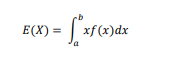
Expected Values of Continuous Random Variables
Let X be a continuous random variable with range [a, b] and probability density function f(x). The expected value of X is defined by
Continuous Uniform Distribution
This is the simplest continuous distribution as it is analogous to its discrete counterpart. A continuous random variable X with probability density function
normal distribution
the most important and most widely used continuous probability distribution. It is the cornerstone of the application of statistical inference in 5analysis of data because the distributions of several important sample statistics tend towards a Normal distribution as the sample size increases.
Binomial Approximation
The normal distribution can be used as an approximation to the binomial distribution if X is a binomial random variable,
Poisson distribution
was developed as the limit of a binomial distribution as the number of trials increased to infinity therefore the normal distribution can also be used to approximate probabilities of a Poisson random variable.
continuity correction
The binomial and Poisson distributions are discrete random variables, whereas the normal distribution is continuous. We need to take this into account when we are using the normal distribution to approximate a binomial or Poisson using a .
Exponential Distribution
obtains its name from the exponential function in the probability density function.
Discrete case.
The function f ( x, y) is a joint probability distribution or probability mass function of the discrete random variables X and Y if
Continuous case.
The case where both variables are continuous is obtained easily by analogy with discrete case on replacing sums by integrals.
Marginal Probability Distributions
If more than one random variable is defined in a random experiment, it is important to distinguish between the joint probability distribution of X and Y and the probability distribution of each variable individually.
Conditional Probability Distribution.
A special type of distribution in the form of f(x, y) / g(x) in order to be able to effectively compute conditional probabilities.
Statistical Independence.
If f (x|y) does not depend on y, then f (x|y) = g(x) and f(x, y) = g(x) h(y). The proof follows by substituting the equation below into the marginal distribution of X.