MOHO: Model of Human Occupation
 Call Kai
 Learn
Learn Practice Test
 Spaced Repetition
 Match
Match Flashcards
 Knowt Play
1/23

There's no tags or description
Looks like no tags are added yet.
Name | Mastery | Learn | Test | Matching | Spaced | Call with Kai | Chat |
|---|
No analytics yet
Send a link to your students to track their progress
24 Terms
What is the most widely used occupation-based model in OT practice?
MOHO
MOHO is...
occupation-based, theory-drive, evidence-based
Who and When created MOHO?
Kielhofner & Burke, 1980
What does MOHO look like?
MOHO model
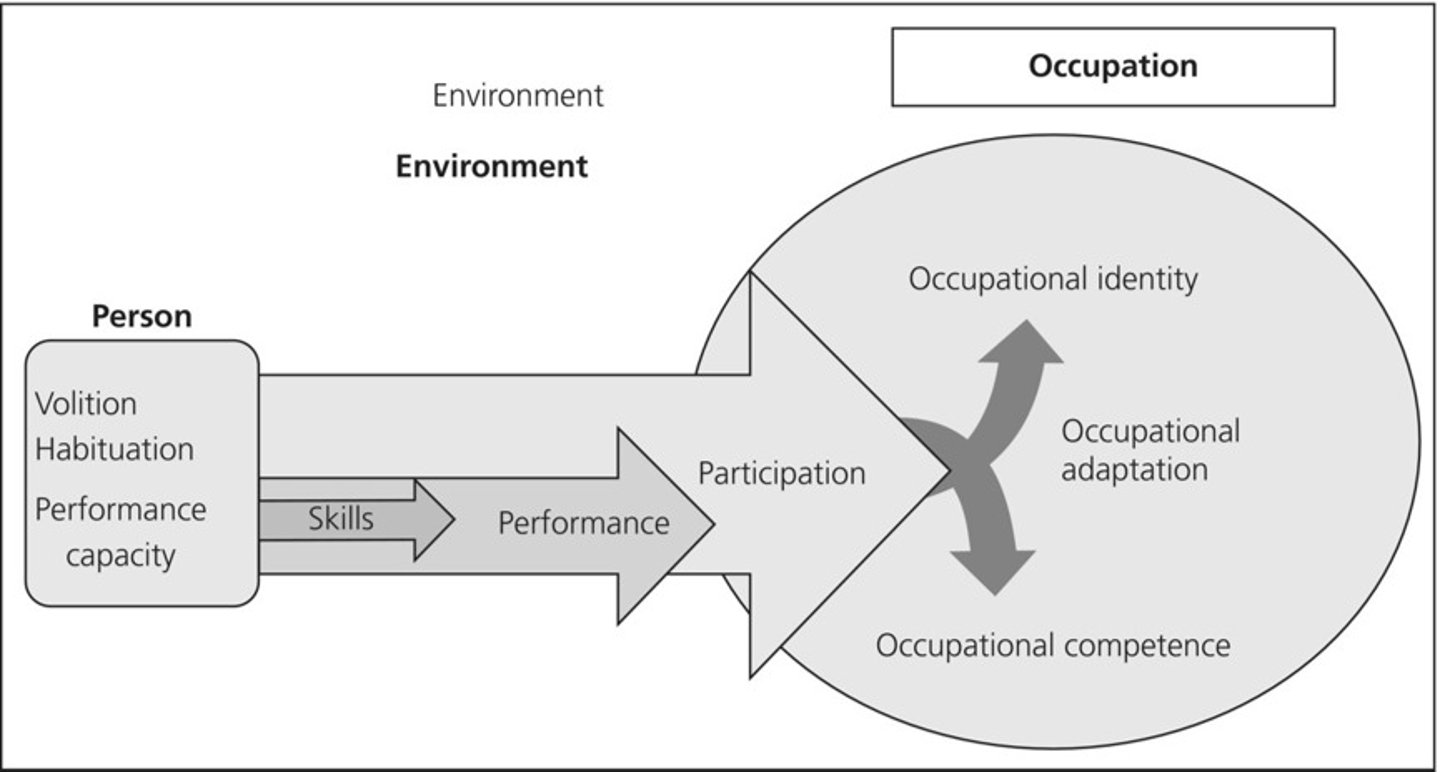
MOHO addresses (4 things)
1- Motivation for occupation
2- Routine patterning of occupations
3- Nature of skilled performance
4- Influence of environment on occupation
MOHO is typically appropriate for ...
clients with a wide range of impairments throughout the life course
MOHO seeks to explain how occupations are ...
chosen, patterned, and performed
MOHO states that people are composed of 3 interacting elements:
volition
habituation
performance capacity
Volition
Definition: The process by which people are motivated toward and choose occupations
Includes: personal causation, values, interests
Habituation
Definition: the process whereby people organize their actions into patterns and routines
Includes:
responses to familiar situations
Performance Capacity
Definition: a person's underlying mental and physical abilities and how those abilities are used and experienced in occupational performance
Includes: body functions/systems/motor skills, processing, communication, interaction
The big idea of the MOHO is the _______ of _____
Dimensions of Doing
Dimensions of Doing include
occupational participation, occupational performance, occupational skills
Occupational participation (MOHO)
Broadest sense of engagement in occupation; may be role based
engaging in work, play, ADL (occupations necessary to well-being)
Occupational Performance (MOHO)
units of doing and discrete actions and/or activities
Occupational Skills (performance skills) (MOHO)
Observable, Goal-directed actions that a person uses for occupational performance
Overarching target of MOHO:
occupational adaptation
(this is a different kind of occupational adaptation than OA theory)
Desired Outcomes of MOHO
occupational competence, occupational identity, occupational adaptation, occupational engagement
occupational competence (MOHO)
the degree to which people are able to sustain a pattern of doing that enacts their occupational identity
occupational identity (MOHO)
from experience of what people do overtime
the values, interests, roles, personal causation, volition, habituation, choice, etc.
occupational adaptation (MOHO)
Creation of occupational identity and ability to enact this identity in variety of circumstances
Occupational engagement (MOHO)
The way clients do, think, and feel under certain contexts
9 dimensions of occupational engagement
Choose/decide
Commit
Explore
Identify
Negotiate
Plan
Practice
Reexamine
Sustain
Therapeutic reasoning is paramount in MOHO. Describe it -
-Generating questions about the client
-Gather info on and with the client
-Use the information gathered to create theory-based explanation
-Generating goals and strategies for therapy
-Implementing and monitoring therapy
-Determining outcomes of therapy