The Knee
 View linked note
 Call Kai
 Learn
Learn Practice Test
 Spaced Repetition
 Match
Match Flashcards
 Knowt Play
1/21

There's no tags or description
Looks like no tags are added yet.
Name | Mastery | Learn | Test | Matching | Spaced | Call with Kai |
|---|
No analytics yet
Send a link to your students to track their progress
22 Terms
ACL Tear
A tear in the ligament that connects the femur to the tibia deep and stabilizes the knee joint.
Function of ACL
Prevents excessive anterior tibia movement and limits rotational knee movements.
Who is most likely to tear the ACL?
Mostly athletes in sports with a lot of change in direction, jumps, and landing; female athletes are 2-8 times more likely.
Symptoms of ACL Tear
Audible pop, severe pain, swelling, loss of range of motion, instability with weight bearing.
ACL Tear Treatments
Surgery options: Allograft (cadaver) and Autograft (from hamstring/tendon)
non-surgical options: intensive physical therapy and RICE.
MCL Tear
A tear in the ligament that connects the femur to the tibia medially and stabilizes the knee joint against valgus forces.
Who is most likely to tear the MCL?
Young to middle-aged adults participating in contact sports; male to female ratio is 2:1.
Symptoms of MCL Tear
Pain, swelling, and tenderness varying by grade of severity: Grade 1 (mild), Grade 2 (moderate), Grade 3 (severe).
MCL Tear Treatments
Knee brace, physical therapy, RICE
surgery: Allograft MCL Reconstruction
Function of Meniscus
Shock absorption, load distribution, stability, and joint lubrication in the knee.
Who is likely to injure the Meniscus?
Athletes twisting their upper leg with a planted foot, people with discoid meniscus, and older adults due to wear and tear.
Symptoms of Meniscus Injury
Pain in knee joint (laterally and medially), locking of the knee, and pain when bending the knee.
Diagnostics for Meniscus Injury
Physical examination, X-ray, and MRI.
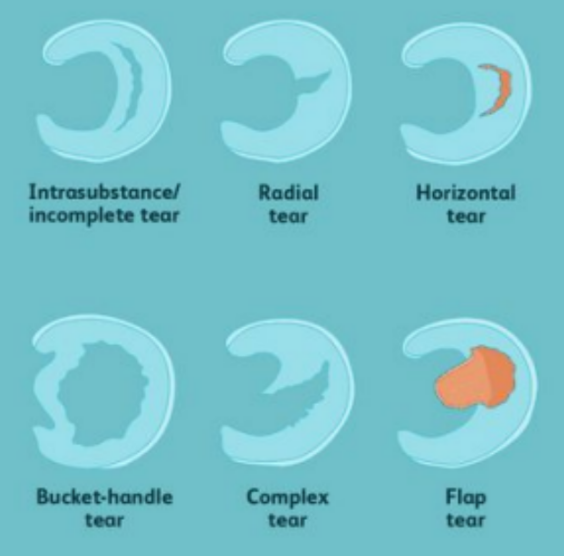
Types of Meniscus Tears
Intrasubstance, radial, horizontal, complex tear, bucket-handle, and flap tear.
Meniscus Treatment Options
RICE, physical therapy
surgery options: arthroscopy, meniscus transplant, and knee replacement
Why would you get an Allograft MCL Reconstruction vs autograft
Allograft MCL reconstruction is often chosen for patients who prefer to avoid a second surgical site for harvesting tissue, have a higher demand for recovery speed, or when the autograft option is not viable due to previous surgeries or injury. Allografts can also provide a larger graft size, which may be beneficial for certain types of reconstructions.
MCL Tear Grade 1
A mild sprain of the medial collateral ligament characterized by slight stretching or microscopic tears. It typically results in minimal pain and swelling, with little to no instability in the knee.
MCL Tear grade 2
A moderate sprain of the medial collateral ligament involving partial tearing. This grade often leads to increased pain, swelling, and some instability in the knee during movement.
MCL Tear Grade 3
A severe sprain of the medial collateral ligament characterized by complete tearing of the ligament. This grade results in significant pain, swelling, and marked instability in the knee, often requiring surgical intervention for repair.
Meniscus Transplant Surgery
A surgical procedure that replaces a damaged or removed meniscus in the knee with donor tissue. It aims to relieve pain, restore function, and prevent further joint damage.
Knee Replacement Surgery
A surgical procedure that involves removing a damaged knee joint and replacing it with an artificial joint, typically made of metal and plastic. This surgery aims to relieve pain, improve mobility.
Tissue Engineering for Meniscus tear
A regenerative medicine approach that aims to create biological substitutes to restore or improve the function of the meniscus in the knee. This technique utilizes scaffolds and cells to promote healing and reduce pain.