Germanic Kingdoms: Notable Groups (inc. Civilizations, Tribes, etc.)
 Studied by 0 people
 Call Kai
 Learn
Learn Practice Test
 Spaced Repetition
 Match
Match Flashcards
 Knowt Play
1/32

Earn XP
Description and Tags
Includes both Frankish (Merovingian and Carolingian) and Anglo-Saxon (Heptarchy) Kingdoms as well as other Germanic Kingdoms
Name | Mastery | Learn | Test | Matching | Spaced | Call with Kai |
|---|
No study sessions yet.
33 Terms
Ambrones (All Facts)
Possible Ancient Germanic tribe from the Jutland that migrated into the eastern Alps around 113 BCE
They invaded Rome in the Cimbrian War, winning the Battle of Noreia in 113 BCE and the Battle of Arausio in 105 BCE losing the war in 101 BCE
When they tried to enter Spain after defeating Rome in the Battle of Arausio in 105 BCE, they were swiftly expelled from there by the Celtiberians
Teutons (All Facts)
Possible Ancient Germanic tribe from the Jutland that migrated into the eastern Alps around 113 BCE
They invaded Rome in the Cimbrian War, winning the Battle of Noreia in 113 BCE and the Battle of Arausio in 105 BCE but losing the Battle of Aquae Sextiae in 102 BCE to Marius and the Romans and losing the war and being destroyed in the Battle of Vercellae in 101 BCE
When they tried to enter Spain after defeating Rome in the Battle of Arausio in 105 BCE, they were swiftly expelled from there by the Celtiberians
Cimbri (All Facts)
Possible Ancient Germanic tribe from the Jutland that migrated into the eastern Alps around 113 BCE
They invaded Rome in the Cimbrian War, winning the Battle of Noreia in 113 BCE and the Battle of Arausio in 105 BCE but losing the Battle of Aquae Sextiae in 102 BCE to Marius and the Romans and losing the war and being destroyed in the Battle of Vercellae in 101 BCE
When they tried to enter Spain after defeating Rome in the Battle of Arausio in 105 BCE, they were swiftly expelled from there by the Celtiberians
They travelled around the Alps and entered Italy from the Northeast
Sugambri (All Facts)
Germanic people who lived in the area between the Rhine, Lippe, and Wupper rivers, in what is now Germany, near the border with the Netherlands
They were first reported by Julius Caesar, who encountered them in 55 BC
They became a significant opponent of Roman imperial power in the Rhine region
After a major defeat by the Romans in 9 BCE, many of them moved into Roman territory
Were defeated by Nero Claudius Drusus and his Roman forces in 9 BCE
Frisii (All Facts)
Ancient Germanic Tribe that neighbored Rome and lived in the low-lying coastal region between the Rhine and the Ems rivers, in what what is now the northern Netherlands
Were defeated by Nero Claudius Drusus and his Roman forces in 9 BCE
Chatti (All Facts)
Germanic people that lived during the times of the Roman Empire in a region approximately corresponding to the modern German federal state of Hesse
They were a highly organized Germanic people who lived in the region of the Upper Weser River and the Diemel
Were defeated by Nero Claudius Drusus and his Roman forces in 9 BCE
Were defeated by Caligula and the Roman Empire in 39 CE
Were defeated by Domitian and the Roman Empire in 83 CE
Were definitively conquered by Clodius Albinus and the Roman Empire in 187 CE
Up to that point, they had been threatening the Agri Decumates region, which included the “Black Forest” region
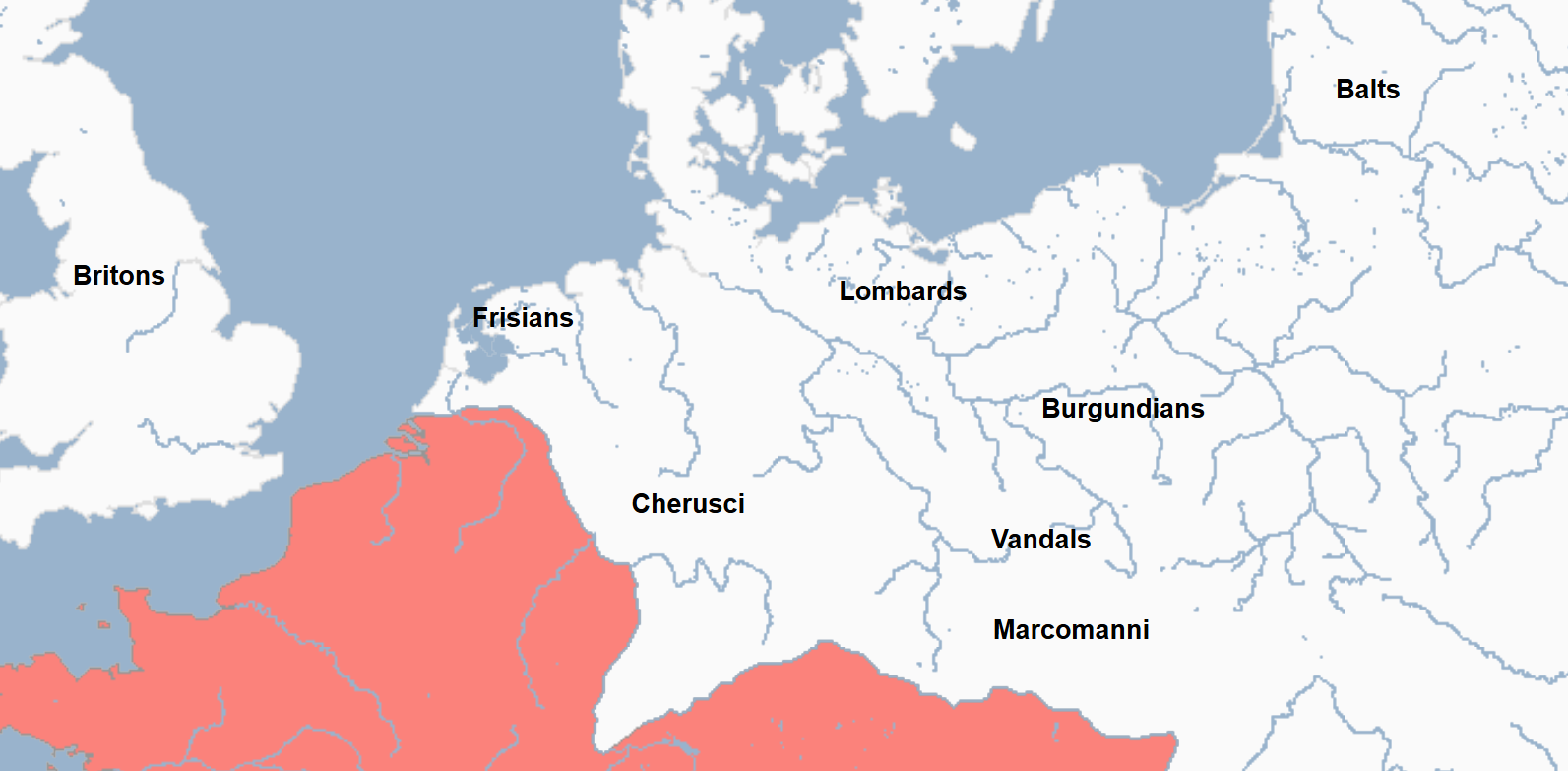
Cherusci (All Facts)
Germanic Tribe that inhabited parts of the plains and forests of northwestern Germania in the area of the Weser River and present-day Hanover from the 0s BCE to the 0s CE
Led by Arminius, they defeated the Romans in the Battle of the Teutoberg Forest in 9 CE
Batavi (All Facts)
Germanic people that lived in Batavia in the eastern Rhine delta in the area that is now the Netherlands, they were contemporaries of Rome
Were led by
Gaius Julius Civilis, who
led his namesake revolt against the Romans called the “War of Liberation” in 69 and supported by Gallic tribes including the Treveri and Lingones
Marcomanni (All Facts)
Germanic people who lived close to the border of the Roman Empire, north of the River Danube
Were led by
Maroboduus
They saved the Dacian Kingdom from total destruction by Domitian and the Romans, forcing Domitian to sign a humiliating peace treaty with the Dacians and their king Decebalus
Fought in the Marcomannic wars with the Quadi against Rome
Prompted by their land being invaded by Goths, Burgundians, and Vandals, they fled west into Roman territory
By 169, they got as far as the plains of north Italy, causing panic in Rome
In 172, they made peace with Marcus Aurelius, in which a strip of land almost five miles wide to the north of the Danube River became forbidden to them
In 177, they declared war against Rome again
However, they were defeated by Tarrutenius Paternus and his Roman forces at the Battle of Vindobona in 179
Initially fought against Commodus on the upper Danube River, but he eventually abandons plans for conquering them and makes peace with them by 180
Quadi (All Facts)
Germanic people during the Roman era, who had a kingdom centered in the area of present-day western Slovakia, north of the Roman border on the Danube river
They saved the Dacian Kingdom from total destruction by Domitian and the Romans, forcing Domitian to sign a humiliating peace treaty with the Dacians and their king Decebalus
Fought in the Marcomannic Wars with the Marcomanni against Rome
Prompted by their land being invaded by Goths, Burgundians, and Vandals, they fled west into Roman territory
By 169, they got as far as the plains of north Italy, causing panic in Rome
In 172, they made peace with Marcus Aurelius, in which a strip of land almost five miles wide to the north of the Danube River became forbidden to them
In 177, they declared war against Rome again
However, they were defeated by Tarrutenius Paternus and his Roman forces at the Battle of Vindobona in 179
Initially fought against Commodus on the upper Danube River, but he eventually abandons plans for conquering them and makes peace with them by 180
Alamanni / Alemanni (All Facts)
Confederation of Germanic tribes on the Upper Rhine River during the first millennium
They successfully fought against Emperors Alexander Severus and Maximinus and the Roman Empire
Their military efforts include
235 - Raided the frontier of the upper Rhine and an area called the Agri Decumates
They withdrew after they were bribed or paid tribute by the Romans
253 - Invaded Gaul
269 - Invaded Rome but was defeated by Emperor Claudius II and the Romans
275 - Pillaged Gaul
276 - Defeated by Emperor Probus, who liberated Gaul
355 - Crossed the Rhine River and wreaked havoc in eastern Gaul
357 - Defeated by Emperor Julian in the Battle of Strasbourg, who drove them back behind the Rhine River
368 - Defeated by Emperor Valentinian at Trier
496 - Defeated by Clovis and the Franks in the Battle of Tolbiac
They never ended up establishing their own barbarian successor state / kingdom
Suebi / Sueves (All Facts)
Germanic People
In 406, they worked together with the Vandals, Burgundians, and the Iranian Alani to take advantage of the exceptional cold to cross the frozen Rhine River and open up the frontier of Gaul for pillaging
In 409 - With the Vandals, Burgundians, and Alani, they then pillaged Spain
They served as auxiliaries for the Roman army
In the 560s, they were converted to Nicene Christianity (Catholicism) by St. Martin of Braga
Gepids (All Facts)
They were famous for being a Germanic vassal of the Huns, and a Germanic tribe most favored by the Huns
Along with other Germanic tribes, they rebelled against Atilla’s sons and defeated them in Pannonia, leading to the dissolution of the Hunnic Empire
East Germanic tribe who lived in the area of modern-day Romania, Hungary, and Serbia, roughly between the Tisza, Sava, and Carpathian Mountains
They shared the religion and language of the Goths and Vandals
They were led by
Ardaric
They served as auxiliaries for the Roman army
Were defeated by a Lombard-Avar alliance, in which their territory along the middle Danube River was taken over by them by 567
“Barbarian” Successor Kingdoms (All Facts)
Includes the
Goths - Visigoths and Ostrogoths
Vandals
Burgundians
Franks
Anglo-Saxons
These groups
Were partly prompted to invade Rome because they were fleeing the Huns, who had invaded and occupied their own territories within Europe by 375 CE
Managed to settle within the imperial frontiers and carve Western Rome up into a number of independent successor kingdoms
They all helped contribute to the fall of the Roman Empire and then established their own namesake entities where
They made use of many Roman traditions and administrative methods
Their leaders saw themselves as successors of Roman Emperors
Outside of politics, life primarily went on just as it had for the inhabitants under Rome
The only major difference in life for the average person was they were being ruled by the namesake leader rather than a Roman Emperor
The namesake rulers could not escape the influence of Rome on culture, power, and prestige but they did not necessarily want or need to either
After all, most of these peoples occupied the western half of the empire and had been living in close contact with the Roman world and had even been working inside the empire for centuries
Aside from the Anglo-Saxons in Britain, life continued like before as Roman culture was absorbed
The namesake rulers continued to adopt Roman government procedures, having made use of Roman law and and administrative practices and continuing to use Roman officials
The namesake rulers continued to issue laws that were binding on all of the people living in territories under their control, having compiled law codes
All of the settlers within these entities adopted the Latin language except for Anglo-Saxons and these sub-languages of Latin gradually evolved into the modern-day Romance languages
During the namesake’s hegemony, Rome had reconquered most of the western Mediterranean
Smaller versions of the namesake entity were absorbed by larger ones until only the Franks and Anglos were left by the 700s
Over the course of time, most of the namesake were assimilated into the classical cultural tradition
Most of the namesake entities looked like nothing more than small-scale models of the Roman Empire
None of the namesake entities had an economy or bureaucracy as complex as those in Rome
The namesake rulers often created an origin myth that gave their ruling families the the legitimacy of rule and the luster of great antiquity
Goths (All Facts)
Germanic People who originated in southern Scandinavia
They migrated from the Baltic and settled on the shores of the Black Sea
They were divided between themselves with those from the West being called Visigoths and those in the East being called Ostrogoths, separated on either side of the Dniester River
They were led by
Radagaisus
Their military efforts include
238 - Took possession of land north of the Black Sea, crossed the Danube River and invaded the province of Moesia
Despite the Romans paying them tribute, they could not persuade them to withdraw from the province of Moesia
250 - Invaded Moesia
251 - Penetrated Dacia
251 - Led by Cniva, they defeated and killed Emperor Decius of the Roman Empire and his forces at the Battle of Abrittus
260 - Attacked Italy and Greece
267 - Pillaged Thrace, Macedonia, and Greece
269 - Defeated by Claudius II and the Romans in the Battle of Naissus
276 - Defeated by Tacitus
406 - Led by Radagaisus, they were defeated by Stilicho and the Romans in the Battle of Fiesole
Visigoths (Origins / Rise to Power)
The Goths from the West on the western side of the Dniester River
They originally inhabited Dacia since 225 CE
Group that had regularly supplied contingents of auxiliaries for the Roman army, they gained access to Roman resources over time
They had the Roman stamp of approval on their occupation of Roman territory and readily adapted themselves to Roman practices
They were the first group of barbarian invaders to settle and maintain their independence on Roman soil, forming the namesake independent kingdom
Visigoths (Relationship with Emperor Valens)
They offered Emperor Valens military service in exchange for his provision of deserted land for them to settle in as a result of their flight from the Huns that had invaded Europe at that time
This helped resolve two issues for Rome, which involved
Finding enough army recruits
Bringing more land onto the tax rolls
Up to this point, the Romans had never brought this many defeated barbarians into their empire before
When the Emperor accepted this offer, he did so on the conditions that they
Turn over their weapons
Were only provided food by the Romans until they could harvest their own crops
They accepted these conditions and settled inside Rome’s borders in order to flee from the Huns
Thousands of them had crossed the Danube River and reached Thrace in order to do this
However, Roman officials under Valens who were in charge of providing them food had
Pocketed much of the food for themselves
Accepted bribes to allow them to keep their weapons
Moreover, local Roman commanders under Valens took advantage of their situation and imposed slavery on a number of their refugees
As a result of these developments, they suffered a horrible famine and the experiences of Roman slavery
As a result of the famine, they rampaged about the Balkans in
Search of food
Revolt against Rome
Emperor Valens had assembled the Roman army to suppress their rampaging, having forced them to accept an unfavorable peace treaty after defending themselves against the invasion instigated by Emperor Valens and the Romans in 369
By 375, they grew to be a major threat to the empire since they were give sanctuary by Emperor Valens, having roamed from Thrace to Illyricum
All of these developments led to their King Fritigern and his forces defeating the Romans in the Battle of Adrianople in 378, one of the most humiliating defeats for the Romans in Roman history
Their military efforts include
402 - The Siege of Asti, where they began to invade northern Italy and take cities away from the Romans like this one
402 - Battle of Verona, in which they were led by Alaric but defeated by Stilicho and the Romans
410 - Led by Alaric, they sack Rome
Those who joined them after Stilicho and the Romans’ defeat had their families massacred by Emperor Honorius
Ostrogoths (All Facts)
They regularly supplied contingents of auxiliaries for the Roman army, gaining access to Roman resources and the roman stamp of approval on their occupation of Roman territory; which led to the formation of their namesake independent kingdom
Settled in Ukraine during the reign of Emperor Gordian III of the Roman Empire
By 375, the Huns had invaded their land and defeated and conquered them
Were led by
Ermanaric
Theodoric
In their kingdom, they
Owned a third of Italy
Were Arian Christians
Ran the army
In their kingdom, Romans
Enjoyed traditional powers
Were Nicene Christians
Ran the civil service
Vandals (All Facts)
Their military efforts include
260 - Attacked Italy and Greece
279 - Expelled by Emperor Probus of the Roman Empire after their occupation of Rhaetia
406 - Worked together with the Burgundians, Suebi and the Iranian Alani to take advantage of the exceptional cold to cross the frozen Rhine River and open up the frontier of Gaul for pillaging
409 - With the Suebi and Alani, they then pillaged Spain
410 - Were hired by the Roman Empire to subdue the threat of the Visigoths after they had sacked Rome
429 - 80K of them crossed the Straits of Gibraltar from Spain into Africa, which they forcibly occupied but were constantly confronted with the possibility of a Roman counter-invasion
430 - Seized Hippo
439 - Seized Sicily, Sardinia, and Corsica
439 - Seized Carthage of Roman Africa, taking with it Rome’s valuable lush wheat fields upon which the empire depended for its bread
After seizing Carthage in 439, they established their successor kingdom there
468 - Conquered Sicily
Burgundians (All Facts)
Their military efforts include
279 - Expelled by Emperor Probus of the Roman Empire from Rhaetia
406 - Worked together with the Vandals, Suebi and the Iranian Alani to take advantage of the exceptional cold to cross the frozen Rhine River and open up the frontier of Gaul for pillaging
409 - With the Vandals, Suebi and Alani, they then pillaged Spain
413 - Signed a treaty with the Roman Empire in which they were allowed to settle on former imperial land near the Rhine River
436 - Defeated by Flavius Aetius and the Romans and the Huns at Worms, they fled to the upper Rhine River
443 - Were given imperial land in the Geneva area of the Roman Empire by Flavius Aetius, becoming allies of Rome under a special treaty in which they agreed to serve in the Roman army
Franks (All Facts)
Their military efforts include
253 - Invaded Gaul
260 - Invaded Gaul again, having swept up into Spain
275 - Pillaged Gaul
276 - Defeated by Emperor Probus, who liberated Gaul
360 - Defeated by Emperor Julian, who restored the Rhine Frontier from them
Rugians (All Facts)
Germanic Tribe that originated near the southern coast of the Baltic Sea and migrated in modern-day Austria
They served as auxiliaries for the Roman army
Heruli (All Facts)
Germanic Tribe that originated from Scandinavia and migrated near other contemporary Gothic tribes
They served as auxiliaries for the Roman army
Scirians (All Facts)
Germanic Tribe that served as auxiliaries for the Roman army
Saxons (All Facts)
One of the three major Germanic tribes who settled in Great Britain after the departure of the Romans there, along with the Angles and Jutes
Were led by
Vortigern
Hengest “The Stallion”
Horsa “The Horse”
Their military efforts include
450 - Seized Kent, destroying the local infrastructure of its Roman government after the Romans had left Britain
Along with the Jutes and Angles, they crossed over to Britain in search of easy money
When their demands for more supplies were refused, their mercenaries rebelled and seized Kent
Since the 400s, they crossed the North Sea and sailed up big rivers, such as the Thames River and Humber River, in search of new lands
They lived mainly in the countryside, where they farmed the heavy soil of the river valleys, with the result that they had largely ignored the old Romano-British towns and villas, many of which gradually fell into ruins
Romano-Britons and Celts that had not wished to live alongside them were pushed westward, having migrated to western Britain or Armorica (Brittany)
They referred to the British natives already living there as “Welsh” (foreigners)
Natives and newcomers coexisted reasonably well until the death of King Maelgwyn of Gwynedd
Angles (All Facts)
One of the three major Germanic tribes who settled in Great Britain after the departure of the Romans there, along with the Saxons and Jutes
Since the 400s, they crossed the North Sea and sailed up big rivers, such as the Thames River and Humber River, in search of new lands
They lived mainly in the countryside, where they farmed the heavy soil of the river valleys, with the result that they had largely ignored the old Romano-British towns and villas, many of which gradually fell into ruins
Romano-Britons and Celts that had not wished to live alongside them were pushed westward, having migrated to western Britain or Armorica (Brittany)
They referred to the British natives already living there as “Welsh” (foreigners)
Natives and newcomers coexisted reasonably well until the death of King Maelgwyn of Gwynedd
Jutes (All Facts)
One of the three major Germanic tribes who settled in Great Britain after the departure of the Romans there, along with the Angles and Saxons
Since the 400s, they crossed the North Sea and sailed up big rivers, such as the Thames River and Humber River, in search of new lands
They lived mainly in the countryside, where they farmed the heavy soil of the river valleys, with the result that they had largely ignored the old Romano-British towns and villas, many of which gradually fell into ruins
Romano-Britons and Celts that had not wished to live alongside them were pushed westward, having migrated to western Britain or Armorica (Brittany)
They referred to the British natives already living there as “Welsh” (foreigners)
Natives and newcomers coexisted reasonably well until the death of King Maelgwyn of Gwynedd
Lombards (All Facts)
Germanic People named “Langobardi” (longbeards)
They conquered most of the Italian Peninsula
Their military efforts include
567 - Worked with the Avars to defeat the Gepids and take over ex-Gepid territory on the middle Danube River
568 - Abandoned Pannonia (Hungary) to the Avars and invaded northern Italy instead
Anglo-Saxons (All Facts)
In terms of their culture, they are known for having produced the epic poem “Beowulf,” which included a hero whose burial featured much treasure on a similar headland “high and broad and visible to those journeying the ocean”
Despite frequent punitive raids of the Franks and valiant efforts of the namesake missionaries, many of the latter namesake still worshipped the same gods they worshipped for hundreds of years and believed in oracles and sacrificial feasts contrary to Christianity
Moreover, they sporadically plundered the Kingdom of Francia, especially when leaders like Charlemagne went away from the kingdom, such as when he advanced into Italy to subdue the Lombards, where they ventured into and plundered Frankish territory repeatedly
They were defeated and fully Christianized in their namesake wars led by Widukind against Charlemagne and his Carolingian forces
Mercians (All Facts)
Frisians (All Facts)
Germanic people group indigenous to Northwestern Europe on the coastal regions of northern Netherlands, north-western Germany and southern Denmark
They are the ancestors of the modern-day Dutch
They were converted to Christianity by St. Willibrord of Northumbria under Pope / St. Sergius
Danes (All Facts)
North Germanic tribe inhabiting southern Scandinavia, including the area now comprising Denmark proper, northern and eastern England, and the Scanian provinces of modern-day southern Sweden, during the Nordic Iron Age and the Viking Age
They were slowly converted to Christianity by St. Ansgar prior to the establishment of their kingdom under their pre-monarchical ruler Harald Klak, who had brought the Frankish monk and missionary with him
Even after the Vikings had destroyed his initial church in Hamburg, St. Ansgar continued to preach to the Danes and Swedes from Bremen
Prior to 865, they plundered the coasts of England
After 865, they dramatically changed their policy by ravaging the country far inland and settling in England
They quickly overwhelmed Northumbria, East Anglia, and Mercia; and forced the Mercians to pay them tribute
However, they were defeated by Aethelred and Alfred the Great in
The Battle of Ashdown in 871
The Battle of Edington in 878
They were defeated once again by Edward the Elder (successor to Alfred the Great) in the Battle of Tettenhall in 910