structrue of prokaryotic and eukaryotic cells 2
 Call Kai
 Learn
Learn Practice Test
 Spaced Repetition
 Match
Match Flashcards
 Knowt Play
1/21

There's no tags or description
Looks like no tags are added yet.
Name | Mastery | Learn | Test | Matching | Spaced | Call with Kai | Chat |
|---|
No analytics yet
Send a link to your students to track their progress
22 Terms
endomembrane system: list organelles
plasma membrane
endoplasmic reticulum
golgi body
transport vesicles
nuclear envelope
microbodies
endoplasmic reticulum
network of flattened sacs and cisternae
connected to outer nuclear envelope
synthesises membrane lipids
export of molecules to the outside of cells
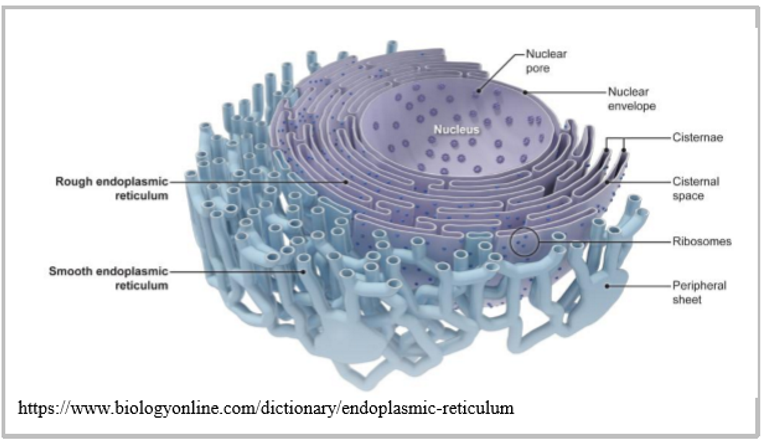
two components of endoplasmic reticulum
rough ER
ribosomes attached → gives bumpy appearance
protein synthesis
smooth ER
no ribosomes attached
lipid synthesis
golgi body
stacks of cisternae
cis face → points towards the endoplasmic reticulum
trans face → points towards the plasma membrane
cis vs trans face
cis face → where vesicles arrive from the ER
trans face → where transport vesicles pinch off and carry proteins and other molecules towards the plasma membrane
proteins can be (?) as they travel through the golgi
glycosylated → sugar group added
exocytic pathways (unregulated vs regulated)
unregulated
used by all eukaryotic cells
secrete soluble proteins
supply new synthesised lipids and proteins to the plasma membrane
regulated
used by specialised eukaryotic cells
store proteins in vesicles until a signal stimulates secretion
endocytic pathway
part of the plasma membrane buds inwards to form a vesicle
entrapping molecules from outside the plasma membrane
molecules are taken up by cell
ultimately molecules are digested in lysosome
endocytosis for viruses
viruses can enter the cell
binds to protein receptors on the outside of the cell membrane
allows entry of viruses into the cell
microbodies
single-membrane bound organelles
e.g. peroxisomes, glyoxysomes, glycosomes, hydrogenosomes
contains enzymes → detoxification (liver), photorespiration (carbon recycling in plants)
double membrane organelles
nucleus
mitochondria
chloroplast
nucleus
surrounded by a nuclear envelope
outer membrane of nuclear envelope connected to the ER
material exchange with the cytosol via nuclear pores
contains most cellular DNA that becomes visible as condensed chromosomes during cell division
transcription of DNA into RNA
partial ribosome assembly in the nucleolus
mitochondria
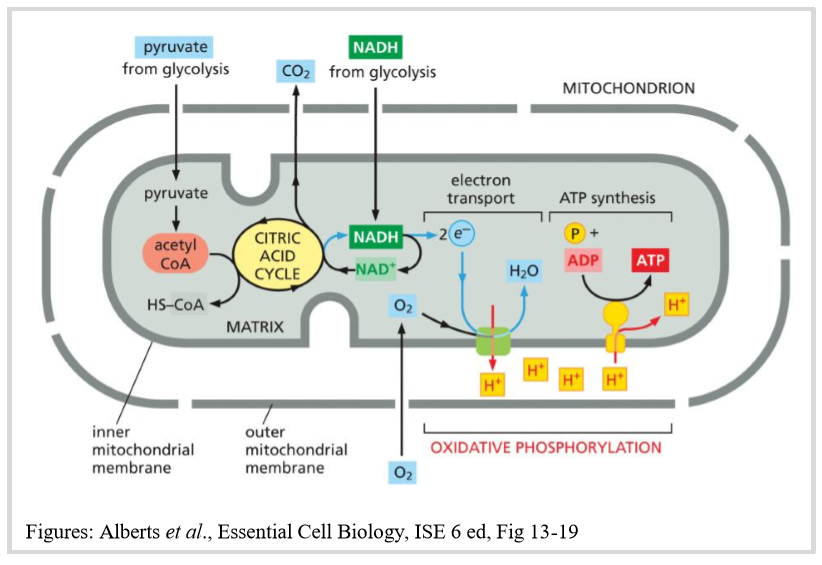
site of cellular respiration and energy (ATP) production
outer membrane → permeable to ions and small molecules
inner membrane → highly folded into cristae and is impermeable: requires transport proteins
matrix → contains DNA that codes for RNA, mitochondrial ribosomes, and enzymes for the citric acid and krebs cycle
energy production in the mitochondria
pyruvate (from glycolysis) enters the mitochondrial matrix where it is oxidised to acetyl CoA
in the matrix: acetyl CoA is further oxidised in the matrix via the citric acid cycle → NADH and CO2
in the inner mitochondrial membrane: electron transport chain uses NADH in oxidative phosphorylation to create a pH gradient
oxidation of NADH to NAD+
reduction of O2 to H2O
pH gradient enables ATP synthase to produce lots of ATP: ADP + Pi → ATP
how do mitochondria and chloroplasts differ in their number of membranes?
mitochondria → 2 membranes
chloroplasts → 3 membranes
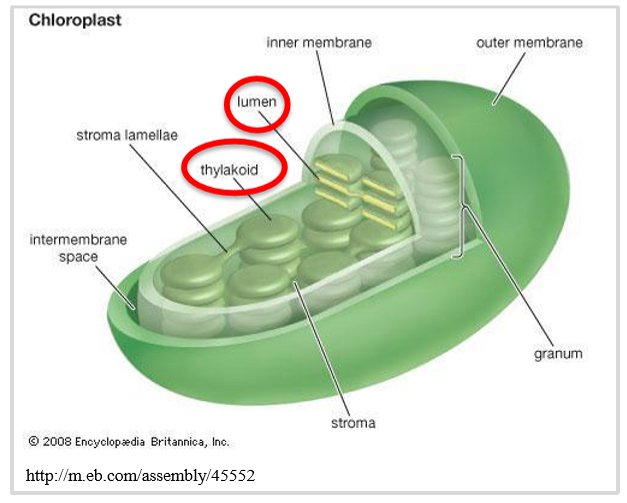
chloroplasts
outer membrane → permeable
inner membrane → impermeable: requires transport proteins
stroma: surrounded by inner membrane
contains chloroplast DNA, ribosomes, RNA, enzymes
contains thylakoids stacked into grana → photosynthesis
mitochondria and chloroplasts similarities
both have an inner and outer membrane
both have a space surrounded by the inner membrane: mitochondrial matrix and chloroplast stroma
matrix and stroma contain circular DNA
ribosomes
DNA replication and transcription enzymes
enzymes for metabolism
both have an electron transport chain and an ATP synthase to generate ATP
mitochondria and chloroplasts differences
mitochondria uses NADH
chloroplasts produce and use NADPH
mitochondria use energy from food
chloroplasts use energy from light
chloroplasts can synthesise sugars whereas mitochondria cannot
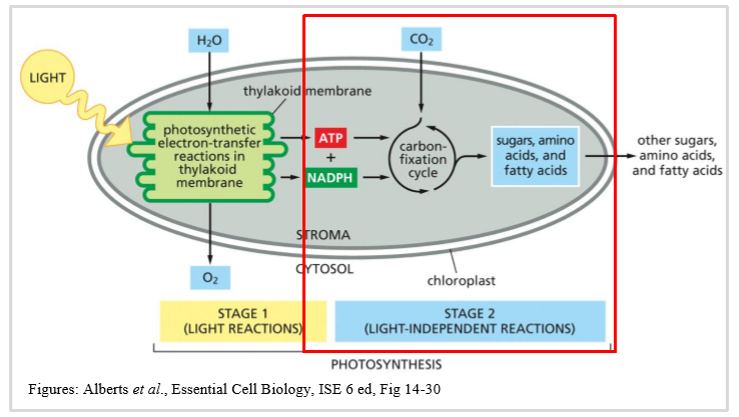
photosynthesis stage 1
thylakoid membranes contain two photosystems PSI and PSII
these contain light harvesting pigments such as chlorophyll that absorb light energy (photons)
light reaction: light energy is converted to reducing power (NADPH) and chemical energy (ATP)
via a series of oxidation-reduction reactions
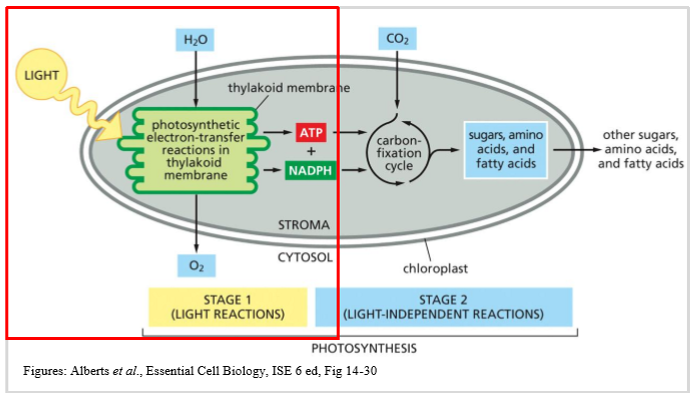
photosynthesis stage 2
in the stroma: NADPH & ATP from the light reactions and atmospheric CO2 are used by the calvin cycle to produce sugars
the enzyme rubisco catalyses the first reaction in the calvin cycle
overall: light energy + CO2 + H2O → sugars + O2
evolution of membrane closed organelles
ancient archaeal cell → expansion of the plasma membrane forming protrusions to better exchange metabolites with environment
segments between protrusions pushed themselves inwards → gave rise to intracellular membrane surrounded spaces
this gave rise to organelles
surrounding the genomic DNA → nucleus
surrounding aerobic bacteria → mitochondria
surrounding photosynthetic bacteria → chloroplasts
forming endomembrane system
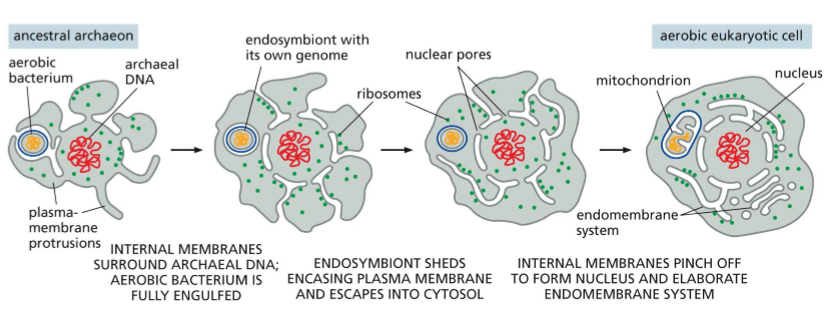
evolution of mitochondria and chloroplasts
ancestral eukaryotic cell ingested an aerobic bacterium → over time evolved into a mitochondrion
plant cells later ingested a photosynthetic bacterium → over time evolved into a chloroplast