5.5 Pressure & Pressure Differences in Fluids
 Call Kai
 Learn
Learn Practice Test
 Spaced Repetition
 Match
Match Flashcards
 Knowt Play
1/27

There's no tags or description
Looks like no tags are added yet.
Name | Mastery | Learn | Test | Matching | Spaced | Call with Kai | Chat |
|---|
No analytics yet
Send a link to your students to track their progress
28 Terms
What is pressure?
Force exerted on a surface per unit of area that force is distributed over
What are the 2 states of matter that a fluid can be?
Liquid
Gas
When a force acts on a surface it causes _________.
pressure
What are 2 ways to increase pressure?
Increase force
Smaller SA
What are 2 ways to decrease pressure?
Decrease force
Larger SA
As you increase the size of the force you ___________ the size of the pressure.
increase
As you increase the size of the area of which the force is spread acts, you ___________ the pressure.
decrease
The pressure in fluids causes a force normal (at ______ ______) to any surface.
right angles
How can the pressure at the surface of a fluid be calculated? State the units.
pressure = force normal to that surface ÷ area of that surface
ρ=AF
pressure — pascals (Pa)
force — newtons (N)
area — metres squared (m2)
What is pressure measured in?
Pascals (Pa)
How can the pressure due to a column of liquid be calculated? State the units.
pressure = height of the column × density of the liquid × gfs
p=hρg
pressure — pascals (Pa)
density — kilograms per metres cubed (kg/m3)
gfs — newtons per kilogram (N/kg)
The pressure in a liquid acts in ____ ____________.
all directions
The pressure in a liquid is ___________ at greater depths.
greater
What is the equation for density? State the units.
density = mass ÷ volume
ρ=vm
density — kilograms per metre3 (kg/m3)
mass — kilograms (kg)
volume — metres cubed (m3)
What is density measured in?
kg/m³
A partially (or totally) submerged object experiences a greater pressure on the ___________ surface than on the _________ surface. This creates a resultant force upwards.
What is this force called?
bottom
top
upthrust
When we submerge an object, an _______ volume of fluid is _________. The weight of the fluid that is __________ is equal to the force of the ________.
equal
displaced
displaced
upthrust
An object that is more dense than the fluid around it will ______.
sink
Why does an object that is more dense than the fluid around it sink?
Object weight > weight of displaced fluid (= upthrust)
Weight (pulls object downwards) > upthrust pushing upwards
An object that is less dense than the fluid around it will ______.
float
Why does an object that is less dense than the fluid around it float?
Partially submerged object’s weight (acting downwards) = weight of displaced fluid — e.g. upthrust (acting upwards)
Resultant force = 0
What is the atmosphere?
Layer of air around Earth
The atmosphere gets less dense with _____________ _________.
increasing altitude
What creates atmospheric pressure?
Air molecules colliding with surface
What is altitude?
Height above sea level
The number of air molecules (and so the ________ __ ______) above a surface ___________ as the height of the surface above _________ ________ increases.
weight of air
decreases
ground level
As height increases there is always ______ air above a surface than there is at a ________ height.
less
lower
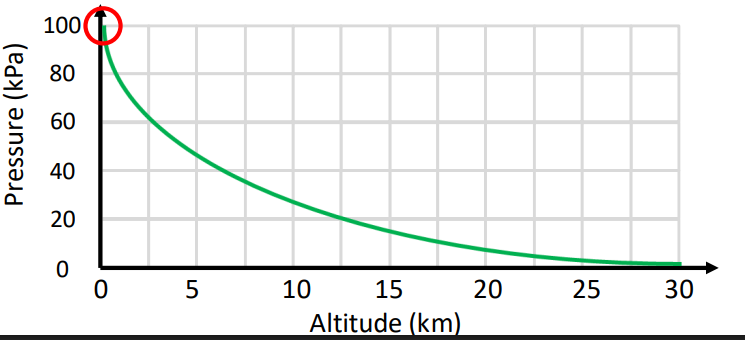
Atmospheric pressure _____________ with an increase in height.
decreases