A&P 1 Exam 4
 Call Kai
 Learn
Learn Practice Test
 Spaced Repetition
 Match
Match Flashcards
 Knowt Play
1/102

There's no tags or description
Looks like no tags are added yet.
Name | Mastery | Learn | Test | Matching | Spaced | Call with Kai | Chat |
|---|
No analytics yet
Send a link to your students to track their progress
103 Terms
Name the special senses.
Vision, olfaction, gustation, and hearing
What determines if a sense is a special sense or a general sense?
Special senses have specialized organs and general senses are distributed throughout the body
Is somatosensory considered a general or special sense?
General
What is a corpuscle?
An encapsulated axon terminal of a sensory neuron
What sensations do Meissner’s Corpuscles detect?
Touch and pain
What sensations do Pacinian Corpuscles detect?
Pressure, vibration and tickle
What sensations do hair follicle receptors detect?
Movement of hair
What cells contain synaptic vesicles which release neurotransmitters and synapse with afferent fibers of neurons?
Merkel Cells
What are the 2 purposes of eyebrows?
Provides shade and prevents sweat from trickling into eyes
What is the technical word for eyelids?
Palpebrae
What are the corners of the eyes called?
Lateral and medial commissures
Name the structure that secrets oil and is responsible for the dried oil and mucus sometimes called eye boogers.
Lacrimal caruncle
What reflex is activated when eyelashes are touched?
Blink reflex
Can a bug that flies into your eye get to your brain and why or why not?
No. The eye is protected by the conjunctiva, eyelids (palpebrae), and the tissues surrounding the eye. There is no open passage from the eye directly into the brain.
Be able to label the 6 extraocular eye muscles on slide 9 of the PowerPoint slides (Special Senses). Make sure you are able to determine if the eye is right or left eye.
Superior rectus, Inferior rectus, Medial rectus, Lateral rectus, Superior oblique, Inferior oblique. Tip for identifying the eye: Medial rectus points toward the nose. Lateral rectus points toward the ear.
Which of the eye muscles contains a tendon that runs through a pulley called the trochlea?
Superior oblique
What two structures make the fibrous layer of the eye?
Cornea and whites of the eye
What are the two layers of the retina of the eye?
Pigmented layer and Neural layer
What are the three parts of the vascular layer of the eye?
Choroid, ciliary body and the iris
What is the boundary between the retina and the ciliary body called?
Ora serrata
The lens focuses light on the retina. What are the structures that suspend the lens?
Cillary zonule or suspensory ligament
What part of the eye contains vitreous humor?
Posterior segment
Where is aqueous humor secreted, and where is it reabsorbed to be deposited back into the blood?
Cillary body secretes and Scleral venous sinus absorbs
What photoreceptor cell has greater visual acuity and is responsible for seeing sharper images and color?
Cones
Name the three colors for which we have cells to detect? All the other colors that we see are a combination of those three.
Red, blue and green
Which photoreceptor cell is more sensitive in dim light, and responsible for our peripheral vision?
Rods
What is the area in the posterior wall of the eye that contains mostly cones?
Macula lutea
What is the center of the macula lutea that contains all cones?
Fovea centralis
What is the first structure light passes through?
Cornea
What is the second structure light passes through?
Aqueous humor
What is the third structure light passes through?
Pupil
What is the fourth structure light passes through?
Lens
What is the fifth structure light passes through?
Vitreous humor
What is the sixth structure light passes through?
Entire thickness of neural layer of retina
What is the seventh structure light passes through?
Rod or one of three types of cones
What is the eighth structure light passes through?
Bipolar cells
What is the ninth structure light passes through?
Ganglion cells
What is the tenth structure light passes through?
Optic nerve
What is the eleventh structure light passes through?
Brain
A myopic eye is too long. This causes the focal point to be before the retina. This causes what condition?
Myopia
What type of lenses will correct myopia (nearsightedness)?
Concave lenses
A hyperopic eye is too short. This causes the focal point to be beyond the retina. This causes what condition?
Hyperopic eye
What type of lenses will correct hyperopia (farsightedness)?
Convex lenses
Name the visual pathology, commonly called pink eye, that is a result of inflammation of the conjunctiva.
Conjunctivitis
Which visual pathology is due to the buildup of pressure in the eye, which results in damage to CN II, the optic nerve?
Glaucoma
What is it called when the lens of the eye becomes cloudy?
Cataract
What is the most common type of color blindness?
Red-green color blindness
Name the test used to determine color blindness.
Ishihara test
What are the airborne chemicals that we smell?
Odorants
What are the structures inside of the nasal cavity that moistens, warms, and filters air?
Nasal conchae
The filaments of the olfactory nerves pass into the cranial cavity through which structure?
Cribriform plate of the ethmoid bone
What structures, within the olfactory bulbs, are the locations where the synapse occurs between the olfactory nerves and mitral cells? The mitral cells distribute the nerve impulses to the appropriate location in the brain.
Glomeruli
What does each glomeruli represent?
One odor receptor type
What are the sensory organs for taste?
Taste buds
Taste buds are located on structures called what?
Papillae
Name the three types of papillae that contain taste buds.
Fungiform, Foliate, and Vallate
What are the two types of cells associated with a taste bud?
Gustatory sensory cells and Basal Epithelial cells
Which cell detects tastes?
Gustatory sensory cells
How often are gustatory (taste receptor) cells replaced, and what type of cells replace them?
Every 7-10 days and by basal cells
What are the 5 basic taste sensations?
Sweet, sour, salty, bitter and umami
What is the purpose of different tastes in food?
Sweet = energy, Salty = minerals/electrolytes, Sour = acidity, Bitter = warns of toxins, Umami = protein
What is the name of the cartilage discs on either side of our heads that funnel sound waves into our ears?
Auricle (pinna)
What is the ear canal more formally called?
External acoustic meatus
Name the membrane, commonly called the eardrum, that separates the external ear from the middle ear.
Tympanic membrane
What is the tube that opens into the middle ear from the pharynx that allows pressure to be equalized between the external and middle ear.
Pharyngotympanic (auditory) tube
Name the 3 bones in the middle ear.
Malleus, incus, and stapes
Name the fluid filled structures in the inner ear that function in balance.
Semicircular canals
The receptors that allow us to keep our balance by responding to rotational movements of our heads, that are located in the ampulla, are called what?
Cristae ampullares
Name the snail looking structure responsible for hearing. This structure contains hairs that when stimulated send nerve impulses to the brain where they are interpreted as sounds.
Cochlea
Know the path of soundwaves through the ear.
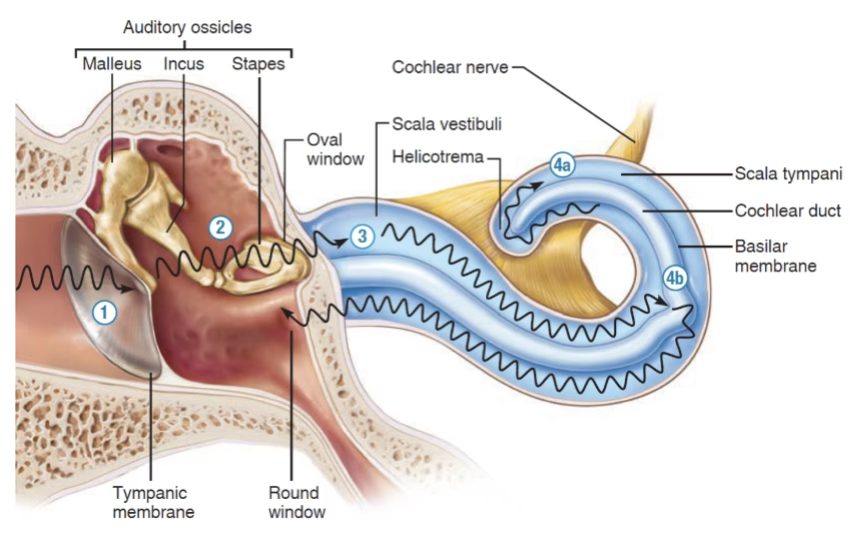
The nervous system controls certain functions of the body using neurons, nerves, and neurotransmitters. The endocrine system controls certain functions of the body using what kind of chemical messengers?
Hormones
How do hormones get transmitted throughout the body?
Through the bloodstream
Name the two main classifications of glands.
Exocrine and endocrine glands
What type of gland sometimes uses ducts and secretes substances onto body surfaces?
Exocrine gland
What type of gland releases substances into the blood?
Endocrine glands
Name the chemical messenger that circulates to distances relatively far from where they were secreted to control their effectors.
Hormone
Name the chemical messenger that exerts their effects on the same cells that secreted them.
Autocrine
What is the chemical messenger that acts as a short distance messenger? It will act on the same tissue that secreted it, but not necessarily the same cell.
Paracrine
Name the chemical messenger that exerts its effects between cells that are in direct or close contact with one another.
Juxtacrine
What type of hormone is water soluble, so it cannot cross the cell's plasma membrane? Because of this, it binds to receptors on the cell surface and uses secondary messengers, relay proteins, and activating or deactivating enzyme cascades, all located inside of the cell, to stimulate the response in the target cell.
Amino acid hormones
What type of hormone is lipid soluble? Because of this, it crosses the cell membrane and binds directly to receptors inside of the cells to exert their effects, which includes initiating mitosis.
Steroid hormones
Name the hormone target cell actions.
Alters plasma membrane permeability or membrane potential, Stimulates synthesis of enzymes and other proteins, Activates or deactivates enzymes, Induces secretory activity, Stimulates mitosis
What is the downregulation of hormone receptors?
Target cells decrease the number of receptors for a specific hormone due to persistently high levels of that hormone.
What is the upregulation of hormone receptors?
Target cells form additional receptors for a specific hormone due to persistently low levels of that hormone.
How are upregulation and downregulation involved in drug, food, or behavior addictions?
Overstimulation of dopamine causes euphoria, driving repeated behaviors or substance use. Downregulation causes desensitization, requiring more stimulation to achieve the same effect.
What is the time frame or number of exposures to a stimulus for downregulation and upregulation to occur.
Downregulation may occur after one exposure if the cell is overstimulated. Upregulation may take several months after downregulation.
How does downregulation contribute to drug desensitization?
Desensitization occurs when receptors downregulate, requiring larger amounts of the drug to produce the same effect.
What are the psychological effects that occur before and after downregulation of dopamine receptors.
Before: Euphoria and reward. After: The patient may feel unwell until receptors upregulate.
Name three stimuli that cause hormones to be secreted.
Humoral, neural, and hormonal
What is the hormone interaction in which one hormone cannot exert its full effects without another hormone being present?
Permissiveness
What is the hormone interaction in which more than one hormone produces the same effects at the target cell? Their combined effects are amplified.
Synergism
What is the hormone interaction in which one hormone opposes the action of another?
Antagonism
Name the hormone that is considered the cuddle hormone. It causes the release of milk and stimulates uterine contractions.
Oxytocin
Which hormone triggers kidneys to reabsorb water into blood from forming urine?
Antidiuretic hormone (ADH)
What is the name of the hormone that stimulates the growth of body tissues?
Growth hormone (GH)
What do the thyroid hormones require, and what do they regulate?
Require iodine. Regulate basal metabolic rate (BMR), tissue growth and repair, and maintain blood pressure.
Name two hormones that are released from the adrenal glands. These are classified as catecholamines and are the sympathetic hormones that increase heart rate, metabolic rate, and blood pressure.
Epinephrine (Adrenaline) & Norepinephrine (Noradrenaline)
What does insulin do?
Lowers blood sugar levels.
What does glucagon do?
Elevates blood sugar levels.
What organ releases insulin and glucagon?
Pancreas