L04 Metals and Ceramics
 Call Kai
 Learn
Learn Practice Test
 Spaced Repetition
 Match
Match Flashcards
 Knowt Play
1/12

There's no tags or description
Looks like no tags are added yet.
Name | Mastery | Learn | Test | Matching | Spaced | Call with Kai | Chat |
|---|
No analytics yet
Send a link to your students to track their progress
13 Terms
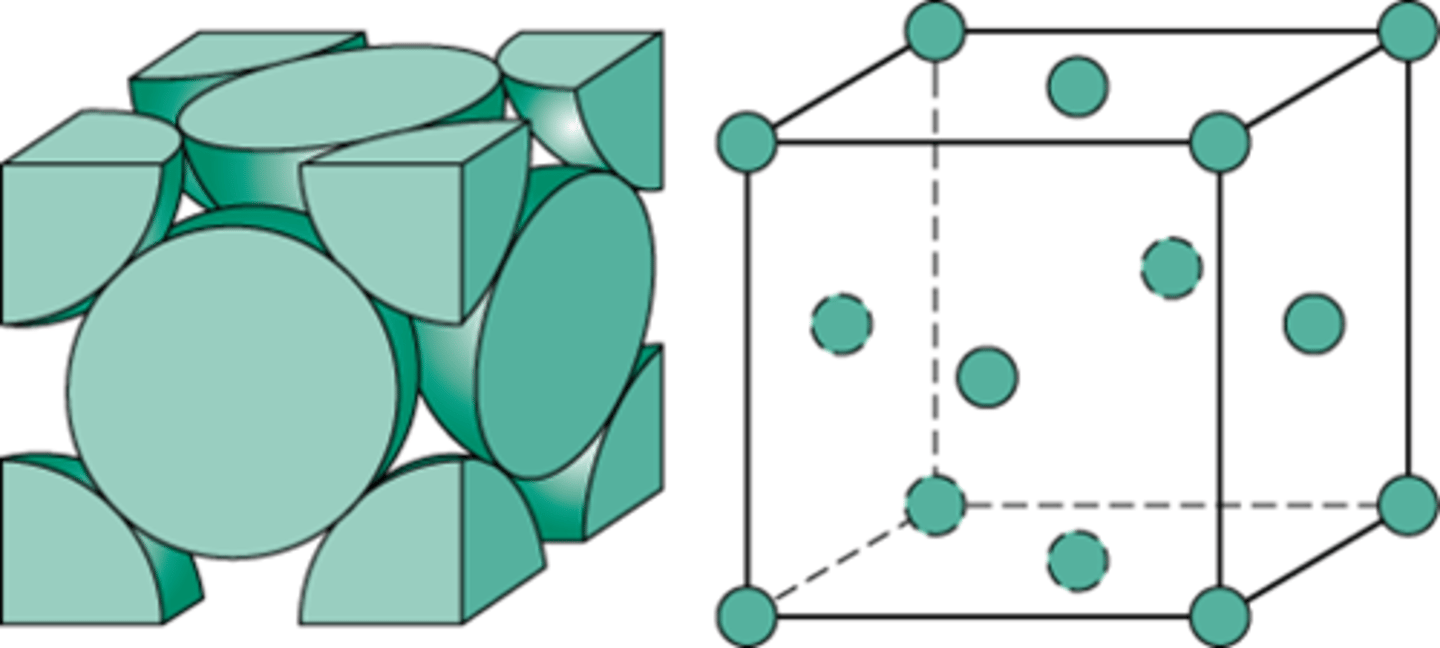
What does FCC stand for and what is its atomic arrangement?
FCC stands for Face-Centered Cubic. It has atoms at each cube corner and at the center of each cube face, creating a densely packed structure.
What are the key differences between BCC and FCC structures in terms of ductility?
FCC structures are more ductile because their slip planes are more closely packed, allowing dislocations to move more easily. BCC structures are less ductile due to their more open structure.
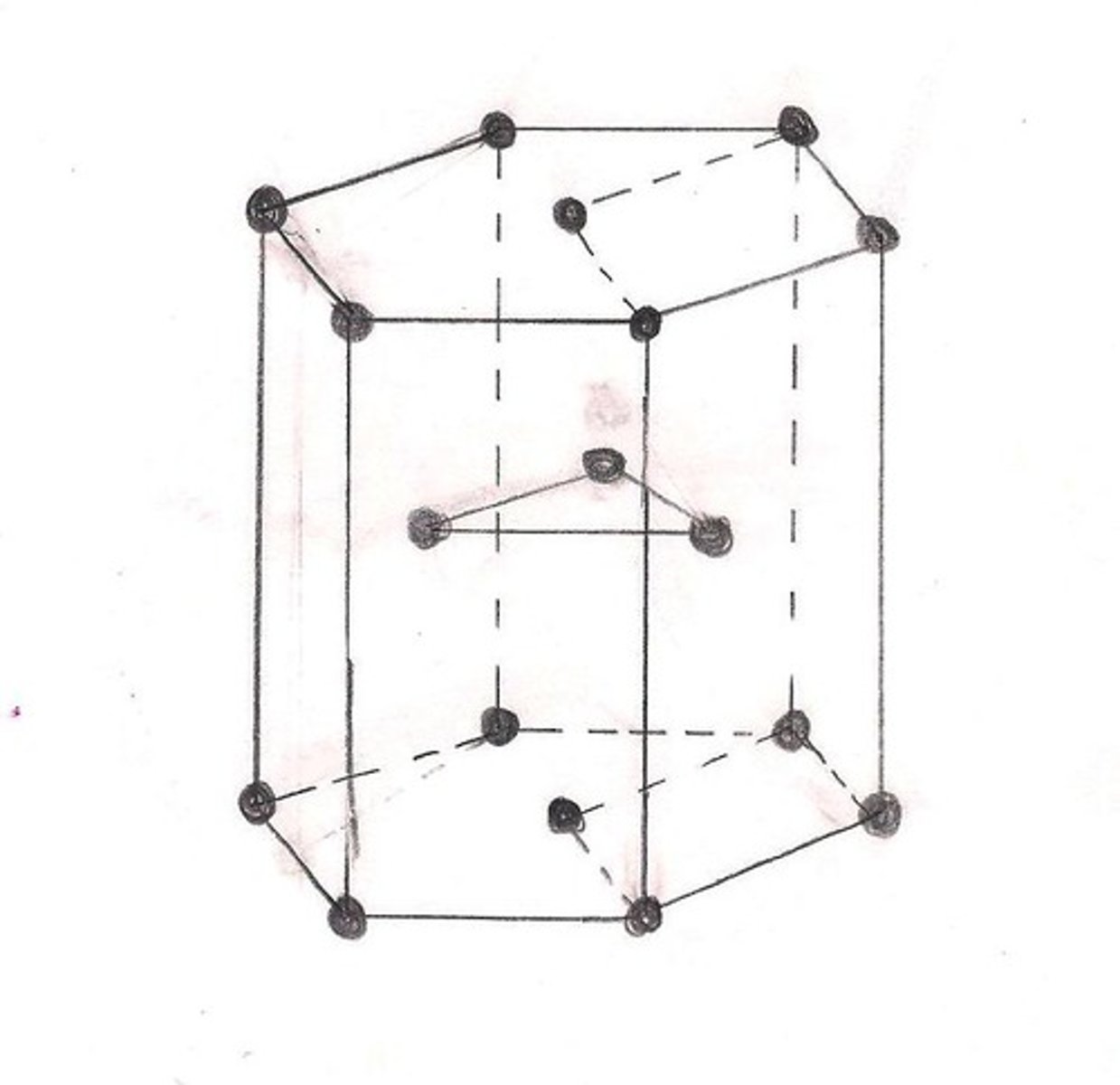
What is unique about the HCP structure compared to FCC and BCC?
HCP (Hexagonal Close-Packed) has a hexagonal lattice and fewer slip systems (only 3), making it less ductile than FCC and BCC. It's tightly packed in two directions but has limited deformability.
What is the difference in molecular structure between crystalline and non-crystalline materials?
Crystalline materials have atoms arranged in a highly ordered structure, while non-crystalline (amorphous) materials lack a regular arrangement.
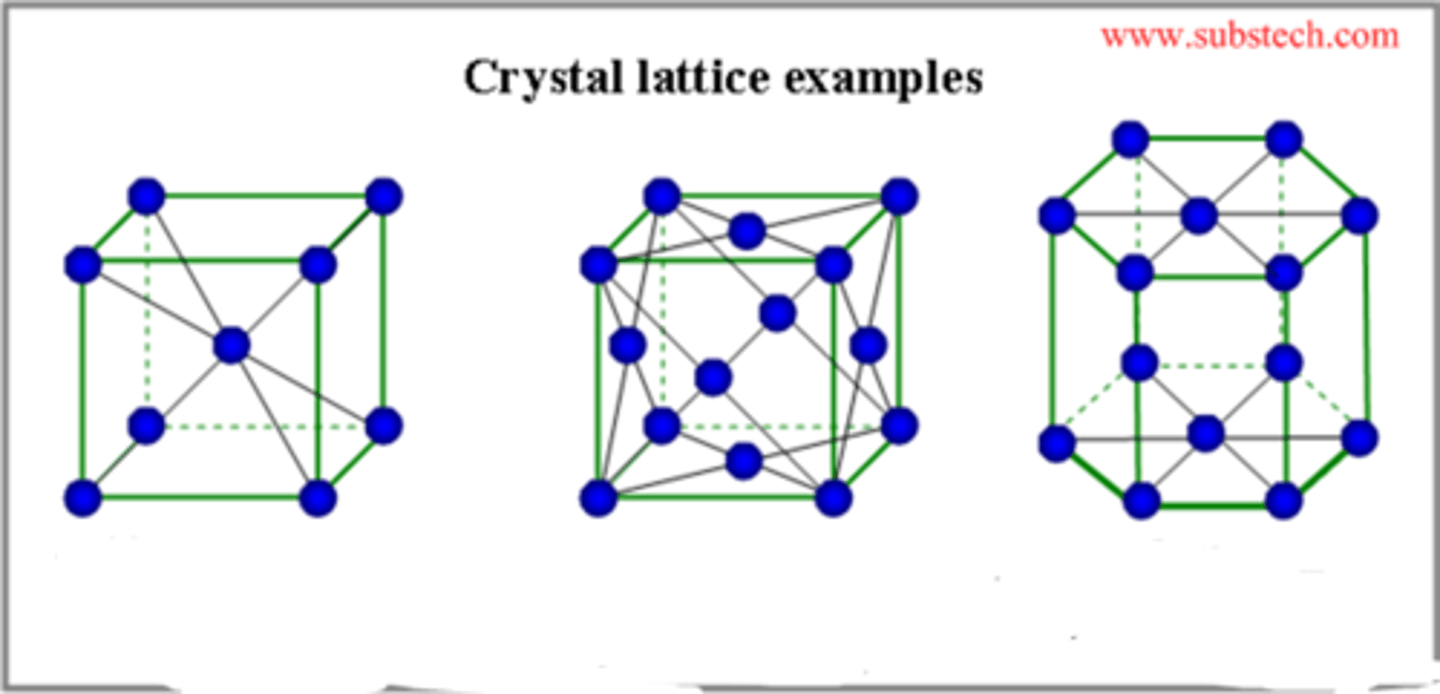
Draw unit cells for FCC, BCC, and HCP crystal structures.
FCC: atoms at each corner and the centers of all the cube faces; BCC: atoms at each corner and one in the center of the cube; HCP: hexagonal structure with layers of atoms stacked in ABAB pattern.
What is the relationship between the unit cell edge and the atomic radius of a BCC structure?
For BCC, the relationship is: a = 4r / sqrt(3), where 'a' is the unit cell edge and 'r' is the atomic radius.
What is the difference between metallic lattices and ceramic lattices?
Metallic lattices usually consist of one type of atom in a simple structure, while ceramic lattices involve at least two elements (cations and anions) and are more complex due to ionic bonding and charge balance.
What are the lattice defects? Why are they important?
Lattice defects are imperfections like point, linear, interfacial, and bulk defects. They are important as they influence material properties such as strength, conductivity, and ductility.
Describe edge and screw dislocation motion from an atomic perspective.
Edge dislocations involve an extra half-plane of atoms; screw dislocations are formed by shear stress twisting the lattice. Both are line defects where atoms are misaligned.
How can materials be plastically deformed?
Materials can be plastically deformed through the movement of dislocations along slip planes in the crystal lattice.
What are slip planes and slip systems?
Slip planes are crystallographic planes along which dislocations move; a slip system is a combination of a slip plane and a slip direction.
How many slip planes do the different crystal lattices have?
BCC and FCC each have 12 slip systems, but FCC has more closely packed planes and is more ductile. HCP has only 3 slip systems and is less ductile.
What are the different types of strengthening mechanisms and how do they work?
Strengthening mechanisms include solid-solution strengthening (foreign atoms distort lattice), grain size reduction (more grain boundaries block dislocation movement), and strain hardening (increased dislocation density hampers motion).