YEAR 10 MIND & BODY EXAM SEM 1
 Call Kai
 Learn
Learn Practice Test
 Spaced Repetition
 Match
Match Flashcards
 Knowt Play
1/63

Earn XP
Description and Tags
pink = mind & body connection, light blue = nervous system, green = neurons, dark blue = gut-brain axis, purple = neuroplasticity, orange = cells and chromosomes, light pink = cell division, teal = inheritance
Name | Mastery | Learn | Test | Matching | Spaced | Call with Kai | Chat |
|---|
No analytics yet
Send a link to your students to track their progress
64 Terms
HOMEOSTASIS
Maintaining stable internal conditions despite internal and external changes
it helps regulate the body.
If the body is too hot or too cold, it could be fatal and homeostasis ensures that vital processes can function properly
TWO SYSTEMS USED FOR INTERNAL CONDITIONS
endocrine system & nervous system
DEFINITION: STIMULUS RESPONSE MODEL
a framework explaining behaviour as a reaction to environmental changes
some responses will be insignificant while others may be life-threatening
FRAMEWORK: STIMULUS RESPONSE MODEL
stimulus - a change in the enviromentimpulse in
Receptor - senses that detect the change
control center - Brain/CNS processes the info → decides
effector - The muscle or gland that carries out the work
Response - final action
TWO FEEDBACK SYSTEMS
Negative Feedback - the response reduces the original stimulus
Positive Feedback - the response increases the original stimulus.
NEGATIVE FEEDBACK
control process that ensures organisms maintain homeostasis
body detects a change and then produces a response that reverses that change to return to stable conditions.
A receptor senses the change (e.g. temperature rising)
A control centre (brain) decides what to do
An effector (muscle/organ/gland) acts to fix it
POSITIVE FEEDBACK
increases the impact of the stimulus resulting in an increasingly
amplified response which does not maintain homeostasis (FIX!!!!!!!)
ENDOCRINE SYSTEM
Hormones are small molecules that are released by the glands into the bloodstream and travel via the blood to reach target cells around the body.
Hormones are specific: only target cells with the correct receptors respond.
Endocrine responses are slower than nervous responses but last longer.
TYPES OF NEURONS
Sensory (afferent) neuron: carries information towards the CNS
Motor (efferent) neuron: carries information away from the CNS
Interneuron: connects neurons together – located in the CNS
PITUITARY GLAND & RELATIONSHIP W/ HYPOTHALAMUS
Work together to control the body’s hormones and keep internal conditions stable (homeostasis). The hypothalamus, which links the nervous system and endocrine system, detects changes in the body such as temperature and water levels. It then sends signals to the pituitary gland, which is called the “master gland” because it controls the release of many hormones. Together, they regulate growth, metabolism, reproduction, stress responses, and water balance.
NERVOUS SYSTEM
Is a rapid response system (direct pathway of communication) comprising of the brain, spinal cord and connecting nerve cells. Receptors synapse onto nerves which then synapse onto effectors = muscles/organs/glands.
DIVISIONS OF THE NERVOUS SYSTEM
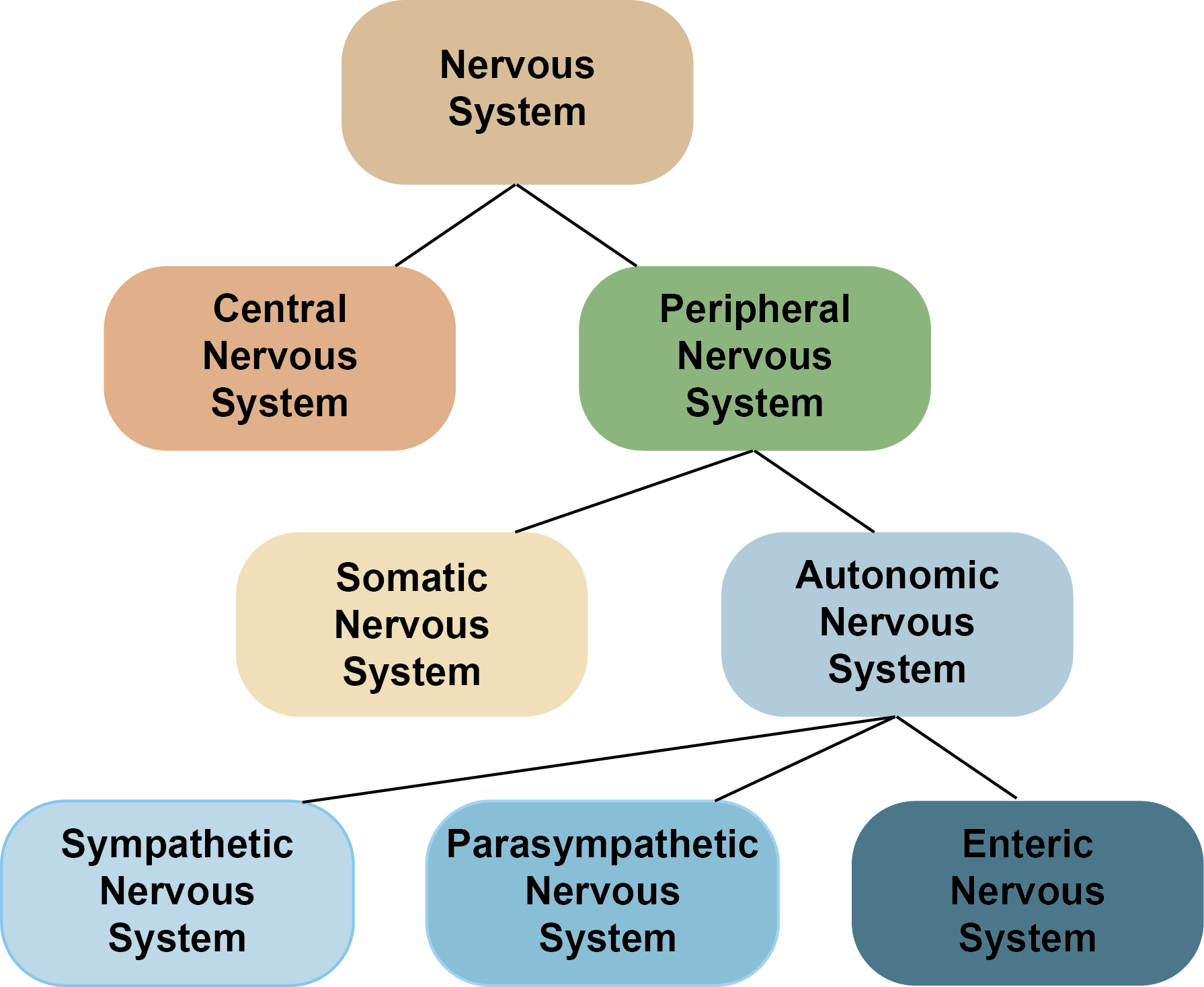
Central Nervous System
Sends and receives messages to and from the Peripheral Nervous System (PNS)
Consists of:
Brain
Spinal Cord
Peripheral Nervous System
Sends and receives messages to and from the Central Nervous System (CNS)
Consists of:
Somatic Nervous System
Autonomic Nervous System
Autonomic Nervous System
Consists of:
Sympathetic Nervous System
Parasympathetic Nervous System
Enteric Nervous System
THREE MAIN FUNCTIONS OF THE NERVOUS SYSTEM
Receive information
Integrate and process information
Respond to information
THREE MAIN PARTS OF THE BRAIN
forebrain, midbrain, hindbrain
KEY STRUCTURE & FUNCTION OF THE HINDBRAIN
responsible for basic survival functions such as breathing and heart rate.
KEY STRUCTURE & FUNCTION OF THE MIDBRAIN
acts as a relay center for sensory and motor information, integrating visual and auditory processing with movement control.
KEY STRUCTURE & FUNCTION OF THE FOREBRAIN
involved in complex cognitive functions, emotions, memory, and decision-making.
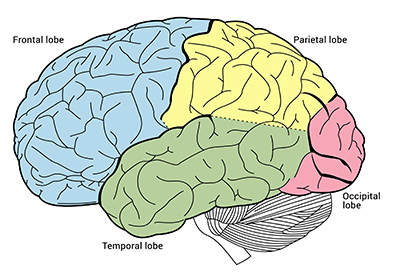
4 LOBES OF THE BRAIN & THEIR FUNCTIONS
Frontal Lobe: Responsible for higher-order thinking (e.g., problem-solving), and personality.
Parietal Lobe: Processes sensory information (e.g., temperature), and spatial awareness.
Occipital Lobe: Primarily involved in visual processing, and interpreting visual information.
Temporal Lobe: Plays a key role in auditory processing, memory, and language comprehension.
4 LOBES OF THE BRAIN & THEIR CORTEX AREAS
SPINAL CORD STRUCUTRE
A column of nerve fibres extending from the base of brain (brain stem) to the lower back.
Encased in a series of bones called the vertebrae.
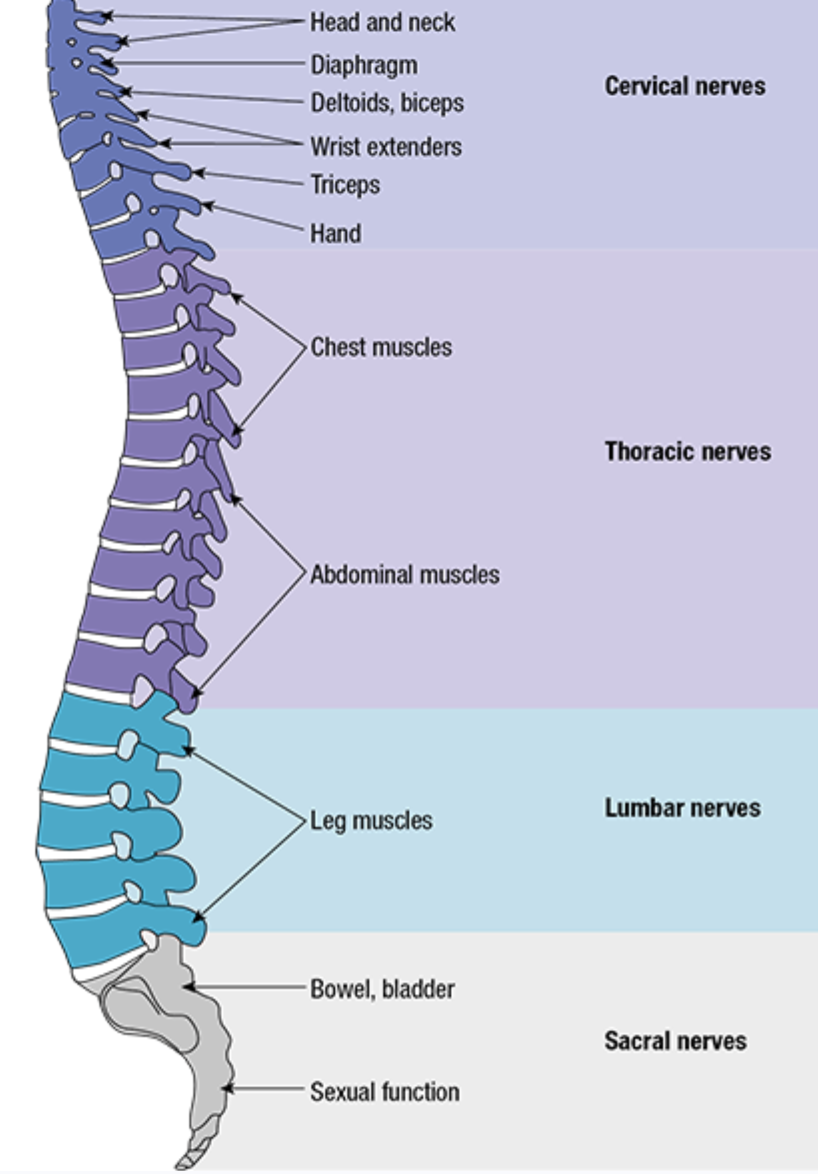
THREE FUNCTIONS OF THE SPINAL CORD
Receive information from the body
Send motor information to the body
Initiate spinal reflex - survival response
DEFINITION: SPINAL REFLEX
survival response
(FIX!!!!!!!)
SOMATIC NERVOUS SYSTEM
Sends sensory information to the CNS for processing
Carries motor information from the CNS to skeletal muscles under voluntary control
Summary: Receives sensory information from the external and internal world and responsible for voluntary movement.
AUTONOMIC NERVOUS SYSTEM
Connects the CNS to the body’s internal organs and glands (many of which are “autonomous”)
Regulates activity of visceral muscles (control the activity of internal organs)
Continuously functions with or without conscious control
Under the Autonomic Nervous System…
Sympathetic Nervous System
Parasympathetic Nervous System
KEY DIFFERENCES IN SOMATIC & AUTONOMIC NERVOUS SYSTEM (function & control)
(FIX!!!!!!!)
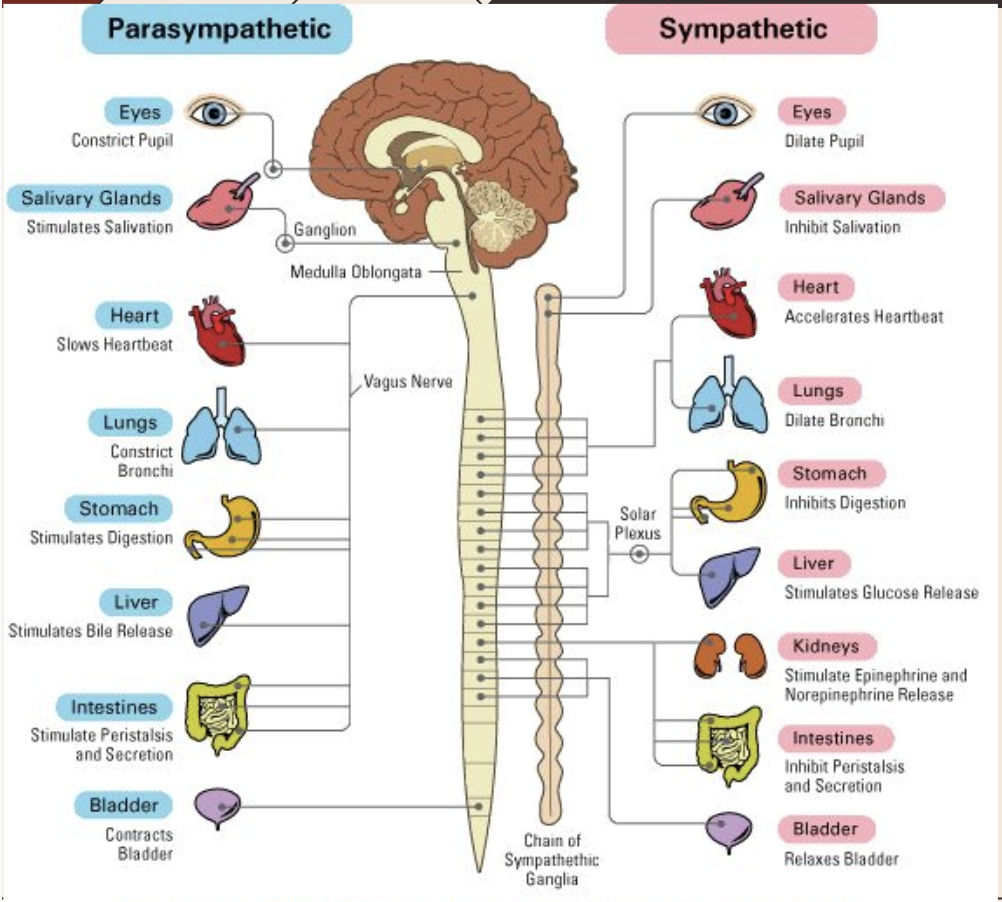
SYMPATHETIC VS PARASYMPATHETIC NERVOUS SYSTEM
(FIX!!!!!!!)
Sympathetic Nervous System
Activated to enhance survival by providing an immediate response in a split second
Prepares body for vigorous activity, stressful and/or threatening situations
Fight-Flight Response
Parasympathetic Nervous System
Maintains balance (“homeostasis”) to minimise energy use
Reverses the response of the sympathetic nervous system to restore bodily functioning to a normal state
NEURON STRUCTURE
dendrites
cell body
axon
myelin sheath
axon terminals
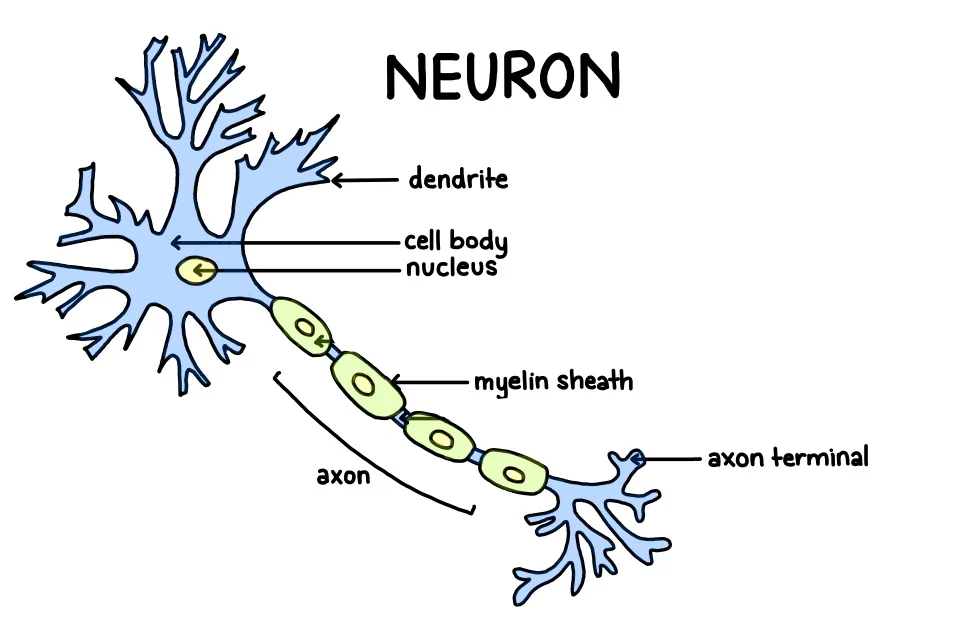
(FIX!!!!!!!)
Neurons are the fundamental units of the nervous system that transmit information throughout the body.
Dendrites receive signals from other neurons, the cell body processes these signals, and the axon transmits the signals to other neurons, muscles, or glands.
ELECTROCHEMICAL COMMUNICATION
Electrical within the neuron, chemical across the synapse
(FIX!!!!!!!)
SYNAPSE STRUCTURE & FUNCTION
○ Presynaptic neuron, synaptic gap, postsynaptic neuron, receptor sites
(FIX!!!!!!!)
DEFINITION: VAGUS NERVE
DEFINITION: GUT BRAIN AXIS
bidirectional relationship, the 90/10 split
MICROBIOTA VS MICROBIOME
def & distinction?
DEFINITION: MICROBIOTA
DEFINITION: MICROBIOME
HOW GUT HEALTH AFFECTS MOOD
Serotonin production in the gut, dysbiosis and its link to anxiety and depression
FOUR TYPES OF NEUROPLASTICITY
Developmental, adaptive, experience-expectant, experience-dependent
DEFINE: DEVELOPMENTAL NEUROPLASTICITY
Developmental plasticity is the brain’s ability to change and grow in response to experiences during early life. It happens naturally as the brain develops, especially during childhood and adolescence.
eg. learning to speak a language, walking
DEFINE: ADAPTIVE NEUROPLASTICITY
Adaptive plasticity is the brain’s ability to change and rewire itself to adjust to new situations or recover from damage, like injury or stroke.
eg. if one part of the brain is damaged, another part may take over its function to help a person relearn skills like walking or speaking.
DEFINE: EXPERIENCE-EXPECTANT NEUROPLASTICITY
Brain development that occurs in response to universal experiences that almost all humans encounter.
eg. learning to see or hear in infancy, exposure to language in early childhood
DEFINITION: EXPERIENCE-DEPENDANT NEUROPLASTICITY
Brain changes that occur in response to individual and unique experiences that vary between people.
eg. learning to play a musical instrument, becoming a skilled taxi driver, mastering a sport
DEFINITION: ATKINSON-SHIFFRIN MODEL OF MEMORY
The three stores (sensory, short-term, long-term) and the processes that move information between them (attention, rehearsal, encoding, retrieval)
SENSORY MEMORY
processes that move information between them (attention, rehearsal, encoding, retrieval)
Function: Receives sensory information from the external environment
Capacity: Potentially unlimited
Duration: 0.2 - 4 seconds
SHORT TERM MEMORY
processes that move information between them (attention, rehearsal, encoding, retrieval)
where all conscious learning, perceiving, feeling, thinking, reasoning and other mental processes take place.
Function:
Receives information from sensory memory
Transfers information to and from long-term memory
Maintains info in conscious awareness for immediate use
Capacity: 7 +/- 2 bits of information OR 5 - 9 bits of information
Duration: 18 - 20 seconds OR Up to 30 seconds
Note: can last longer if information is rehearsed
LONG TERM MEMORY
processes that move information between them (attention, rehearsal, encoding, retrieval)
Function: Information is stored for later use and re-access
Capacity: Potentially unlimited
Duration: Potentially permanent
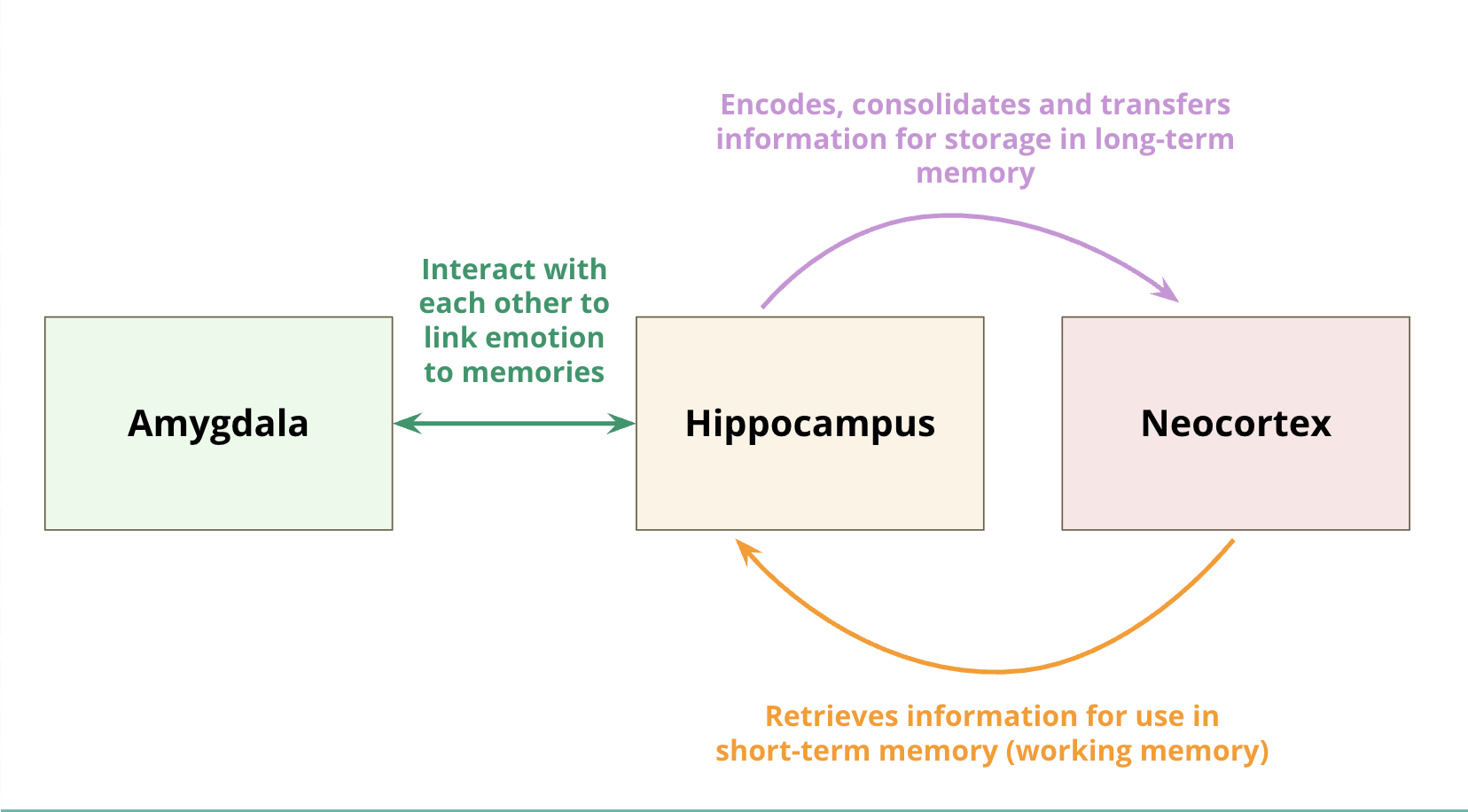
BRAIN AREAS ASSOCIATED W/ MEMORY
Hippocampus - encoding, consolidation and retrieval of memories.
Amygdala - attaches emotions to memories.
Neocortex - storing of long term memories.
THE BRAIN AREAS ASSOCIATED W/ MEMORY INTERACTING
how they interact
DEFINITION: OBSERVATIONAL LEARNING
Attention: The individual must focus on the model’s behaviour.
Retention: The behaviour must be remembered and stored in memory.
Reproduction: The individual must be physically and mentally capable of reproducing the behaviour.
Motivation: The individual must desire to perform the behaviour.
Reinforcement: If the behaviour is reinforced, the likelihood of the behaviour being repeated increases.
FUNCTION OF A CELL
Key organelles and what they do (cell membrane, cytoplasm, nucleus, mitochondria, vacuoles…)
STRUCTURE OF A CELL
Key organelles and what they do (cell membrane, cytoplasm, nucleus, mitochondria, vacuoles…)
DIFFERENCES & SIMILARITIES BETWEEN PROKARYOTIC & EUKARYOTIC CELLS
STRUCTURE OF CHROMOSONES
○ What they are, where they are found, and what they carry
DEFINITION: KARYOTYPING
how it is done, and what it can reveal
TYPES OF CELL DIVISION & PURPOUSES
binary fission
mitosis
meisos
STAGES OF MITOSIS
IPMANT, WHAT HAPPENS AT EACH STAGE
KEY EVENTS OF MEIOSIS | & MEIOSIS ||
CROSSOVER & RECOMBINATION
KEY DIFFERENCES BETWEEN MEIOSIS & MITOSIS
Number of divisions, cells produced, genetic outcome, purpose
DEFINE: ALLELE
Different forms of the same gene
DEFINE: GENOTYPE
a combination of alleles inherited from one parent
two alleles of particular gene are the same → homozygus
two alles are different → hetrozyguys
DEFINE: PHENOTYPE
A trait that is shown on an organism is known as it’s phenotype
eg. brown hair, dark skin, blue eyes
DEFINE: HOMOZYGOUS
two allels of a particular gene are the same
DEFINE: HETROZYGOUS
two alleles of a particular gene are different. there are two types: dominant and recessive
DEFINE: DOMINANT
the trait that overides the other is the dominant trait
DEFINE: RECESSIVE
trait that is being overridden => recessive