Business Test #3
 Studied by 0 people
 Call Kai
 Learn
Learn Practice Test
 Spaced Repetition
 Match
Match Flashcards
 Knowt Play
1/70

There's no tags or description
Looks like no tags are added yet.
Name | Mastery | Learn | Test | Matching | Spaced | Call with Kai |
|---|
No study sessions yet.
71 Terms
Small Business
one that is independent (not part of a larger business) and that has relatively little influence in its market
Small Business Administration (SBA)
government agency charged with assisting small businesses
The importance of small businesses in the US
Job Creation
Innovation
Contributions to big businesses
Entrepreneur
businessperson who accepts both the risks and the opportunities involved in creating and operating a new business venture
Entrepreneurship
the process of seeking business opportunities under conditions of risk
Entrepreneurial Characteristics
Resourcefulness
Concern for goods, personal customer relations
Strong desire to be their own bosses
Deal with uncertainty and risk
Understanding Distinctive Competencies
Established Market
Niche
First-mover advantage
Established Market
one in which many firms compete according to relatively well-defined criteria
Niche
a segment of a market that is not currently being exploited
First-mover advantage
any advantage that comes to a firm because it exploits an opportunity before any other firm does
Business Plan
document in which the entrepreneur describes her or his business strategy for the new venture and demonstrates how it will be implemented
Crafting a Business Plan
setting goals and objectives
sales forecasting
financial planning
Starting the Small Business triangle
Buying an existing business (small)
Franchising (medium)
Starting from Scratch (large)
Starting from Scratch questions
Who and where are my customers?
How much will those customers pay for my products?
How much of my product can I expect to sell?
Who are my competitors?
Why will customers buy my products rather than the product of my competitors?
Financing a Small Business
Personal resources
Loans from family and friends
Bank loans
Venture capital companies
Minority Enterprise Small-Business Investment Companies (MESBICs)
SBA financial programs
Small-Business Investment Companies (SBICs)
Venture Capital Company
group of small investors who invest money in companies with rapid growth potential
Small-Business Investment Company (SBIC)
government-regulated investment company that borrows money from the SBA to invest in or lend to a small business
Franchise
arrangement in which a buyer (franchisee) purchases the right to sell the good or service of the seller (franchiser)
Franchising Advantages
-proven business opportunity
-access to management expertise
Franchising Disadvantages
- Start-up costs
- Ongoing payments
- Management rules and restrictions
Trends in Small Business Start-ups
Emergence of E-commerce, Crossovers from Big Businesses, Opportunities for Minorities and Women, Global Opportunities, and Better survival rates
Emergence of E-commerce
The Internet provides fundamentally new ways of doing business - growing every year
Crossovers from Big Business
More businesses are being started by people who have opted to leave big corporations and put their experience to work for themselves
Opportunities for Minorities and Women
More small businesses are also being started by minorities and women
Some reasons women give in starting businesses
gain control over my schedule
saw a market opportunity and decided to pursue it
frustrated with "glass ceiling" at big companies
Global Opportunity
many entrepreneurs are also finding new opportunities in foreign markets
Better Survival Rates
Today, 44 percent of new start-ups can expect to survive for at least four years
Popular Areas of small-business enterprise
service, retailing, construction, wholesaling, finance and insurance, manufactoring, other
Reasons for failure
managerial incompetence or inexperience, neglect, weak control systems, insufficient capital
Reasons for Success
Hard work, drive, and dedication
Market demand for the products or services being provided
Managerial competence
Luck
Business Forms
sole proprietorship, general partnership, corporation
Noncorporate Business Ownership
sole proprietorship and general partnership
Sole proprietorship
business owned and usually operated by one person who is responsible for all of its debts
General Partnership
business with two or more owners who share in both the operation of the firm and the financial responsibility for its debts
Sole Proprietorship Advantages
Freedom
Simple to form
Low start-up costs
Tax benefits
Sole Proprietorship Disadvantages
Unlimited liability
Limited resources
Limited fundraising capability
Lack of continuity
General Partnership Advantages
More talent and money
More fundraising capability
Relatively easy to form
Limited liability for limited partners
Tax benefits
General Partnership Disadvantages
Unlimited liability for general partners
Disagreements among partners
Lack of continuity
Alternatives to General Partnerships
Limited Partnership & Master Limited Partnership
limited partnership
- Allows for limited partners who invest money but are liable for debts only to the extent of their investments
- General (or active) partners run the business
Master Limited Partnership
- Master partner has majority ownership and runs the business; - minority partners have no management voice
cooperatives (co-ops)
- combine the freedom of sole proprietorship with the financial power of corporations
- groups of sole proprietorships or partnerships agree to work together for their common benefit
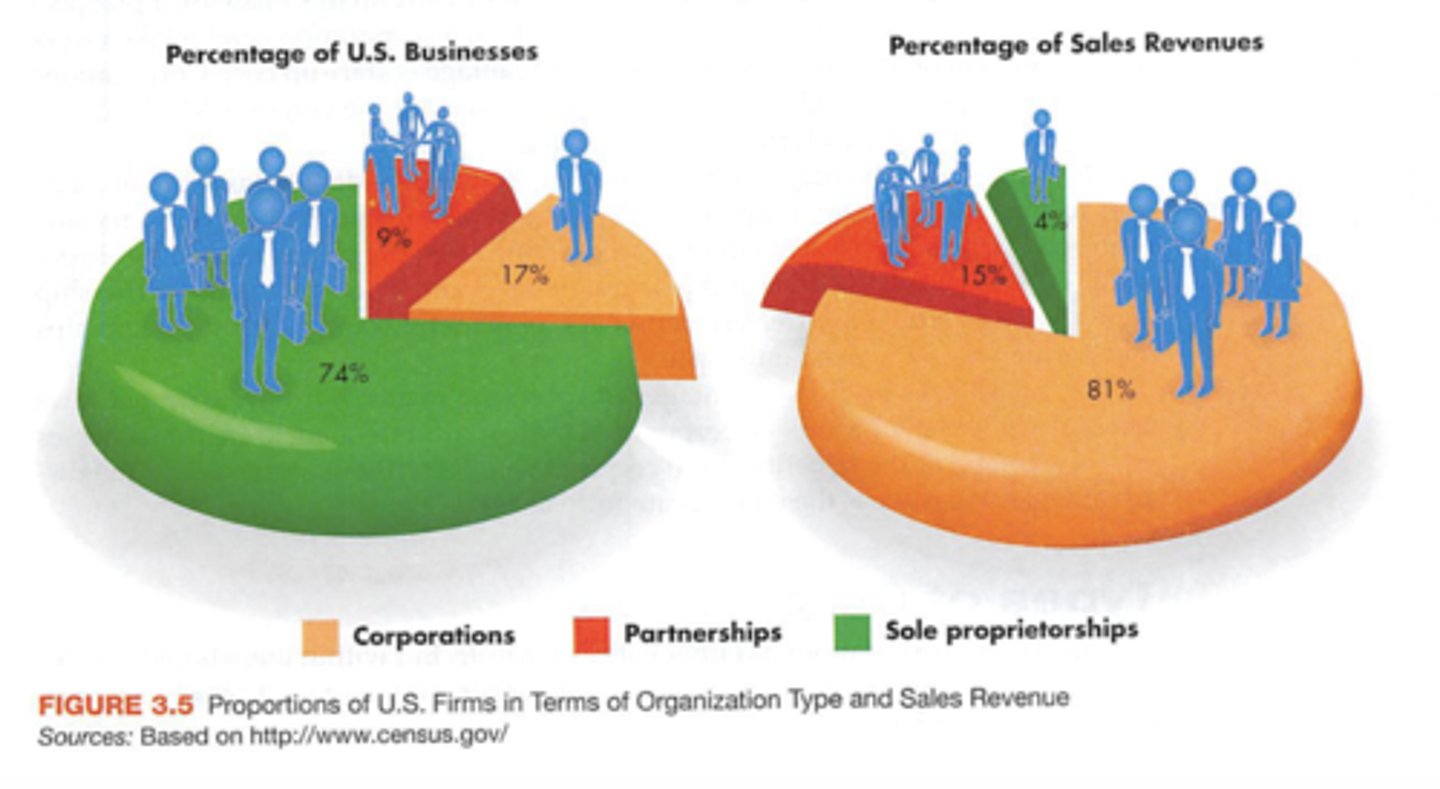
Proportions of US firms in terms of organization type/sale revenue
Percentage of US businesses - (SP,C,P)
Percentage of Sale revenue - (C,P,SP)
Corporation
- business that is legally considered an entity separate from its owners and is liable for its own debts
- owners' liability extends to the limits of their investments (shareholders)
Corporation Advantages
limited liability
continuity
stronger fundraising capability
Corporation Disadvantages
Can be taken over against the will of its management via tender offer
Double taxation of profits
Complicated and expensive to form
Tender Offer
offer to buy shares made by a prospective buyer directly to a target corporation's shareholders, who then make individual decisions about whether to sell
Double Taxation
taxes may be payable BOTH by a corporation on its profits and by shareholders on dividend income
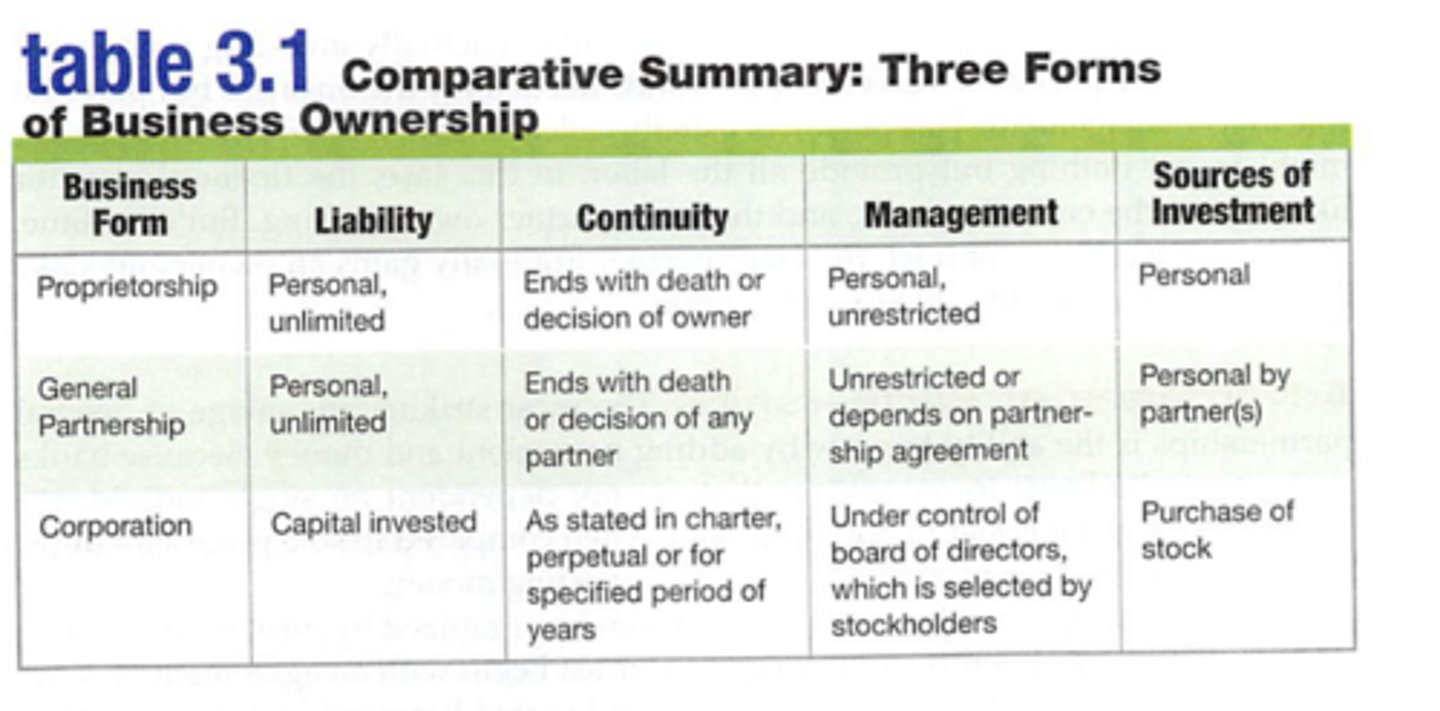
Comparative Summary : Three Forms of Business
Types of Corporations
Closely Held (or Private) Corporation
Publicly Held (or Public) Corporation
S Corporation
Limited Liability Corporation (LLC)
Professional Corporation
Multinational (or Transnational) Corporation
Closely Held (or Private) Corporations
corporation whose stock is held by only a few people and is not available for sale to the general public
Publicly Held (or Public) Corporation
corporation whose stock is widely held and available for sale to the general public
S Corporation
hybrid of a closely held corporation and a partnership, organized and operated like a corporation but treated as a partnership for tax purposes
Limited Liability Company (LLC)
hybrid of a publicly held corporation and a partnership in which owners are taxed as partners but enjoy the benefits of limited liability
Professional Corporation
form of ownership allowing professionals to take advantage of corporate benefits while granting them limited business liability and unlimited professional liability
Multinational (or Transnational) Corporation
form of corporation spanning national boundaries
Managing a Corporation
Corporate Governance
Corporate Governance
roles of shareholders, directors, and other managers in corporate decision making and accountability
Corporate Governance roles
Stockholders (Shareholders), Board of Directors, Officers
stockholders/shareholders
owners of shares of stock in a corporation
Board of Directors (BOD)
governing body of a corporation that reports to its shareholders and delegates power to run its day-to-day operations while remaining responsible for sustaining its assets
Officers
top management team of a corporation
Relationship between Corporate Governance roles
Shareholders elect the BOD and BOD talk with officers about ideas/opinions
Special Issues in Corporate Ownership
- Joint Ventures and Strategic Alliances
- Employee Stock Ownership Plans
- Institutional Ownership
- Mergers
- Acquisitions
- Divestitures
- Spin-offs
joint venture
strategic alliance in which the collaboration involves joint ownership of the new venture
Employee Stock Ownership Plan (ESOP)
arrangement in which a corporation holds its own stock
institutional investors
large investor, such as a mutual fund or a pension fund, that purchases large blocks of corporate stock
Merger
the union of two corporations to form a new corporation
Acquisition
the purchase of a company by another company
Divestiture
strategy whereby a firm sells one or more of its business units
Spin-offs
strategy of setting up one or more corporate units as new, independent corporations