Week: 3 Suggestibility in Children’s Eyewitness Memory
 Call Kai
 Learn
Learn Practice Test
 Spaced Repetition
 Match
Match Flashcards
 Knowt Play
1/17

There's no tags or description
Looks like no tags are added yet.
Name | Mastery | Learn | Test | Matching | Spaced | Call with Kai | Chat |
|---|
No analytics yet
Send a link to your students to track their progress
18 Terms
What is the forensic context of children's evidence?
Child victims as witnesses (e.g. child abuse) + Child witnesses who are not victims.
Are child witnesses taken seriously?
Children 10+ years old tend to be presumed competent by magistrates and judges , compared to those younger. This difference is assumed to occur due to people's assumed understanding of a child's suggestibility → for example, a younger child may be more vulnerable to leading questions compared to a full adult.

What are methods that could be used to test if children are more susceptible to suggestion than adults?
(1) Loftus 3-Stage Paradigm A - Event encoding B. Post event Suggestion C. Memory test
(2) Adaptation By Ceci, Ross, Toglia
Describe Loftus 3- Stage Paradigm?
Has 3 x stages
Event-encoding → initial learning - can be a range of different types of events
Post-Event Suggestion → given leading or mis-leading details about the event
Memory Test → final test on the individual.
Describe an adaptation of the Loftus 3-Stage Paradigm by Ceci, Ross & Toglia (1987)?
This was an adaptation of the loftus 3-stage paradigm. Tested 4 x age groups, 3.5-years, 5-year-olds, 8-year-olds, 11-year-old. The initial learning event was a reading of a picture book. They had a between-subject design, some kids were exposed to misleading questions vs. not. (this is the adaptation)
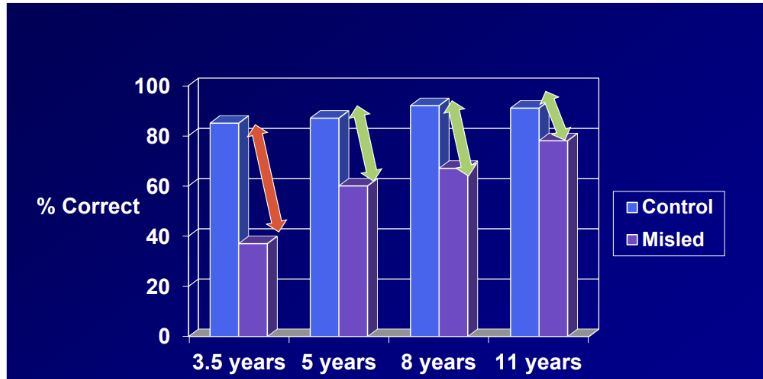
they found that as age increased, the difference between control and mislead became slimmer. Young children (3.5 year old) seem to be more susceptible compared to older children
What are the mechanisms that produce suggestibility?
Changes to the memory of the event via either
(a) overwriting to memory for the event
(b) retrieval competition (not replaced but in competition with)
OR
Social/demand factors → Zaragoza, the authority of the suggested information forced individuals to recall the ‘wrong’ memory.

Explain how they tested the social demand hypothesis?
Used the 3 x stage Loftus Paradigm, had different questioner authority. They operationalised this as a function of the experimenter being child or an adult
they found that the difference in inaccuracy in the control and the misled in the child group was smaller than in the adult group, this suggests that children are more susceptible to false information suggested by authority.
What is the modified recognition test?
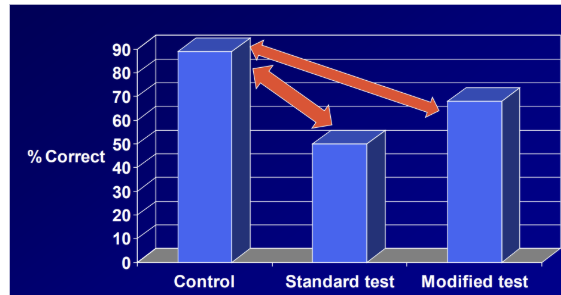
Has the same 3 x stages, but the 2nd stage involves introducing a complete novel detail, this detail does not appear as an option in the 3rd test stage.
This test hypothetically removes social demand, as technically there is no demand on behalf of the experimenter – the child cannot even choose the ‘misleading’ response. If it is just social demand, then the novel misleading detail group should not be different from the control group (with no 2nd stage/misleading detail). However, if there is still a memory component then there should be a difference.
They found that the modified test still had an impact on the %correct, even when you take out the ‘social demand’ portion. - this suggests that there is still a memory component of the memory demand process
What are the implications of research around child suggestibility?
Children CAN report witnessed information accurately
Suggestibility is a common problem in eyewitnesses – adult and children
Suggestibility is driven by two causal processes
Social demands
Memory
Exposure to suggestions means that some original memory details may be hard to retrieve.
Needs to take special care in interviewing children below 6 years of ages.
What are some criticisms of the Ceci/Loftus paradigms?
external validity critiques → that is, the three phase paradigm does not reflect in the real world cases of individuals
E.g there may be different amounts of emotional distress - e.g abuse cases
E.g there may be different intervals from the encoding event and when questions are asked - pre-trial delays
E.g personal connection to the event.
E.g there is repetition of questions - repeated interviews in the real world
Describe the inoculation study?
5 year olds are put through an altered version of the Ceci/Loftus paradigm.
Children are put through an event which may be:
Routine medical exam (Doctor)
Talk + Poster + Treat (RA)
Oral vaccine + Injection (Doctor)
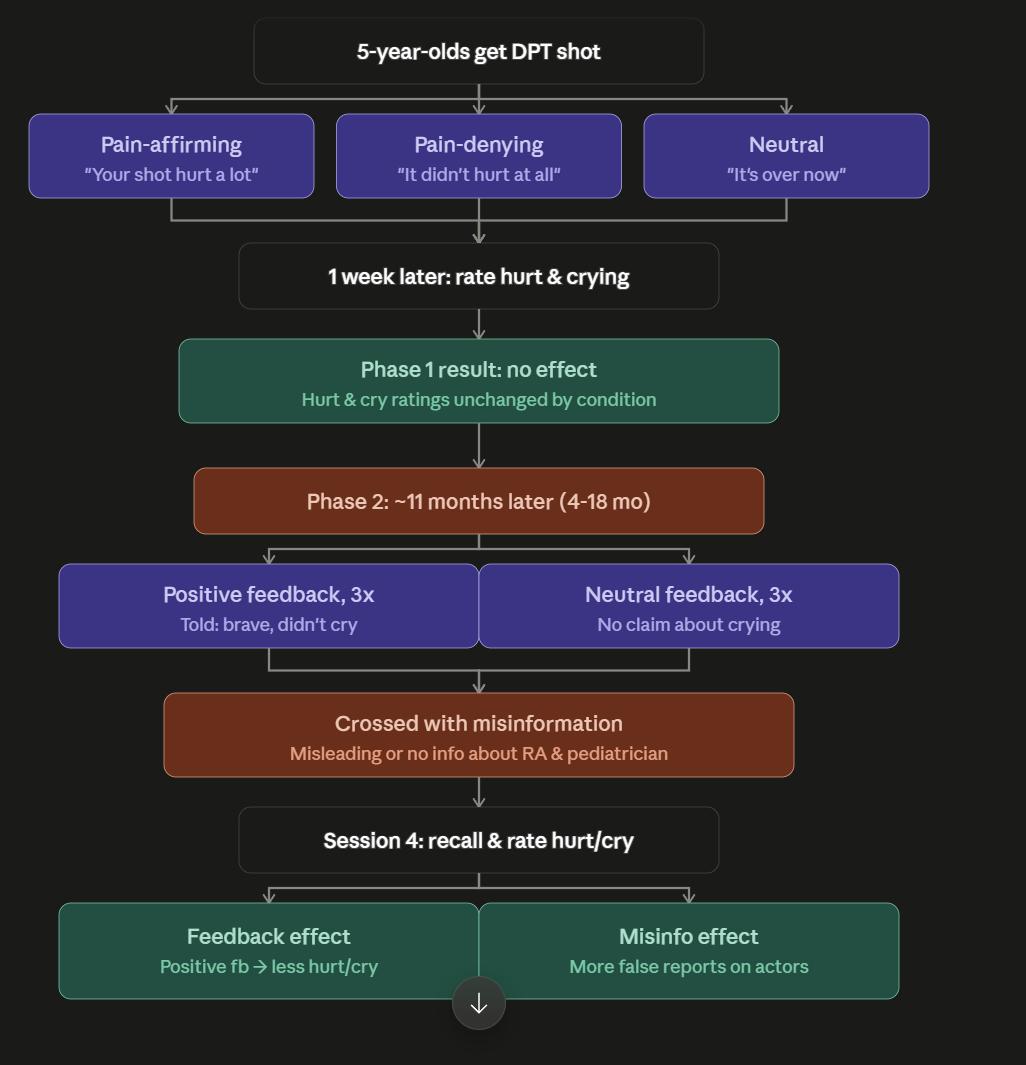
In Phase 1 - Suggestions are made immediately, which could be neutral, Hurt or no hurt remarks on the shots.
They tested the memory for distress 1 week later.
In Phase 2 - Suggestions are made approx 1 year later with 3 interview sessions (making suggestions about an emotionally charged event, and showing a neutral event). In these sessions
1 - given no suggestions
2 - given suggestions only about the doctor
3 - given suggestions only about the RA only
4 - both types of suggestions
In Phase 3 - they tested children’s memories.

Describe the results of the inoculation study?

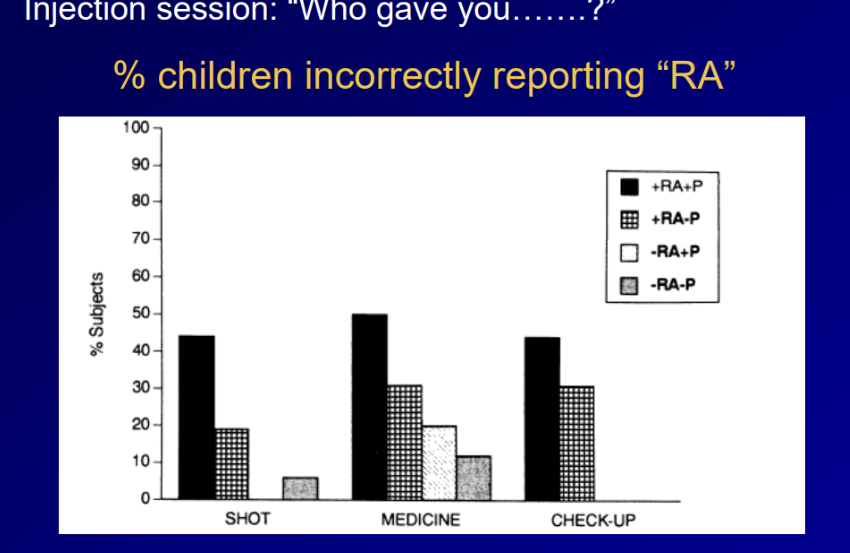
Talk/poster suggestions → They found that children given no suggestions - never make the error/ are very good at recalling correctly. But as suggestions increase, children make significant levels of errors.

Injection session questions → they found that children given no suggestions - never make the error/ are very good at recalling correctly. But as suggestions increase, children make significant levels of errors.
Overcoming Suggestiability What are ineffective techniques?
Hypnosis → no evidence of increased accuracy in recall, increase in report of events (both real and imagined), increased suggestibility Sociodramatic Play → does not increase accuracy but may be useful for building rapport.
What are controversial techniques?
Anatomically detailed dolls → some evidence of increased disclosure of non-verbal play with dolls Very sensitive to distortion for suggestive questioning, creates concerns about the developmental competence of very young children.
Describe the Cognitive interview?
Originally developed by LAPD for use by adults. Composed 4 techniques based fundamental principles of memory processing
Context reinstatement - encoding specificity
‘Report all’
Reverse recall - makes sure that script memory is not recalled.
Perspective taking .
Describe the cognitive interview in the context of young children?
Found that using the complete package of all four techniques, found that there is a demonstrated increase of 35% more information accurately recalled, They found that in children, however, context reinstatement and ‘Report all’ were the most useful.
Describe Hayes & Delamothe’s study on cognitive interviewing (context reinstatement + reports all components)
In phase 1 - children engaged with an engaging video, phase 2 - children were or were not misled with suggestions. Interviews - are given are standard or cognitive interval, before having a free recall, cued and general recall test. Found that

n phase 1 - children engaged with an engaging video, phase 2 - children were or were not misled with suggestions. Interviews - are given are standard or cognitive interval, before having a free recall, cued and general recall test.
Found that:
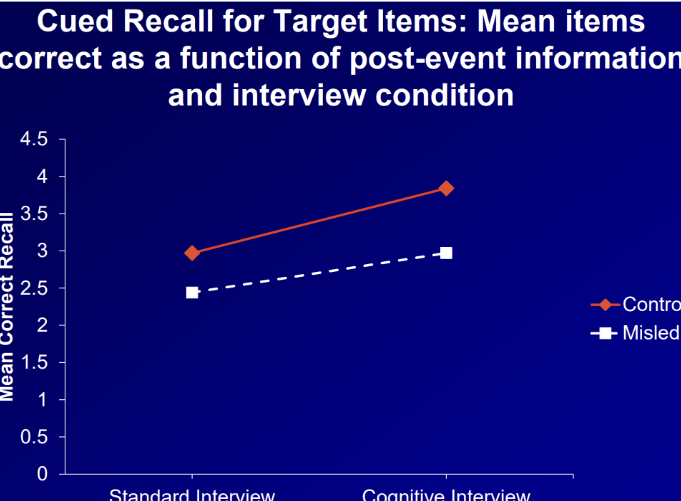
Found a suggestibility effect in both standard and cognitive conditions. In the cognitive interview, children increased their mean recall in both control and misled conditions.
The cognitive interview did not overcome the effect of suggestions
What is the final conclusion on overcoming suggestibility?
The two CI techniques increased children’s free recall 2. Exposure to misleading suggestions reduced recall accuracy 3. The two CI techniques DID NOT reduce children’s susceptibility to misleading suggestions
Therefore, prevention of misleading suggestions, is probably best in increasing accurate recall.