chem chapter 2 kinetic particle theory
 Call Kai
 Learn
Learn Practice Test
 Spaced Repetition
 Match
Match Flashcards
 Knowt Play
1/16

Earn XP
Description and Tags
Name | Mastery | Learn | Test | Matching | Spaced | Call with Kai | Chat |
|---|
No analytics yet
Send a link to your students to track their progress
17 Terms
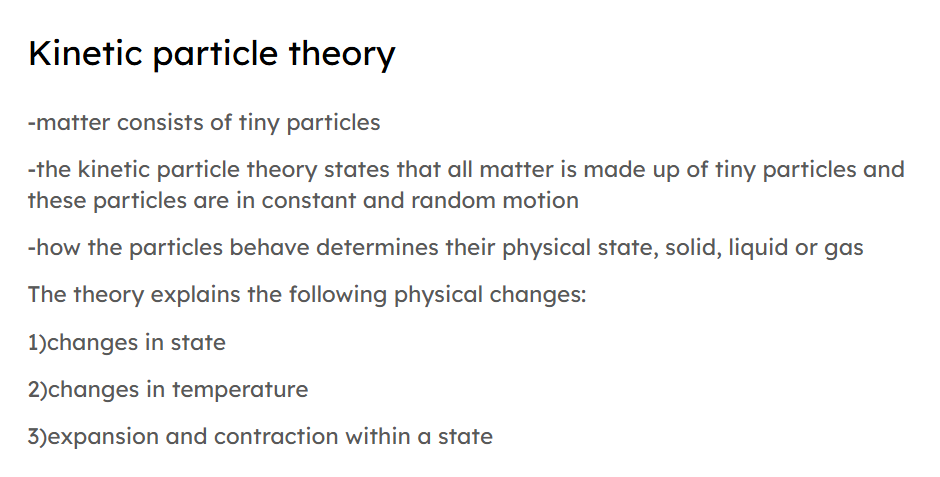
kinetic particle of theory
**the kinetic particle of theory states that all matter is made up of tiny particles and these particles are in constant and random motion
solids

liquids

gases

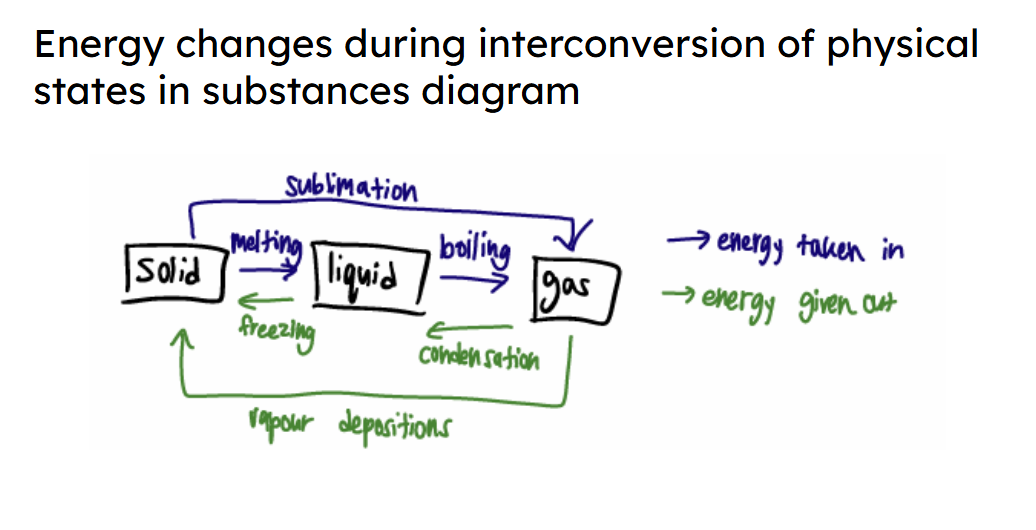
changes of state

physical change

physical change
boiling point = point of condensation as at the boiling point, gas condenses to create smoke
smoke is liquid particles

energy changes during interconversion of physical states in substances diagram
heating curve
why is a temperature a constant during melting/boiling (change of state)?
-energy is taken in to overcome the attractive forces between particles
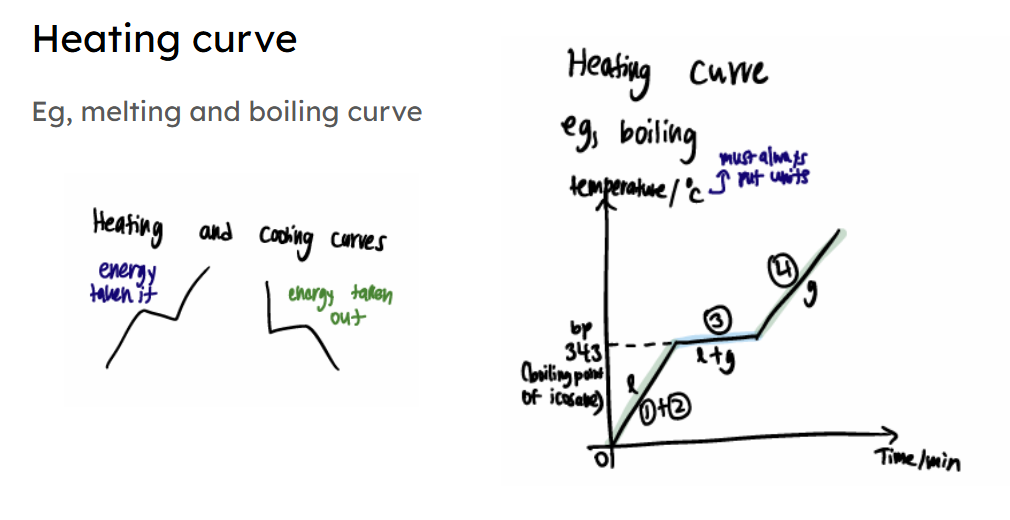
cooling curve
why is temperature a constant during freezing/condensation(change of state)?
-energy is given out to formate the attractive forces between particles

drawing of graph or curve

describing melting/boiling/evaporation using KPT
when describing anything, always state before and after ***

describing freezing/condensation using KPT

expansion and contraction of KPT
substance is heated/cooled, particles gain/lose thermal energy which is then converted to kinetic energy
particles move/vibrate more/less vigourously
particles move further/closer apart
occupies more/less space, volume increases/decreases
expand/contract
vibrate → solid
move → liquid/gases
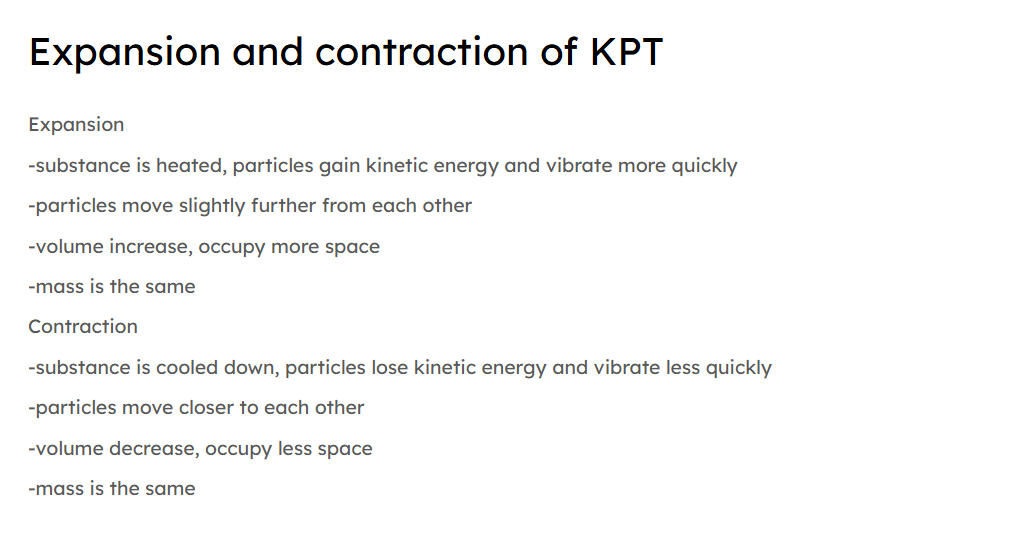
examples of expansion and contraction

sublimation
sublimation is the process by which a solid changes directly into a gas
sublimation : solid to gas

vapour deposition
vapour deposition : gas to solid
During vapour deposition , the particles transfers thermal energy to the surroundings to formate the attractive forces between particles, so the attractive forces between the particles become stronger
-vapour deposition is the opposite of sublimation
