NE203 Lecture 3 - Voltage Dependent Membrane Permeability
 Call Kai
 Learn
Learn Practice Test
 Spaced Repetition
 Match
Match Flashcards
 Knowt Play
1/37

There's no tags or description
Looks like no tags are added yet.
Name | Mastery | Learn | Test | Matching | Spaced | Call with Kai | Chat |
|---|
No analytics yet
Send a link to your students to track their progress
38 Terms
What problem does the voltage-clamp technique solve?
Membrane potential and Na+ permeability influence each other, so you can't study one while the other changes freely. Voltage clamp holds membrane potential constant so ion currents can be measured.

How does the voltage-clamp amplifier keep membrane potential constant?
An internal electrode measures Vm; the amplifier compares Vm to the command potential and injects current through a second electrode whenever they differ. This negative feedback forces Vm to equal the command potential.
In a voltage-clamp experiment, what does the injected current actually tell you?
It equals the current flowing across the neuronal membrane at that clamped voltage.
Capacitive current
redistribution of charge across the neuronal membrane

What current response follows a hyperpolarizing voltage step in a squid axon?
Only a brief instantaneous current — no sustained ionic current.
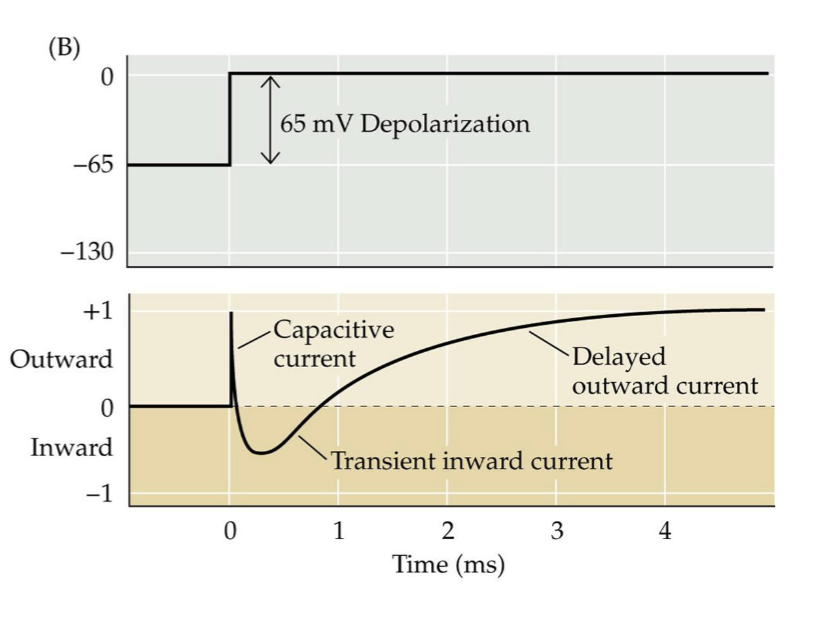
What current response follows a depolarizing voltage step in a squid axon?
Transient inward current, followed by a delayed (sustained) outward current.
What does the asymmetry between hyperpolarizing and depolarizing responses prove?
Axon membrane permeability is voltage-dependent.
What ion carries the early inward current?
Na+ (influx).
What ion carries the late outward current?
K+ (efflux).
What is the approximate ENa+ in the squid axon?
About +55 mV.
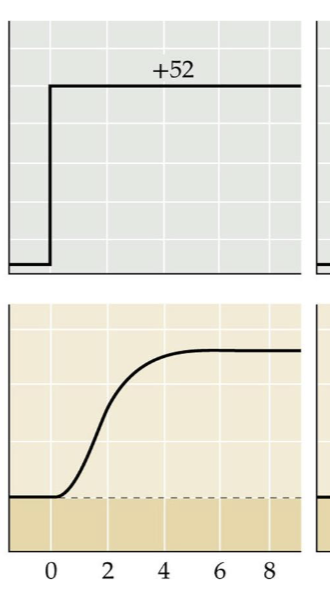
Why is there almost no early current when the membrane is clamped near +52 mV?
The clamped voltage is essentially at ENa+ (+55 mV), so the driving force on Na+ (Vm - ENa) is ~0 and no net Na+ current flows.

What happens to the early current when external Na+ is removed?
It reverses polarity — the inward current becomes outward. Restoring external Na+ makes it inward again (Figure 3.4).

What does tetrodotoxin (TTX) block?
The voltage-dependent Na+ current → no transient inward current

What does tetraethylammonium (TEA) block?
The voltage-dependent K+ current → no sustained outward current
What is membrane conductance?
The reciprocal of membrane resistance — a measure of how easily ions cross the membrane.
How were gNa+ and gK+ calculated from voltage-clamp data?
Vm was set by the clamp, so ENa and EK could be calculated; the measured INa and IK (from currents with and without external Na+) were then divided by the driving force.

What two conclusions did Hodgkin and Huxley draw about Na+ and K+ conductances?
(1) Both conductances change over time; (2) both are voltage-dependent — they progressively increase as the neuron is depolarized.
What three conductance events underlie the ion currents produced by depolarization?
(1) gNa+ activation; (2) gK+ activation; (3) gNa+ inactivation.
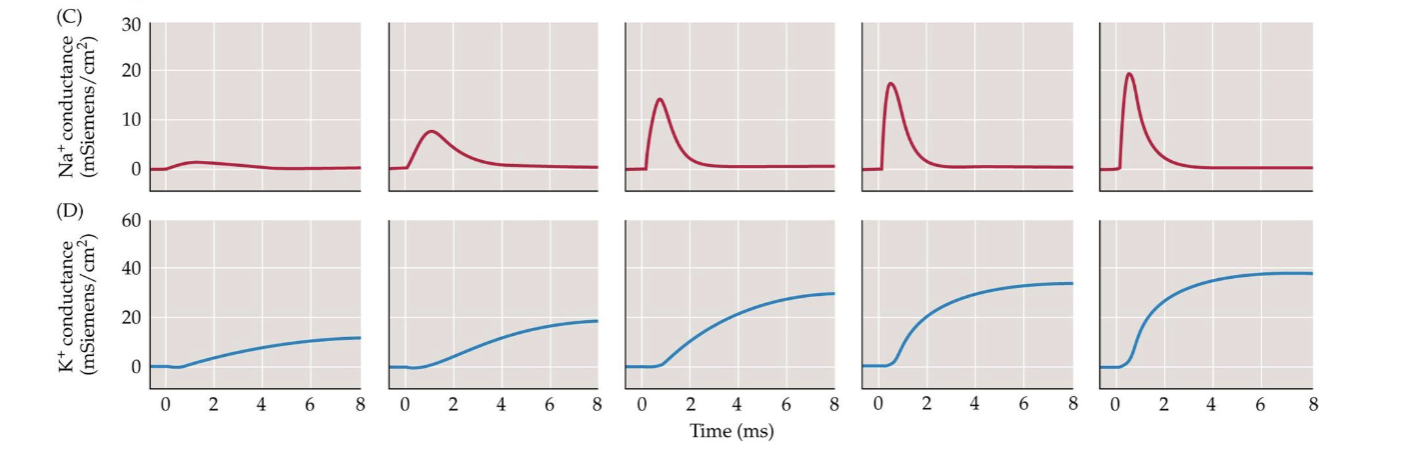
How do the time courses of gNa+ and gK+ differ during a depolarizing step?
gNa+ rises rapidly and then inactivates (transient peak); gK+ rises more slowly and stays elevated (sustained) for the duration of the step.

What did the Hodgkin-Huxley mathematical model accomplish?
Based on Na+ and K+ conductances, it accurately predicted whether an action potential would fire.

How is the refractory period demonstrated experimentally?
Stimulate the axon with two current pulses separated by variable intervals. The first reliably evokes an action potential; if the second comes too soon, it produces only a small action potential or none at all.
What happens to action potential amplitude as the interval between two stimuli increases?
Amplitude recovers progressively, approaching full size at longer intervals (~9-10 ms in squid axon).

Describe the fast positive feedback cycle of the action potential.
1) Depolarization opens Na+ channels 2) increases Na+ current 3) depolarization to start the cycle again

Describe the slow negative feedback cycle of the action potential.
4) Depolarization slowly opens K+ channels 5) increases K+ current 6) hyperpolarizes the membrane
Why is the action potential described as self-regenerating?
Because of the positive feedback loop between Na+ channel opening, increased Na+ current, and further depolarization.
What do the feedback loops explain about action potentials?
Their all-or-none behavior and the existence of a threshold.
What are the active and passive components of current flow of action potential propagation?
Active: local Na+ influx and depolarization, then local K+ efflux and hyperpolarization. Passive: local shuttling of charge to the adjacent segment of membrane.

Walk through propagation at points A, B, and C.
t=1: stimulus opens Na+ channels at A, generating an AP; inward current spreads passively down the axon.
t=2: that depolarization opens Na+ channels at B, initiating an AP there and spreading current to C.
t=3: the AP has propagated to C, while earlier regions repolarize as upstream Na+ channels inactivate, while K+ channels open → refractory
Why can't an action potential propagate backward?
Repolarization (K+ channel opening plus Na+ channel inactivation) leaves a "wake" of refractoriness behind the action potential.
3 roles of refactoriness
1) Limits the number of APs per unit time
2) Prevents re-excitation of the segment just excited
3) Prevents backward propagation toward the point of initiation.
What two strategies increase action potential conduction velocity?
1) Increase axon diameter (increases passive flow due to larger volume of ions)
2) myelinate the axon (increases active flow via saltatory jump conduction)
What is saltatory conduction?
Conduction in which the action potential is regenerated only at the Nodes of Ranvier, jumping between nodes rather than being regenerated continuously.
Where are voltage-gated Na+ and K+ channels located in a myelinated axon?
Only at the Nodes of Ranvier.
Why does myelin speed conduction?
Myelin improves passive current spread along the internode so depolarization reaches the next node quickly, and the AP only has to be actively regenerated at the nodes.
What kind of disease is multiple sclerosis?
Firmly established as at least a demyelinating disease.
Beyond demyelination, how else can MS damage neurons?
Inflammation coincident with destroyed myelin may also destroy axons, so nerve conduction fails entirely.
What is the likely autoimmune basis of MS?
The immune system produces antibodies against myelin proteins, e.g. contactin-2.
What infectious hypothesis is proposed for MS?
That MS may be caused by a persistent infection with a virus or other microorganism.