Spirometry
 Call Kai
 Learn
Learn Practice Test
 Spaced Repetition
 Match
Match Flashcards
 Knowt Play
1/32

There's no tags or description
Looks like no tags are added yet.
Name | Mastery | Learn | Test | Matching | Spaced | Call with Kai | Chat |
|---|
No analytics yet
Send a link to your students to track their progress
33 Terms
Movement of air in and out of the lungs is called pulmonary ventilation, and it involves the main structures of the respiratory system
Movement of air in and out of the lungs is called _______ ______, and it involves the main structures of the respiratory system
Gaseous exchange
refers to the transfer of oxygen and carbon dioxide between the air and blood
The walls of the alveoli are only one cell thick
The walls of the _____ are only ___ cell thick
This is also true of the walls of the tiny capillaries surrounding the alveoli (Figure 1) therefore carbon dioxide and oxygen can move by diffusion
This is also true of the walls of the tiny ______ surrounding the alveoli (Figure 1) therefore carbon dioxide and oxygen can move by _______
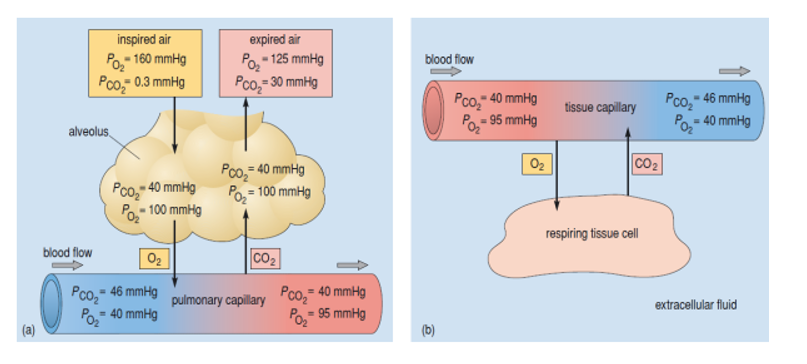
When oxygen rich air is breathed in, the oxygen diffuses into the red blood cells (erythrocytes) which deliver the oxygen to all the other cells of the body
Carbon dioxide, returning from the body in the blood, diffuses from the red blood cells into the alveolar space and is breathed out.
The capillaries are so tiny that they only allow one blood cell at a time to pass through, slowing the blood flow and allowing time for gaseous exchange
When oxygen rich air is breathed in, the oxygen diffuses into the _____ blood cells (_____) which deliver the oxygen to all the other _____ of the body
Carbon dioxide, returning from the body in the blood, diffuses from the red blood cells into the ______ _____ and is breathed ____.
The capillaries are so ____ that they only allow _____ blood cell at a time to pass through, slowing the blood ____ and allowing time for gaseous ______
capillaries
tiny that they only allow one blood cell at a time to pass through, slowing the blood flow and allowing time for gaseous exchange
gases diffuse from a region of high concentration to a region of lower concentration (move down their concentration gradient)
An important feature of gaseous exchange
The convention is to use partial pressures when describing the concentration of respiratory gases and the units shown in Figure 1 are millimetres of mercury (mmHg).
The convention is to use ______ pressures when describing the ______ of respiratory gases and the units shown in Figure 1 are millimetres of _____ (mmHg).
partial pressure
the proportion that gas contributes to atmospheric pressure.
At sea level, the average atmospheric pressure is 760 mmHg – so, if the partial pressure for oxygen at sea level in inspired air is 160 mmHg, then the percentage of oxygen in inspired air can be calculated by dividing 160 mmHg by the atmospheric pressure and multiplying the result by 100:
(partial pressure of the respiratory gas/atmospheric pressure) x 100 = percentage of the gas
(160 mmHg/760 mmHg) x 100 = 21%
The percentage of oxygen in inspired air is 21%
At sea level, the average atmospheric pressure is 760 mmHg – so, if the partial pressure for oxygen at sea level in inspired air is 160 mmHg, then the percentage of oxygen in inspired air can be calculated by dividing 160 mmHg by the _______ pressure and multiplying the result by 100:
(partial pressure of the respiratory gas/atmospheric pressure) x 100 = percentage of the gas
(____ mmHg/_____ mmHg) x 100 = 21%
The percentage of oxygen in inspired air is 21%
when inspiring, ribcage moves upwards and expands outwards as the air enters the lungs
movement of diaphragm and intercostal muscels acts to expand the size of the thoracic cavity drawing air into the lungs
when inspiring, ribcage moves ______ and expands ______ as the air enters the lungs
movement of _______ and ______ muscels acts to expand the size of the ______ cavity drawing air into the lungs
in expiration, ribcage moves downwards and retracts inwards as the air leaves your laungs
relaxation of the intercostal muscles and diaphragm reduces the size of the thoracic cavity. The ribcage, diaphragm and lung tissue itself return by elastic recoil to their original pre inspiratory positions. The consequent retraction of the chest wall forces air out of the lungs
in expiration, ribcage moves ______ and retracts ______ as the air leaves your lungs
________ of the intercostal muscles and diaphragm _______ the size of the thoracic cavity. The ribcage, diaphragm and lung tissue itself return by ____ _____ to their original pre inspiratory positions. The consequent _______ of the chest wall forces air ____ of the lungs
relaxation
occurs in intercostal muscles and diaphragm reduces the size of the thoracic cavity
elastic recoil
The ribcage, diaphragm and lung tissue itself return by what to their original pre inspiratory positions
The consequent retraction of the chest wall forces air out of the lungs
The consequent _______ of the chest wall forces air out of the lungs
compliance
The ease with which the lungs and pleura expand and contract, based on changes in pressure is called
Low lung compliance
means that the lungs and alveoli are ‘stiff’, so a higher-than-normal pressure is needed to get the lungs to expand and contract
fibrosis of the lungs
Low lung compliance results to
asbestos
tobacco smoke
indoor cooking smoke
car exhaust fumes
coal smoke
ATICC
Low lung compliance results to fibrosis of the lungs due to prolonged inhalation of small particle
chronic bronchitis
Prolonged exposure to tobacco smoke and indoor cooking smoke can cause inflammation of the lungs
emphysema
Prolonged exposure to tobacco smoke and indoor cooking smoke can cause damage to the alveoli called
Chronic Obstructive Pulmonary Disease (COPD)
Prolonged exposure to tobacco smoke and indoor cooking smoke can cause inflammation of the lungs (chronic bronchitis) and damage to the alveoli (emphysema) – a condition called
Chronic Obstructive Pulmonary Disease (COPD).
This makes it more difficult to breathe, reduces the elastic recoil properties of lung tissue and reduces the lung respiratory surface area available for gaseous exchange.
Lung function can be measured using a spirometer – a simple and inexpensive device that measures the flow and volume of expired air
Lung function can be measured using a __________ – a simple and inexpensive device that measures the flow and volume of expired air
spirometer
measures the flow and volume of expired air
forced vital capacity (FVC)
is calculated as the total volume of air that can be forcefully blown out of the lungs in one expiration (one breath).
Peak expiratory flow (PEF)
measures the maximum speed at which air is forcefully expired (litres per second).
forced expiratory volume 1 (FEV1)
is the amount of air that is forcibly blown out within the first second of a forced expiration.
Plotting the FVC and PEF values generates a spirograph, which you will produce when you use the spirometry application.
Plotting the FVC and PEF values generates a ______, which you will produce when you use the spirometry application.
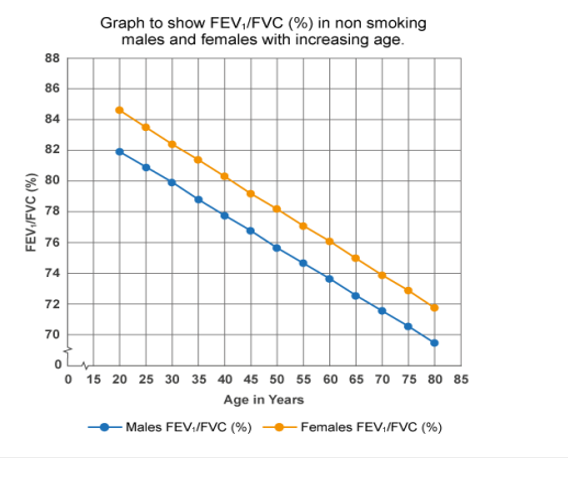
FEV1/FVC ratio (normally expressed as a percentage)
used to evaluate lung function
0.8, meaning that 80% of total volume of air is blown out within the first second.
In healthy individuals, the FEV1/FVC ratio is approximately
A value of less than 70% indicates that lung function is impaired
A value of less than 70% indicates that lung function is _______
Normal lung function is dependent on an individual’s age, height, sex, ethnicity and general fitness
Normal lung function is dependent on an individual’s ___, _____, ___, ______ and general _____