Comprehensive Guide to Tests, Measures, Movement Analysis, and Body Mechanics in Clinical Practice
 Call Kai
 Learn
Learn Practice Test
 Spaced Repetition
 Match
Match Flashcards
 Knowt Play
1/215

There's no tags or description
Looks like no tags are added yet.
Name | Mastery | Learn | Test | Matching | Spaced | Call with Kai |
|---|
No analytics yet
Send a link to your students to track their progress
216 Terms
What is the primary purpose of tests and measures in patient/client management?
To assess body structure/functions, activities, and participation roles.
What are the three main parts of the examination process?
Patient History and Subjective Interview, Systems Review, Tests and Measures.
What is the goal of the Systems Review?
To identify safety needs, need for referrals, and areas for further investigation.
What is the role of advanced or special tests in clinical evaluation?
To strengthen clinical hypotheses and focus diagnosis/prognosis.
What are Red Flag findings?
Medically concerning findings that require further investigation or immediate action.
What is an outcome measure?
A test or measure used to assess the effectiveness of an intervention.
Name three categories of tests and measures.
Aerobic Capacity/Endurance, Range of Motion, Reflex Integrity.
What are subjective measures?
Patient reports or therapist observations based on perceptions, feelings, or opinions.
What are objective measures?
Instrumental readings or counts that are based on facts and free of bias.
What is the difference between generic and disease-specific measures?
Generic measures are for all populations, while disease-specific measures focus on patients with specific diagnoses.
What is the purpose of performance-based measures?
To assess patient performance on specific activities in a test environment.
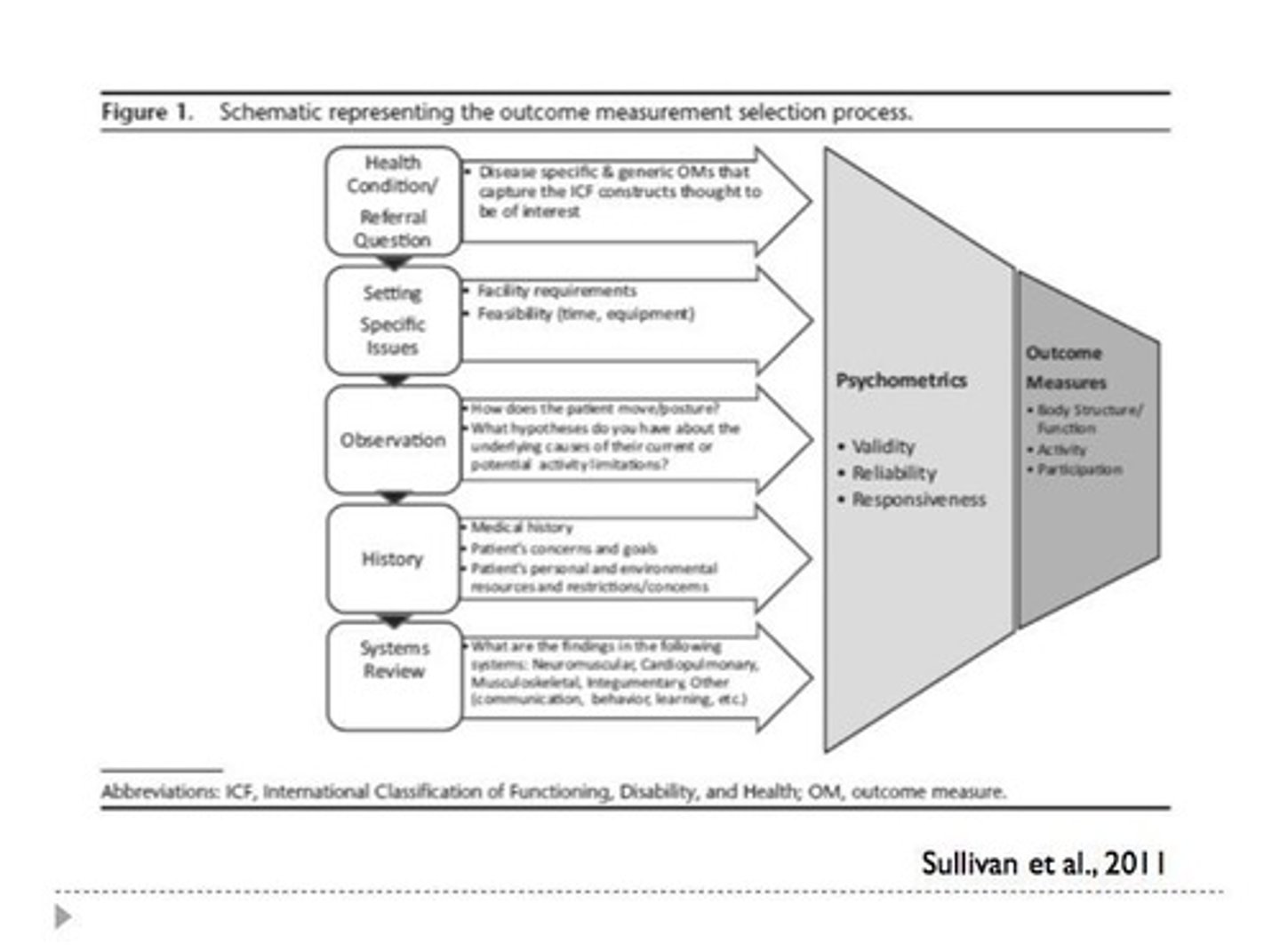
What factors should be considered when selecting outcome measures?
Body function/structure, purpose, type of measure, patient and clinic factors, psychometric properties, feasibility.
What does reliability in psychometrics refer to?
The ability to reproduce consistent results over time and space.
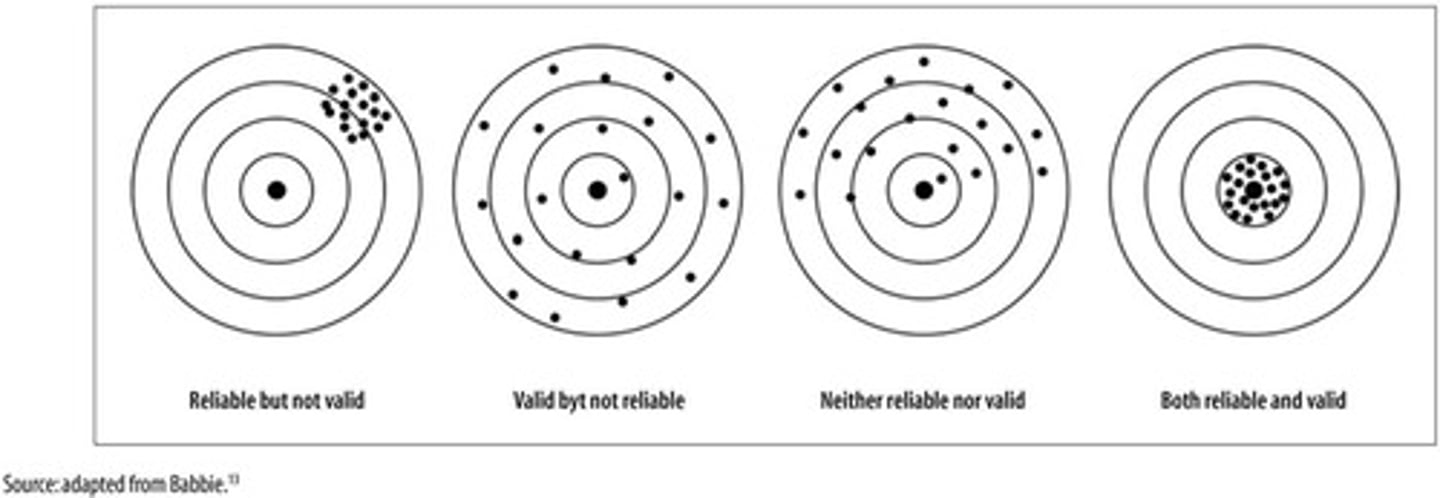
What is interrater reliability?
Consistency in results between two or more observers or raters.
What is intrarater reliability?
Consistency in results within a single observer or rater over time.
What does validity in psychometrics indicate?
The tool measures what it proposes to measure.
What is measurement error?
Variation in measurements made on the same individual under the same conditions at different times.
What are some factors influencing the feasibility of a measure?
Time, space, equipment, training, cost, proprietary restrictions, burden, language, and culture.
Why are tests and measures critical for sound documentation?
They provide meaningful and reproducible findings that support clinical decisions.
What should guide the choice of tests and measures?
Current evidence and best practice.
What is the importance of standardization in testing?
It improves reproducibility and allows for comparison and interpretation of patient scores.
What is the significance of the patient interview in the evaluation process?
It provides essential information for understanding the patient's condition and planning interventions.
What are some common purposes of outcome measures?
Evaluation, prediction, and discrimination between individuals or groups.
What is the role of the therapist in administering subjective measures?
To gather insights about the patient's opinions and perceptions of their health condition.
What is the purpose of the initial observations in the testing process?
To refine the list of potential outcome measures based on the patient's condition.
What is the relationship between tests and measures and patient safety?
Tests and measures help identify safety needs and monitor changes in function.
What is the importance of considering patient factors when choosing outcome measures?
To ensure the measures align with the patient's current functional status, goals, and expectations for recovery.
What is the purpose of movement and task analysis in patient care?
To inform examination strategy and intervention.
What are the three classifications of tasks according to Gentile's Taxonomy?
Discrete, Continuous, and Serial tasks.
What characterizes a discrete task?
A task with a discernable beginning and end.
What characterizes a continuous task?
A task with no discernable beginning or end.
What is a serial task?
A task that consists of sequential discrete movements.
Why is understanding normal movement important in task analysis?
It aids in effective task analysis and intervention planning.
What are the typical phases of the sit-to-stand functional task?
Weight shift/flexion momentum, momentum transfer, lift/extension, and stabilization.
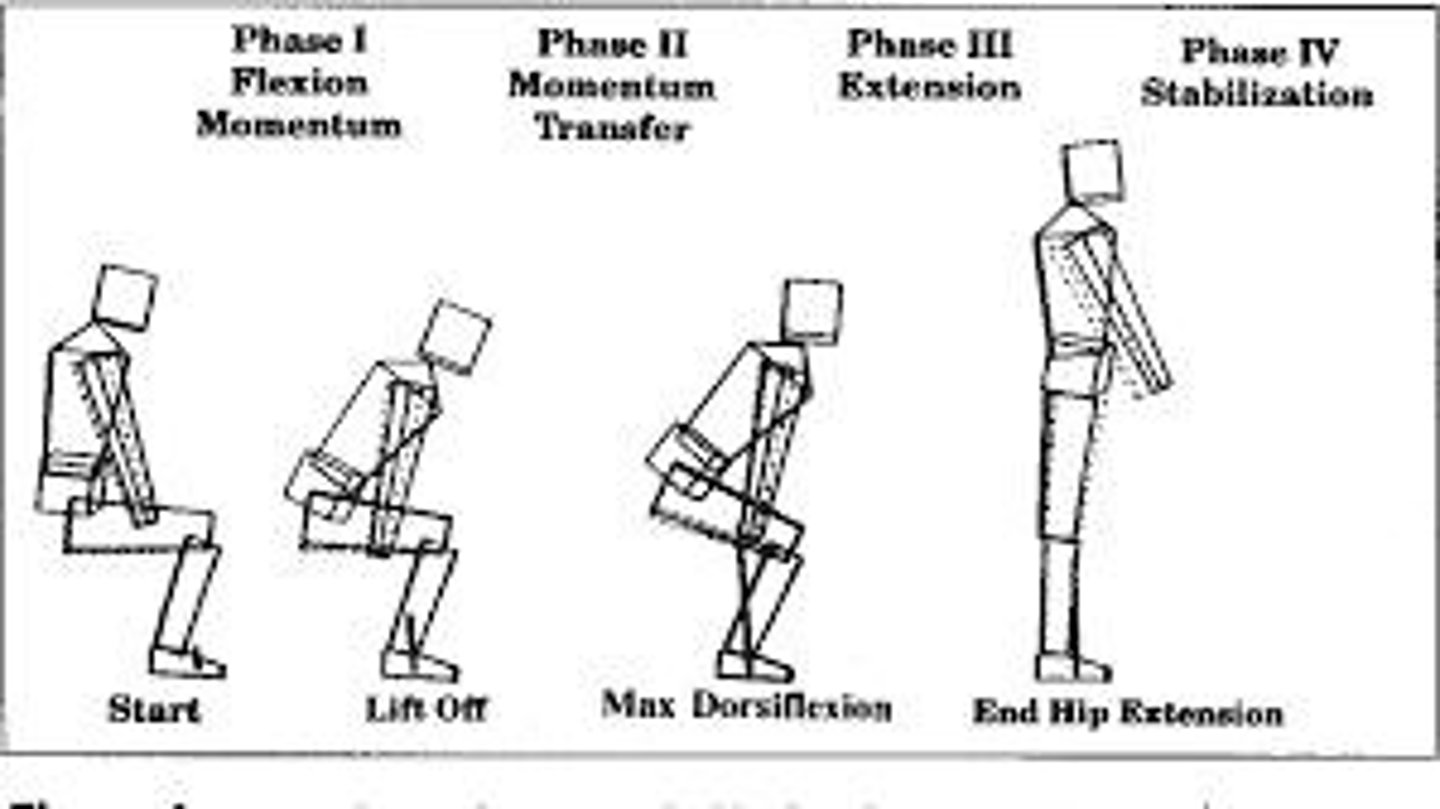
What is the first phase of the sit-to-stand task?
Flexion momentum phase, beginning with the initiation of movement.
What occurs during the momentum transfer phase of sit-to-stand?
Momentum from the upper body is transferred to the total body as the buttocks lift off the seat.
What is the role of the hip flexors during the flexion momentum phase?
They create trunk flexion to generate upper body momentum.
What is the significance of maximal ankle dorsiflexion during the momentum transfer phase?
It marks the most unstable position before the body shifts to a vertical direction.
What muscle activity is involved in the extension phase of sit-to-stand?
Concentric activation of plantar flexors and knee extensors, and eccentric activation of dorsiflexors.
What is intertrial variability (ITV)?
Variation in activity between trials that affects task performance.
What does a closed environment indicate in task analysis?
The environment is predictable and the activity is the same each time.
What does an open environment indicate in task analysis?
The environment is variable and unpredictable during action.
What are the two types of manipulation in Gentile's Taxonomy?
No manipulation and manipulation of objects.
What is the outcome of a task analysis?
Determining if the task goal was reached and under what conditions.
What is the main goal of observing movement?
To gather information necessary for effective task analysis.
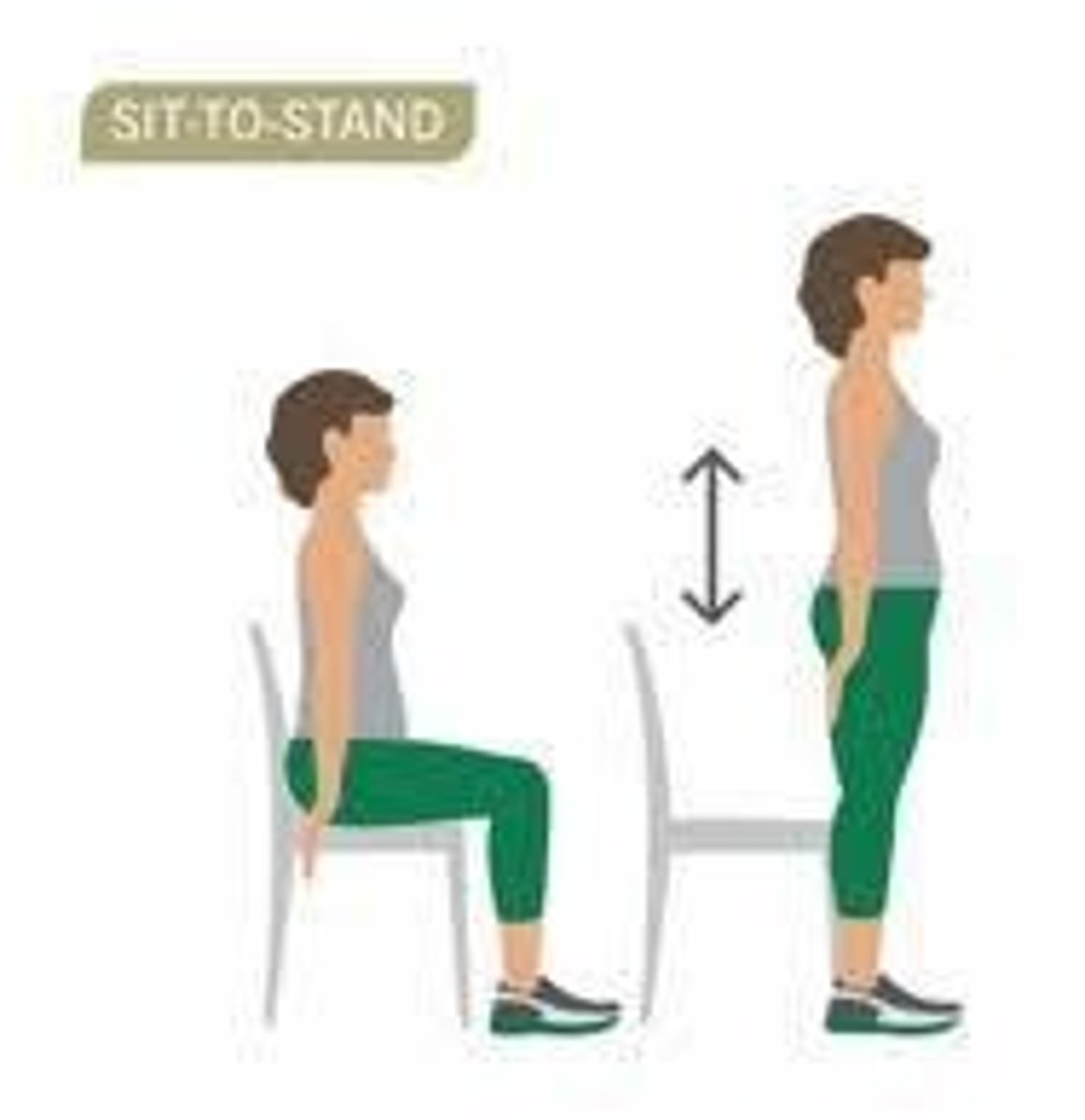
What is the significance of the sit-to-stand task in patient care?
It is essential for ambulation and standing transfers.
What is the role of the vastus lateralis during the momentum transfer phase?
It activates to prevent excessive knee flexion as lift-off occurs.
What is the final phase of the sit-to-stand task?
Stabilization phase, where the individual maintains balance after standing.
What is the importance of muscle strength in the extension phase?
Adequate strength is required for effective extension and rising.
What does 'body stability' refer to in task categorization?
Maintaining balance while performing a task without movement.
What does 'body transport' refer to in task categorization?
Moving the body from one location to another during a task.
What is the purpose of categorizing tasks and environments?
To tailor interventions based on the complexity and variability of tasks.
What is a common example of a closed environment task?
Sitting or standing statically.
What is a common example of an open environment task?
Walking with no assistive device in public with obstacles.
What begins the stabilization phase in the sit to stand movement?
It begins just after the hip-extension velocity reaches 0 degrees/sec.
What is the normal movement time for completing all phases of sit to stand?
1.86 seconds.
What factors affect the motion characteristics of sit to stand?
Seat height, handrail, and foot position.
What occurs during the stand-to-sit movement?
Trunk flexion, knee flexion, and dorsiflexion occur simultaneously and symmetrically.
What is required for control during the stand-to-sit movement?
A large amount of eccentric control.
What are the observable constructs in movement analysis?
Symmetry, speed, amplitude, alignment, postural control, verticality, stability, coordination, smoothness, sequencing, timing, accuracy, and symptom provocation.
What is the definition of symmetry in movement?
Agreement of the external kinetics and kinematics of movement (e.g., left vs right).
What does speed refer to in movement analysis?
Rate of change or velocity of segment or body displacement from start to finish of a task.
What is amplitude in the context of movement?
The extent or range of movement used to complete a task.
What does alignment refer to in movement analysis?
The biomechanical relationship of body segments to one another and to the base of support.
What is verticality in the context of movement?
The ability to orient the body in relation to the line of gravity.
What is stability in movement analysis?
The ability to control the body's center of mass in relation to the base of support under various conditions.
What does coordination refer to in movement?
The smoothness and timing of motor output required to achieve the intended goal of the task.
What is the significance of end feel in range of motion testing?
It describes the quality of resistance at the end of the range of motion.
What are the normal end feels in range of motion testing?
Bony end feel, capsular end feel, muscular end feel, and soft tissue approximation.
What is an abnormal end feel?
Examples include empty, muscle spasm, and springy block.
What is the first step in the procedure for measuring joint range of motion?
Introduce yourself, explain the purpose to the patient, and obtain consent.
What is Active Range of Motion (AROM)?
When the patient performs the movement against gravity.
What is Passive Range of Motion (PROM)?
When there is no active muscle contraction by the patient.
What is Active Assisted Range of Motion (AAROM)?
When the patient performs the movement with assistance or when gravity is eliminated.
What instruments are used to assess range of motion?
Goniometer, inclinometer, tape measure, electrogoniometer, radiographic equipment, and photography/video recording.
What are the types of goniometers?
Clear plastic, metal, full circle, half circle, finger goniometers, hard, and flexible plastic.
What is the importance of confirming goniometer alignment?
To ensure accurate measurement of range of motion.
What should be observed during the sit to stand movement?
Speed of movement, amount of movement, symmetry of movement, control, and symptom alteration.
What is the significance of patient history in palpation and testing?
It guides the clinician on which areas to palpate or test for range of motion and strength.
What is the role of palpation in clinical practice?
It helps in assessing range of motion and strength testing.
What is the first step in measuring joint ROM?
Introduce yourself, explain the purpose to the patient, and obtain consent.
Why should layperson terms be used when instructing a patient?
To ensure the patient understands the instructions clearly.
What should be ensured about the patient before measuring ROM?
The patient must be positioned comfortably and able to assume the required position.
What does PROM stand for in the context of joint measurement?
Passive Range of Motion.
What is the purpose of assessing end feel during ROM measurement?
To evaluate the quality of the motion and identify any discomfort.
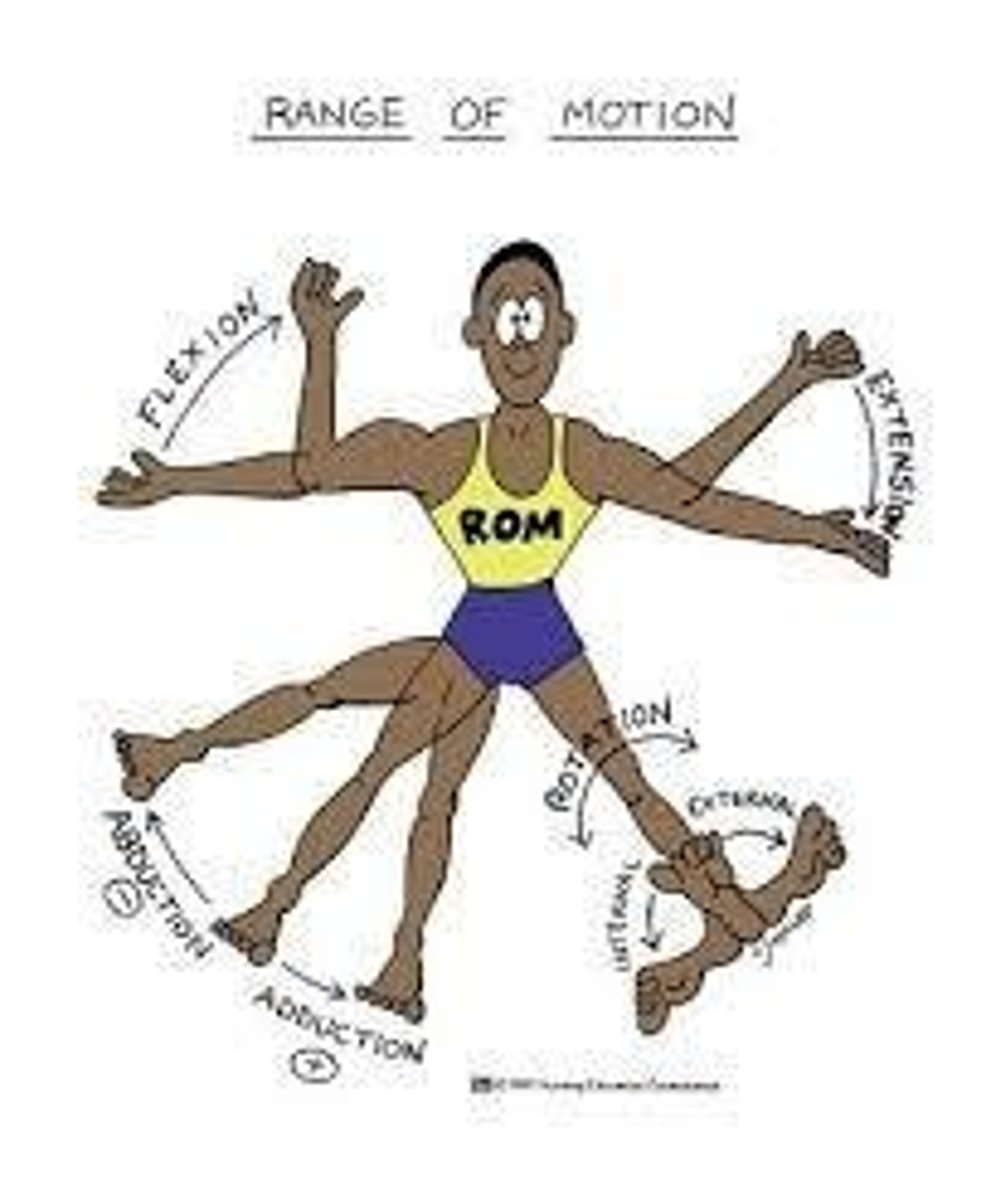
What is the significance of measuring the start position in ROM?
To establish a baseline for the measurement, ensuring at least 0 degrees start position.
What should be recorded after measuring joint ROM?
The beginning and ending ROM, type of muscle contraction, and any notes related to pain or positioning.
What is the standard recording format for joint ROM?
Record as beginning-end degrees, e.g., Right shoulder flexion = 0-180 degrees AROM.
What factors can affect joint ROM?
Age, sex, culture, and occupational/recreational activities.
What are safety precautions to consider when measuring ROM?
Avoid measuring if there is suspected joint dislocation, tendon rupture, or severe osteoporosis.
What is normative data in the context of ROM?
Standardized values for joint movement, often referenced from AAOS or similar sources.
What is the significance of documenting the testing position?
It ensures reproducibility of the measurement in future assessments.
What is the difference between AROM and PROM?
AROM is Active Range of Motion, while PROM is Passive Range of Motion.
What is the purpose of a Manual Muscle Test (MMT)?
To assess muscle strength through standardized procedures.

What are the advantages of using MMT?
Requires little to no equipment and follows standard procedures.
What are the disadvantages of MMT?
Subjective for grades above 3 and not quantitative.
What does good reliability in MMT indicate?
Consistent results across different raters or repeated measures by the same rater.
What types of muscle testing can be performed in a lab?
Manual Muscle Test (MMT) and Hand-Held Dynamometry (HHD).
What is the importance of checking alignment before recording a measurement?
To ensure accuracy in the measurement and avoid errors.
What are the three types of gravity considerations in muscle testing?
Gravity Resisted, Gravity Assisted, and Gravity Eliminated.