Concept 8.3: ATP powers cellular work by coupling exergonic reactions to endergonic reactions
 Call Kai
 Learn
Learn Practice Test
 Spaced Repetition
 Match
Match Flashcards
 Knowt Play
1/9

Name | Mastery | Learn | Test | Matching | Spaced | Call with Kai | Chat |
|---|
No analytics yet
Send a link to your students to track their progress
10 Terms
Chemical work
Work that pushes endergonic reactions
Transport work
Work that pumps substances across membranes against the direction of spontaneous movement
Mechanical work
Work such as beating cilia or contracting muscle cells
Energy coupling
The use of an exergonic process to drive an endergonic one to manage energy resources in a cell
Mediated by ATP in most cells
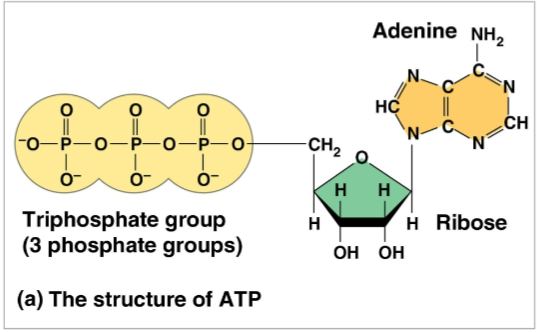
Adenosine triphosphate (ATP)
Particle composed of ribose (a sugar), adenine (a nitrogenous base), and three phosphate groups
Functions in energy coupling and as one of the nucleoside triphosphates used to make RNA
Energy is released when the terminal phosphate bond is broken by hydrolysis (adding water molecules)
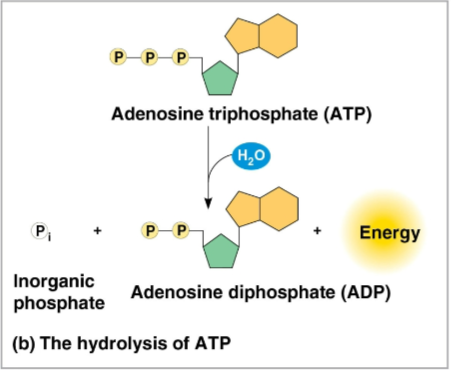
Hydrolysis
The addition of a water molecule to break a bond in another molecule
Used to release energy in ATP by breaking the terminal bond through its chemical change to a state of lower free energy in the products
This is an exergonic change to drive later endergonic reactions as well as transport and mechanical work in the cell
Repulsion
A word that describes molecules pushing away from each other in a bond
Phosphate groups do this in ATP, creating lots of potential energy as in a compressed spring
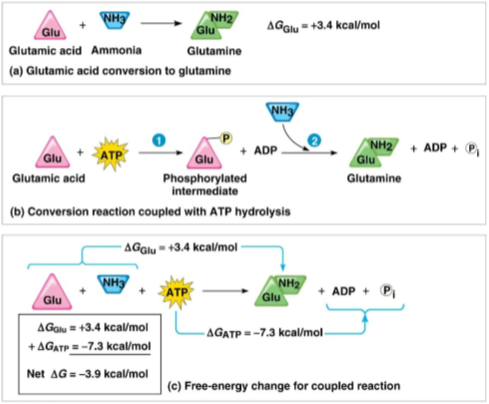
Phosphorylation
The transfer of a phosphate group from ATP to another molecule typically used to power endergonic reactions
Seen in ADP gaining a group after exergonic, catabolic reactions
Adenosine diphosphate (ADP)
One of the products after ATP hydrolysis that helps regenerate ATP through the addition of a phosphate molecule
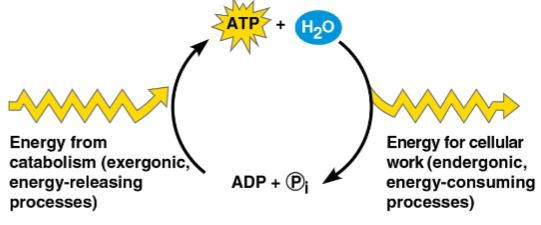
ATP cycle
The shuttling of inorganic phosphate and energy between ATP and ADP that couples energy-yielding processes to energy-consuming ones