Exam 1
 Call Kai
 Learn
Learn Practice Test
 Spaced Repetition
 Match
Match Flashcards
 Knowt Play
1/30

There's no tags or description
Looks like no tags are added yet.
Name | Mastery | Learn | Test | Matching | Spaced | Call with Kai | Chat |
|---|
No analytics yet
Send a link to your students to track their progress
31 Terms
Microboe
microorganism - is a microscopic organism It is usually a single-celled organism, or it can exist as acolony of cells

who discovered Microorganism
Antonie van Leeuwenhoek in ~1670 when he built the fist microscope

prokaryotic microbes
Bacteria and Archaea

Eukaryotic microbes
fungi, algae and protozoa
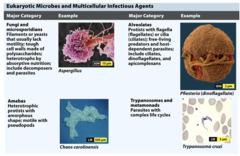
are viruses the most abundant microbe? (T/F)
true
prokaryotic cell

Eukaryotic Cell

Bacteria
single-celled prokaryotic organisms
Very ancient, first living cells were prokaryotic and resembled bacteria
ENORMOUS GENE DIVERISTY
phylogenetically
unicellular

Bacteria shape
many shapes, most commonly spherical, rod like, spirals, and so on

Archaea
organization is between Bacteria and Eukarya
Many can survive in extreme environments
Extremophiles
cannot cause disease
phylogenetically
unicellular

Archaea grow above 100 C (T/F)
True

Bacteria and Eukarya membrane lipids are ether linked (T/F)
False
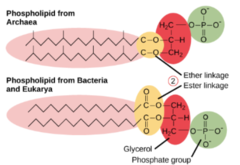
Why can archaea survive in harsh environments?
Because ether bonds are more chemically and physically resistant than ester bonds, archaea membranes are more stable.

Fungi
Many different types, yeasts are the most common fungal microorganisms
fungal cells contain chitin.
They are abundant (human skin and human gut) to fermenters of carbohydrates (wine, beer, etc)
can cause human diseases
unicellular and Multicellular (more abundant)
phylogenetic

chitin
A structural polysaccharide, consisting of amino sugar monomers, found in many fungal cell walls.

Algae
many unicellular microalgae
Photosynthetic
Many clades, phylogenetically not a single group
Protozoa
Heterotrophic single-cell eukaryotic organisms
Not a single phylogenetic group
Most are motile
Many cause disease in humans: Amoeba, Trypanosoma, Plasmodium
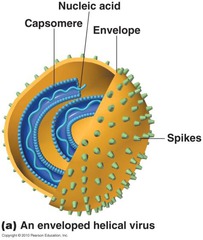
Viruses
The most numerous "organisms" on Earth
Are not cells but rather packages of nucleic acids and proteins, sometimes with lipid and carbohydrate envelopes
they require the invasion of a living cell to proliferate (pathogenic)
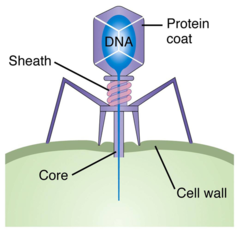
Bacteriophages
Viruses that specifically infect bacteria.
are viruses of bacteria
features of microorganisms
Proliferate quickly, can recover populations VERY quickly
Can adapt to many different conditions
Very fast evolution
- horizontal Gene transfer
- High mutation rates
- Short time scale for natural selection
Can find a way to live in almost any environment
Deinococcus radiodurans
extremely resistant to DNA damage (present in nuclear reactors and nuclear waste)
Has extraordinary capacity to survive high levels of ionizing radiation and the double-strand DNA breaks that result from exposure to this type of radiation
Bacteria
How do Deinococcus radiodurans live?
Mainly due to the presence of multiple genomecopies in each cell.
When their genome gets damaged by radiation, the genom repairs due to the multiple genome copies they have.
Genome organization in eukaryotic
multiple linear chromosomes
much larger total genome size than most prokaryotes
Lots of non-coding regions
Each gene tends to be regulated separately (no operons)
Introns interrupt open reading frames
operons
In prokaryotic cells, a cluster of genes under control of a promoter.
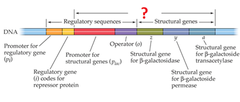
Genome organization in prokaryotic
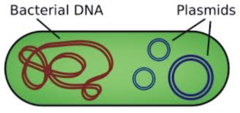
Larger chromosomes
- Most are circular but can also be linear
- Linear chromosomes have strands often linked at the ends by hairpins for exonuclease protection
Smaller plasmids
- Can be either circular (moreoften) or linear
endosymbionts
Organelles originated from prokaryotes (e.g., chloroplasts from Cyanobacteria) that were engulfed by eukaryotic cells. Over time, they became endosymbionts and lost the majority of their original genomes.
chloroplasts
Eukaryotic organelle that originated from Cyanobacteria (prokaryotic).
Cyanobacteria
Taken up by Eukaryotic cell.
Genome of mitochondria and chloroplasts
Similar to their prokaryotic ancestors, the genomes are circular.
Their genomes encode the essential machinery needed for protein synthesis, including ribosomes and a minimal set of tRNAs.
High gene density
High gene density
The DNA is highly compact, meaning a large proportion of the genome codes for functional proteins with very little wasted space.
Horizontal gene transfer
The transfer of genes from one genome to another through mechanisms such as transposable elements, plasmid exchange, viral activity, and perhaps fusions of different organisms.
Much more prevalent in unicellular organisms
- Easy to accomplish
Allows rapid adaptation to new environment
- Acquisition of antibiotic resistance genes