5205 Teaching Reading: Elementary
 Call Kai
 Learn
Learn Practice Test
 Spaced Repetition
 Match
Match Flashcards
 Knowt Play
1/466

There's no tags or description
Looks like no tags are added yet.
Name | Mastery | Learn | Test | Matching | Spaced | Call with Kai | Chat |
|---|
No analytics yet
Send a link to your students to track their progress
467 Terms
Phonological awareness
The awareness of the sound structure of language and the ability to consciously analyze and manipulate this structure via a range of tasks.
An overarching skill that includes identifying and manipulating units of oral language, including:
- parts of words
- syllables (syllabication)
- onsets
- rimes
Phonological awareness is critical for learning to read any alphabetic writing system

Children who have phonological awareness are able to:
- Identify and make oral rhymes
- Clap the number of syllables in a word
- Recognize words with the same initial sound
- Recognize the sound of spoken language
- Divide and manipulate words
Phonological awareness includes two very important subskills
- Phonemic awareness
- Phonics
Phonemic awareness
Understanding the individual sound in words
Phonics
Understanding the relationship between sounds and the spelling patterns representing those sounds
Letter-sound correspondence or phoneme-grapheme correspondence (students MUST see letters or words to engage phonics)
Essential components of Phonemic Awareness
- Focus on phonemes or the smallest units of sounds
- Spoken language
- Mostly auditory
- Manipulating sounds in words
Essential components of Phonics
- Focus on graphemes or letters and their corresponding sounds
- Written language/print
- Both visual and auditory
- Reading and writing letters according to sounds, spelling, patterns, and phonological structure
What is the role of phonological and phonemic awareness in reading development
these skills help students develop the foundational skills needed for:
- Word recognition
- Spelling
- Syllabication
- Fluency
- Reading comprehension
Reading and spelling require a level of metalinguistic speech that is not natural or easily acquired. Therefore, teachers MUST...
focus on phonemic and phonological awareness explicitly
Strategies for teaching phonological awareness
Students can break words down into smaller pieces by focusing on letter-sound relationships.
Words can be broken down by:
- infliction
- contractions
- possessives
- compound words
- syllables
- base words
- etc.
Blending
the ability to string together the sound that each letter stands for in a word
ex. /p/-/a/-/t/ -> /pat/
Sometimes blending exercises focus just on the consonant blend
Onsets
beginning consonant and consonant cluster
Rimes
vowel and consonant that follow the onset consonant cluster
common rimes:
- ick
- ing
- op
- ack
- aw
- an
- and more
Rhyming
the repetition of sounds in different words
students listen to the sounds within words and identifying word parts
Segmentation
breaking a word apart.
This can be down by breaking compound words into two parts, segmenting by onset and rime, segmenting by syllables, or breaking the word into individual phonemes
Examples of segmenting
- Compound Words: Baseball -> Base ball
- Onset and Rime: Dad -> /d/-/ad/
- Syllables: Behind -> /be-hind/
- Individual Phonemes: Cat -> /c/ /a/ /t/
Isolation
To separate word parts or to isolate a single sound in the word
Deletion
Omitting a sound in a word
This skill is usually practiced orally
Substitution
Whens students replace one sound with another in a word
Phonemic Awareness Continuum
There are 6 main levels of phonemic awareness
1. Phoneme isolation
2. Blending
3. Segmenting
The following steps involve manipulation or changing in the words. These skills are considered complex phonemic awareness skills:
4. Addition
5. Deletion
6. Substitution

Level 1: Phoneme Isolation
When students hear and separate out individual sounds in words
Level 2: Blending
When students can combine sounds in a word
Level 3: Segmenting
When students can divide the word into individual sounds
Includes being able to sound or identify how many sounds in a word
Level 4: Addition
When students can manipulate a word by adding a sound that is not originally in the word
Level 5: Deletion
Students manipulate words by deleting sounds to make a new word
Remember, it is not the spelling we are concerned about with these activities. It is JUST the sounds.
Level 6: Substitution
The highest level of phonemic awareness because students not only have to identify the sounds and locate the sounds in the word, but they also have to switch them with other sounds
Students learn the beginning and ending sounds in consonants before they can
identify the medial, or middle, sounds in words
Word manipulation is part of the complex stage of
phonemic awareness
Phonological Awareness Continuum
1. Rhyming
2. Alliteration
3. Sentence segmentation
4. Syllable segmentation
5. Onset and rime blending, and segmenting
6. Phoneme manipulation
Level 1: Rhyming
when students can match ending sounds of words
Level 2: Alliteration
when students can identify and produce words with the same initial sounds
Level 3: Sentence segmentation
when students can blend and segment sentences into words
Level 4: Syllable segmentation
when students can blend and segment syllables of spoken words
Level 5: Onset and rime blending, and segmenting
when students can blend or segment the initial consonant or consonant cluster and the vowel and consonant sounds following the rime
Level 6: Phoneme manipulation
when students can manipulate sounds in words. This is the most complex skill on the continuum and includes several skills:
- Blending
- Segment individual phonemes
- Add and delete individuals phonemes
- Substitutes phonemes to create new words
What are the two levels at the top of the phonemic awareness continuum
deletion and substitution
Evidence-based strategies to promote phonological and phonemic awareness
explicit instruction in phonemic and phonological awareness involves systematically teaching children to manipulate phonemes with letters, focusing the instruction on one or two types of phonemes manipulations rather than multiple types, and teaching children in small groups
Explicit instruction
phonemic awareness and phonological awareness has strong results in spelling and reading development
the form of instruction adopted by most states, districts, and schools because research supports that the explicit approach is effective
Implicit instruction
in phonemic awareness is sometimes called the whole language approach.
Students are not taught sounds in isolation, they hear the words and see the words in their entirety.
Phonological processing
when students use phonemes to process spoken and written language. Phonological processing includes:
- phonological awareness
- phonological working memory
- phonological retrieval
All three components are important for speech production as well as the development of the spoken and written language skills necessary for reading.
Phonological working memory
involves storing phoneme information in temporary, short-term memory, this phonemic information is then readily available for manipulation during phonological awareness tasks
Phonological Retrieval
the ability to recall the phonemes associated with specific graphemes, which can be assess by rapid naming.
this ability to recall the speech sounds in one's language is also integral to phonological awarness.
Nurturing students first language so that students can master their second language is
very important for EL phonemic awareness (focus on sounds)
When students begin to read, they acquire vocabulary skills. There skills progress in order:
1. Listening
2. Speaking
3. Reading
4. Writing
Listening vocabulary
Refers to the words we need to know to understand what we hear. This is part of a students receptive vocabulary.
Speaking vocabulary
Consists of the words we use when we speak. This is part of a students expressive vocabulary.
Reading vocabulary
Refers to the words we need to know to understand what we read. This is part of a students receptive vocabulary.
Writing vocabulary
Consist of the words we use in writing. This is part of a students expressive vocabulary.
Listening comprehension
This skill is related to listening vocabulary. Students will develop listening comprehension before reading comprehension.
The student can understand a story being read aloud.
Receptive vocabulary
Reading & Listening
Expressive vocabulary
Speaking & Writing
Print Awareness
A child's understanding of the nature and use of print
When do children develop print awarness
when they can recognize words as distinct elements of oral and written communication
Environmental print
Print in everyday life
Print concepts
involve understanding the difference between letters, words, punctuation, and directionality
- Directionality
- Layout
- Differentiation
Directionality
reading from left to right and top to bottom
Layout
front and back of books
Differentiation
words vs. pictures and letters vs. words
What do print concepts foster
reading comprehension and vocabulary growth
Strategies to promote print awareness
- Hang labels on key objects in the classroom
- Use posters that include captions and pictures
- Display an oversized book to show directionality and print
- Point out the titles, headings, beginning, middle, and end of a book or passage before reading
5 early signs on print awareness
1. The child holds a book correctly. If you hand a book that is upside down to the child, the child will turn it right side up.
2. The child understands that books are read from left to right, top to bottom, and front to back.
3. The child pretends to write by scribbling. This means the child understands that pictures and writing are distinct from one another.
4. The child points to a story and asks you to read it, understanding that the words on the page have meaning.
5. The child picks up a familiar book and reads it aloud. The child is using a memory of the story and not actually reading the book.
Alphabetic principle
the idea that letters and letter patterns represent the sounds of spoken language
learning that there are predictable relationships between sounds and letters allows children to apply these relationships to bth familiar and unfamiliar words, and to begin to read with fluency
To promote the alphabetic principle, teachers should
- Teach letter-sound relationships explicitly and in isolation
- Provide opportunities for children to practice letter-sound relationships in daily lessons
- Provide practice opportunities that include new sound-letter relationships, as well as cumulatively reviewing previously taught relationships
- Using writing or print to represent what student say during class, so students understand speech can be represented in print
Pre-Alphabetic Phase
Students read words by memorizing visual features or guessing words from context
Parital-Alphabetic Phase
Students recognize some letters and can use them to remember words by sight
Full-Alphabetic Phase
Readers possess extensive working knowledge of the graphophonemic system, and they can use this knowledge to analyze fully the connections between graphemes and phonemes in words. '
They can decode unfamiliar words and store fully analyzed sight words in memory.
Consolidated-Alphabetic Stage
Students consolidate their knowledge of grapheme-phoneme blends into larger units that recur in different words
Oral language consist of 6 major areas:
phonology, vocabulary, morphology, grammar, pragmatics, and discourse
Phonology
encompasses the organization of sounds in language
Vocabulary
(semantics) encompasses both expressive (speaking) and receptive (listening) vocabulary
Morphology
is the smallest units of meaning in words
Grammar
(syntax) the structure of language and words
Pragmatics
focuses on the social cues or norms in language
often referred to as situations in language
Discourse
Focuses on speaking and listening skills in language
discourse means dialogue
Writing and letter formation requires fine motor skills. Sometimes it helps to separate letter formation and pencil skills because some students may have poor fine motor skills when they are young.
What are some strategies for teaching letter formation and pencil control?
Letter formation:
- Build upper and lowercase letters
- Tracing letters
- Draw letters in the sand
Pencil Control:
- Use large grip
- Strengthen hands by using play dough or silly putty
When teaching phoneme-grapheme correspondence it is important to
model the pronunciation of each sound that can be used when blending sounds to make words
Simple to complex phoneme-grapheme correspondence
Group 1: a, m, s, f, i, p, t, n, d, nasalized a, CVC Pattern
Group 2: c, o, sh, k, u, b, g, e, CCVC and CVCC Patterns
Group 3: h, v, th, ch, ck, r, l, j, z, w/wh, y, s, silent e, CVCe, ff, ll, ss, zz
Group 4: ar, or, er, ai, ay, ee, ea, Vr and CVVC Patterns
Group 5: ir, ur, oa, ow, y, closed and open syllables, multi syllable
Group 6: ou, ow, oi, oy, oo, ie, x, qu, ph, accented syllables, final stable syllables
Group 7: ea, oe
Group 8: ng, igh, ew, au, aw, ar, and or
Group 9: ue, y, ou, eu
Group 10: ei, eigh, ey, ar, or, wa, u, ou
Group 11: wr, kn, gn, mb, gh, stle, ps, pn
Group 12: alk, ough, augh, ch, ture, ti, si, ci
Suggested sequence for the systematic consonant and vowel instruction
Skill level 1: Consonant sounds (c)
Skill level 2: Short vowel sounds (v)
Skill level 3: Blend short vowel sounds with consonants (cvc)
Skill level 4: Long vowel sounds (v)
Skill level 5: Blend long vowel sounds with consonants (cvcv)
Skill level 6: Consonant blends (cc)
Skill level 7: Vowel combinations (vv)
Skill level 8: R-controlled (vc)
Skill level 9: Silent letters (cv)
Explicit phonics instruction
a method of teaching students how to connect the graphemes with phonemes and how to use this letter-sound relationship to read and spell words
Systematic phonics instruction
using a logical and specific scope and sequence that is developmentally appropriate to teach students the major letters and sounds
Includes short and long vowels, blends, and consonant digraphs
Recursive phonics instruction
lessons build on those previously taught and students will have to draw and recall from previous lessons
lessons move from simple to complex, and include clear, concise student objectives
Decoding, encoding, fluency, and reading comprehension are all interrelated. A student must have these skills to be a proficient reader. Typically students acquire these skills in a particular order:
1st: Decoding
2nd: Encoding
3rd: Fluency
4th: Comprehension
Decoding
sounding out words while reading.
The students use phonics generalizations. letter sound correspondence, and phonological awareness
Encoding
The process of hearing a word and spelling it based on sound and phonics.
Usually assessed with a spelling test.
Fluency
Moving through the text accurately without having to stop to decode
Comprehension
Reading fluently and understanding the text by forming pictures in the brain, predicting, and asking questions
Single letter consonant
a single consonant letter can be represented by a phoneme
Doublet
uses two of the same letters to spell a consonant phoneme
ex. ff, ll, ss, zz
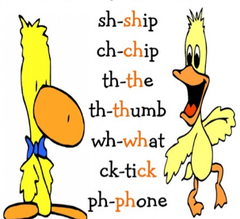
Digraph
two-letter combinations that create one phoneme
ex. th, sh, ch, wh, ph, ng, gh, ck
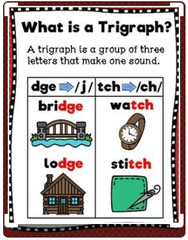
Trigraph
three-letter combinations that create one phoneme
ex. -tch, -dge
Diphthong
sounds formed by the combination of two vowels in a single syllable, in which that sound begins as one vowel and moves toward another
They can appear in the initial, middle, or final position of a word
ex. aisle, coin, loud
Consonant blends
include two or three graphemes, and the consonant sounds are separate and identifiable
ex. s-c-r (scrape), c-l (clean), l-k (milk)
Silent letter combinations
use two letters: one represents the phoneme and the other is silent
ex. kn (knock), wr (wrestle), gn (gnarl)
Combination qu
These two letters alway go together and make a /kw/ sound
ex. quickly
Single letters vowels
A single vowel letters that stands for a vowel sound
ex. cat, hit, gem, pot, sub, me , no, mute
Vowel teams
combinations of two, three, or four letters that stand for a vowel sound
ex.
short vowels: head, hook
long vowels: boat, rain, weigh
diphthongs: soil, bout
Schwa sound
a vowel sound in an unstressed syllable, where a vowel does not make its long or short vowel sound.
Often called the lazy sound in a word
CVC Pattern
Consonant-Vowel-Consonant
ex. bat, cat, tap
CVCe
Consonant-vowel-consonant-silent e
ex. make, take, bake
CCVC
Consonant-consonant-vowel-consonant
ex. trap, chop, grit