2. Anxiety Disorders ✅
 Call Kai
 Learn
Learn Practice Test
 Spaced Repetition
 Match
Match Flashcards
 Knowt Play
1/49

There's no tags or description
Looks like no tags are added yet.
Name | Mastery | Learn | Test | Matching | Spaced | Call with Kai | Chat |
|---|
No analytics yet
Send a link to your students to track their progress
50 Terms
Life can be altered by what a patient:
“HAS” – diseases ---such a bipolar disorder, and major depressive disorder.
“IS” – dimensions --- such as intelligence and personality traits: openness, conscientiousness, extrovert/introvert, agreeable, worries.
“DOES” – behaviors --- such as excessive use of alcohol or drugs.
“ENCOUNTERS” - life-story --- such as grief due to the death of a loved one, fear after a rape, or demoralization after loss of a job.
biopsychosocial view
Overview
Anxiety, fear, and avoidance are normal and adaptive responses --- difficult to diagnose. Can be comorbid with e.g. mood disorders.
Anxiety-related emotions can be most predominantly experienced as somatic symptoms.
More than temporary worry or fear.
Does not go away and may get worse.
Symptoms may significantly impact daily activities such as school, relationships and work
Facts
Most common mental illness in the U.S., affecting 40 million adults
18 and older, or 18.1% of the population every year.
highly treatable, only 36.9% of those suffering receive treatment.
3-5xmore likely to go to the doctor and 6x more likely to be hospitalized for psychiatric disorders
Develop from a complex set of risk factors, epigenetics, brain chemistry,
personality, and life events.
To some degree useful and occasionally experienced by everyone.
Distinguished from fear– more transient, intense and focused response to an immediate threat.
More sustained and variable emotion developed in the fact of a more subtle threatening and prolonged situation
psychoeducation: the anxiety response


Cognitive Manifestations of anxiety
Thought processes range from generalized worry to overwhelming fear (focus on impending doom)
Behavioral Manifestations of anxiety
The avoidance of anxiety-provoking situation
Somatic Manifestations of anxiety
Physiological complaints due to activation of sympathetic nervous system (stomach aches, headaches, shakiness etc.)
Biological Explanation for anxiety
Fears may have an evolutionary basis (contribute to survival)
Genetic predisposition to fears and anxiety
Lack of GABA neurotransmitter
Cognitive Explanation for anxiety
Irrational beliefs regard feared stimulus
Behavioral Explanation for anxiety
Classical conditioning of fear
Avoidance relieves fear (negative reinforcement)
Biopsychosocial Model Explanation for anxiety
Anxiety has a biological involvement and learning component, both of which are influenced by culture
Types of Anxiety
Generalized Anxiety Disorder
Panic Disorder
Phobia-Related Disorders
Social Anxiety Disorder
Separation Anxiety Disorder
Generalized Anxiety Disorder (GAD)
Excessive anxiety and worry, more days than not for at least 6 months, about a number of events/activities (e.g. work or school performance).
Difficult to control the worry.
Feeling restless, wound up, or on edge
Being easily fatigued
Having difficulty concentrating
Being irritable
Having muscle tension
Difficulties controlling feelings of worry
Having sleep problems
Panic Disorder
Panic attack: sudden period of intense fear that comes on quickly and reaches panic in minutes.
People who have recurrent unexpected panic attacks.
Can occur unexpectedly or be brought on by a trigger, such as a fear object or situation.
6 million American adults.
People without panic disorder can have panic attacks.
More than one in five people will experience a panic attack in their lifetime
signs of a panic attack
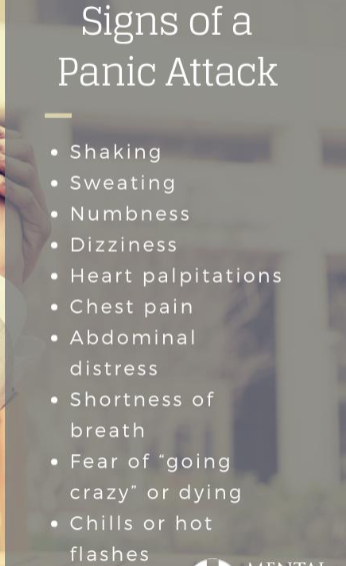
Feeling of impending doom
Feelings or being out of control
Feelings of being out of your body
During a Panic Attack
Worries about when the next attack will occur and try to prevent future attacks by avoiding places, situations or behaviors associated with the attack.
These worries can be so severe it may cause people to stop driving, or to not leave their houses
how to approach someone During a Panic Attack
Get on their level
Speak slowly and confidently
Use a gentle, caring tone of voice.
Use short, clear sentences
Provide reassurance
Do not argue with or challenge the person.
Do not threaten.
Do not raise your voice or talk too fast.
Use positive words instead of negative words.
Stay calm and avoid nervous behavior.
Do not restrict the person’s movement.
Be aware of what may increase the person’s fear and aggression.
Take a break from the conversation
Grounding
Simple exercises to help you focus on the present moment and help you detach from painful emotions so you can return to the here and now.
Research has shown that practicing grounding exercises can;
• Lower blood pressure in the body
• Reduce inflammation
• Reduce stress
• Increase mood
• Improve immune response
how to ground yourself
Relax your body, slow your breathing, take note of how you’re feeling (sensations in your body and everything around you). Uncross your legs, put feet flat on the floor.
Find a good place for hands and arms to rest that is comfortable for you.
Ideally you can take off your shoes (at home) and take note of how your feet feel on the floor.
Notice how your body feels resting against the chair.
Take a deep breath and allow shoulders to drop and relax.
Continue to focus on your breath and allow body to relax or keep your mind in the present moment.
Visualize energy pulling your body and your feet deeper toward the ground.
Let your body feel heavy and grounded.
You can scan the room and notice your surroundings, take note of things you see in the room, colors, material anything in the room.
Notice how the room feels for you.
The air, the temperature, continue to breathe.
Focusing on breath and take this moment to be very present in the moment.
Present in your body, how you feel and your mind and begin to gently move around
Phobic-Related Disorders
Phobia: intense fear or --- an avoidance of specific objects or situations.
May have some basis in reality but is out of proportion to the actual danger of the feared object or situation.
People with a Phobia
May have an irrational worry about going to the dentist
Take steps to avoid going to the dentist
Experience immediate intense anxiety when encountering the dentist
Endure unavoidable objects and situations with intense anxiety – snakes, bugs
normal fears vs phobias
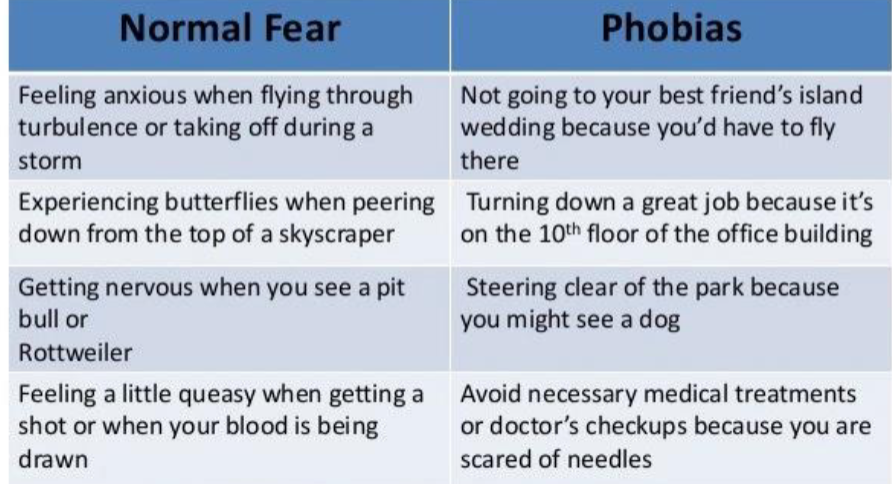
dentophobia

5 Elements of Dentophobia
Most people fear more than one
severe dentophobia may fear all or most simultaneously
the dentist
pain
numbness/gagging
sounds + smells
needles
5 Elements of Dentophobia: the dentist
Dentist is often cast as cold and unfeeling at best, or sadistic at worst.
If you have had a negative personal experience with a particular dentist, you may be more prone to this phobia
5 Elements of Dentophobia: pain
Completely painless dentistry was difficult or impossible.
Some procedures may involve a slight amount of pain.
Many people are extremely sensitive to mouth pain and fear that the pain may be excruciating
5 Elements of Dentophobia: numbness or gagging
Some people, particularly those who have experienced choking or difficulty breathing, are afraid of having their mouths numbed.
You might worry that you will be unable to breathe or swallow
5 Elements of Dentophobia: sounds + smells
Many people, particularly those who have had previous bad experiences with dentists, are afraid of the sounds and smells of a dentist’s office, particularly the sound of the drill
5 Elements of Dentophobia: needles
If you have a needle phobia, you might be extremely afraid of the injections that dentists use to numb the mouth.
The ranking of fears associated with going to the dentist are the following:
1. Extraction
2. Injection
3. Drilling
4. Prophy
Social Anxiety Disorder
People have a general intense fear of anxiety toward, social or performance situations.
People worry that others will negatively evaluate them, leading to embarrassment.
Avoid social situations

Separation Anxiety Disorder
Children and adults experience SAD
Fears about being parted from people they are attached.
Often worry that harm will happen to parent or spouse while they are separated.
Child who refuses to go to school has stomach aches.
Genetic and Environmental Factors
Temperamental traits of shyness or behavioral inhibition in childhood
Exposure to stressful life or environmental events in early childhood or
adulthood
A family history of anxiety or other mental illness
Prognosis
Early diagnosis and treatment can limit the problems caused by an anxiety disorder and improve the outlook.
Many anxiety disorders are not recognized and, as a result, not treated.
Anxiety and Dentistry
Survey of 6,000 people, 43% reported that they avoided going to the dentist unless they had trouble with their teeth.
Of these 43%, 58% said part of the reason was they were scared of the dentist.
One study found that visiting the dentist ranked 4th, behind fear of snakes, heights, and storms.
Phobic or intensely fearful dental patients suffered pain an average of 17.3 days before consulting a dentists, as compared with only 3 days for non-phobic patients.

Early signs include a sense of vigilance and tension.
With increasing anxiety, more uncomfortable states emerge:
Fatigue, persistent exhaustion, worry, agitation, distractibility, jumpiness, an odd state of derealization/depersonalization, a loss of mental and physical efficiency, increased heartbeat, stomach cramps, dry mouth, and lightheadedness.
Derealization
Sense of distance from activities going on in the world or feeling that one's surroundings are distorted or somewhat unrecognizable.
This may include:
• Feeling as if objects are the wrong size/color
• Feeling as though time is speeding up/slowing down
• Experiencing sounds as louder/softer than expected
• Feeling as though watching events and activities unfold in a movie/on a computer screen, rather than participating
Depersonalization
Sense of experiencing one's own behavior, thoughts, and feelings from a dreamlike distance.
Symptoms include:
• Feeling emotionally numb, as if the person is not controlling his or her words and actions
• Feeling detached from ordinary sensations, such as touch, thirst, hunger, and libido
Implications of Survey Data:
Dentists will see many patients who view them as someone who inflicts distress.
Dentists will meet with patients who require extensive restorative work and will not agree to have it
Key Principle of Patient Care
Your relationship with your patient is the strongest anesthetic and anti-anxiety agent
Treating the Anxious Patient
For children, the most important preventive measure is a setting in which
they feel safe and trusting.
Experienced dentists know that the actual accomplishment of treatment
is always secondary to the establishment of trust when a new patient enters the office.
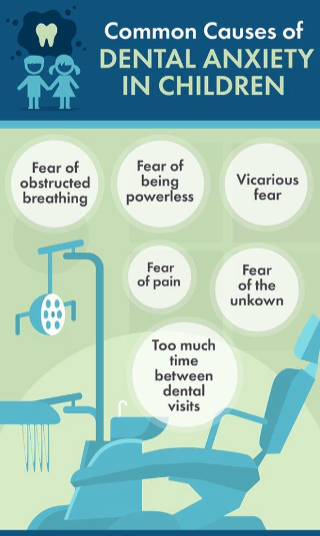
Anxiety and Dentistry: fear over time
Show and experience anxiety in different ways
Not always possible to tell how anxious a patient might be.
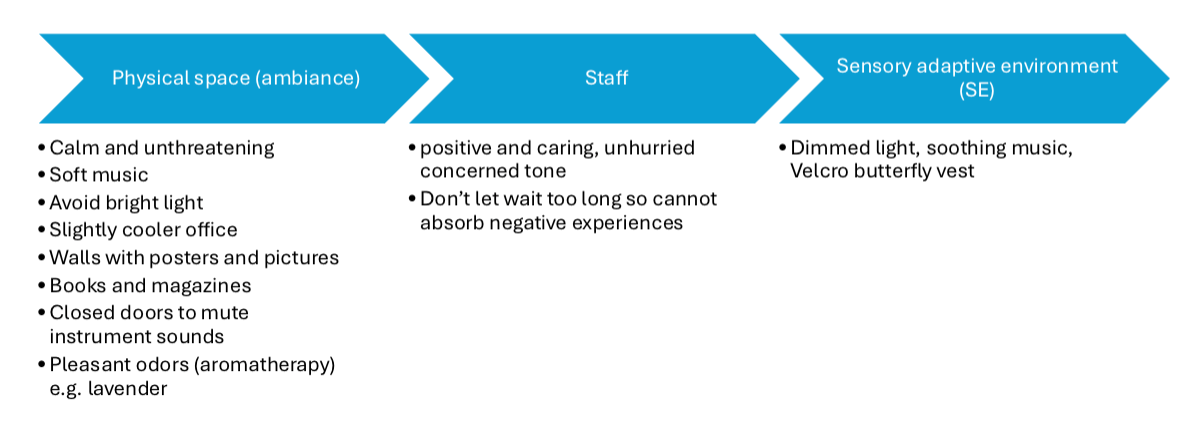
Anxiety levels might be higher in the waiting room, so a receptionist’s judgment may be useful.
Anxiety can run in families, new child patient may experience a similar level of anxiety as the parent
Gradual introduction is often especially helpful.
Exposure to dental setting is increased gradually, so patient’s coping strategies are not overwhelmed.
Anxious patients often ashamed of difficulties and may be concerned about critical judgment of them.
Important to be accepting and non-evaluative
provide provide give
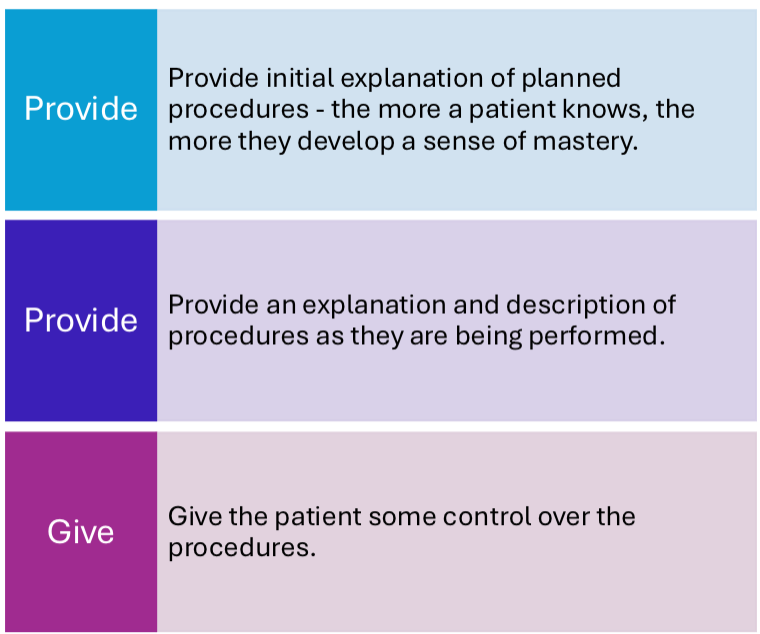
Recommendations
Mild cases of panic respond to cognitive-behavioral therapy, but many
patients need medication.
Serotonin reuptake inhibitors.
The agoraphobic patient should be gently encouraged to get out and explore the world.
Progress will only occur if patient confronts the feared places and situations
Patients should minimize their caffeine intake.
Sometimes behavioral techniques are useful.
Exposure, desensitization, relaxation training.
Therapy
Holistic Remedies

Practical Application
Ost’s applied relaxation technique

Jacobson’s progressive muscle- relaxation technique

Brief or functional relaxation therapy
The awareness that you will have to take your place in the dentist’s chair in a few minutes quite possibly provokes an unpleasant feeling over your body, leading to a hardening of your muscles.
This tension may be relieved by the technique of functional relaxation.
For this exercise, please try to feel your body more intensely.
Please perform and repeat each sequence of movements as described for 2–3 seconds.
Pause for a moment to register your body’s perception of changes from one sequence of movements to another.
Try to assume a comfortable position in your seat, and perform only small, almost imperceptible, movements

4S Rule/4S Principle
Anxious patients who must undergo restorative procedures are often managed this way
Based on eliminating four of the primary sensory triggers for dental anxiety when in the dental setting:
sight (air-turbine drill, needles)
sounds (drilling)
sensations (high-frequency vibrations [the annoyance factor])
smells
Tips for staying calm (for patients)
Share your fears. If you're tense or anxious, tell your dentist and the dental staff. Expressing your concerns will help your dentist adapt the treatment to your needs.
Focus on breathing regularly and slowly during dental procedures. When people are nervous they tend to hold their breath, which decreases oxygen levels and further increases feelings of panic. As in some meditation techniques, a focus on slow, regular breathing helps reduce stress levels.
Listen to music. If the sound of the drill bothers you, bring along your favorite music and earphones.
Watch what you eat and drink. Avoid caffeine before appointment. Eat high-protein foods which – unlike sugary foods – produce a calming effect.
Use hand signals. Empower yourself by agreeing on hand signals to communicate with your dentist. When you feel uncomfortable, signal the dentist to ease off or stop the procedure.
Choose a low-stress appointment time. Select a time for your dental visit when you’re less likely to be rushed or under pressure. This might mean a Saturday or an early morning appointment.