Equity Valuation (Formulas)
 Call Kai
 Learn
 Practice Test
 Spaced Repetition
 Match
 Flashcards
 Knowt Play
1/23

There's no tags or description
Looks like no tags are added yet.
Name | Mastery | Learn | Test | Matching | Spaced | Call with Kai | Chat |
|---|
No analytics yet
Send a link to your students to track their progress
24 Terms
Perceived mispricing
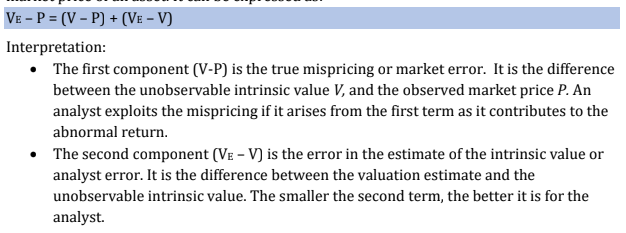
The value of a stock for infinite holding periods is:
The value of a stock using the Gordon growth model is:
• Dividends grow at a constant growth rate g.
• Discount rate r is constant and is greater than g.
• Dividends bear and understandable and consistent relationship with profits.

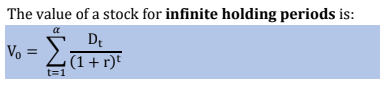
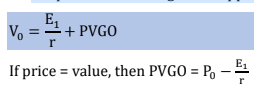
The present value of growth opportunities (PVGO),
• present value of the company with no growth component and
• present value of growth opportunities.
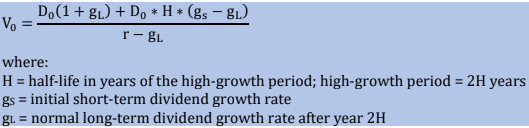
The value of a stock using the H-model is:
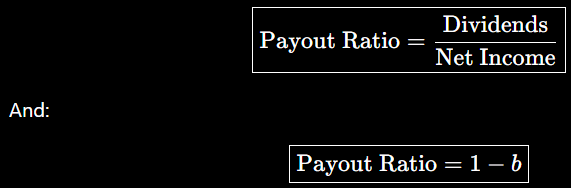
Earnings retention rate (b)
Simply the % of earnings retained after paying out dividends.
Also calculated as 1 - payout ratio
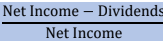
Dividend Payout Ratio
b = % of retained earnings after paying dividends
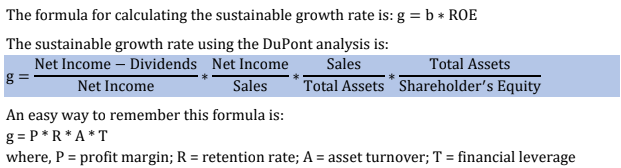
Sustainable growth rate
FCFF

FCFE

Normalized EPS
Historical average method: Normalized EPS is calculated as the average EPS over the most recent full cycle.
Average ROE method: Normalized EPS = average full cycle ROE * current BV per share
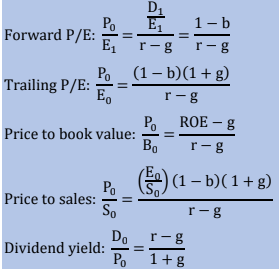
Forward P/E:

Trailing P/E:

Price to book value:

Price to sales:

Dividend yield:
Residual income
is defined as the earnings for a given period minus the opportunity cost of
equity holders. It can be calculated in two ways:

Equity Value add
EVA is a commercial implementation of the residual income concept.

Residual income model
According to the residual income model, the intrinsic value of equity is a sum of two
components:
• The current book value of equity
• The present value of expected future residual income

The fundamental determinants of residual income are:
• book value of equity
• return on equity

Expanded CAPM:

Build-up method:

DLOC (Discounts for lack of control)

DLOM (discount for lack of marketability)
