Digestive System Basics & GI Tract Anatomy
 Call Kai
 Learn
Learn Practice Test
 Spaced Repetition
 Match
Match Flashcards
 Knowt Play
1/33

There's no tags or description
Looks like no tags are added yet.
Name | Mastery | Learn | Test | Matching | Spaced | Call with Kai | Chat |
|---|
No analytics yet
Send a link to your students to track their progress
34 Terms
What is the digestive system and what does it obtain
the organ system that allows us to process food, digest the nutrients, and remove waste
it obtains energy for atp production and raw material for building and repair
what is the 6 stages of digestion
ingestion, propulsion, digestion, absorption, compaction, and defecation
Ingestion
intaking the food
Propulsion
swallowing & peristalsis (muscle contractions that push food foward)
Digestion
mechanical and chemical breakdown of food to usable material
Absorption
uptake of nutrients/ nutrients enter body
compaction
absorbing water and consolidate indigestible material → basically removing water and compacting into feces
Defecation
removal of feces
What are the two types of digestions
mechanical and chemical
Mechanical digestion and why
The physical breakdown of food into smaller pieces - chewing/ churning through stomach and intestines → smaller pieces = more surface area exposed to digestive enzymes (doesnt change molecules = bread is still bread just small bits)
Chemical digestion
digestive enzymes → hydrolysis reactions that turn macromolecules into monomers
Chemical digestion turns polysaccharides, proteins, fats, and nucleic acid into what
polysaccharides → monosaccharides
proteins → amino acids
fats → monoglycerides and fatty acid
nucleic acid → nucleotides
What nutrients are usable without chemical digestion (5)
vitamin, amino acid, water, cholesterol, minerals
What are the two subdivision/ group of organs in the digestive system
Digestive tract (alimentary canal) and the accesory organs
Digestive tract / alimentary canal (7 organs)
the tube from mouth to anus that the food travels through
mouth → pharynx → esophogus → stomach → small intestine → large intestine → anus
GI tract (6)
Gastrointestinal tract thats part of alimentary canal/ digestive tract
Accessory organs
helps with the digestion but food doesn’t move through here
teeth, tongue, salivary gland, liver, gallblander, pancreas
Difference between digestive tract/ aliment canal and the GI tract
GI tract is only stomach and intestines
while digestive tract is from mouth to anus (mouth → pharynx→ esophagus → stomach → intestines → anus)
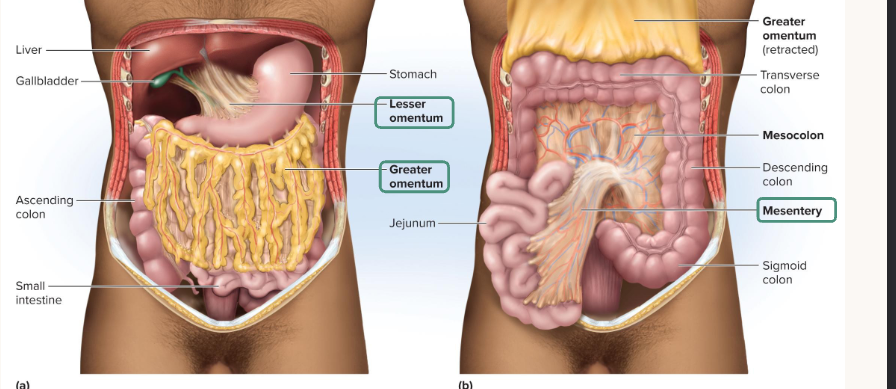
Peritoneum
Double layer of serous membrane tha surrounds the organs of the abdominal cavity

Mesentery and omentum (lesser and greater)
Mesentery - double layer of peritoneum that holds digestive organs in place to abdominal wall + carries their vessels and nerves
Omentum - a fold of peritoneum for the stomach → greater → from stomach and covers intestines → lesser → connecst stomach to liver
what are the 4 layers / tunics of the alimentary canal from innermost to outermost
mucosa, submucosa, muscularis externa, serosa

Mucosa
innermost layer of the alimentary canal
Epithelium → lamina propria → muscularis mucosae
also has MALT (mucosa associated lymphatic tissue)

Submucosa
connective tissue layer that contains vessels, nerves, and lymphatics
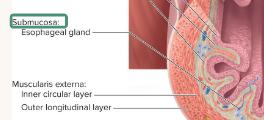
Musclaris externa - what is it and what 2 functions
2 layers of smooth muscle (inner circular, outer longitudinal) for peristalsis (pushing forward) and segmentation (mixing)
Serosa
outermost layer of the alimentary canal (digestive tract)
anchors the digestive tract to surrounding tissue
adventitia
replaces serosa in esophagus and rectum area
Enteric plexus -what is it and what does it regulate (3)
nervous network within digestive tract that regulates motility secretion and blood flow
What are the two neuron networks of the enteric plexus
submucosal plexus and myenteric plexus
How is motility and secretion of the digestive tract controlled (3)
neural control, hormonal control, paracrine secretions
What are the two neural controls of secretion and motility of the digestive system
Short myenteric reflex and long vagovagal reflex
Short myenteric reflex
reflex through the enteric/ myenteric plexus that reacts to stretch or chemical stimulation INSIDE the digestive tract
Long vagovagal reflex
reflex from parasympathetic stimulation /CNS
Hormone vs paracrine secretion
Hormones are released and travels to target elsewhere through bloodstream while paracrine secretion is when a cell release chemicals that affect nearby cells
gastrin, secretin
two hormones that regulate secretion and motility in the digestive tract