W + H - 主要係...定係 | Final Particles
 Call Kai
 Learn
Learn Practice Test
 Spaced Repetition
 Match
Match Flashcards
 Knowt Play
1/15

There's no tags or description
Looks like no tags are added yet.
Name | Mastery | Learn | Test | Matching | Spaced | Call with Kai | Chat |
|---|
No analytics yet
Send a link to your students to track their progress
16 Terms
主要係學口語, 定係寫字同認字?
(zyu2 jiu3 hai6 hok6 hau2 jyu5, ding6 hai6 se2 zi6 tung4 jing6 zi2?)
Mandarin:
主要是学口语还是写字和认字?
(Zhǔyào shì xué kǒuyǔ háishì xiězì hé rènzì?)
你主要係想買樓定租樓?
(nei5 zyu2jiu3 hai6 soeng2 maai5lau2 ding6 zou1lau2?)
Do you primarily want to buy a house or rent a house?
Mandarin:
你主要是想买房还是租房?
(Nǐ zhǔyào shì xiǎng mǎifáng háishì zūfáng?)
我主要係想租房,因為我出年工作可能會換地方。
(ngo5 zyu2jiu3 hai6 soeng2 zou1fong2, jan1wai6 ngo5 ceot1 nin2 gung1 zok3 ho2nang4 wui5 wun6 dei6fong1.)
I primarily want to rent because my job might change locations next year.
Mandarin:
我主要是想租房,因为我明年工作可能会换地方。
(Wǒ zhǔyào shì xiǎng zūfáng, yīnwèi wǒ míngnián gōngzuò kěnéng huì huàn dìfāng.)
你工作主要係同客戶傾偈定係寫報告?
(nei5 gung1zok3 zyu2jiu3 hai6 tung4 haak3wu6 king1gai2 ding6hai6 se2 bou3gou3?)
Is your work mainly speaking with clients or writing reports?
Mandarin:
你工作主要是跟客户聊天还是写报告?
(Nǐ gōngzuò zhǔyào shì gēn kèhù liáotiān háishì xiě bàogào?)
其實我工作兩邊都有,不過我花多啲時間寫報告。
(kei4sat6 ngo5 gung1zok3 loeng5 bin1 dou1 jau5, bat1gwo3 ngo5 faa1 do1 di1 si4gaan3 se2 bou3gou3.)
Actually, my work is a bit of both, but I spend more time writing reports.
Mandarin:
其实我工作两边都有,不过我花更多时间写报告。(Qíshí wǒ gōngzuò liǎngbiān dōu yǒu, bùguò wǒ huā gèng duō shíjiān xiě bàogào.)
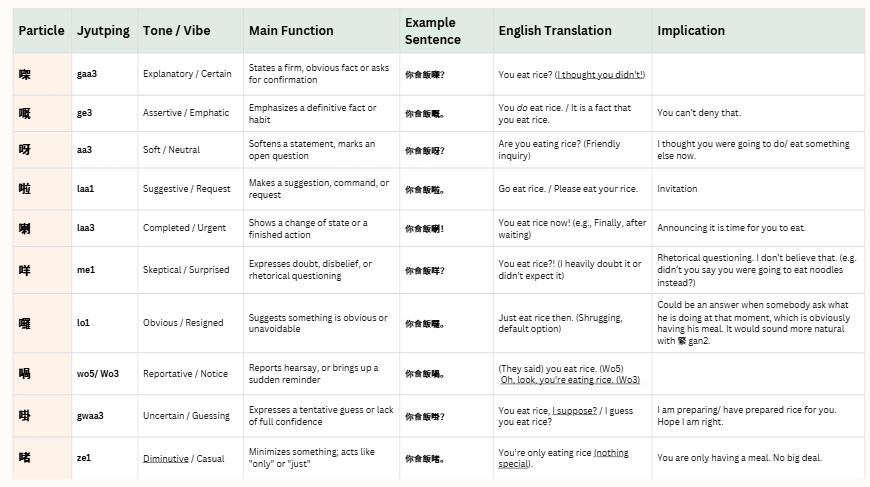
Cantonese Sentence - Final Particles Comparison
Particle | Jyutping | Tone / Vibe | Main Function | Example Sentence | English Translation | Implication |
㗎 | gaa3 | Explanatory / Certain | States a firm, obvious fact or asks for confirmation | 你食飯㗎? | You eat rice? (I thought you didn't!) | |
嘅 | ge3 | Assertive / Emphatic | Emphasizes a definitive fact or habit | 你食飯嘅。 | You do eat rice. / It is a fact that you eat rice. | You can’t deny that. |
呀 | aa3 | Soft / Neutral | Softens a statement, marks an open question | 你食飯呀? | Are you eating rice? (Friendly inquiry) | I thought you were going to do/ eat something else now. |
啦 | laa1 | Suggestive / Request | Makes a suggestion, command, or request | 你食飯啦。 | Go eat rice. / Please eat your rice. | Invitation |
喇 | laa3 | Completed / Urgent | Shows a change of state or a finished action | 你食飯喇! | You eat rice now! (e.g., Finally, after waiting) | Announcing it is time for you to eat. |
咩 | me1 | Skeptical / Surprised | Expresses doubt, disbelief, or rhetorical questioning | 你食飯咩? | You eat rice?! (I heavily doubt it or didn't expect it) | Rhetorical questioning. I don’t believe that. (e.g. didn’t you say you were going to eat noodles instead?) |
囉 | lo1 | Obvious / Resigned | Suggests something is obvious or unavoidable | 你食飯囉。 | Just eat rice then. (Shrugging, default option) | Could be an answer when somebody ask what he is doing at that moment, which is obviously having his meal. It would sound more natural with 緊 gan2. |
喎 | wo5/ Wo3 | Reportative / Notice | Reports hearsay, or brings up a sudden reminder | 你食飯喎。 | (They said) you eat rice. (Wo5) Oh, look, you're eating rice. (Wo3) | |
啩 | gwaa3 | Uncertain / Guessing | Expresses a tentative guess or lack of full confidence | 你食飯啩? | You eat rice, I suppose? / I guess you eat rice? | I am preparing/ have prepared rice for you. Hope I am right. |
啫 | ze1 | Diminutive / Casual | Minimizes something; acts like "only" or "just" | 你食飯啫。 | You're only eating rice (nothing special). | You are only having a meal. No big deal. |
㗎
gaa3
Explanatory / Certain
States a firm, obvious fact or asks for confirmation
Example: 你食飯㗎? (nei5 sik6 faan6 gaa3?)
You eat rice? (I thought you didn't!)
嘅
ge3
Assertive / Emphatic
Emphasizes a definitive fact or habit
Example: 你食飯嘅。(nei5 sik6faan6 ge3.)
You do eat rice. / It is a fact that you eat rice.
Implication: You can’t deny that.
呀
aa3
Soft / Neutral
Softens a statement, marks an open question
Example: 你食飯呀?(nei5 sik6faan6 aa3)
Are you eating rice? (Friendly inquiry)
Implication: I thought you were going to do/ eat something else now.
啦
laa1
Suggestive / Request
Makes a suggestion, command, or request
Example: 你食飯啦。(nei5 sik6faan6 laa1)
Go eat rice. / Please eat your rice.
Implication: invitation
喇
laa3
Completed / Urgent
Shows a change of state or a finished action
Example: 你食飯喇!(nei5 sik6faan6 laa3)
You eat rice now! (e.g., Finally, after waiting)
Implication: Announcing it is time for you to eat.
咩
me1
Skeptical / Surprised
Expresses doubt, disbelief, or rhetorical questioning
Example: 你食飯咩?(nei5 sik6faan6 me1)
You eat rice?! (I heavily doubt it or didn't expect it)
Implication:
Rhetorical questioning. I don’t believe that. (e.g. didn’t you say you were going to eat noodles instead?)
囉
lo1
Obvious / Resigned
Suggests something is obvious or unavoidable
Example: 你食飯囉。(nei5 sik6faan6 lo1)
Just eat rice then. (Shrugging, default option)
Implication:
Could be an answer when somebody ask what he is doing at that moment, which is obviously having his meal. It would sound more natural with 緊 gan2.
喎
wo5/ Wo3
Reportative / Notice
Reports hearsay, or brings up a sudden reminder
Example 1:
你食飯喎。(nei5 sik6faan6 wo5)
(They said) you eat rice.Example 2:
你食飯喎。(nei5 sik6faan6 wo3)
Oh, look, you're eating rice.
啩
gwaa3
Uncertain / Guessing
Expresses a tentative guess or lack of full confidence
Example: 你食飯啩? (nei5 sik6faan6 gwaa3)
You eat rice, I suppose? / I guess you eat rice?
Implication:
I am preparing/ have prepared rice for you. Hope I am right.
啫
ze1
Diminutive / Casual
Minimizes something; acts like "only" or "just"
Example: 你食飯啫。(nei5 sik6faan6 ze1)
You're only having meal (nothing special).
Note: “食飯” = having meal in this context.Implication:
You are only having a meal. No big deal.