Week 2 Material
 Call Kai
 Learn
Learn Practice Test
 Spaced Repetition
 Match
Match Flashcards
 Knowt Play
1/19

There's no tags or description
Looks like no tags are added yet.
Name | Mastery | Learn | Test | Matching | Spaced | Call with Kai | Chat |
|---|
No analytics yet
Send a link to your students to track their progress
20 Terms
Definition of price system
-A price system is an economic mechanism that uses the forces of supply and demand to determine the prices of goods and services in a market, facilitating resource allocation and distribution.
-communication between buyers and sellers regarding desire
Definition of WTP
Willingness to Pay (WTP) is the maximum amount a consumer is willing to spend on a good or service, reflecting their perceived value of that item.
What is the Law of Demand?
-states the inverse effect of demand and price
-increase in price, decrease in demand
-decrease in price, increase in demand
*all other factors are held at constant
What is demand?
Demand refers to the quantity of a good or service that consumers are willing and able to purchase at various prices over a specific period. It is influenced by factors such as price, consumer preferences, and income levels.
Definition of Substitution effect?
Definition of Income effect?
The substitution effect refers to how consumers adjust their purchasing behavior when the price of a good changes, opting for a cheaper substitute when the price rises.
The income effect describes how a change in a consumer's real income, due to price changes, affects their purchasing power and subsequently their demand for goods and services.
What are the seven demand shifters?
1.tastes and preferences
2.Income (define terms below)
-inferior good:
-normal good:
3.Prices of related goods (define terms below)
-substitutes:
-complements:
4.Number of buyers
5.Expectations regarding future prices, income, and product availability
Tax on buyers
subsidy on buyers
What occurs when one of these determinants changes?
a. a shift occurs in either the left or right direction
-right: an increase in demand
-left: a decrease in demand
b.
-inferior good: An inferior good is a type of good whose demand increases when consumer income decreases,
-normal good: a normal good is one whose demand increases as consumer income rises.
c.
-substitutes: goods that be substituted for one another.
ex: when 1 good increase(movie), a comparable good demand increase
-complements: goods that are consumed/paired together. If good A increase, then the demand for other good declines(vice versa)
*they have a tied relationships that affects each other
What is the difference between change in demand vs change in quantity demanded
change in demand: the entire demand curve shifts due to one of 7 demand shifters
change in quantity demanded: caused by ONLY a change in the price of that product and results in movement along the demand curve, reflecting a change in the amount of the good consumers are willing to buy at that specific price.*DOES NOT MOVE DEMAND CURVE
Definition of Supply
-max amount of product that producers are willing and able to offer for sale at various prices
Definition of Law of Supply?
The Law of Supply states that, all else being equal, an increase in the price of a good leads to an increase in the quantity supplied, and vice versa. This relationship illustrates that producers are willing to offer more of a good at higher prices.
*lower prices, less likely to supply as much
6 Supply Curve Shifters
1.Production Technology
influence how rapid and how much labor is required to product something
as technology advances, productivity increases, cost per unit decreases, profit increases, supply will increase
2.Cost of Resources
inputs into making the product
if inputs cost increases: production is more expensive: supply decreases
if inputs cost decrease: production is less expensive: supply increases
3.Prices of related commodities
if good the price of 1 good increase, the supply may increase, but another good supply may decrease due to price point not being as advantageous
ex: celery $ goes up, farmers grow more celery, there maybe a decrease in radish supply
4.Expectations
-if producers expect that a higher price to be set in the future, they will restrict supply. *only movement along the supply curve
-when the price is presently changed to a higher price, then the supply curve will shift
5.Number of sells(producers)
-more producers, increase in market supply
6.Taxes + Subsidies
tax: increase in tax will shift supply curve to left (increases production)
subsidy: payment to firm for selling good ( shift curve to the right and increase supply)
look at terms and conditions
What is the difference between change in supply and change in quantity supplied?
change in supply:
change in quantity supplied: a shift of the entire supply curve, driven by factors like production costs or technology.
change in quantity supplied: refers to movements along the supply curve due to price changes of the product itself.

Overview for Supply and Demand Curve Shifts
view conditions
Give the definition of the following terms:
a. equilibrium:
b. equilibrium price:
equilibrium quantity:
a. equilibrium: balance in quantities demands by consumers just equal the quantities supplied by producers
b. equilibrium price: the price at which the quantity demands are just demanded to the quantity supplied
equilibrium quantity: The quantity that corresponds to the equilibrium price, where the quantity demanded is just equal to the quantity supplied.
Definition of Surplus?
Definition of Shortage?
Surplus: Occurs when the price is above market equilibrium and quantity supplied exceeds quantity demanded.
a. back to EQBM: inventories will cut production. They lower prices until surplus is over
Shortage: Occurs when the price is below market equilibrium and quantity demanded exceeds quantity supplied.
b.back to EQBM: suppliers increase production or raise prices to eliminate the shortage.
What causes a shift in equilibrium?
-when either the supply or demand curve shifts
Shift in Supply Curve Affects Equilibrium
-price: movement along the curve
-supply shifts: move curve left or right
If price increases, the quantity supplied increases
if price decreases, the quantity supplied decreases.
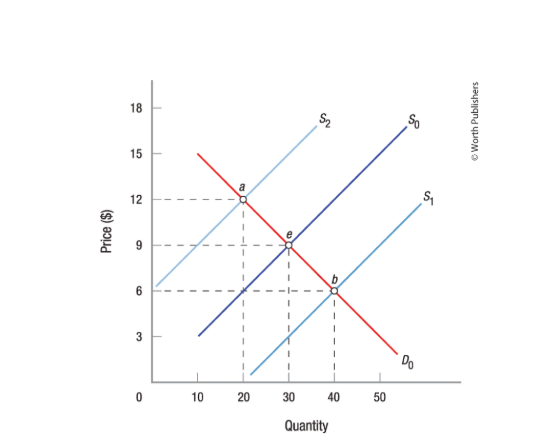
Shift in demand equilibrium
-price: movement along the curve
-if demand increases, price rises
-if demand decreases, price decreases

Four possibilities when demand curve and supply curve move?
list them
1.demand growth greater than supply= higher EQBM price
2.demand growth less than supply=lower EQBM

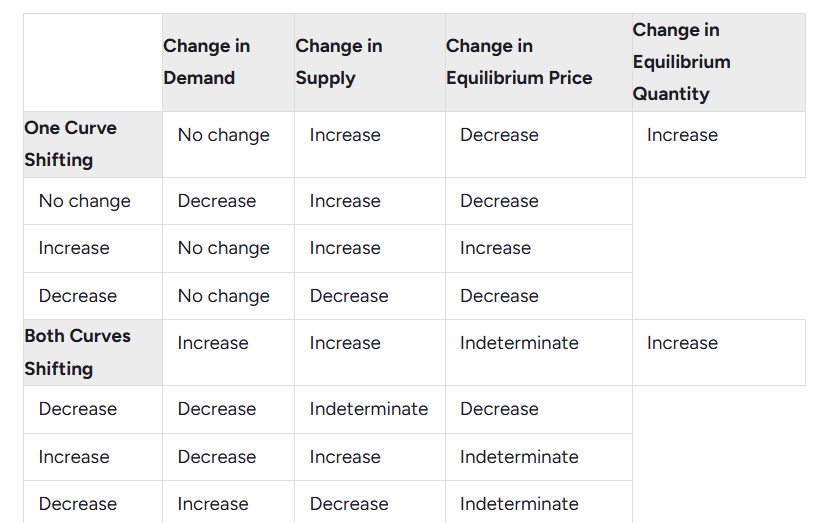
Overview Summary of only 1 curve shifting
look at table
Calculate surplus on graph:
answer: 6 million
-look at the supply and demand curve intersect with surplus line( find the difference of those values
