D.1 Gravitational fields
 Call Kai
 Learn
Learn Practice Test
 Spaced Repetition
 Match
Match Flashcards
 Knowt Play
1/17

There's no tags or description
Looks like no tags are added yet.
Name | Mastery | Learn | Test | Matching | Spaced | Call with Kai | Chat |
|---|
No analytics yet
Send a link to your students to track their progress
18 Terms
When can extended bodies be treated as point masses?
When dealing with gravitational forces (weights) over great distances large bodies with volumes can be treated as point masses, with all their mass acting at a single infinitesimally small point called the ‘center of mass’.
Newton’s Law of Gravitation
The force of attraction between two masses is proportional to each mass and inversely proportional to the distance between their centres squared.
Newton’s Law of Gravitation formula
For bodies treated as point masses

Gravitational field strength
The gravitational force per unit mass experienced by a small point mass m placed at that point.

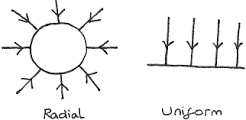
What do gravitational field lines show?
The direction the test mass would experience a force when placed at that point.
The density of the field lines represent the relative field strength.
What are the two types of gravitational field lines?
Kepler’s 1st Law
Planets move on eclips
Kepler’s 2nd Law
The line joining a planet and the sun sweeps out equal areas at equal intervals of time.
Kepler’s 3rd Law
The period of revolution of a planet around the sun is proportional to the 3/2 power of the semi-major axis of the eclipse.
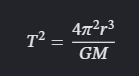
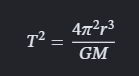
Derive the following, using vo and v = 2πR/T
Geostationary Satellites
A geostationary satellite is one that orbits the Earth in such a way that it is stationary with respect to a point on the surface of the Earth. This means its orbital period must be 24 hours.
Gravitational potential energy
Escape speed & formula
Minimum speed an object needs to escape a planets gravitational pull.
On the surface of a planet you have to gain GPE to reach infinity. This will be transferred from kinetic energy.
When you arrive at infinity: total energy will be 0.


Derive the following using energy equations.
What happens to the total orbital energy when a satellite is in low orbit?
A satellite in low orbit will experience a small frictional force (due to the atmosphere) in a direction opposite to the satellites velocity.
Since there is a frictional force acting, the satellites total energy will decrease (become more negative). e.g. from -1000J to -2000J.
A lower total energy will decrease the orbital radius as ET = -1/2(GMm/R)
At a lower orbital radius it will have a higher velocity as vo = (GM/R)1/2
As the satellite gets closer to Earth it experiences more friction because the atmosphere gets denser and the satellite moves faster —> more energy is converted into Q, so the satellite most likely burns up.
Gravitational Potential
The work done that would be required per unit mass (kilogram) in a moving test mass from infinity to the point in the field.

What is a equipotential surface?
A surface that consists of points that all have the same gravitational potential.
Are always perpendicular to field lines.
Can never cross or meet any equipotential that has a different value.
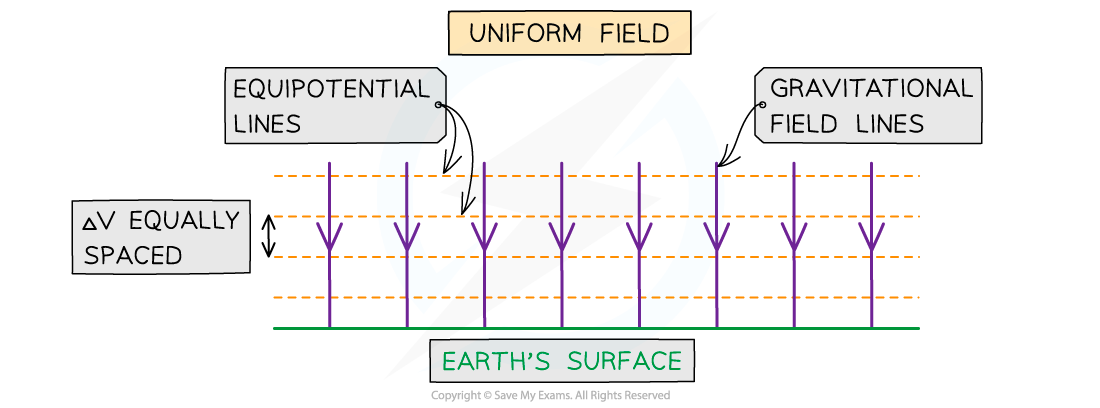
Gravitational potential gradient
The gradient of the gravitational potential vs position graph is called the potential gradient, this is always equal to the gravitational field strength of that location. Can be measured in Vm-1, Nkg-1 or ms-2.
