Introduction to Genetics, DNA Structure, and Gene Regulation
 Call Kai
 Learn
Learn Practice Test
 Spaced Repetition
 Match
Match Flashcards
 Knowt Play
1/52

There's no tags or description
Looks like no tags are added yet.
Name | Mastery | Learn | Test | Matching | Spaced | Call with Kai | Chat |
|---|
No analytics yet
Send a link to your students to track their progress
53 Terms
What is genetics?
The study of heredity.
What is a genome?
The sum total of genetic material of an organism.

What are plasmids?
Tiny extra pieces of DNA.
Where is the genetic material located in eukaryotic cells?
In the nucleus.
How many chromosomes do human cells have?
46 chromosomes.
What is the difference between genotype and phenotype?
Genotype is the sum of all genes in an organism, while phenotype is the expression of the genotype that creates traits.
What is the basic unit of DNA?
A nucleotide.
What are the two types of nitrogenous bases in DNA?
Purines and pyrimidines.
Which nitrogenous bases pair together in DNA?
Adenine (A) pairs with Thymine (T) and Guanine (G) pairs with Cytosine (C).

What is semiconservative replication?
A process where each daughter DNA molecule is identical to the parent and contains one original strand.

What is the leading strand in DNA replication?
The strand synthesized continuously in a 5′ to 3′ direction.
What are Okazaki fragments?
Short segments of DNA synthesized in a 5′ to 3′ direction that are later sealed together.
What is the central dogma of genetics?
The process of transcription (DNA to RNA) and translation (RNA to protein).

What role do proteins play in an organism?
Proteins determine the phenotype of an organism.
What are introns and exons?
Introns are non-coding sequences, while exons are coding regions of a gene.
What is the function of mRNA?
To carry the genetic information from DNA to the ribosome for protein synthesis.

What is the role of tRNA?
To transport amino acids to the ribosome during protein synthesis.
What is the significance of the reading frame in translation?
It determines how nucleotides are grouped into codons, each coding for an amino acid.
How do prokaryotic and eukaryotic gene expression differ?
Eukaryotic mRNA codes for one protein, while prokaryotic mRNA can contain information from several genes.
What is the function of the spliceosome?
To recognize exon-intron junctions and cut through them during RNA processing.

What is the role of regulatory RNA?
To regulate gene function.
What is the function of rRNA?
To form the core of the ribosome's structure and catalyze protein synthesis.
What is the significance of DNA structure?
It maintains the genetic code during reproduction and provides variety through base sequences.
What is the primary structure of a protein?
The sequence of amino acids that determines its shape and function.
What is a codon?
A sequence of three nucleotides that corresponds to a specific amino acid.
What is the enzyme that directs transcription?
RNA polymerase.
What is the function of the COVID-19 mRNA vaccine?
It contains viral mRNA that codes for a surface protein, prompting an immune response.

What is an operon?
A coordinated set of genes regulated as a single segment of DNA, found only in bacteria and archaea.
What are inducible operons involved in?
Catabolic processes.
What triggers the lactose operon to turn on?
The presence of lactose, which acts as an inducer.
What is the arginine operon?
A repressible operon that is normally on but turns off when excess arginine accumulates.
What are the three important features of the lac operon?
Regulator, control locus (promoter and operator), and structural locus (three genes for lactose catabolism).
What is the role of the repressor protein in the lac operon?
It binds to the operator to block transcription in the absence of lactose.
What is horizontal gene transfer?
Any transfer of DNA that results in organisms acquiring new genes not directly from parent organisms.
What is conjugation in bacteria?
Genetic exchange through a pilus.
What is transformation in bacteria?
The acceptance of small fragments of soluble DNA from the surrounding environment.
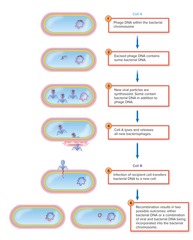
What is transduction?
The process by which a bacteriophage carries DNA from a donor cell to a recipient cell.
What are transposable elements?
Also known as 'jumping genes', they shift from one part of the genome to another.
What are the effects of transposable elements in bacteria?
They can change colony morphology, pigmentation, and contribute to drug resistance.
What is a mutation?
Any change to the nucleotide sequence in the genome, serving as a driving force of evolution.
What is a wild type organism?
A microorganism that exhibits a natural, nonmutated characteristic.
What is a mutant strain?
An organism that bears a mutation.
What is the Ames Test?
A test used to rapidly detect chemicals with carcinogenic potential using bacteria.

What are the positive effects of mutations?
They can contribute to the success of individuals and populations by providing variants that adapt and survive.
What is generalized transduction?
Transduction where random fragments of disintegrating host DNA are taken up by a phage.

What is specialized transduction?
Transduction where a specific part of the host genome is incorporated into the virus.
What is the role of corepressors in repressible operons?
They block the action of the operon when excess nutrients are present.
What is competence in bacterial transformation?
The ability of a bacterial cell to accept genetic material through transformation.
What is the significance of mutations in microorganisms?
They become evident in altered gene expression, such as changes in pigment production or drug resistance.
What is the formal name for 'jumping genes'?
Transposable elements or transposons.
True or False: Mutations are always harmful to organisms.
False; mutations can be beneficial, neutral, or harmful.
What must a cell be in order to be transformed?
Competent.
What is the driving force of evolution?
Mutation.