Chapter 2: The Chemistry of the Cell
 Call Kai
 Learn
Learn Practice Test
 Spaced Repetition
 Match
Match Flashcards
 Knowt Play
1/106

There's no tags or description
Looks like no tags are added yet.
Name | Mastery | Learn | Test | Matching | Spaced | Call with Kai | Chat |
|---|
No analytics yet
Send a link to your students to track their progress
107 Terms
What five principles does the slide identify as important to cell biology?
Characteristics of carbon
Characteristics of water
Selectively permeable membranes
Synthesis by polymerization of small molecules
Self-assembly
What does “characteristics of carbon” refer to as a principle of cell biology?
The properties of carbon that make it important in biological molecules
What does “characteristics of water” refer to as a principle of cell biology?
The properties of water that are important to cells and biological molecules.
What does selectively permeable mean when describing a cell membrane?
The membrane allows some substances to pass through while restricting others
What does synthesis mean?
Making or building something
What does polymerization mean?
Joining smaller molecules together to form a larger molecule.
How does polymerization allow cells to synthesize larger molecules?
Smaller molecules are joined together to produce larger molecules.
What does self-assembly mean in cell biology?
Molecules interact and organize themselves into larger structures.
What is the basic difference between polymerization and self-assembly?
Polymerization joins smaller molecules to form larger molecules, while self-assembly involves molecules organizing into larger structures through their interactions.
What is organic chemistry?
The study of carbon-containing compounds
What is biological chemistry, or biochemistry?
The study of the chemistry of living systems
What is the difference between organic chemistry and biochemistry?
Organic chemistry studies carbon-containing compounds, while biochemistry studies the chemistry of living systems.
What is the most important atom in biological molecules?
Carbon (C)
What are bonding properties of an atom?
Characteristics that determine how the atom forms chemical bonds with other atoms.
How do carbon's bonding properties relate to the characteristics of carbon-containing compounds?
Carbon's specific bonding properties account for the characteristics of carbon-containing compounds.
Why is studying carbon important for understanding biological molecules?
Carbon is the most important atom in biological molecules, and its bonding properties influence the characteristics of carbon-containing compounds.
What is the valence of a carbon atom?
4
What does valence mean when describing an atom?
The number of chemical bonds the atom can form
How does carbon's valence of 4 affect its bonding ability?
A valence of 4 allows carbon to form four chemical bonds with other atoms
Which atoms is carbon most likely to form covalent bonds with according to the cell
Carbon (C)
Oxygen (O)
Hydrogen (H)
Nitrogen (N)
Sulfur (S)
What is a covalent bond?
The sharing of a pair of electrons between two atoms
How many electrons are shared in a covalent bond as defined on the slide?
A pair, or 2 electrons.
What types of chemical bonds can carbon form with other atoms?
Single, double, or triple bonds

How does the carbon atom in methylamine (CH₃—NH₂) demonstrate carbon's valence of 4?
Carbon forms three single bonds with hydrogen and one single bond with nitrogen, for four bonds total.

How does the carbon atom in carbon dioxide (O=C=O) demonstrate carbon's valence of 4?
Carbon forms two double bonds, giving it four bonds total.

How does each carbon atom in acetylene (H—C≡C—H) demonstrate carbon's valence of 4?
Each carbon forms one single bond with hydrogen and a triple bond with the other carbon, giving four bonds total.
How can carbon form single, double, or triple bonds while still maintaining a valence of 4?
Carbon can use different combinations of bonds that total four, such as four single bonds, two double bonds, or a triple bond plus a single bond.
What is bond energy?
The amount of energy required to break 1 mole of a particular type of bond.
Approximately how many particles are in 1 mole?
Approximately 6 × 10²³
How is bond energy expressed according to the cell biology slide?
Calories per mole (cal/mol); the figures show energy in kcal/mol
How does bond energy relate to bond stability?
The higher the bond energy, the more energy required to break the bond, making the bond harder to break and more stable.

According to the graph of biologically important bond energies, which have higher bond energies: covalent bonds or hydrogen bonds?
Covalent bonds have much higher bond energies than hydrogen bonds

How does vibrational (thermal) energy compare with covalent bond energies on the slide?
Vibrational (thermal) energy is much lower than covalent bond energies
What happens to energy as wavelength increases on the energy-versus-wavelength graph?
Energy decreases as wavelength increases
How are UV, visible, and infrared radiation arranged from shorter to longer wavelengths on the slide?
UV → visible → infrared

What bond energies are shown for C—H, C—C, and C—N bonds?
C—H = 99 kcal/mol, C—C = 83 kcal/mol, and C—N = 70 kcal/mol
How does the energy of visible sunlight compare with the energy of C—C bonds?
The visible portion of sunlight is lower in energy than C—C bonds
Why does the relatively high bond energy of carbon's covalent bonds make carbon-containing molecules stable?
A relatively large amount of energy is required to break the covalent bonds, so they do not break easily.
Why does the slide compare visible sunlight with C—C bond energy?
Visible sunlight is lower in energy than C—C bonds, helping show why these carbon-containing bonds are not readily broken by visible light
Why are carbon-containing molecules described as diverse?
Carbon can form many different structures by bonding to itself and other atoms in different arrangements.
What structures can form when carbon atoms bond to other carbon atoms?
Chains or rings
What structures can form when carbon atoms bond to other carbon atoms?
Chains or rings
What variations can occur within carbon chains?
Carbon chains may branch and may contain single or double bonds between carbon atoms.
What is a hydrocarbon?
A chain or ring composed only of carbon and hydrogen
Are hydrocarbons soluble or insoluble according to the cell biology slide?
Insoluble
What important exception does the slide give to the limited biological importance of hydrocarbons?
Hydrocarbons are important as components of membranes.
What elements are present in most biological compounds according to the slide?
Carbon, hydrogen, and one or more oxygen atoms.
What additional elements may be found in biological compounds according to the slide?
Nitrogen, phosphorus, or sulfur
In biological compounds, nitrogen, phosphorus, sulfur, and other atoms are usually part of what?
Functional groups
How does carbon-carbon bonding contribute to the diversity of carbon-containing molecules?
Carbon-carbon bonds can produce chains or rings, and the chains can branch and contain different types of bonds
How do carbon's bonding properties allow relatively few kinds of atoms to produce many different compounds?
The same kinds of atoms can be connected and arranged in many different ways, producing different molecular structures.
What is the difference between the stability and diversity of carbon-containing molecules?
Stability refers to carbon-containing molecules being difficult to break apart, while diversity refers to carbon forming many different molecular structures.
What six functional groups does the cell biology slide say to know?
Amino
Carbonyl
Carboxyl
Hydroxyl
Phosphate
Sulfhydryl
How can you recognize an amino functional group?
Look for —NH₂


What is this functional group?
amino
What family of molecules contains amino groups?
Amines
What property does an amino group have?
It acts as a base and tends to attract a proton (H⁺)
How can you recognize a carbonyl functional group?
Look for C=O, a carbon double-bonded to oxygen
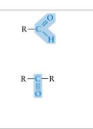
What two families of molecules are shown containing carbonyl groups?
Aldehydes and ketones
Give an example of a carbonyl functional group with aldehydes as the family of molecules

Give an example of a carbonyl functional group with ketone as the family of molecules
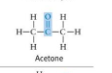
How can you recognize a carboxyl functional group?
Look for —COOH, which contains C=O and —OH on the same carbon


What functional group is this?
Carboxyl
What property does a carboxyl group have?
It acts as an acid and tends to lose a proton (H⁺) in solution.
How do amino and carboxyl functional groups differ in their acid-base behavior?
Amino groups act as bases and attract H⁺, while carboxyl groups act as acids and lose H⁺
How can you recognize a hydroxyl functional group?
Look for —OH

What functional group is this?
Hydroxyl
How does a hydroxyl group affect a compound's interaction with water?
It is highly polar and can hydrogen bond with water, making the compound more soluble.
How can you distinguish a hydroxyl group from a carboxyl group?
Hydroxyl is —OH alone, while carboxyl contains both C=O and —OH on the same carbon.
How can you recognize a phosphate functional group?
Look for a phosphorus atom attached to several oxygen atoms
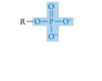
What happens when O—P bonds between linked phosphate groups are broken according to the slide?
Large amounts of energy are released
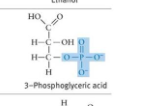
What functional group is this?
Phosphate
How can you recognize a sulfhydryl functional group?
Look for —SH
What can sulfhydryl groups form when present in proteins?
Disulfide (S—S) bonds that contribute to protein structure.
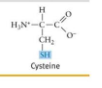
What functional group is this?
sulfhydryl
What does “R” represent in the functional-group structural formulas?
The rest of the molecule
How do functional groups contribute to the diversity of carbon-containing biological molecules?
Different functional groups attached to carbon-containing molecules give the molecules different chemical properties.
What makes a covalent bond polar?
If electrons in the bond are shared unequally.
What is electronegativity?
An atom's affinity for, or tendency to attract, electrons.
Which atoms does the bond-polarity slide identify as having high electronegativity compared with carbon and hydrogen?
Oxygen (O), sulfur (S), and nitrogen (N)
What do δ− and δ+ represent in a polar bond?
δ− is a partial negative charge
δ+ is a partial positive charge
How does a difference in electronegativity create a polar bond?
One atom attracts the shared electrons more strongly, causing the electrons to be shared unequally
What two factors determine a molecule's overall polarity?
The polarity of its individual bonds and its overall 3D shape
Are the O—H bonds in water polar or nonpolar?
Polar covalent
Why is water a polar molecule?
It has polar O—H bonds and a bent shape, so the bond polarities do not cancel

What is the molecular shape of water shown on the bond-polarity slide?
Bent

What is the molecular shape and overall polarity of methane (CH₄) on the slide?
Methane is tetrahedral and nonpolar

Are the C=O bonds in carbon dioxide (CO₂) polar or nonpolar?
Polar covalent

Why is CO₂ nonpolar even though its C=O bonds are polar?
CO₂ is linear and symmetrical, so the polarities of the two C=O bonds cancel each other

Can a molecule contain polar bonds but still be nonpolar overall?
Yes. CO₂ has polar C=O bonds but is nonpolar overall because its linear shape causes the bond polarities to cancel.
How does molecular polarity affect solubility in water?
Polar molecules are more soluble in water than nonpolar molecules.
Two molecules both contain polar bonds. Can you conclude that both molecules are polar overall?
No. You must also consider the molecules' overall 3D shapes and whether the bond polarities cancel.
What 3D structure does a carbon atom with four bonded groups have according to the slide?
A tetrahedral structure
What is an asymmetric carbon atom?
A carbon atom with four different substituents
What is a substituent when discussing an asymmetric carbon?
An atom or group of atoms attached to the carbon
A carbon is bonded to H, H, OH, and CH₃. Is it an asymmetric carbon?
No. Two substituents are H, so it does not have four different substituents
A carbon is bonded to H, OH, CH₃, and NH₂. Is it an asymmetric carbon?
Yes. All four substituents are different
What are stereoisomers according to the slide?
Nonsuperimposable configurations that are mirror images of each other.
What does nonsuperimposable mean?
The structures cannot be placed on top of each other so that they match perfectly.
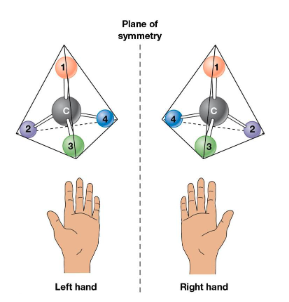
Why does the slide compare stereoisomers to left and right hands?
Left and right hands are mirror images but cannot be perfectly superimposed, like the stereoisomers shown